Conclave by Robert Harris


Conclave

I really didn’t expect to enjoy Conclave as much as I did, but then I’ve enjoyed all of his books that I’ve read, so I shouldn’t have been surprised. Conclave is about an election of a Pope and I found it absolutely fascinating as the process of the election unfolded. Harris describes the procedure as Cardinal Lomeli, the Dean of the College of Cardinals leads the 118 Cardinals through the voting stages. I felt as though I was a fly on the wall watching it throughout as the Cardinals are locked inside the Sistine Chapel, isolated from contact with the outside world.

There are quite a lot of characters involved, which at first was a bit confusing but soon their personalities became clearer and I began to have my favourites and hope that one of them would be elected. It’s all seen from Lomeli’s point of view, so my thoughts were coloured by what he reveals about each of the main candidates. As they progress through the stages of the election, whittling down the candidates to just a few, lots of secrets, scandals and disagreements are revealed. It becomes increasingly tense with each stage and Lomeli, who had been wanting to retire before the last Pope had died, finds that he too is one of the contenders – most reluctantly:

All he had ever desired in this contest was to be neutral. Neutrality had been the leitmotif of his career. (page 98)

And he realised that, whoever was elected Pope would never be able to wander around the city at will, could never browse in a bookstore or sit outside a café, but would remain a prisoner here! (page 142)

It’s also dramatic as events in the outside world impact on the Conclave.  I was completely engrossed and hoping that my favourite would be elected. Harris has thoroughly researched the subject and seamlessly woven the facts into the novel. He visited the locations used during a Conclave that are permanently closed to the public and interviewed a number of prominent Catholics including a cardinal who had taken part in a Conclave, as well as consulting many reports and books.

There is one point that I found hard to accept (I think that to say any more would spoil the book), although it is something I’d thought might happen but I’d dismissed as rather fanciful. Nevertheless I still think this is a 5* book as I enjoyed it so much – one of the best books I’ve read this year.

  • Format: Kindle Edition
  • File Size: 3282 KB
  • Print Length: 287 pages
  • Page Numbers Source ISBN: 0091959179
  • Publisher: Cornerstone Digital; 01 edition (22 Sept. 2016)
  • Source: I bought it
  • My rating: 5*

New Books

Over the last few months I’ve been lucky enough to receive copies of these books for review. I’ve finished some of them and am currently reading a few, with more yet to start:

Birdcage Walk by Helen Dunmore – first published 2 March 2017 – set in 1792, Europe is seized by political turmoil and violence. Lizzie Fawkes has grown up in Radical circles where each step of the French Revolution is followed with eager idealism. Weaving a deeply personal and moving story with a historical moment of critical and complex importance, Birdcage Walk is an unsettling and brilliantly tense drama of public and private violence, resistance and terror.

The Square and the Tower: Networks, Hierarchies and the Struggle for Global Power by Niall Ferguson – publication date 5 October 2017 – non fiction. Most history is hierarchical: it’s about popes, presidents, and prime ministers. But what if that’s simply because they create the historical archives? What if we are missing equally powerful but less visible networks – leaving them to the conspiracy theorists, with their dreams of all-powerful Illuminati? I’m currently reading this book.

Fair of Face by Christina James – publication 15 October 2017. This is set in the Fenlands of South Lincolnshire, where a double murder is discovered in Spalding. The victims are Tina Brackenbury and her baby daughter. Her 10 year-old foster daughter, Grace has escaped the killer because she was staying at her friend, Chloe Hebblethwaith’s house at the time. Four years earlier Chloe had escaped the massacre of her family. DI Yates and his team face a series of apparently impossible conundrums.

Katharina: Deliverance by Margaret Skea – publication 18 October 2017.   A compelling portrayal of Katharina von Bora, set against the turmoil of the Peasant’s War and the German Reformation … and of Martin Luther, the controversial priest at its heart. The consequences of their meeting in Wittenberg, on Easter Sunday 1523, has reverberated down the centuries and throughout the Christian world. I have finished reading this book – my review will follow in the next few days.

The Last Hours by Minette Walters – publication date 2 November 2017. Historical fiction set in 1348 about the Black Death. In the estate of Develish in Dorsetshire, Lady Anne quarantines the people, including two hundred bonded serfs, by bringing them with the walls.  Ignorant of what is happening in the world outside they fear starvation but they fear the pestilence more. Who amongst them has the courage to leave the security of the walls? I’m currently reading this book.

The Vanishing Box by Elly Griffiths – publication date 2 November 2017. The fourth book in the Stephens and Mephisto mystery series. It’s Christmas 1953, Max Mephisto and his daughter Ruby are headlining Brighton Hippodrome, an achievement only slightly marred by the less-than-savoury support act: a tableau show of naked ‘living statues’. This might appear to have nothing in common with DI Edgar Stephens’ investigation into the death of a quiet flowerseller, but if there’s one thing the old comrades have learned it’s that, in Brighton, the line between art and life – and death – is all too easily blurred… I have finished reading this book – my review will follow.

The Hanged Man by Simon Kernick – publication date 16 November 2017. This is the  second in The Bone Field series, featuring DI Ray Mason and PI Tina Boyd. A house deep in the countryside where the remains of seven unidentified women have just been discovered. A cop ready to risk everything in the hunt for their killers. A man who has seen the murders and is now on the run in fear of his life. So begins the race to track down this witness before the killers do.

Mount TBR Checkpoint 3

It’s time for the third quarterly checkpoint for  Bev’s Mount TBR Reading Challenge 2017 now that we only have 3 months of the year left to complete the challenge.

I’ve not been doing too well with this challenge, mainly because I keep reading new books and library books! I’ve read 20 of the books I owned prior to January 1 this year, which takes me near the top of Mont Blanc (24 books). I hope to get back to reading my TBRS soon!

Bev has asked asked some questions … I’m answering these:

 Who has been your favorite character so far? And tell us why, if you like.

My favourite character is one of the main characters in  Winifred Holtby’s South Riding., Mrs Beddows. She was the first woman alderman of the district, a strong older woman (age 72), a generous, warm-hearted, compassionate and charitable woman, dedicated to fighting poverty and wanting the best for the South Riding and its people.


Pair up two of your reads. But this time we’re going for opposites. One book with a male protagonist and one with a female protagonist. One book with “Good” in the title and one with “Evil.”

Colin Dexter’s The Dead of Jericho is set in a city – Jericho is an area of Oxford – with a male detective – Inspector Morse, whereas A Death in the Dales by Frances Brody is set in and around Langcliffe, a village in the countryside of the Yorkshire Dales, with a female sleuth, Kate Shackleton.

Six Degrees of Separation: from Like Water for Chocolate to The Spy Who Came In From The Cold

Six Degrees of Separation is a monthly link-up hosted by Kate at Books Are My Favourite and Best. Each month a book is chosen as a starting point and linked to six other books to form a chain. A book doesn’t need to be connected to all the other books on the list, only to the one next to it in the chain.

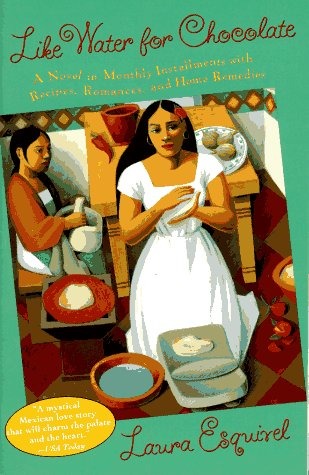
This month the chain begins begin with a book that Kate says people may not have discovered, were it not for the hugely popular movie version – Laura Esquivel’s Like Water for Chocolate. I hadn’t discovered it at all until now! But I see that it’s a ‘bestseller’, a book about passion and the magic of food (including recipes), a tale of family life in  Mexico.

Like Water for Chocolate

The first link in my chain is a book also set partly in Mexico:

The Lacuna

The Lacuna by Barbara Kingsolver is the story of Harrison Shepherd, the son of a Mexican mother and an American father and it’s told through his diaries and letters together with genuine newspaper articles, although whether they reported truth or lies is questionable. As you can see from the cover swimming plays a part in this book. As a boy, Harrison, loved swimming and diving into a cave, which was only available at certain tides, a cave that was there one day and gone the next – a lacuna.

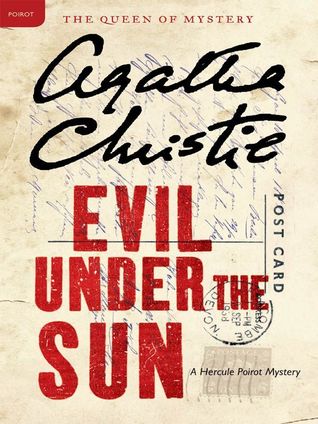
Swimming also features in Evil Under the Sun by Agatha Christie.

Evil Under the Sun (Hercule Poirot, #23)

Poirot is on holiday in Devon staying in a seaside hotel. It’s August, the sun is hot, people are enjoying themselves, swimming and sunbathing until Arlena is found dead – she’d been strangled.

The next book in my chain is also crime fiction  – Blue Heaven by C J Box.

Blue Heaven

This is a story set in North Idaho about two children, Annie and William who decide to go fishing without telling their mother, Monica, and witness a murder in the woods. One of the killers sees them and they run for their lives. It’s fast-paced and full of tension right to the end.

I chose Half of a Yellow Sun by Chimamanda Ngozi Adichie as the next link, a book that also has a colour in its title.

Half of a Yellow Sun

It’s based on the Nigeria-Biafra War of 1967 – 70. Focusing on the struggle between the north and the south, the Igbo, Yoruba and Hausa people, it brings home the horrors brought about by war, the ethnic, religious and racial divisions and the suffering that results.  It is also a novel about love and relationships, a beautiful and emotional book without being sentimental and factual without being boring.

Another book about war, but this one is non-fiction about a spy operation during World War Two – Operation Mincemeat by Ben Macintyre.

Operation Mincemeat: The True Spy Story That Changed the Course of World War II

It’s about the Allies’ deception plan in 1943, code-named Operation Mincemeat, which underpinned the invasion of Sicily. It was framed around a man who never was. I thought it was so far-fetched to be almost like reading a fictional spy story. I marvelled at the ingenuity of the minds of the plans’ originators and the daring it took to carry it out.

Operation Mincemeat led me to think about a fictional spy in The Spy Who Came in from the Cold by John Le Carré.

The Spy Who Came In from the Cold

This is set in the Cold War period in the 1960s and tells the story of Alex Leamas’s final assignment. It’s a dark, tense book and quite short, but very complicated; a story  full of secrecy, manipulation, of human frailty and its duplicitous nature.

What a journey! My chain moves through time and place – from Mexico to Devon, North Idaho, Nigeria, Sicily and Berlin. It encompasses fiction and non-fiction and takes in several wars. All, except for the book that starts the chain, are books I’ve read and enjoyed. Six Degrees of Separation is always fascinating to compile and I’m always surprised at where it goes and where it ends up. Who would have thought that a book about family life in Mexico would end up linked to a spy novel about the Cold War?

My Friday Post: Conclave by Robert Harris

Book Beginnings Button

Every Friday Book Beginnings on Friday is hosted by Gillion at Rose City Reader where you can share the first sentence (or so) of the book you are reading, along with your initial thoughts about the sentence, impressions of the book, or anything else the opener inspires.

This week’s first paragraph is from Conclave by Robert Harris, a thriller set in the Vatican as the 118 cardinals meet in the Sistine Chapel to cast their votes for a new Pope.

Conclave

It begins:

Cardinal Lomeli left his apartment in the Palace of the Holy Office shortly before two in the morning and hurried through the darkened cloisters of the Vatican towards the bedroom of the Pope.

He was praying: O Lord, he still has so much to do, whereas all my useful work in Your service is completed. He is beloved, while I am forgotten. Spare him, Lord. Spare him. Take me instead.

Also every Friday there is The Friday 56, hosted by Freda at Freda’s Voice. These are the rules:

  1. Grab a book, any book.
  2. Turn to page 56, or 56% on your eReader.
  3. Find any sentence (or a few, just don’t spoil it) that grabs you.
  4. Post it.
  5. Add the URL to your post in the link on Freda’s most recent Friday 56 post.

Page 56

Lomeli reckoned the Holy Father had had it in mind to remove almost half of the senior men he had appointed.

From the back cover:

The Pope is dead. 

Behind the locked doors of the Sistine Chapel, one hundred and eighteen cardinals from all over the globe will cast their votes in the world’s most secretive election. 

They are holy men. But they have ambition. And they have rivals. 

Over the next seventy-two hours one of them will become the most powerful spiritual figure on earth.

I’ve thoroughly enjoyed other books by Robert Harris, so I’m expecting to like this one too.


A – Z of TBRs: G, H and I

I have been neglecting my TBRs this year and have been reading mainly new books and library books.So here is the third instalment of my A – Z of TBRs, a series of posts in which I take a fresh look at some of my TBRs to inspire me to read more of them by the end of the year. These TBRs are all physical books – I’ve not included e-books.

I’m enjoying searching my shelves – finding books I’d forgotten were there (the disadvantage of shelving books behind others).

a-z tbrs ghi P1020304


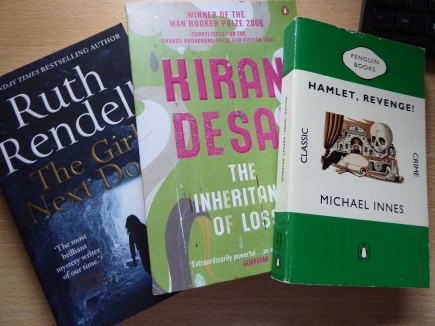
G is for The Girl Next Door by Ruth Rendella book I’ve had for just over a year. When a new house is being built a long buried secret is uncovered – a tin box is found in an earthen tunnel. It contained two skeletal hands, one male and one female.

Their garden was not beautiful. It had no flowering trees, no roses, no perfumed herbs. Tunnels, they called it at first. The word ‘qanat’, an impossible word, was found by Daphne Jones and adopted by the rest of them. It meant, apparently, a subterranean passage for carrying water in some oriental language. They liked it because it started with a q without a u. Their scholteachers had taught them that no word could ever start with a q unless it was followed by u, so Daphne’s idea appealed to them and the tunnels became qanats. In time to come the qanats became their secret garden. (pages 14 -15)

HHamlet, Revenge! by Michael Innes (on my TBR shelves since May 2015). This is a green Vintage Penguin, first published in 1937, and in this edition in 1961, about a murder planned to take place in the middle of a private performance of Hamlet.

It had begun as a family frolic. And now, although it would not be publicly reported, the dramatic critics were coming down as if to an important festival. Professors were coming to shake learned respectable bald heads over a fellow-scholar’s conception of an Elizabethan stage. Aged royalty  was coming to be politely bewildered. Most alarming of all, ‘everybody’ was coming – for the purpose no doubt, of being where ‘everybody’ was. And even if it was a select and serious everybody – a known set before whom a Lord Chancellor might mime without misgiving – it was still a crowd, and its actions were unpredictable. (page 28)

IThe Inheritance of Loss by Kiran Desai, a book I’ve had for just over 10 years! It won the Man Booker Prize in 2006. This is set in India, in a dilapidated mansion high in the Himalayas, the home of three people each dreaming of another time – a retired judge, Sai, his granddaughter and a cook.

In Kalimpong, high in the northeastern Himalayas where they lived – the retired judge and his cook, Sai and Mutt – there was a report of new dissatisfaction in the hills, gathering insurgency, men and guns. It was the Indian Nepalese this time, fed up with being treated like the minority in a place where they were the majority. They wanted their own country, or at least their own state, in which to manage their own affairs. Here, where India blurred into Bhutan and Sikkim, and the army did pull-ups and push-ups, maintaining the tanks with khaki paint in case the Chinese grew hungry for more territory than Tibet, it had always been a messy map. The papers sounded resigned. A great amount of warring, betraying, bartering had occurred; between Nepal, England, Tibet, India, Sikkim, Bhutan; Darjeeling stolen from here, Kalimpong plucked from there – despite, ah, despite the mist charging down like a dragon, dissolving, undoing, making ridiculous the drawing of border. (page 9)

What do you think? Do you fancy any of them? 

One reason I haven’t read these books yet is that they’re all in such a small font!