The Immortal Life of Henrietta Lacks by Rebecca Skloot

Immortal life of HL

Pan|First Paperback Edition edition (1 Jan. 2011)|431 pages|5*

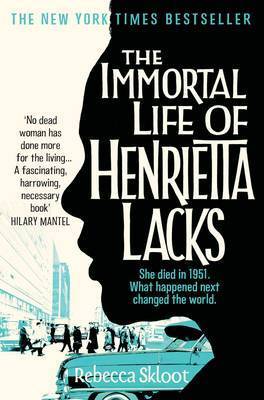
The Immortal Life of Henrietta Lacks by Rebecca Skloot is an outstanding book! It took her more than ten years to research and write and has won numerous awards and been made into a film starring Oprah Winfrey as Deborah Lacks, Renee Elise Goldsberry as Henrietta Lacks, and Rose Byrne as Rebecca Skloot.

I found it all fascinating, but harrowing to read in parts, from all the details of Henrietta’s life, how she was treated for cervical cancer in 1951, when she was just 30, to her death nine months later.  During her diagnosis and surgery cancer cells taken from her tumour were cultured and amazingly those cells multiplied, doubling every twenty four hours. They became known as HeLa cells (pronounced hee-lah) and have formed the basis for much medical research and drug development ever since. It is also a history of the diagnosis and treatment of cancer and considers the ethical issues around ownership of her cells and the distress, anger and confusion this caused her family. It raises many issues not just regarding ethics, but also regarding science, race and class.

Cancer treatment in 1951 with radium was brutal, but what made it worse was that Henrietta was a black woman, living in near-poverty in Baltimore. Black oral history from at least the 1800s tells of kidnapping black people for research and there were disturbing truths behind the stories – doctors did test drugs on slaves and carried out operations to develop surgical techniques. In 1951 Henrietta was treated at Johns Hopkins Hospital, a hospital built for the benefit of Baltimore’s poor, but black residents suspected it had been ‘built in a poor black neighborhood  for the benefit of scientists – to give them easy access to potential research subjects.’ (page 190)

The Lacks family were poor and they misunderstood what was happening. They became fearful and distressed, and some of them were aggressive when they realised with horror that Henrietta still lived on in a way they couldn’t understand. They had no health insurance and received no financial benefit from the research done on the HeLa cells. Rebecca Skloot’s investigation reveals the mental anguish they went through and her account is so very moving. In particular her times with Henrietta’s daughter, Deborah are heart breaking as she records the terrible struggles Deborah had to overcome. It was only years later that Deborah understood that it was her mother’s cancer cells that were still ‘alive’ and not her own normal cells.

‘So we don’t have the thing that made her cells grow forever?’ Deborah asked. Christoph shook his head. ‘Now you tell me after all these years!’ Deborah yelled. ‘Thank God, cause I was wonderin.’

She pointed at a cell on the screen that looked longer than the others. ‘This one is cancer, right? And the rest are her normal ones?’

‘Actually, HeLa is all just cancer,’ Christoph said.

‘Wait a minute,’ she said,’you mean none of our mother’s regular cells still livin? Just her cancer cells?’

‘That’s right.’

‘Oh! See, and all this time I thought my mother regular cells still livin!’ (page 302)

Rebecca Skloot based her book on an impressive amount of research  – archival documents, scientific and historical research, including legal documents and medical records. She also used Deborah’s personal journals as well as conducting more than a thousand hours of interviews with Henrietta’s family and friends, and lawyers, ethicists, scientists and journalists who have written about the Lacks family.

This is not a dry scientific account – although there is a lot of scientific detail in the book (not all of which I’m sure I fully understood). It is a remarkable and personal record of the Lacks family that comes to life through dialogue, by adopting the language with which each person spoke and wrote. She explains that where she wrote in the first person using Deborah’s voice she was quoting what she said, only edited for length and occasionally clarity. It is brilliantly written, giving me much to think over – one of the most moving books of non-fiction I’ve read!


The Island by Ragnar Jónasson

Nordic Noir – dark, chilling and utterly gripping

The Island (Hidden Iceland #2)

Penguin UK Michael Joseph|4 April 2019|313 pages|Review copy|5*

I was delighted to receive a review copy of  The Island by Ragnar Jónasson from the publishers.  

This is my first book by Ragnar Jónasson. I discovered after I’d read it that it’s the second in his Hidden Iceland series – but I had no difficulty reading it as a standalone novel. It begins with a Prologue that indicates that the main story has elements of horror as well as mystery. It’s unsettling and sinister.

Four friends visit the isolated island of Elliðaey off the coast of Iceland, ten years after the murder of a fifth friend, Katla, but only three of them return. One of them, Klara, fell to her death from a cliff – but did she jump or was she pushed? Detective Inspector Hulda Hermannsdóttir is sent to investigate. She realises that there are similarities with the death of Katla. A suspect had been charged, but had committed suicide before the verdict was announced and the case had been closed. But are the two murders connected, even though they are ten years apart?

Hulda is an interesting character, with a back story that is only partly revealed in this book. Her name means ‘hidden woman‘. The first book in the series dealt with her later life, with this second book going back in time to her earlier life. In The Island she lives alone, her mother having recently died and there is a mystery about her father. She only knows that he was an American soldier and part of the novel records her search for him. It’s a police procedural, so Hulda’s somewhat fractious relationships with her colleagues also form part of the story.

The narrative also switches between the deaths of the two young women ten years apart, told from the various characters’ perspectives. They present an intricate mystery that Hulda gradually unravels, sifting through the lies that the suspects tell her. It’s not a fast-paced novel, but it is full of suspense and foreboding, set against the beautiful and dramatic Icelandic landscape. One by one I suspected each character, unsure who to believe. I loved it!

My thanks to the publishers, Penguin UK Michael Joseph for my review copy via NetGalley.

A Snapshot of Murder by Frances Brody

A Snapshot of Murder (Kate Shackleton #10)


Crooked Lane Books |19 April 2019|Print length 339 pages|e-book review copy|3*

Blurb (Amazon):

Yorkshire, 1928. Indomitable sleuth Kate Shackleton is taking a well-deserved break from her detective work and indulging in her other passion: photography. When her local Photographic Society proposes an outing, Kate jumps at the chance to visit Haworth and Stanbury, in the heart of Brontë country, the setting for Wuthering Heights.

But when an obnoxious member of their party is murdered, the group is thrown into disarray. Is the murderer amongst them, or did the loud-mouthed Tobias have more enemies than they might have imagined?

Armed with her wit and wiles, and of course her trusty camera, it’s up to Kate to crack the case, and get that perfect shot too . . .

A Snapshot of Murder by  Francis Brody is the 10th in her Kate Shackleton series. I’ve read three of her earlier books and I have to say that I didn’t enjoy this one as much. I think, though, that the setting is excellent, particularly in Haworth when the Bronte Parsonage Museum was opened in 1928. But I was disappointed to find that the murder could have taken place anywhere – it no connection to the Brontes, or to the opening of the Museum, apart from the fact that the murderer took advantage of being in a crowd of people and managed to slip away unnoticed. 

I like Kate Shackleton – she’s a competent private investigator, but the murder mystery was too easy to solve. It began well but it was obvious who was going to end up dead and although there are several suspects, it soon became obvious who the culprit was and my interest waned. And any sympathy I had for the murderer had just disappeared by the end of the book.

My thanks to the publishers, Crooked Lane Books for my review copy via NetGalley.

My Friday Post: The Passengers by John Marrs

Book Beginnings Button

Every Friday Book Beginnings on Friday is hosted by Gillion at Rose City Reader where you can share the first sentence (or so) of the book you are reading, along with your initial thoughts about the sentence, impressions of the book, or anything else the opener inspires.

This week I’m featuring The Passengers by John Marrs, one of the books I currently reading. It’s a thriller set in the near future.

The Passengers

PROLOGUE

UK NEWS House of Lords votes unanimously in favour of driverless vehicles on British roads within five years. Ban on non-autonomous vehicles expected within  a decade.

Also every Friday there is The Friday 56, hosted by Freda at Freda’s Voice.

30879-friday2b56These are the rules:

  1. Grab a book, any book.
  2. Turn to page 56, or 56% on your eReader. If you have to improvise, that is okay.
  3. Find any sentence (or a few, just don’t spoil it) that grabs you.
  4. Post it.
  5. Add the URL to your post in the link on Freda’s most recent Friday 56 post.

Page 56:

Two male security operatives approached her. They each had one slightly discoloured iris that Libby recognised as Smart lenses. Why does everything these days have to be Smart? she wondered. Perhaps Nina had been right and Libby would have been better suited to the dark ages, albeit without the dinosaurs.

Blurb:

When someone hacks into the systems of eight self-drive cars, their passengers are set on a fatal collision course.

The passengers are: a TV star, a pregnant young woman, a disabled war hero, an abused wife fleeing her husband, an illegal immigrant, a husband and wife – and parents of two – who are travelling in separate vehicles and a suicidal man. Now the public have to judge who should survive but are the passengers all that they first seem?

~~~

I’ve read 40% of this book so far and I’m enjoying it. It paints a scary picture of the future and I’m wondering how it will end. I’m expecting a twist in tale – or I should say, I’m hoping there will be.

What do you think? Would you keep reading?

Library Loans

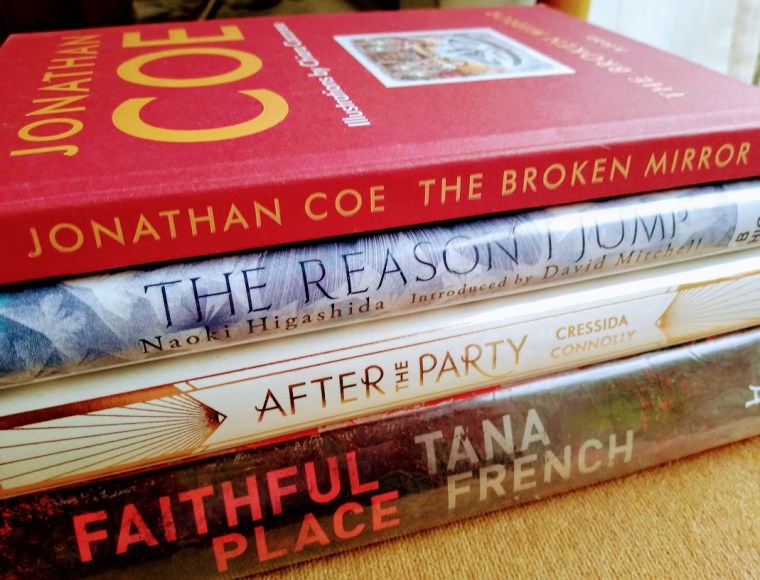
These are just some of the books I’ve recently borrowed from the library:

Library bks April 2019

  • The Broken Mirror by Jonathan Coe, Illustrations by Chiara Coccorese. This little book looked a bit out of place on the adult fiction shelves so I picked it up and the blurb on the back cover made me even more curious – ‘a political parable for children, a contemporary fairy tale for adults, and a fable for all ages.’ It shouldn’t take me long to read – 81 pages, including the illustrations – so I hope to write more about it soon.
  • The Reason I Jump: One Boy’s Voice from the Silence of Autism by Naoki Higashida with an introduction by David Mitchell. Naoki was only thirteen when he wrote this book. I’m sure I’ve read about this book somewhere, but I can’t think where or in what context, but I think that was why this book caught my eye.
  • After the Party by Cressida Connolly, historical fiction as Phyllis looks back at her life during World War Two. This is a book several bloggers have written about and I thought I’d like to read it. It’s on this year’s shortlist for The Walter Scott Prize for Historical Fiction along with A Long Way From Home by Peter Carey,  The Western Wind by Samantha Harvey and Now We Shall Be Entirely Free by Andrew Miller. I’ve read the last two and enjoyed them both.
  • Faithful Place by Tana French. I couldn’t come away from the library without a crime fiction novel – this is the third  book in the Dublin Murder Squad series. It’s a psychological mystery focusing on the police force set in present day Dublin.

The Classics Club Spin Result

Classics Club

The spin number in The Classics Club Spin was announced today. It’s number …

19

which for me is Sweet Thursday by John Steinbeck. The rules of the Spin are that this is the book for me to read by May 31, 2019.

Sweet Thursday

I added this book to my Classics Club list after reading Steinbeck’s Cannery Row, a book I loved. I’m hoping it will be just as good,

Here’s the blurb from Amazon:

In Monterey, on the California Coast, Sweet Thursday is what they call the day after Lousy Wednesday – one of those days that’s just bad from the start. But Sweet Thursday is sunny and clear, a day when anything can happen. Returning to the scene of Cannery Row, Steinbeck brilliantly creates its bawdy, high-spirited world of bums, drunks and hookers, telling the story of what happened to everyone after the war. There are colourful characters old and new, all united by love, laughter and tears: Fauna, the latest madam at the Bear Flag brothel, Doc, still there for everyone else but feeling strangely sad himself, and Suzy, the new hustler in town who might just be the girl to save him.

Did you take part in the Classics Spin? What will you be reading?