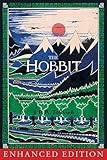
Tolkien, The Hobbit and Middle-Earth

The Hobbit
Last Wednesday we went to see The Hobbit: an Unexpected Journey. Whereas I’ve read The Lord of the Rings several times, I’ve never read The Hobbit, so the story was new to me. It meant that I could watch the film, totally unbothered by any changes from the book. And no doubt there are differences, as the book has been transformed into three films.

I enjoyed the film immensely, although, as I expected, there was too much fighting for my liking, which made my eyes glaze over. (This is my normal reaction to fighting scenes.) The hobbit, Bilbo Baggins, Gandalf and a party of dwarves, led by their king, Thorin Oakenshield go on a quest to recover the lost Dwarf Kingdom of Erebor and its long-lost treasure, guarded by Smaug, the dragon. Their journey takes them into great danger through lands occupied by orcs, goblins, wargs and sorcerers and sees the first meeting of Bilbo and Gollum (Andy Serkis) in which Bilbo gains possession of the precious Ring.

Martin Freeman was perfect as Bilbo Baggins, as was Ian McKellen as Gandalf, and Richard Armitage as Thorin Oakenshield. It was Ken Stott’s voice (and his mouth) that made me realise he was taking the part of Balin the dwarf, but I completely failed to see that the Goblin King was played by Barry Humphries. The rest of the cast was also excellent and the scenery was magical.

There are many books now about Tolkien and his writings – I have just two books of reference on Tolkien’s works, both from pre-movie days:The Tolkien and Middle Earth Handbook by Colin Duriez, which is a mine of information about Tolkien’s life, thoughts and writings. It’s an A-Z of people, places and things of importance in Tolkien’s books as well as containing details of Tolkien’s friends, colleagues, writers and thinkers who influenced his work.

Tolkien is now so well known, not only through his books, but also through Peter Jackson’s films, that it’s hard to believe that at one time his publishers thought the The Lord of the Rings could make a financial loss for them. Duriez writes:

In those unenlightened days, the learned Professor could mutter the word ‘Orc’ at uncouth behaviour, or exclaim ‘Mordor in our midst’ at an ugly example of modern life, without its meaning being known to the general public.

I think this book is a good source to discover information not only about the characters, but also the back-stories of Tolkien’s invented mythology. It is, of course, selective and certainly doesn’t aim to be comprehensive, because of the sheer volume and breadth of Tolkien’s works, but it’s certainly a good starting place.

The other book I have is A Tolkien Bestiary by David Day. A bestiary is an illustrated book about beasts, popular in the Middle Ages and this one includes Tolkien’s fantastical beasts and monsters, together with the races, flora and fauna that inhabit Middle-Earth and the Undying Lands. There are colour and black and white illustrations, maps, time charts and genealogical tables, plus a useful index. A mine of information from before Peter Jackson’s movies were made. Here, for example is the illustration of Gandalf (very similar to Ian McKellan’s portrayal, I think!) and of Gandalf and some of the dwarves making their way to Bilbo’s house in the Shire:
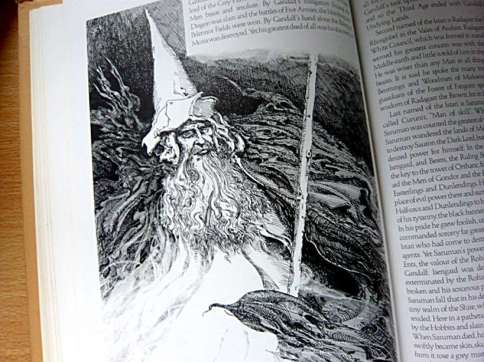
Tolkien Bestiary Gandalf

Since seeing the film I’ve downloaded an Enhanced Edition of The Hobbit. This has illustrations and audio/video content available for iPads, iPhones, and iPod Touch devices, including J R R Tolkien singing and reading from his book.

It also includes illustrations by Tolkien and one of the manuscript pages of his original draft of the first chapter. In the Foreword, Christopher Tolkien, Tolkien’s son reveals that his father had a clear recollection of writing the opening sentence of The Hobbit. It was whilst he was sitting correcting School Certificate papers and on a blank piece of paper he scrawled: ‘In a hole in the ground there lived a hobbit.’ He did not know then and later why that came into his head, but years later it became The Hobbit. And he couldn’t remember when. But his sons think it must have been around 1929. During the years that followed Tolkien wrote more of the book and became engrossed in The Silmarillion, the myths and legends of his invented world.

Now I just need to read the book itself! And then I may have to re-read The Lord of the Rings, and find a biography of Tolkien too. There are so many books about Tolkien – can anyone recommend any of them?

This Isn't Fiction Reading Challenge

Last year I read just 12 non fiction books, a very small percentage of all the books I read. So, this year I’m aiming to read more widely, perhaps cutting back on reading crime fiction, which made up more than half my reading last year. When I saw that Birgit is hosting a non fiction challenge I thought that it would give me a push in that direction.

All non fiction genres are allowed!

Books must be at least 100 pages long (excluding appendix and annotations)!

Books must be read in their entirety and not just in part (which consequently excludes encyclopedias, then again who in their right mind would want to read one of those from beginning to end)!

No picture heavy books – you’re supposed to read not just look at pretty photos (that said, books should have a 75:25 text/picture ratio – if it’s a big tome with 300 or more pages, then it may be a 50:50 ratio)!

ARCs and re-reads are allowed!

So, what’s it going to be for you?
  • 5 Books – Kindergarden
  • 10 Books – Elementary School
  • 15 Books – High School
  • 20 or more Books – College

After looking at my list of unread non fiction on my LibraryThing catalogue I found that I have 30+ books, so I should find plenty of choice to go for the High School  level and maybe even for the College level. Most of them are autobiographies/biographies, with some history and a touch of philosophy and travel.

Anna Märklin's Family Chronicles by Dorte Hummelshoj Jakobsen

This is the second book by Dorte Hummelshoj Jakobsen that I’ve read. I liked the first one The Cosy Knave, but I liked her latest book, Anna Märklin’s Family Chronicles even more. The Cosy Knave, as the title suggests, is humorous and rather quirky, whereas Anna Märklin’s Family Chronicles is a psychological mystery and not at all cosy.

Set in Denmark in the present day with flashbacks to Sweden (where her father’s family came from) during the early part of at the beginning of the twentieth century, Anna Storm finds herself with beset with problems. Her father is seriously ill and strangely secretive about his family background:

There were so many things her father did not want to talk about. Illness and death, war and accidents. Things did not change for the better because you talked about them  he claimed.

Anna longs to know more and when she finds her grandmother’s journal she is enthralled. But digging into the past can reveal secrets that you might not want to know.

At the same time she is concerned about Karin, her best friend and neighbour, whose life is under threat for reasons Karin doesn’t divulge. When Anna can’t contact Karin, either by phone or at home, she eventually uses Karin’s spare key to enter her flat and finds her lying dead on the kitchen floor. it looks as though she slipped and hit her head – but was it really an accident?

Anna Märklin’s Family Chronicles has depth both in mystery and in characterisation and the setting is superb. I was transported in time and place as I read and fearful for Anna’s safety as she dug deeper into the mysteries surrounding her. I really enjoyed this book and hope that Dorte Jakobsen will write more in this vein.

  • Format: Kindle Edition
  • File Size: 439 KB
  • Publisher: Candied Crime (18 Dec 2012)
  • Sold by: Amazon Media EU S.à r.l.
  • Language: English
  • ASIN: B00AQIGSVQ
  • Source: my copy supplied by the author
  • My Rating: 4/5

Dorte Hummelshoj Jakobsen is a teacher from Denmark, teaching English at upper secondary level. In her spare time she reads and writes crime fiction in English and Danish, and in 2010 she sold her first flash stories to American magazines or publishers. One story appeared in Discount Noir (edited by Ste Weddle & Patricia Abbott).

Since then she has published two collections of flash fiction, “Candied Crime” (humour) and “Liquorice Twists” (a bit darker). Her bestsellers are the romantic ghost story “Heather Farm” (suspense plus romance in the Dunes near the Danish west coast) and the cosy novel “The Cosy Knave” (European title: “Murder deLight”).

For an interview with Dorte see Linda Rae Blair’s website.

Turn of the Century Salon – Introduction

This year Katherine at November’s Autumn is hosting the Turn of the Century Salon to discuss works from authors written between the 1880s and the 1930s.

T

Katherine has asked a few questions as an introduction:

What draws you to read the Classics?
That’s both a difficult question to answer and yet an easy one – I love reading. But why the classics? Well, I suppose it’s because they’re great stories, with memorable characters. They’re from the past so it’s like entering a different world and yet it’s still a fairly familiar world. They’ve stood the test of time and they’re books that you can read and re-read, and come away feeling satisfied.

What era have you mainly read? Georgian? Victorian? Which authors?
I’ve read mainly Victorian authors,Thomas Hardy, Charles Dickens, the Brontes and Elizabeth Gaskell for example and Jane Austen from the Georgian era.

What Classics have you read from the 1880s-1930s? What did you think of them?
I love Thomas Hardy’s books and have read most of them. I like their depiction of tragic characters battling against their passions and the restrictions of Victorian society. Charles Dickens, of course, is also highly critical of much of the society in which he lived and his books have strong plots and interesting characters. D H Lawrence whose books I find quite varied – some like Sons and Lovers and Women in Love I first read many years ago and found them quite challenging. I’d like to revisit them and see whether I think the same. I’ve also read some of Virginia Woolf’s books and liked her stream of consciousness style of writing and her explorations of her characters’ emotions and motives.


Name some books you’re looking forward to read for the salon (in no particular order):
  • The Voyage Out by Virginia Woolf – her first novel, first published in 1915
  • Women and Writing by Virginia Woolf, essays first published between 1904 and 1934.
  • Parade’s End by Ford Madox Ford, first published between 1924 and 1928.
  • The Forsyte Saga by John Galsworthy, published between 1906 and 1921.
  • The Age of Innocence by Edith Wharton, first published in 1920.
  • Ethan Frome by Edith Wharton, first published in 1911.
  • The House of Mirth by Edith Frome, first published in 1905.
  • Heart of Darkness by Joseph Conrad, first published 1899.
  • An Autobiography by Anthony Trollope, first published 1883.
  • Of Human Bondage by W Somerset Maugham, first published 1915.
  • The Adventures of Sherlock Holmes by Arthur Conan Doyle, first published 1892.
  • The Thirty Nine Steps by John Buchan, first published in 1915.
  • All Quiet on the Western Front by Erich Maria Remarque, first published in 1928.
  • The Making of a Marchioness by Frances Hodgson Burnett, first published in 1901.

Reading Resolutions

btt button

Any reading resolutions for the new year? Reading more? (Reading less?) Reading better books? Bigger books? More series? More relaxing books?

It’s been a while since I wrote a Booking Through Thursday post – this week’s question seems appropriate.

This year I’m aiming to read as slowly as possible to try to absorb more of the book, because I often race through, eager to know what happens and after a day or two I can’t remember much about it. I want to take time and think about what I’m reading.

I also want to read as many books as I can from my own shelves, because I have a lot of unread books. My difficulty with this is that I’m always tempted by new books, or books other bloggers recommend.

In 2012 I read 105 books but this year I’m undecided about setting a target (such as the one on the Goodreads Reading Challenge which I did last year), because although I like keeping records and statistics, I think they don’t actually mean much €“ it’s the reading that counts for me. Setting a target makes me anxious especially when Goodreads tells me how many books behind my target I am. So my target at the moment is to read what I feel like, as and when I want and never mind the numbers.

I began this blog to record at least a short note about each book I read, but that doesn’t seem relevant to me any more, and it has become a chore, so this year I’ll only write about a book if I feel like it.

In short, I’m looking forward to a year full of lots of carefree reading.

Best Crime Fiction 2012

Kerrie of Mysteries in Paradise is collecting our best crime fiction reading for 2012.The titles can have been published any time, but must be crime fiction.

I read 61 crime fiction books in 2012 – see the full list here.

My top ten are as follows. (Inevitably this post includes six of the books I’ve already identified as my ‘best’ books read in 2012.)

Books with 5 stars:

  1. After the Funeral by Agatha Christie, first published in 1963. Poirot investigates the death of Cora Abernethie, who had announced at the funeral of her brother Richard that he had been murdered.
  2. The Crimson Rooms by Katherine McMahon, published in 2010 – historical crime fiction set in London in 1924, with Britain still coming to terms with the aftermath of the First World War. Evelyn Gifford, one of the few pioneer female lawyers takes on two cases, one child custody case and the other a murder case.
  3. Fatherland by Robert Harris, published in 2009,  a fast-paced thriller set in Germany in 1964, a murder mystery, beginning with the discovery of the naked body of an old man, lying half in the Havel, a lake on the outskirts of Berlin. The homicide investigator is Xavier March of the Kriminalpolizei (the Kripo) and the victim is Josef Buhler, one of the former leading members of the Nazi Party who had been instrumental in devising €˜the final solution’.
  4. Silent Voices by Ann Cleeves, published in 2011, a Vera Stanhope mystery, set in Northumbria. It begins with Vera’s discovery of a dead woman in the sauna of her local gym.

Books with 4.5 stars:

  1. The Chalk Circle Man by Fred Vargas, published in 2010, a very cleverly constructed and quirky murder mystery set in Paris  where strange blue chalk circles start appearing on the pavements. Only Commisaire Adamsberg takes them €“ and the increasingly bizarre objects found within them €“ seriously. 
  2. Hickory Dickory Dock by Agatha Christie, a Poirot mystery, first published in 1955, set in a London students’ lodging house where death strikes. There are plenty of suspects and red herrings and some interesting reflections on crime and the psychology of behaviour.
  3. The Girl on the Stairs by Louise Welsh, published in 2012. It’s set in Germany, a dark, psychological thriller, full of atmosphere and claustrophobic tension.
  4. One, Two, Buckle My Shoe by Agatha Christie, first published in 1940, in which Hercule Poirot and Inspector Japp investigate the apparent suicide of Mr Morley, Poirot’s Harley Street dentist, who was found dead in his surgery, shot through the head and with a pistol in his hand.
  5. The Redeemed by M R Hall, published in 2011. Coroner Jenny Cooper investigates the death of a man found lying outside a Bristol church with a sign of the cross gouged into his flesh, It looks to her like another grisly, routine suicide, but the unexpected arrival of an enigmatic Jesuit priest reveals deeper levels of mystery.
  6. The Sixth Lamentation by William Brodrick, published in 2010, it looks back  to the Second World War in occupied France, telling a dramatic tale of love and betrayal, full of suspense, and interwoven stories.