Deaf Sentence by David Lodge

I have mixed feelings about Deaf Sentence, but overall, I liked it.
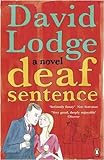
Synopsis from the back cover:

Retired professor of linguistics Desmond Bates is going deaf. Not suddenly, but gradually and – for him and everyone nearby – confusingly. It’s a bother for his wife, Winifred, who has an enviably successful new career and is too busy to be endlessly repeating herself. Roles are reversed when he visits his hearing-impaired father, who won’t seek help and resents his son’s intrusions. And finally there is Alex. Alex is the student Desmond agrees to help after a typical misunderstanding. But her increasingly bizarre and disconcerting requests cannot – unfortunately – be blamed on defective hearing. So much for growing old disgracefully …

After an amusing start, the book almost slowed down to a stop for me with too much detail. It was only towards the middle of the book and the final third that it really came alive for me. It’s a mixture of reflections on deafness, life, death, ageing and bereavement.

It switches between the first person and the third person, which does give it a slightly disjointed effect but highlights Desmond’s unease with his situation. Not only is he having to come to terms with his increasing deafness but also with his retirement from the academic world. He still hankers after his position as a Professor of Linguistics. He’s having to deal with academic rivalry, and his feelings of isolation and inadequacies in his relationship with his wife and family.

I liked the word-play, the misunderstood conversations and the comedy surrounding deafness and the references to authors, poets and artists who had also suffered. But overall I thought this was a melancholy book about the problems of ageing, not just deafness:

Deafness is a kind of pre-death, a drawn-out introduction to the long silence into which we will all eventually lapse. (page 21)

I did enjoy the picture of Gladeworld that Lodge painted – if you’ve been to Center Parcs it’s instantly recognisable! Desmond likens it to ‘a benevolent concentration camp. A benign prison’, with the Tropical Waterworld a modern version of Dante’s Inferno, with

… half naked crowds tossed in the turbulent waves, or hurtling down the spirally semi-transparent tubes at terrifying velocity, or tumbled arse over elbow through the rapids, choked with water, blinded by spume, spun round in whirlpools, dragged backwards by undertow, entangled with each other’s limbs, bruised and battered by impact with the fibre glass walls, to be tipped at last into a boiling pit at the bottom … (page 225)

I know this from my own experience!

But contrast this with Desmond’s visit to Auschwitz – a real hell on earth. As Desmond reflects there are no words adequate to describe the horror of what happened there and no adequate emotional response:

In the end perhaps the best you can do is to humble yourself in the face of what happened here, and be forever grateful that you weren’t around to be drawn into its vortex of evil, in either suffering or complicity. (page 269)

Lodge acknowledges that Desmond’s deafness and his Dad have their sources in his own experience and for me this is the heart of the book, the parts that captured real life with depth of feeling, emotion and empathy. For these reasons I did like this book.

  • Paperback: 320 pages
  • Publisher: Penguin (4 Jun 2009)
  • Language: English
  • ISBN-10: 0141035706
  • ISBN-13: 978-0141035703
  • Source: I bought the book

Pride and Prejudice 200th Anniversary

Title page from the first edition of the first volume of Pride and Prejudice 1813

Today is the 200th anniversary of the publication of Jane Austen’s Pride and Prejudice and to mark the occasion the Jane Austen Centre in Bath is hosting a 12 hour readathon (click this link to go to the readathon site) of the book. It’s taking place at the Centre in Gay Street and will be filmed and broadcast around the world live on the internet.

From 11am this morning Pride and Prejudice will be read in short 10 minute segments by up to 140 celebrities, authors, politicians, musicians, Olympians, school children, competition winners and personalities.

First Chapter, First Paragraphs: The Unquiet Bones

Uetred thought he had discovered pig bones. He did not know or care why they were in the cesspit at the base of Bampton Castle Wall.

Then he found the skull. Uetred was a villein, bound to the land of Lord Gilbert, third Baron Talbot, lord of Bampton Castle and had slaughtered many pigs. He knew the difference between human and pig skulls.

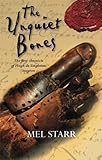
I was browsing in the library, when the medieval style script on the spine of this book caught my eye. Taking it from the shelf I was also struck by the dramatic cover, showing a strange wooden or leather artificial foot. When I read the opening paragraphs and flicked through the pages I decided to borrow the book. It seems it’s a good choice because the library assistant said she had enjoyed it as she likes historical crime fiction – so do I. And there are more books in the series.

It’s The Unquiet Bones: the first chronicle of Hugh de Singleton, surgeon by Melvin R Starr.

I was interested in the foot – is it a genuine medieval prosthetic? I discovered that it is actually an Ancient Egyptian prosthetic toe found on a female mummy at Luxor. The big toe is carved from wood and has holes for lacing it to a leather-type casing.

Now, as far as I know, this is nothing to do with The Unquiet Bones, which is set in the English village of Bampton, but I think it’s fascinating. It certainly drew my attention to the book.

First Chapter, First Paragraphs is a weekly event hosted by Diane at Bibliophile By the Sea.

Books for Cat Lovers

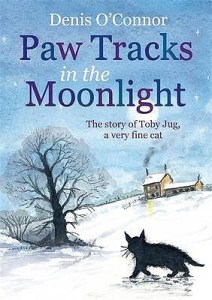
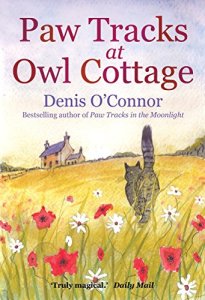
I loved both these books by Denis O’Connor:

Paw Tracks in the Moonlight and Paw Tracks at Owl Cottage.

Denis O’Connor trained as a psychologist and teacher. Throughout his career he taught in schools and lectured in colleges and universities. He holds a doctorate in education and psychology and is now retired, living with his wife Catherine and his two Maine Coon cats in a remote country cottage in Northumberland.

Paw Tracks in the Moonlight tells the story of how he rescued a kitten during a snowstorm and how kitten survived, despite the vet’s prediction that he wouldn’t. O’Connor lived at Owl Cottage and as he was out at work all day he put the kitten in a jug to keep him safe and named him Toby Jug. This memoir covers the first year of Toby Jug’s life and it’s a remarkable story because this is no ordinary cat (if such a creature exists, that is). He is a Maine Coon cross. He learns to walk on a lead and even goes on a camping trip on horseback during the summer in the Cheviot Hills with O’Connor.

Paw Tracks at Owl Cottage chronicles O’Connor’s experiences with four more cats, all Maine Coons. He had moved from Owl Cottage, unable to face living there after Toby Jug died in 1978, but years later, when he took early retirement, Owl Cottage came up for sale – and he and his wife bought it. it’s a wonderful place for cats and they acquired four – Pablo, Carlos, Luis and Max. The book is divided into sections describing each cat and there are also reminisces of Toby Jug, with more stories of their lives together.

Both contain beautiful descriptions of the Northumberland countryside, most of which I’m familiar with, which made the books even more special for me. Inevitably the death of Toby Jug filled me with sadness, but both books are full of the cats’ personalities and the joy they brought to O’Connor and his wife. They demonstrate the close bonds that are possible between people and cats:

I tell them [his friends who are astonished at the close bonds]  I believe that any animal, be it a horse, dog, cat, parrot or budgerigar, will always respond to kindly attention and caring affection, and that I know this because I’ve made good friendships with them all.

But to return to how I am with our cats, I can honestly state that quite apart from loving them deeply and being loved in return, I know them inside their minds and they know me; we are linked on a mental plane of mutual affection and understanding. (page 222 of Paw Tracks at Owl Cottage)

Definitely books for cat lovers!

Denis O’Connor has written a third book (which I haven’t read) – Paw Tracks: a Childhood Memoir, described on Amazon as ‘a searingly honest account of how the power of nature can lift the human spirit and overcome the most unloving of childhoods.’

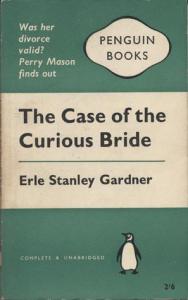
The Case of the Curious Bride by Erle Stanley Gardner

First published in 1935 The Case of the Curious Bride is the 5th Perry Mason book by Erle Stanley Gardner.

Synopsis extracted from the back cover:

An attractive young woman calls at Perry Mason’s office to inquire if a friend can marry again without getting a divorce as her husband had been presumed killed in an air accident seven years previously. Mason sees sinister implications and as a result of his investigations – helped by his secretary Della Street – dramatic developments lead to a court case in which the tables are turned on the police.

My view:

There are plenty of twists and turns in this mystery surrounding Rhoda Montaine, who is accused of murder and it certainly looks as though she is guilty.  I found it very puzzling. I also thought it was unsatisfactory as Perry Mason resorts to trickery, fooling everyone. At times I was at a complete loss to understand what he was doing and why. It all becomes clear at the end, but I found it far-fetched.

  • Paperback: 208 pages
  • Penguin Books 1960 (first published by Cassell 1935)
  • Source: I bought the book
  • My Rating 2/5
  • Challenges: Mount TBR, What’s in a Name 6 (a book with an emotion in the title)

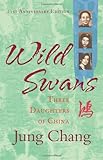
Wild Swans by Jung Chang

It’s taken me a couple of months to read Wild Swans: Three Daughters of China (first published in 1991), Jung Chang’s book about her grandmother, her mother and herself, telling of their lives in China up to and during the years of the violent Cultural Revolution. Her family suffered atrociously, her father and grandmother both dying painful deaths and both her mother and father were imprisoned and tortured.

Needless to say that this is a harrowing book to read, but it’s also an eye-opener (for me at any rate) about what happened in China under Mao.

Jung Chang was born in Yibin, Sichuan Province, China, in 1952. She was briefly a Red Guard at the age of fourteen, and then a peasant, a ‘barefoot doctor’, a steelworker and an electrician. She came to Britain in 1978, and in 1982 became the first person from the People’s Republic of China to receive a doctorate from a British university. Wild Swans  won the 1992 NCR Book Award and the 1993 British Book of the Year. She lives in London.

In Wild Swans she casts light on why and how Mao was able to exercise such paralysing control over the Chinese people. His magnetism and power was so strong and coupled with his immense skill at manipulation and his ability to inspire fear, it proved enough to subdue the spirit of most of the population; not to mention the absolute cruelty, torture and hardships they had to endure.

I wondered how she knew so much about what happened to her mother and grandmother (I don’t know nearly as much about mine) but in the Introduction she explains that when her mother came to visit her in London they talked every day for months. She talked about their eventful lives – her grandmother had been a concubine of a warlord general and her mother had joined the Communist underground at the age of 15. She also recorded sixty hours of her memories.

I wrote a bit about the book in a Book Beginnings post at the end of last November, when I’d just started to read it. It’s a personal story, reflecting the twentieth century history of China. A remarkable book, full of courage and spirit.

  • Paperback: 720 pages
  • Publisher: HarperPress; New edition edition (1 Mar 2012)
  • Language: English
  • ISBN-10: 0007463405
  • ISBN-13: 978-0007463404
  • Source: borrowed from a friend