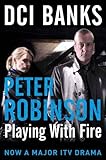
Playing With Fire by Peter Robinson

I wrote about the opening of Playing With Fire in my Tuesday post.  I’ve watched the TV version of DCI Banks, (although I don’t remember this seeing this particular one) but there are changes in the televised versions and to my mind the books are better – but then I always think that.

Synopsis (from the back cover)

In the early hours of a cold January morning, two narrow boats catch fire on the dead-end stretch of the Eastvale canal. When signs of accelerant are found at the scene, DCI Banks and DI Annie Cabbot are summoned. But by the time they arrive, only the smouldering wreckage is left, and human remains have been found on both boats.

The evidence points towards a deliberate attack. But who was the intended victim? Was it Tina, the sixteen-year-old who had been living a drug-fuelled existence with her boyfriend? Or was it Tom, the mysterious, lonely artist?

As Banks makes his enquiries, it appears that a number of people are acting suspiciously: the interfering ‘lock-keeper’, Tina’s cold-hearted step-father, the wily local art dealer, even Tina’s boyfriend . . . Then the arsonist strikes again, and Banks’s powers of investigation are tested to the limit . .

My thoughts

I’ve been reading Peter Robinson’s DCI Banks books totally out of order and as I began this one I thought that I’d read the next book in the series a few years ago. One of the benefits of writing a book blog is that I can look back and see what I thought about a book just after I’d read it, instead of having to rack my brain trying to remember. On checking back (nearly five years ago!) I found that I had indeed read the next book – Strange Affair and had thoroughly enjoyed it.

I liked Playing With Fire too, although maybe not quite as much as Strange Affair. It’s a complicated plot and at times I had to remind myself who the various characters were. I did get a bit fed up with reading about what music Banks is playing but I liked the way his relationship with Annie Cabbot is portrayed and the insights into how his mind works.

I thought I’d spotted who the killer was quite early on and was pleased to see at the end that I was right, although I thought Banks should also have spotted it earlier!
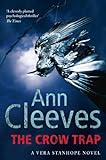
The Crow Trap by Ann Cleeves

The Crow Trap by Ann Cleeves is the first book in her Vera Stanhope series. I’ve been thinking (and writing) about my difficulties in reading books where I think the detail and description swamp the characters and plot, but I had absolutely no problems with that in The Crow Trap – I think Ann Cleeves has got the balance just right.

It begins with chapters about three of the female characters, Rachael, Anne and Grace all staying at Baikie’s an isolated cottage on the North Pennines whilst they carry out an environmental survey. When Rachael arrives at the cottage she is confronted by the body of her friend Bella Furness, who it appears has committed suicide. I was so drawn in by the character portraits and the vivid descriptions of the setting, that I almost forgot that this is a murder mystery. Then Grace is found dead and the mystery really begins.

There is a full cast of characters, all clearly distinct, and a very intricate and clever plot, with plenty of red herrings subtly masking the important clues. Vera is a great character and even though I do like Brenda Blethyn’s portrayal of her in the TV series, I prefer her as she is in the books –  a woman in her fifties, who looks like a bag lady. Here’s a description of her when she first interviews Rachael and Anne:

She was a large woman – big bones, amply covered, a bulbous nose, man-sized feet. Her legs were bare and she wore leather sandals. Her square toes were covered in mud. Her face was blotched and pitted so Rachael thought she must suffer from some skin complaint or allergy. Over her clothes she wore a transparent plastic mac and she stood there, the rain dripping from it onto the floor, grey hair sleeked dark to her forehead, like a middle-aged tripper caught in a sudden storm on Blackpool prom. (page 230)

And this description too:

Vera was wearing a dress of the sort of material turned into stretch settee covers and advertised in the Sunday papers. (page 406)

The identity of the killer foxed me. I kept changing my mind about who I thought it was and when it was revealed I was surprised, because although I’d worked out the motive, I’d got the circumstances completely wrong!

The My Kind of Mystery theme began on 1 February and this book really is ‘my kind of mystery’. A most satisfying book.

Reading Non-Fiction in 2014

Most of my reading is fiction, but I do like to read non-fiction too. Last year I read 9 non-fiction books and would like to read more this year, maybe 12 which would average out at one a month. I’ve decided that I won’t join any of the non-fiction reading challenges run by other bloggers but I’m going to record what I’ve read on my own personal non-fiction project for 2014 on this page – Reading Non-Fiction in 2014.

Non Fiction books

The photo above shows a small selection of my non-fiction books. I’ve got plenty more to choose from in different categories including Autobiographies, Biographies, Diaries, Letters, History, Philosophy, Religion, Writing, and Nature. I hope by the end of the year I’ll have read at least one book from each category.

At present I’m reading a history book – Steel Bonnets: the Story of the Anglo-Scottish Border Reivers by George MacDonald Fraser. I’m planning on reading one non-fiction book alongside any novels I’m reading, but apart from that I’m leaving my options open and shall see where my fancy takes me.

First Chapter First Paragraph

First chapterEvery Tuesday Diane at Bibliophile by the Sea hosts First Chapter First Paragraph Tuesday Intros, where you can share the first paragraph, or a few, of a book you are reading or thinking about reading soon.

Today’s pick is a book that I’m currently reading from my TBR books, Playing With Fire by Peter Robinson, a DCI Banks book (incidentally a new series of DCI Banks started last night on ITV1 – I haven’t watched it yet).

Chapter 1 begins:

‘The barge she sat in, like a burnish’d throne, burn’d on the water,’ Banks whispered. As he spoke, his breath formed plumes of mist in the chill January air.

Detective Inspector Annie Cabot, standing beside him, must have heard because she said, ‘You what? Come again.’

‘A quotation,’ said Banks. ‘From Anthony and Cleopatra.’

‘You don’t usually go around quoting Shakespeare like a copper in a book,’ Annie commented.

Banks and Annie are watching as two narrow boats are burning on a dead-end stretch of the Eastvale canal – inside they find the remains of two dead bodies. Was this an accident or murder?

The Classics Club Spin

The Classics ClubIt’s time for another Classics Spin. To take part in the Spin you:

  • List any twenty books you have left to read from your Classics Club list.
  • Number them from 1 to 20.
  • Next Monday the Classics Club will announce a number.
  • This is the book you need to read during February and March!

Here’s my list chosen by using a random number generator:

  1. North and South by Elizabeth Gaskell
  2. Uncle Tom’s Cabin by Harriet Beecher Stowe
  3. Oliver Twist by Charles Dickens
  4. The Old Wives Tale by Arnold Bennett
  5. Mansfield Park by Jane Austen
  6. The Adventures of Sherlock Holmes by Arthur Conan Doyle
  7. Anne of Green Gables by Lucy Maud Montgomery
  8. Little Dorrit by Charles Dickens
  9. The Man Who Would Be King by Rudyard Kipling
  10. Lord Jim by Joseph Conrad
  11. Parade’s End by Ford Maddox Ford
  12. Lorna Doone: A Romance of Exmoor by R D Blackmore
  13. Notre-Dame of Paris by Victor Hugo
  14. No Name by Wilkie Collins
  15. The Making of a Marchioness by Frances Hodgson Burnett
  16. Where Angels Fear to Tread by E M Forster
  17. Out of Africa by Karen Blixen
  18. Walden by Henry James Thoreau
  19. Moby Dick by Herman Melville
  20. Ethan Frome by Edith Wharton

I don’t really mind which one comes up in this Spin, although there are some I’d prefer over others. What would you chose off this list?

2014 Sci-Fi Experience Wrap-Up

Carl’s Science-Fiction Experience came to an end on 31 January. I enjoyed it much more that I anticipated and whilst I’d thought I’d give it a go, reading one book, I ended up Sci-Fi Experiencereading four:

  1. The Midwich Cuckoos by John Wyndham €“ review 3 December 2013
  2. Stowaway to Mars by John Wyndham €“ review 16 December 2013
  3. Cloud Atlas by David Mitchell €“ review 7 January 2014
  4. The Uncertain Midnight by Edmund Cooper €“ review 11 January 2014

I used to read a lot of science fiction many years ago but hadn’t read much recently. I began by reading The Midwich Cuckoos, first published in 1957, and then remembered that we had some old sci-fi books in a box up in the loft, none of which I’d read, so I had several more books to chose from.

Apart from Cloud Atlas, these are all old books, and very different from Cloud Atlas. My favourite is Stowaway to Mars, even though it’s so very dated – it was first published in 1936. I enjoyed it immensely. Another plus is that all four books are ones I’ve owned for years and thus have reduced my huge TBR Mountain!

My thanks to Carl, for hosting this Experience, which has encouraged me to go back to reading science fiction!