Book Selection

Sometimes it’s hard to find the right novel to read and recently I have started several, only to put them back on the shelves after reading a few pages. It’s not that the books aren’t good, it’s just that they haven’t been the right books for me at that moment. I haven’t abandoned these books, as I’m sure at another time they could be the right books.

The books I’ve started include these (and there were several others too):

  • The Robber Bride by Margaret Atwood, described on the back cover as seething ‘with imagination, inventiveness and intelligence’ (Sunday Times). That’s as may be, but it’s written in the present tense, which I’m not keen on – another time and I may not even notice, after all I like other books by her that I’ve read.
  • The Goldfinch by Donna Tartt. I’ve read more than a few pages of this, 87 to be precise, but it has nearly 800 pages. I thought when I started it that it was going to be one I could get really engrossed in, but then the story seemed to get swamped in too much detail, too much description and I wanted it to get a move on. So, I stopped reading.
  • The Snow Geese by William Fiennes – a book about natural history, poetically written about leaving and homing, belonging and wandering. But again the detail was just too much for me – I needed something with more bite, more action, more cohesion.  Another time I can tell this book could be the one for me, but the time and my mood weren’t right.

I like to read more than one book at a time but sometimes one book will grab me more than others and I leave them to finish it. That happened last week. I was reading and enjoying The Joyous Invasions by Theodore Sturgeon, three science fiction stories from the 1950s. The first story is To Marry Medusa, in which a down-and-out is taken over by a seeding of the Medusa, from outer space. But I was also reading The Crow Trap by Ann Cleeves and had got to the point where I just had to know what happened next and who the murderer was, so The Joyous Invasions had to go on the back burner for a while.

This is why I can’t plan what I’m going to read and why I’m finding it difficult to stick to reading just from my own unread books. I think I’m going to stop doing the Triple Dog Dare Challenge mainly because I’ve borrowed some books from the library this week that I really want to start soon. I ‘have’ to borrow library books to make sure that the library service keeps the mobile library running! If there aren’t enough borrowers it will be cut.

Reading in January

It’s been a good month for reading. I’ve been making inroads into my own unread books, as well as reading books I’ve had on loan from the library since last year. These are the books I’ve read with links to my posts:

  1. Vengeance* by Benjamin Black
  2. Cloud Atlas by David Mitchell
  3. The Uncertain Midnight by Edmund Cooper
  4. Not Dead Enough* by Peter James
  5. The Hangman’s Song* by James Oswald
  6. Cannery Row by John Steinbeck
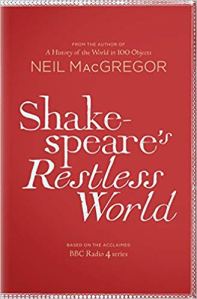
  7. Shakespeare’s Restless World by Neil MacGregor
  8. In the Woods* by Tana French

Half of them are crime fiction(*) and my Crime Fiction Pick of the Month is Not Dead Enough by Peter James. For more nominations for the Crime Fiction Pick of the Month see Kerrie’s blog – Mysteries in Paradise.

But my all-round Best Book of the Month is a tie between Shakespeare’s Restless World by Neil MacGregor, a non-fiction book that beautifully recreates Shakespeare’s world through examining twenty objects;

and Cannery Row by John Steinbeck. I came to this book with no idea of what it was about or what to expect. I loved it – there is humour and tragedy, meanness and generosity, life and death all within Cannery Row’s 148 pages.


Reading Challenges progress in January (for details of these challenges see my Challenges page):

  • Mount TBR Reading Challenge – 5 of my own unread books. My target is 48.
  • Read Scotland Challenge – 2 books. My target 13+.
  • Sci-Fi Experience also 2 books read. This ran from December to the end of January. There was no target as such, other than to read sci-fi books and my total was 4.
  • Triple Double Dog Dare – this is to read just my own unread books with some exceptions allowed, so I made it through January. In addition I’m trying not to buy any books, which has been a struggle, but I managed it this month. Somehow I doubt I can keep it up for much longer, nor can I see myself sticking to reading just my own unread books, not with the library van coming round once a fortnight and the temptation of borrowing books (the ones I’ve read so far were ones I’d borrowed last year). In any case I like to be spontaneous in my reading and this is getting to be too restricted for me.
  • What’s in a Name 7 – 1 book (Cloud Atlas in the weather section).
  • Historical Fiction Challenge – no progress. My target is 25 books.
  • Colour Coded Challenge – no progress. The target is to read 9 books in the different colour categories.
  • The Agatha Christie Reading Challenge – no progress!! I’ll be reading some of her books soon.
  • My Kind of Mystery Challenge – starts today!

In the Woods by Tana French

I have had In the Woods by Tana French on loan from the library since last November – fortunately I was able to keep renewing it, until I got round to reading it. It’s Tana French’s debut novel first published in 2007.

When I began reading I thought this was going to be a really great book. It has all the elements I like – a current murder mystery to solve and a cold case from 20 years earlier, well drawn characters and a writing style that contains enough description to visualise the action easily. It’s set in Ireland mainly around an archaeological dig of a site prior to the construction of a motorway. Most of the wood that covered the land had already been cleared, but a small section remains. A little girl’s body is discovered on the site. Is her death connected to the disappearance of two twelve year-olds 20 years earlier? And it just so happens that the detective, Rob Ryan,  investigating the current murder was the third child who was involved in the disappearance – except he came back and has no memory of what had happened.

I was immediately drawn into the book, enjoying the mystery and wondering how long Ryan can keep his identity hidden and whether he will remember what happened. However, as the story progresses, the descriptive passages get longer and more complicated as the characters’ back stories are revealed, in particular the dead girl’s family and other peripheral characters. And whilst I still think this is a good book, it isn’t a great one. I like the psychological elements and the twists and turns, although I think some of them were predictable. I’ve seen criticism about the way the book ends, but I didn’t find that disappointing at all, in fact I think that is the only credible way that it could end. And I liked it well enough to look out for French’s second book – The Likeness.

The Book Q and A

I saw this on Cathy’s blog Kittling Books who in turn found it on Margot Kinberg’s blog Confessions of a Mystery Novelist, (I can’t believe I missed it on Margot’s blog as I’m a regular reader of her excellent blog, but now I’ve had a look at Margot’s post and it was whilst I was away).  A bit late in the day, but I thought I do it too!

What are you reading right now?

I usually have at least two books going at the same time, including one fiction and one non-fiction. At the moment, I’m reading The Steel Bonnets: the Story of the Anglo-Scottish Border Reivers by George MacDonald Fraser and In the Woods by Tana French, crime fiction – a police procedural/psychological thriller. I’ve also started reading After Elizabeth: the Death of Elizabeth and the coming of King James by Leanda de Lisle

Do you have any idea what you’ll read when you’re done with that?

Not really. I don’t like to plan too far ahead, but as I belong to a book club there’s always the next book for that, which is The Grass is Singing by Doris Lessing. Apart from that I’m not al all sure which book I’ll pick up next – maybe one of the next five books listed below, or not.

What 5 books have you always wanted to read but haven’t got round to?

  • The Count of Monte Cristo by Alexander Dumas
  • David Copperfield by Charles Dickens
  • The Voyage Out by Virginia Woolf
  • The Mill on the Floss by George Eliot
  • Barchester Towers by Anthony Trollope

What magazines do you have in your bathroom/family room right now?

The Radio Times is the only magazine I buy regularly and now and then I buy the Leisure Painter.

What’s the worst book you’ve ever read?

There must be several, but I try to erase them from my mind and if they are so bad I don’t finish them anyway!

What book seemed really popular but you didn’t like?

I’m not keen on reading books that are over-hyped and usually wait a while before reading them. I wouldn’t say there are any I actually disliked, but I found The Time Traveler’s Wife quite disappointing.

What’s the one book you always recommend to just about everyone?

This is difficult. I always hesitate before recommending books to people, in fact I don’t do it if I don’t know the person.

What are your three favorite poems?

Pippa’s Song by Robert Browning
Not Waving but Drowning by Stevie Smith
The Road Not Taken by Robert Frost

Where do you usually get your books?

From a variety of sources, libraries, bookshops such as Barter Books for secondhand books, local shops and on-line – Amazon and secondhand booksellers such as World of Books, Bookdonors CIC etc. I also borrow books from family and friends.

Where do you usually read your books?

Mainly in bed, but really I can read anywhere, except whilst travelling because it makes me feel sick! I don’t often read outside though, it’s either too hot, too windy, too many insects or too chilly. When I was at work I used to read whilst waiting for the lift – it was so slow coming, I could read quite a lot there.

When you were little, did you have any particular reading habits?

I don’t think so. My parents used to tell me off for walking up and downstairs whilst reading – oh yes, and for reading in bed under the covers with a torch when I was supposed to be sleeping.

What’s the last thing you stayed up half the night reading because it was so good you couldn’t put it down?

I can’t do that – I just fall asleep.

Have you ever “faked” reading a book?

I don’t remember ever claiming to have read a book when I haven’t.  There are books I think I’ve read but when I look at them I realise I haven’t €“ I just know the story either from a film or TV programme, just as there are books I don’t think I’ve read and then when I start reading I realise that I have!

Have you ever bought a book just because you liked the cover?

Yes, but it wasn’t just for the cover – the contents have to interest me too, but I am put off by some covers – headless women (usually on historical fiction), or lurid illustrations for example.

What was your favorite book when you were a child?

Oh dear, there were so many I just loved, different ones as I grew older. As a small child I loved Enid Blyton’s books, then the Heidi books, and Louisa May Alcott’s books. I can’t single out just one.

What book changed your life?

Pinkerton’s Sister by Peter Rushforth. The main character is Alice who is most definitely eccentric, nothing she does is what people expect of her. The book starts off: ‘The madwoman in the attic was standing at the window.’ Her neighbours think she is simple, strange and definitely mad and are outraged by what she says and does. It’s a bizarre story mainly seen through Alice’s mind which because she lives mainly in the world of books is a very strange place indeed. It’s funny, well ludicrous at times, full of literary and musical references and I got lost in it for hours. It was whilst I was trying to find out more about this book that I came across the world of book blogs – which then led me to writing my own blog.

What is your favorite passage from a book?

There are so many, but this one from To Kill a Mockingbird came to mind straight away:

€˜First of all,’ he [Atticus] said, €˜if you can learn a simple trick, Scout, you’ll get along better with all kinds of folks. You never really understand a person until you consider things from his point of view -‘

Who are your top 5 favorite authors?

I have many – the ones that come to mind right now are Hilary Mantel, Margaret Atwood, Agatha Christie, Ian Rankin, Ian McEwan, Ann Cleeves, Jane Austen and … that’s already more than five, so I’d better stop!

What book has no one heard about but should read?

I  don’t like to say anyone ‘should’ read a book, but if you like 17th century British history and biography then Adrian Tinniswood’s book The Verneys of Claydon Verney: A true story of love, war and madness in seventeenth century England is the book for you. It’s based on the Verneys’ family correspondence, tens of thousands of their letters have survived and Adrian Tinniswood has made a superlative job of weaving together their family story from the family archives and placing it within the national context.

What 3 books are you an evangelist for?

I’ve recently ‘discovered’ John Steinbeck and loved his book, Cannery Row. Then there is One Fine Day by Mollie Panter-Downes and Little Boy Lost by Marghanita Laski.

What are your favorite books by a first-time author?

Standing Water by Terri Armstrong
Dissolution by C J Sansom
Quite Ugly One Morning by Chris Brookmyre
Playing with the Moon by Eliza Graham
Emotional Geology by Linda Gillard
The Crossing Places by Elly Griffiths

What is your favorite classic book?

I always used to say my favourite book is Jane Austen’s Pride and Prejudice. Last year I read To Kill a Mockingbird by Harper Lee, which is now a favourite too.

Five other notable mentions?

The Poisonwood Bible by Barbara Kingsolver
The Long Song by Andrea Levy
A Judgment in Stone by Ruth Rendell
The Season of the Witch by Natasha Mostert
Half of a Yellow Sun by Chimamanda Adichie
Pastel Painting

For a change I thought I’d write about what I’ve been painting and some painting books.

After dabbling with watercolours and trying out acrylics I’ve settled on pastel painting – or at least the paintings I’ve done recently have all been with pastels, using a mix of soft pastels, hard pastels and pastel pencils. Pastels are pure pigment, held together with a small amount of gum. You can use them on their own or blended together. You do get your fingers messy though!

There are loads of books on watercolour and oil paintings, not so many on pastels, but I have a small selection that I’ve found useful. They all begin with the basics, explaining the different types of pastels and the various techniques, composition and giving step by step demonstrations of how to build up your picture.

  •  The Pastel Artist’s Bible, edited by Claire Waite Brown – this is spiral bound so it’s easy to use and full of good ideas, but the illustrations are quite small. This is more of a reference book than an ‘how to paint’ book.
  • Pastel School by Hazel Harrison – another good book of reference on techniques and developing your own style.
  • Pastel Workbook: a complete course in ten lessons by Jackie Simmonds. This is what it says in the title, with lessons in landscape, water and skies, still life, winter scenes and sketching.
  • Pastel Painting Step-by-Step by Margaret Evans, Paul Hardy and Peter Coombs, a lovely book, with large illustrations from three artists demonstrating a variety of styles and techniques.
  • Painting with Pastels, edited by Peter D Johnson, another book of demonstrations by different artists, which I’ve found very useful for the descriptions of how each artist works. It highlights the fact that there is no correct way of painting.

Shakespeare's Restless World by Neil MacGregor

Shakespeare’s Restless World was an impulse buy last year. I saw it on display at Main Street Trading bookshop, took it down off the shelf to look at it whilst having lunch there and then couldn’t resist buying it. It’s such a beautiful book recreating Shakespeare’s world through examining twenty objects. It reveals so much about the people who lived then, who went to see Shakespeare’s plays in the 1590s and 1600s, and about their ideas and living conditions.

The objects include an iron fork  found, when the Rose Theatre on the south bank of the river Thames was excavated, in the remains of the theatre’s inner gallery walls, relics, medals, gold objects, a rapier and a dagger and strange objects such as an eye relic mounted in silver, complete with photos and illustrations. Through looking at each object MacGregor explores a number of themes, not just the theatre, but including what people ate whilst watching plays, religion, medicine, the plague, magic, city life, treason, and the measuring of time amongst other topics. It’s all fascinating and informative, and easy to read. There are plenty of quotations from Shakespeare’s plays and puts both him and his work into context. For me, it was a new way of seeing into the past, which I missed when the series was broadcast on BBC Radio4.

It may seem strange to include this book in the Read Scotland 2014 challenge, but Neil MacGregor, the Director of the British Museum, was born in Glasgow and the challenge is to “read and review Scottish books -any genre, any form- written by a Scottish author (by birth or immigration) or about or set in Scotland.”

I would have read this book in any case, but I was pleased to find that there are sections in it that fit very well into the challenge, including a chapter on Shakespeare’s ‘Scottish Play’ ie Macbeth. Shakespeare lived through a period of great change for Britain, not only the changes to be expected through the passage of time, but also changes nationally and politically with the death of Elizabeth I. The big question of the day in the 1590s was the constitutional question of who would succeed her, but in England the Treasons Act of 1571 forbade any discussion of the succession.  But dramatists addressed this through their plays – such as Shakespeare’s dramatization of the Wars of the Roses.

MacGregor covers James VI of Scotland’s succession to the English crown in 1603, bringing the whole island of Britain under one rule for the first time.  It was not clear then how things would change:

Everybody knew that with James as King of England and King of Scotland a new political world had been born. But it was not at all clear how things were going to change. …

But making a new nation turned out to be very difficult. For much of the previous 300 years England and Scotland had been at war; they had very different political and legal systems, a different established church, different currencies, separate parliaments and a long history of intense dislike and deep suspicion. James’s central ambition was to make two very foreign countries into one new state, with a new name – Great Britain.

The succession of James VI of Scotland to the English throne in 1603 created a dynastic union, and a personal union of political authority, but it did not create a union of the crowns in constitutional, legal, ecclesiastical or economic terms. Forging such a union was James’s paramount aim. (pages 204 – 205)

It was another hundred years before the formal Act of Union united England and Scotland into one state of Great Britain. These days Scotland is currently debating whether to break the union and once again things are very unclear – how will things change if Scotland becomes an independent state?

This post is also my contribution to The Classics Club’s event Shakespeare in January, as well as qualifying for the Mount TBR Challenge 2014.nIt’s also the first non-fiction book I’ve read this year.