Crucible by S G MacLean

Once again I was transported back to 17th century Scotland with Crucible by S G Maclean, the third of her Alexander Seaton books. I read the first, The Redemption of Alexander Seaton in February 2013 and now a year later I’ve been just as engrossed in Crucible. I think her style of writing suits me perfectly, the characters are just right, credible well-rounded people, the plot moves along swiftly with no unnecessary digressions and it’s just full of atmosphere. I loved it.

It’s set in 1631 in Aberdeen, where Alexander is now a Master at Marischal College. On Midsummer’s eve he stumbles across the body of his friend, Robert Sim, the college librarian, a few feet from the library steps, with his throat cut, blood congealing around the wound. Dr Dun, the college principal asks Alexander to investigate the matter, to look into Robert’s private life, hoping he’ll find nothing to reflect badly on the college.

I found it absolutely compelling reading. Robert had been cataloguing a new acquisition to the library before he was killed and Alexander is convinced that Robert was troubled by what he found there, amongst the books of history, alchemy  and hermetics – the quest for ‘a secret, unifying knowledge, known to the ancients’ since lost to us. There are many twists and turns and another man is killed before he finally arrives at the truth.

This is the third book in the series, but although I haven’t read the second book, I don’t think that matters as I think Crucible stands well on its own. The fourth book in the series is The Devil’s Recruit – the hardback and Kindle versions are available now, whilst the paperback will be available on 14 May. Now I’ve lifted my book buying ban I think I may just have to get the Kindle version soon.

Crucible qualifies for four of the challenges I’m doing this year – the Mount TBR challenge, the Historical Fiction Challenge, My Kind of Mystery Challenge and the Read Scotland Challenge.

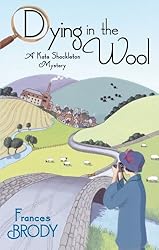
Dying in the Wool by Frances Brody

After I finished reading The Grass is Singing (see my previous post) I felt I needed to read something lighter and easier, so I turned to Dying in the Wool by Frances Brody and it turned out to be just the right book – not too taxing on either the brain or the emotions and a rather interesting mystery too.

It’s the first of Frances Brody’s Kate Shackleton Mysteries set in Yorkshire in 1922, with flashbacks to 1916. Bridgestead is a peaceful mill village, until the day in 1916 when mill owner Joshua Braithwaite went missing after apparently trying to commit suicide. Seven years later his daughter, Tabitha, who is getting married, still can’t believe her father is dead and she asks her friend Kate Shackleton to find out what really happened to him.

This is another post World War 1 crime novel, along the lines of Jacqueline Winspear’s Maisie Dobbs and Carola Dunn’s Daisy Dalrymple books, with an independent female amateur detective. Kate is a widow, her husband was missing in action during the war, presumed dead, her father is a police superintendent and she is a keen amateur photographer. On her father’s recommendation she hires Jim Sykes, an ex-policeman to help her. Once they start asking questions things start to happen with disastrous effects.

I liked the characters, Kate and Jim in particular, and the setting is lovely. The novel is well grounded historically in the aftermath of the First World War. I also liked the way the chapter headings were textile related with an explanation of the terms used and relevant to the events described in the chapters – very skilfully done, I thought. And just like woven cloth this mystery has many separate strands that Kate and Jim have to bring together to reveal what had happened in 1916.

This book fits well into several challenges – see the categories listed above.

Other books in the Kate Shackleton series are:

2. A Medal For Murder (2010)
3. Murder in the Afternoon (2011)
4. A Woman Unknown (2012)
5. Murder on a Summer’s Day (2013)
6. Death of an Avid Reader (2014)

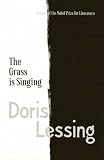
The Grass is Singing by Doris Lessing

I hadn’t read any of Doris Lessing’s books before I read The Grass is Singing, although I’d looked at one or two whilst browsing the library shelves. I wasn’t sure I’d like her books and now I’ve read this, her first novel, I’m still not sure. ‘Like’ is not the right word! How can you ‘like’ the portrayal of the breakdown of a personality, a marriage, a community? The Grass is Singing is a powerful book. Set in Southern Rhodesia (now Zimbabwe) in the 1940s, it’s a novel about failure and depression, disaster, racism, racial tension and prejudice, colonialism at its worst. It’s beautifully written, but so tragic.

Anger, violence, death, seemed natural to this vast, harsh country … (page 19)

It’s hard to write about without some spoilers! My immediate reaction to The Grass is Singing was that it is so bleak and depressing and I didn’t want to read any more of Doris Lessing’s books. It’s now nearly a week since I finished reading it and my reaction has changed as I’ve thought over what to write about it. There is so much in it to take in and whilst my reading is mostly for enjoyment with just a nod towards analysing what I’ve read I really think this book deserves more study than I’ve given it. So what follows just scratches the surface and doesn’t really do justice to the book. I think I may very well read more of Lessing’s books – this edition includes a selection of her other books – The Golden Notebook; The Good Terrorist; Love, Again; and The Fifth Child.

It begins with the newspaper report of the death of Mary Turner, the wife of Richard (Dick) Turner, at Ngesi. She was found on the verandah of their house and their houseboy had confessed to the crime. From there it goes back, recounting all the events that lead up to the murder. It’s deceptively simple story, brimming, overflowing with cruelty and suppressed emotion. What is so tragic about it is that Mary and Dick are unable to communicate with each other – neither understands what the other person is feeling. It is unremitting in portraying their poverty and their helplessness to improve their situation.When you add to this the racial prejudice, colonialism – the contempt that the white farmers had for the natives, and the disintegration of personality – Mary has a mental breakdown – it’s a very hard book to read.

One of its strengths is the atmospheric setting. There is no mistaking the location, the stifling heat adding to the tension, the towns with their ‘ugly scattered suburbs‘, ‘ugly little houses stuck anywhere over the veld, that had no relationship with the hard brown African soil and the arching blue sky’ (page 44), and the farm where Dick and Mary lived, over 100 miles from town, surrounded by trees and the bush, with its tiny rooms, red-brick floor, and its corrugated iron roof, rooms with no ceilings, stuffy and unbearably hot.

… the house was built on a low rise that swelled up in a great hollow several miles across, and ringed by kopjes that coiled blue and hazy and beautiful, a long way off in front, but close to the house at the back. It will be hot here, closed in as it is. (page 58)

What is also remarkable is Doris Lessing’s portrayal of Mary. At the beginning of the novel she is an independent woman, maybe a little different from women her own age, a little aloof and shy. But she hadn’t been married and when she reached thirty, vaguely feeling that maybe there was more to life, she overheard people talking about her, wondering why she wasn’t married and saying there was ‘something missing somewhere’. She was stunned and outraged. Dick seemed to be the answer, but he disliked the town, which she loved and where she felt safe. Marrying him, moving to his farm was the trigger that set off  her eventual inner disintegration. So, by the end of the book Mary has changed almost beyond recognition! Her reaction to the natives is also shocking, swinging from fear to violence and then passive acceptance of the presence of Moses, the houseboy, who kills her.

It’s a disturbing book about an ugly subject, racism; it’s passionate, and dramatic. I couldn’t like any of the characters, but they got under my skin as I read and I wanted it all to end differently – of course, it couldn’t.

Newly Acquired Books

Note: TBRs are books I’ve owned before 1 January 2014.

This year I’m taking part in the 2014 Mount TBR Reading Challenge, which is aimed at reading as many of your own books as you can during the year, and also during January to the end of March I’m doing the TBR Triple Dog Dare, which dares you to read only books already in your TBR pile or those you’ve already reserved at the library (with allowed exceptions).

The TBR Triple Dog Dare doesn’t mean you have to stop acquiring books €“ you just have to resist reading them until after March 31st, but I rashly decided that I was going to try not buying books too. The important word there is ‘try’ – and I have tried. But imposing a ban on buying books is like deciding to go on a diet, which immediately means craving for the food you love but is not allowed on the diet!

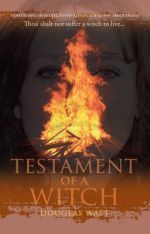
I resisted until 5th February when I bought Testament of a Witch by Douglas Watt. I’d enjoyed Watt’s first book, Death of a Chief, so when I saw that this, his second book was a Kindle Daily Deal for 99p I just had to buy it. And today I bought Flight Behaviour by Barbara Kingsolver, another Kindle Deal for 99p. I’ve read conflicting views of this book but I thought it was worth risking 99p on this book. So my self-imposed ban on buying books is over.

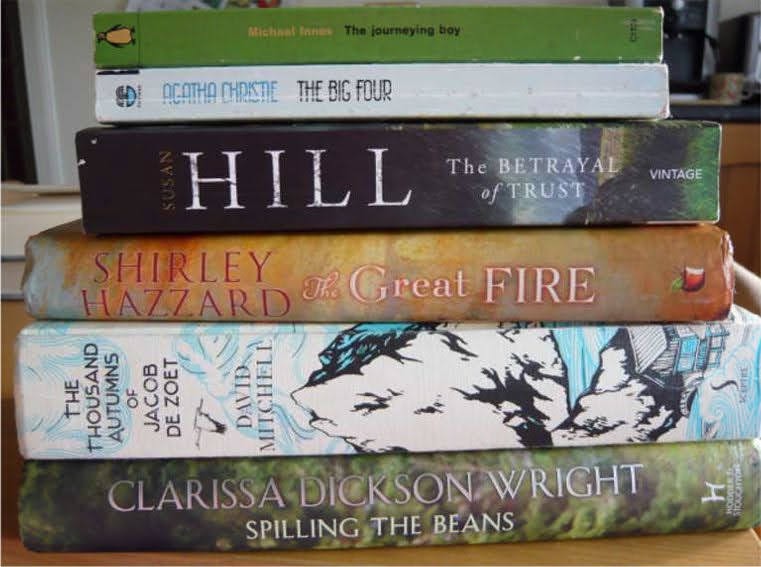
I don’t count exchanging books at Barter Books as ‘buying’ books and in January I exchanged some books and yesterday as we were passing Alnwick we called in and I exchanged some more. I haven’t read any of them yet, so I’m still sticking to the Dare, but these books are tempting me to read them very soon:

They are

  • The Journeying Boy by Michael Innes – because I read and enjoyed his book Death at the President’s Lodging. This book, first published in 1949, is another Inspector Appleby book involving murder and kidnapping.
  • The Big Four by Agatha Christie – one of her Poirot books. Each time I go to Barter books I check to see if there are any I haven’t read. Yesterday there were several books on the shelves, but this was the only one I haven’t read – it was televised last year. It was first published in 1927.
  • Moving on to more modern books with The Betrayal of Trust by Susan Hill. This is the sixth Simon Serrailler book. I’m behind in reading this series so, it’ll be a while before I get round to this book.
  • The Great Fire by Shirley Hazzard. I was pleased to find this book in Barter Books as it’s one Alex had read and enjoyed and I’d added it to my list of books to look out for, described on the cover as ‘a triumphant novel of lives shadowed by war and redeemed by love.’ 
  • The Thousand Autumns of Jacob de Zoet by David Mitchell – because after all I did like his Cloud Atlas. This book is set in Japan in 1799 where Jacob de Zoet, a Dutch clerk encounters an adventure ‘of duplicity, love, guilt, faith and murder.’
  • Spilling the Beans by Clarissa Dickson Wright – another book I seen on another blog, this time Cath’s, and thought I’d like to read sometime. I was surprised and pleased to find it so easily at Barter Books. It’s her autobiography. I always enjoyed her cookery programme, The Two Fat Ladies, even if I wasn’t inspired to cook any of their recipes. She’s had a colourful life.

My book buying habit is fuelled by reading other book blogs as well as browsing the actual shelves at Barter Books and online at Amazon. I’m sure I’d get through my TBRs much quicker if I didn’t check out these sources – but what a lot I’d miss!

And will I hold out until April 1 to read one or more of these books?

The Classics Club Spin Result

The Classics ClubLast week I decided to take part in the Classics Club Spin. The rules were €“ list twenty books from your Classics Club list, number them 1 to 20, and the number announced on Monday represents the book you have to read during February and March. The number that has been selected is 20, which means the book I’ll be reading is:

Ethan Frome by Edith Wharton. This is a short novel. I gave up on reading Edith Wharton’s House of Mirth a few years ago, mainly because I thought it was too long winded, so I’m hoping that this much shorter novel will be more to my liking. However, it’s a tragedy and as I’ve just finished reading Doris Lessing’s The Grass is Singing, which is also a tragedy I think I’ll wait a couple of weeks before I start Ethan Frome – too much tragedy is – well, too much all at once.

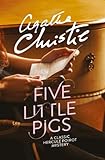
Five Little Pigs by Agatha Christie

There are many things I like about Five Little Pigs, a Poirot mystery first published in 1943. I like the plot and the way it’s structured, the characterisation, the dialogue, and Agatha Christie’s fluent style of writing. In addition the solution is convincing and satisfying.

Caroline Crale was convicted of the murder of her husband, Amyas and died in prison. Sixteen years later, her daughter, a child of five at the time of the murder, asks Poirot to clear her mother’s name, convinced that she was innocent.

Poirot checks the police records, talks to the lawyers who conducted the trial and to the five eyewitnesses, persuading them to write down their versions of events. He finds that she had ample motive for the crime, at no time had she protested her innocence, although she contended that he had committed suicide, and all the eyewitnesses thought she was guilty.

Inevitably there are different versions of the events and conflicting views of Caroline’s character, all very clearly set out. So what did actually happen? Was Caroline innocent or guilty?

Poirot, in his usual methodical manner, goes through the sequence of events, and having gathered together all the people involved, using logic and psychology to detect the incongruous he makes his denouement.

The description of Amyas Crale’s house, Alderbury appears to have been modelled on Agatha Christie’s own house, Greenway, complete with a Battery overlooking the river, just as at Greenway. The book was written in 1943, making it 16 years after 1926, the year of her disappearance before her divorce from her first husband, Archie Christie, so I don’t think that it’s a coincidence that Amyas Crale, a womaniser who was proposing to leave his wife for another woman has the same initials as Archie Christie!

I think the nursery rhyme theme of the title and the chapter headings is rather forced, as it doesn’t really throw any light on the mystery. It seems that Agatha Christie was a bit carried away with her ‘crimes of rhymes’, just as Poirot was obsessed with the jingle:

A jingle ran through Poirot’s head. He repressed it. He must not always be thinking of nursery rhymes. It seemed an obsession with him lately. And yet the jingle persisted.

This little pig went to market, this little pig stayed at home…’ (page 33)

This is the first Agatha Christie book I’ve read this year and I’m pleased it was such a good one!

Five Little Pigs is my 8th TBR book I’ve read this year in the Mount TBR Challenge, and the TBR Triple Dog Dare, the 2nd for the My Kind of Mystery Challenge and the 2nd for the What’s in a Name 7 Challenge (in the category, a book with a number written in letters in the title). And last, but by no means least, it’s the 56th Agatha Christie book I’ve read in the Agatha Christie Reading Challenge.