The Potter's Hand by A N Wilson

Now that the TBR Triple Dog Dare has finished I am free to read anything I want. I have bought/borrowed a few books since the beginning of the year and I immediately turned to The Potter’s Hand by A N Wilson, a library book I borrowed in March and fortunately I’ve been able to renew it. I had actually read the first couple of chapters, because I just couldn’t stop myself once I’d glanced at the dramatic opening paragraph, which I wrote about in a Book Beginnings post in March, but I resisted reading any more until April!
The novel begins in 1768 and roughly follows the fortunes of the Wedgwood family until 1805, 10 years after the death of Josiah Wedgwood, an English potter and the founder of the Wedgwood company. I say roughly because the narrative moves back and forth in time and place. It is a most remarkable book, which kept me wanting to read it each time I had to stop reading – it’s a long book which took me several days to read.

As Wilson explains in an Afterword the broad outlines of the story and most of the details are true, but he has altered dates and rearranged historical events and nearly all the letters are invented. It is ‘meant to be read as fiction, even thought it is intended in part, as an act of homage to one of the great men of our history.’

For me it really did convey what it must have been like to live in that period – whilst the the American War of Independence, the French Revolution, were taking place. It was a time of great change (what time isn’t?) both social and political change as the industrial revolution got under way in England. It’s full of ideas about colonialism, the abolition of slavery, working conditions, and women’s rights. It brought about small changes as well as big ones – for example, before Josiah’s time many families ate off pewter plates or wooden platters, but with his production of creamware ‘there was hardly a respectable household in the kingdom which did not eat its dinner off well-glazed delicate plates.’

Wedgwood’s fame was international and resulted in an order to supply Catherine the Great, the Empress of Russia with an enormous dinner service – the Frog Service, decorated with illustrations of grand houses, scenes of country estates, parks and gardens and numerous other British landscapes. And his great creation towards the end of his life was the Portland Vase, a copy of the original cameo glass Roman vase. But Wedgwood was not only a master craftsman, he was also involved with his friends – philosophers, scientist and inventors – in the development of the canals and roads improving transportation as his factory grew and prospered .

It’s big on character (lots of them), the main ones being Josiah Wedgwood himself, ‘Owd Wooden Leg‘, his daughter Sukey, his nephew Tom Byerley, his childhood friend Caleb Bowers and Blue Squirrel, an American Cherokee Tom fell in love with in America. But there are plenty more who come in and out of the narrative along the way, both fictional and historical, including Voltaire, George Stubbs (who painted the Wedgwood family portrait) and Samuel Taylor Coleridge. I was particularly interested in Dr Erasmus Darwin, Charles Darwin’s grandfather, with his stammer and familiar way with his lady patients (if Wilson’s depiction is true to life) and his ideas on creation and evolution.

Overall it is the story of a remarkable family, their lives, loves, work, illnesses, depressions, addictions and deaths. I found it fascinating throughout, whether it was set in America during the fight for independence, or in England in Wedgwood’s factories, or his grand new house Etruria Hall, or travelling through England on the new canals.

Walter Scott Prize for Historical Fiction

Historical fiction is one of my favourite genres, so I was immediately interested to read that the shortlist for the £25,000 Walter Scott Prize for Historical Fiction has been announced. The Prize honours the achievements and legacy of Sir Walter Scott, the founding father of the historical novel and the winner will be announced at the Borders Book Festival in Melrose, Scotland, on 13 June.

To qualify, books must be by authors from the UK, Ireland or the Commonwealth.

The shortlist is:

  • LIFE AFTER LIFE by Kate Atkinson
  • THE LUMINARIES by Eleanor Catton
  • HARVEST by Jim Crace
  • FAIR HELEN by Andrew Greig
  • AN OFFICER AND A SPY by Robert Harris
  • THE PROMISE by Ann Weisgarber

Life After Life (which won the Costa Novel Award) is the only one of these books that I have, but I fancy reading some of the others, such as Luminaries, which won the Man Booker Prize and Fair Helen set in the Borders in the 1590s, based on a Border Ballad and legend often called €˜the Scottish Romeo and Juliet’. And I’ll certainly take at least a look at the others before June.

Shiny New Books!

Ever wondered about all the new books pouring out into the booksellers and libraries, about whether they’re any good or not?

Well, tomorrow sees the launch of a new quarterly online magazine Shiny New Books: what to read next and why. It’s the creation of some of my favourite book bloggers, Annabel from Annabel’s House of Books, Victoria from Tales from the Reading Room, Simon from Stuck-in-a-Book, and Harriet from Harriet Devine’s Blog, and will be full of information about the best books published each quarter – fiction, non-fiction, and reprints, including author interviews, behind-the-scenes pieces by publishers, and other bonus material.

You can sign up for the newsletter on the website, like on Facebook, follow on Twitter, and on Feedly (or any other feed reader you use). The newsletter will have bonus material, and come out more frequently than the quarterly magazine issues.

The Last Enchantment by Mary Stewart

Magic is the door through which mortal man may sometimes step, to find the gates in the hollow hills, and let himself through into the halls of the other world. (The Last Enchantment, page 121)

I love books that take me away to another time and place – The Last Enchantment (1979) by Mary Stewart is just such a book, magically whisking me back to the time of King Arthur and Merlin. This is not a book to read quickly, but a book to savour both for the story and for Mary Stewart’s descriptive writing.

I’ve been fascinated with the legend of King Arthur from childhood, the tales of the Sword in the Stone, the Knights of the Round Table, the Lady of the Lake, and of Merlin and so on. The Last Enchantment is the third book of the Arthurian Saga, a book of myth and legend and about the conflict between good and evil.

The narrator is Merlin and this book is set after Arthur has become the High King of Brtian, he has drawn the sword, Caliburn (Excaliber) from the stone and he is now plunged into battle against the Saxons , whilst Merlin is in a battle of a different kind, against Arthur’s half-sister, Morgause, the rose-gold witch. Merlin is now getting older and although he is losing his powers, they have not totally deserted him.

In fact this is a story of power, peopled by many richly depicted characters from Bedwyr, Arthur’s companion, who takes the place of Lancelot in this book, to Nimue (Niniane, Vivien), Merlin’s pupil who Merlin initiates into his magic powers. There is the story of Mordred’s birth (his mother Morgause had seduced Arthur), of Guinevere and her rape by King Melwas, and Merlin’s illness and recovery in the wild forest, and his incarceration in the Crystal Cave.

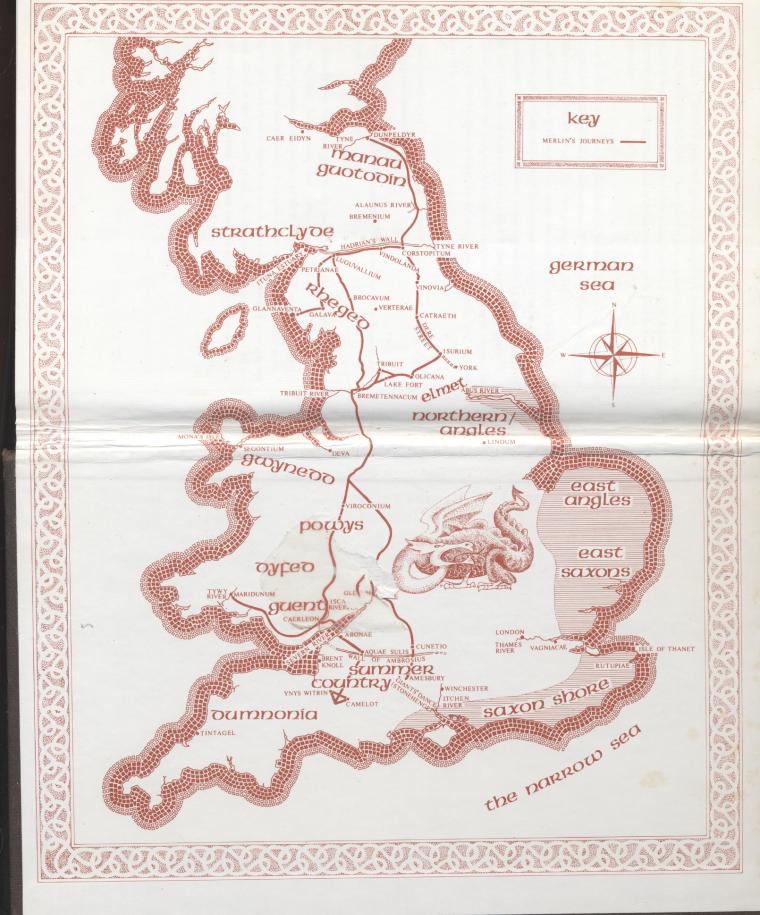
Above all, it is about Merlin and his relationship with Arthur and towards the end of the book with Niniane. As it narrated through Merlin’s eyes the battles that followed Arthur’s acsension are not the main focus of the book. He travels around the country and there is a helpful map on the endpapers of my hardback copy showing the routes he took and the places he visited.

Last Enchantment map 001

(I spent quite some time studying the map and working out what the places are called today.)

Merlin’s travels took him to numerous places including Dunpeldyr in the north-east, possibly on the site of the hill-fort on the present day Traprain Law, not far from Haddington and Dunbar, now in Scotland, then part of Northumbria; Caerleon (now the northern outskirts of Newport in South Wales); Galava (near present day Ambleside in the Lake District; and Vindolanda on the Great Wall of the Emperor Hadrian, where he visits his friend Blaise, to name but a few. It tells of how Merlin built Camelot on the hill then known as Caer Camel (caer is Welsh for fort or castle), a fictional place on a flat topped hill, not far from the sea and the Lake with its Isle of Glass.

Many years ago I read the first two books, The Crystal Cave (1970), about Merlin’s early days and The Hollow Hills (1973), in which Arthur learns who he is and becomes King.  I’d borrowed the books from the library, but never read the third book, so I was really happy when I found it in a library sale a few years ago for just 10p. I can’t think why I’ve not read it until this year, just too many other books clamouring to be read all at once, I expect.

Mary Stewart was born Mary Rainbow in January 1916 in County Durham. She currently lives in Scotland. On Goodreads I found this video of an interview with Mary Stewart in 1992 in which she talks about her writing and another interview with her in 1999, published by the University of Rochester. There are 2 other books following on from the Merlin TrilogyThe Wicked Da(1983), in which Mordred is the main character and The Prince and the Pilgrim (1995).

This historical fantasy is a perfect book not only for the Mount TBR Reading Challenge, but also the Once Upon a Time Challenge, the Historical Fiction Reading Challenge and because Mary Stewart lived in Scotland the Read Scotland 2014 Challenge too.

March's Books

After a bumper month of reading in February I’m back to reading a more normal (for me) number of books in March, finishing reading 7 books, all of them from my To Be Read shelves, bringing my total for the year up to 26:

  1. Her Fearful Symmetry by Audrey Niffenegger
  2. Death Under Sail* by C P Snow
  3. They Do It With Mirrors* by Agatha Christie
  4. The King’s Evil* by  Edward Marston
  5. The English: a Portrait of a People by Jeremy Paxman (non-fiction)
  6. The Office of the Dead* by Andrew Taylor
  7. The Time Machine by H G Wells

The books marked * are crime fiction and my favourite book of the month and also my Crime Fiction Pick of the Month (hosted by Kerrie at Mysteries in Paradise) is:

The Office of the Dead by Andrew Taylor, the third book in the Roth Trilogy, a chilling novel of crime and retribution.

TBR Triple Dog Dare

Triple Dog DareJames’s TBR Triple Dog Dare came to an end yesterday and I’ve actually made it through the whole three months of sticking to reading only books already in my TBR pile or those I’d already reserved at the library. Exceptions were allowed and mine were books chosen for my local book group, two books I’d had on loan from the library in December and the one ARC I received in January.

In addition I decided that I was going to try not buying books too because I thought that it would be easier to read my own books without the temptation of any new books I might buy/borrow. This was a silly idea and although I lasted six weeks of not buying books I just had to give in in February, the urge to get new books and bargain offers was just too strong. But apart from reading the openings of some books I haven’t read them yet and I’m looking forward to reading them very soon.

It’s been an eye-opener for me to realise just how much I want to read books I don’t already own. It’s been like being on a diet, when the urge to eat food not allowed on the diet almost overwhelms me, and seeing books other bloggers are reading, books online or in bookshops is just so tempting. But on the plus side I have read 23 of my TBRs and thoroughly enjoyed most of them. I’ve also realised that some of my TBRs are books I bought to make up the 3 for 2 offers and may not be what I want to read at all – I need to do some ‘weeding’.