The Cabinetmaker by Alan Jones

When Alan Jones emailed me about reading his book The Cabinetmaker he described it as a gritty crime novel based in Glasgow that tells the story of a local cabinetmaker, Francis Hare, father of a murdered son, and John McDaid, a young detective on the investigation.

He went on to say that it contained some strong language, some sleazy police and a smattering of Glasgow slang, which did make me unsure I wanted to read it. But he also said that it combined Glasgow gang culture, sloppy policing and amateur football with fine furniture making and taking that into account I thought that it probably wouldn’t be your normal run-of-the mill crime fiction.

And I was right – it is different and I did like it, despite some of the language (which actually is no worse than in some other books) and there are no truly gruesome descriptions to put me off. In parts I thought it lost focus somewhat, the crime and justice aspects becoming a bit lost in a wealth of detail about football and furniture making, but apart from that it is a intricately plotted book which had me totally gripped. By the end of the book I realised that there is a purpose to those chapters beyond Alan Jones’s obvious love of football and furniture making. Within them lie the clues to what was really going on in Francis and John’s lives.

The Cabinetmaker follows John McDaid’s life from his first day as a detective up to his retirement in 2008, focussing on one crime – the killing of Patrick Hare, a student by a gang of thugs in Glasglow’s west end. The killers were tried but walked free.  From that point onward the story is of John and Francis and their search for justice.  Patrick’s death was a turning point in their lives and although they become friends through a shared interest in football and cabinet making, under pinning everything is their desire for justice.

There are many characters, including police and villains and at times some of them did begin to blur in my mind, with the exception of Francis, John and Sarah, Patrick’s girl friend, who all stand out as vivid and believable people. There are many twists and turns in the story, before the full truth is revealed. It’s a novel of loss and retribution.

Alan Jones (his pen name) is Scottish, living on the Clyde coast. I see from this interview on Omnimystery News that he is writing another book – I’ll be looking out for it.

First Chapter, First Paragraph: Burial of Ghosts

First chapterEvery Tuesday Diane at Bibliophile by the Sea hosts First Chapter First Paragraph Tuesday Intros, where you can share the first paragraph, or a few, of a book you are reading or thinking about reading soon.

Today’s pick is a book that I mentioned in my post the other day on New Additions at BooksPlease. It’s Burial of Ghosts by Ann Cleeves.

It begins:

My nightmares feature knives and blades and blood. I don’t do falling down holes or being chased through deserted streets. And though I usually dream in black and white, the blood is very red, glossy, and it slides out from the rest of the scene, which is flat and dull. The worst thing is that when I wake, I realise it wasn’t a dream at all.

I’m in Blyth. It’s market day and I’m there to shop for Jess. There’s a stall where she buys all her fruit and veg – she knows the bloke who runs it and he always gives her a good deal. It’s mid-morning , with lots of people about. It’s not long before Christmas and everyone’s in the mood when they have to buy, even if the stuff’s crap, otherwise they feel they’re not prepared. A foggy, drizzly day, and cold with it. There’s a raw east wind which cuts into the skin. But it doesn’t draw blood. Not like the scissors I buy in Woolworths. I ask the assistant to take them out of the plastic packet to check they’re sharp. I run my thumb across the blade and there’s a small read line and then tiny, perfectly round red drops like jewels. I fumble with the money when I pay, not because of the cut, which is already healing, but because my hands are freezing.

What do you think? Would you keep reading?

Burial of Ghosts is a standalone book. It’s not a new book as it was first published in 2003 It’s now available in a new Pan paperback edition, which was published in September 2013.

Note: I see ITV are trailing series four of Vera when the first episode will be an adaptation of Harbour Street, the sixth and latest Vera Stanhope book. I really must read that one soon.

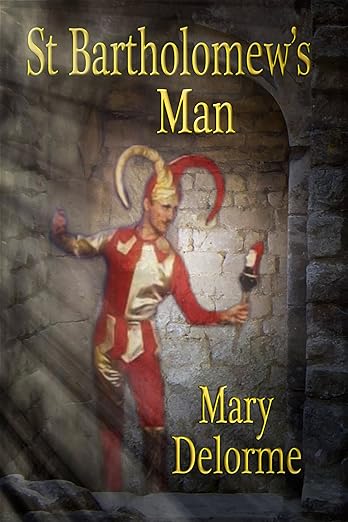
St Bartholomew's Man by Mary Delorme

I was intrigued when I was asked if I would like to read Mary Delorme’s book St Bartholomew’s Man, about Rahere, a man who was a court jester to Henry I and who was also instrumental in the foundation of St Bartholomew’s Hospital in 1123. I was intrigued because it seemed an odd combination, that a jester and the founder of St Bartholomew’s should be one and the same person. And I wondered how that had come about.

It is historical fiction but as Mary Delorme clarifies in her Author’s Note it is based on fact with this proviso:

Almost nine hundred years lie between Rahere and myself; enough to blur historical facts, and leave room for doubt. Rahere is often described as a man of lowly origins, and a jester – something I find difficult to accept, bearing his mind his outstanding achievements and experiences. I therefore began my novel assuming that he was more highly born; not of the highest, but still an educated man. (Loc 26)

It seems to me that she has thoroughly researched her material, and managed to incorporate it seamlessly into her book. St Bartholomew’s Man follows the life of Rahere, from his childhood growing up as an orphan in a monastery, where he was one of the singing children, and he helped the monks in their healing work.

It is a book that left me knowing a lot more about the late 11th and early 12th centuries. It tells of the lives of ordinary people, of the monastic life and above all of the dangers and turbulence of life, moving through the oppressive reign of the irreligious William II (William Rufus), the more settled and peaceful reign of Henry I, followed by the violent conflict that ensued with the reign of Stephen and Matilda. I liked the historical setting and the detail both about healing and building methods. The plot kept me interested to read on to find out whether Rahere succeeded, despite all the suffering he endured and the challenges he had to overcome, in fulfilling his vow to build a hospital to care for the poor in London. The characterisation is good and I felt all the main characters came over as real people, who grew and developed throughout the book.

I enjoyed reading this book, which made me want to find out more about Rahere and St Bartholomew’s. St Bartholomew’s Hospital website outlines the history of the Hospital and St Bartholomew the Great’s website gives some information about the founding of the Priory church and Prior Rahere. Rahere’s tomb is in the church.

Then there is Rudyard Kipling’s poem Rahere, based on the legend that Rahere founded St Bartholomew’s Hospital after suffering a bout of depression and seeing a family of lepers in a London street. I also see that Rosemary Sutcliff’s children’s book The Witch’s Brat is set in the reign of Henry I and features Rahere – I’m hoping to read that one too.

My thanks to Jon Delorme for providing a copy of St Bartholomew’s Man for review, a book that entertained me and led me on to other sources of history and literature. I really want to know more about the 12th century. My knowledge is limited to schoolgirl history and Ken Follett’s The Pillars of the Earth!

New Additions at BooksPlease

Dance of Love pile

I’ve acquired a mixed batch of  books recently, some old and some new- one very new, not yet published actually, a review copy of The Dance of Love by Angela Young (publication date 31 July).  I’m looking forward to reading it very soon. I read her first book Speaking of Love in 2007 – now available on Kindle.

The Dance of Love is set against the backdrop of the Edwardian age, moving from the ballrooms of London to the grand houses of Scotland and Devon, and there is a link to the tragedy of the Titanic.

Another new book is Casting the Net by Pam Rhodes, which came to me from the publishers via LibraryThing’s Early Reviewers Programme. This is described on the back cover as ‘light and amusing’, a ‘social comedy’ but dealing with issues of faith, family and friendship. It’s the second book in The Dunbridge Chronicles. I haven’t read anything by Pam Rhodes, but remember seeing her on Songs of Praise. It promises to be a bit different from the usual books I read.

Then there are some library books:

A Trick of the Light by David Ashton, a Scottish actor and writer – a new-to-me author, but it turns out he has written for film, television, theatre and radio. This book is crime fiction – an Inspector McLevy Mystery – set in Edinburgh in 1881, where a vicious murder has been discovered. It features a young Arthur Conan Doyle who has recently graduated from medical school.

Burial of Ghosts by Ann Cleeves – not a Vera or a Shetland book, but a stand-alone book in which Lizzie Bartholomew, running away from her past goes on holiday to Morocco where she has a brief affair. She returns to England only to find her nightmares are far from over.

The Man Who Smiled by Henning Mankell. I’ve probably watched the TV version of this book with Kenneth Branagh as Kurt Wallender because the synopsis does sound familiar, but I often prefer books to theirTV versions so I borrowed the book anyway. It was the title as much as anything that attracted me – Wallender is not known for his cheery disposition!

And finally in a different genre again The Roundabout Man by Clare Morrall (another new-to-me author). I think I’ve read about this book on some book blogs. The idea of a man living on a roundabout in a caravan seemed funny and quirky, and reading the blurb it promises to be a suspenseful tale too as the man (Quinn) is forced to confront his past.

Happy Birthday BooksPlease!

SevenBooksPlease is 7 Today!

An unbelievable seven years have gone by since I started my blog! There have been many changes in those years but I’m still here on my blog. I love reading and seven years ago I decided to write about the books I read, partly to help me remember what I’ve read and also to extend the pleasure of reading and to record what I thought about the books. And so ‘BooksPlease‘ was born.

I thought of calling my blog ‘Books Matter‘, or ‘Book Matters‘ but decided that it should be ‘BooksPlease‘ because they do and also because if somebody asked me what I wanted for my birthday or Christmas when I was a child I always said ‘ooh, books please!

I can hardly believe that I’ve been blogging this long. There have been, inevitably, ups and downs over the years and there have been times when I’ve thought of giving it up, but it’s become as much a part of my life as reading is and I carry on regardless. One of the unexpected pleasures of blogging has been the contact with other like-minded people all over the world, book lovers I would never have known about, or been able to ‘meet’ who have contributed to my blog with their comments. Thank you to all of you – and I hope to continue ‘talking’ to you as long as possible.

The Baileys Women's Prize for Fiction 2014

Yet another book award – this one is the Baileys Women’s Prize for Fiction. This year’s judges are Helen Fraser, Caitlin Moran, Sophie Raworth, Mary Beard, and Denise Mina.

It’s not a new award – it was formerly known as the Orange Prize for Fiction, set up in 1996 and is awarded for the best novel of the year written by a woman in the English language. Previous winners include A.M. Homes, Barbara Kingsolver, Zadie Smith, Lionel Shriver, Andrea Levy and Kate Grenville.

The books on the shortlist are:

  • The Lowland by Jhumpa Lahiri
  • A Girl Is A Half-Formed Thing by Eimear McBride
  • The Goldfinch by Donna Tartt
  • Burial Rites by Hannah Kent
  • Americanah by Chimamanda Ngozi Adichie
  • The Undertaking by Audrey Magee

Every book on this year’s list, bar The Undertaking, has been previously nominated for a major award – A Girl is a Half-formed Thing was on the inaugural Folio Prize list; Burial Rites was shortlisted for the Guardian First Book Award; The Lowland made it to the Man Booker shortlist; whilst Americanah beat Donna Tartt’sThe Goldfinch to the American National Book Critics’ Circle Award last year.

The winner, to be announced on 4th June, will receive a cheque for £30,000 and a limited edition bronze known as a ‘Bessie’, created by the artist Grizel Niven.

The only one of these books I have is The Goldfinch by Donna Tartt. I started to read it in February this year but I’ve only read up to page 87. It has nearly 800 pages, so it’s really too early in the book to make any sort of judgement on it. But, my initial thoughts were that it was going to be a book I could get really engrossed in, but then the story seemed to get swamped in too much detail, too much description and I wanted it to get a move on. So, I stopped reading. I expect I’ll pick it up again soon – I know other book bloggers have rated it highly.

I think Americanah looks very interesting and I loved the two of Chimamanda Ngozi Adichie’s books that I’ve read, Purple Hibiscus and Half of a Yellow Sun, so I’m hoping to read this one too.