Show Me Your Book Stash!

Carolyn of Riedel Fascination has asked people who’re doing one of her challenges to ‘show me your book stash‘, because she wonders what they look like, where they are, and  how tipsy  the piles are? In other words she wants to see photos of your books wherever they are, on shelves, in piles, propping up the piano, whatever, and put them into a blog post.

It should be no surprise to anyone who reads my blog that I am a bookaholic and there are book shelves/cases/piles of books in nearly every room. They keep changing as I move books around from the shelves into piles deciding what to read next. They start off in some sort of order separating fiction from non fiction and in a-z author or subject order – but they get out of control as I take books off the shelves/piles and somehow they don’t get put back in the same place.

Anyway here are some photos of some of my ‘stash’ (click the photos to see them full size):

First some shelves in the hall. The books here are a mixture of books to read and books I have read and include both fiction and non-fiction. The fiction is mostly double shelved.

Bks Hall Dec 2014Next a few of the books on the shelves behind me as I sit at the computer. These are books I have read and am keeping (for now at any rate – they do get ‘weeded’ every now and then). The back wall of this room is lined with books.

Bks Dec 2014 P1010329

An orderly shelf in the kitchen of just a few of my cookery books – the rest are on other bookshelves elsewhere in the house.

Bks Kit Dec 2014 P1010336

But now for the book shelves that are not so tidy! The bookcase in the living room – again a mix of unread and read books with a shelf of old LPs at the bottom. This is a bit of a jumble really, double shelved with books plied on top of other books in heaps!

Bks LR Dec 2014 P1010339Here are a few of my book piles – the pile next to my computer. For ease of taking the photo I’ve put these in one pile – they are actually in two piles, so not quite such a towering pile. This pile shows just how disorganised I am – books I’ve read and not put away, books I’m going to read, library books and a notebook at the bottom of the pile – not the best place for it!

Bk pile Dec 2014  computer

Two little piles on the floor below the desk. Some of these are books I’ve recently acquired, either bought or borrowed from the library. Others are books, like Dominion that I’ve read recently!

Bks floor Dw

And finally books on the floor in our bedroom, another mixed pile. I’ve just finished reading the Bainbridge book this morning and there are two or three other books I’ve read before and have been tempted to re-read. The other books are all books that have been on the floor too long – I have to dust them! They are books I’ve wondered about reading next but have been left for later. I will read them one day …

Bks bedrm Dec 2014These are just some of my bookshelves/piles – yes there are more!!
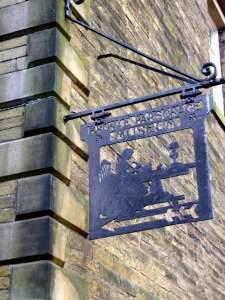
The Bronte Parsonage Museum, Haworth

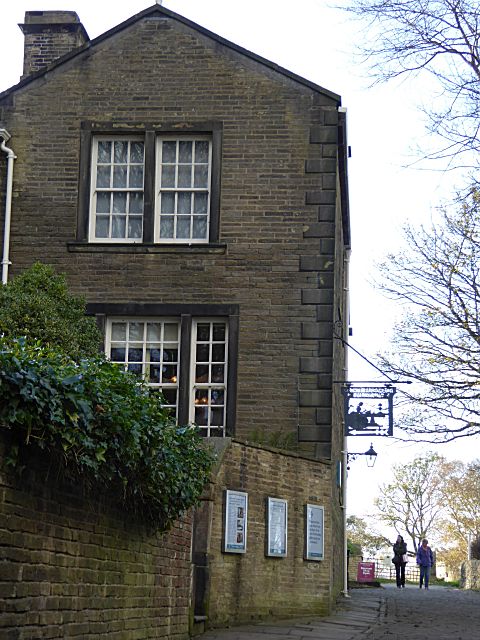
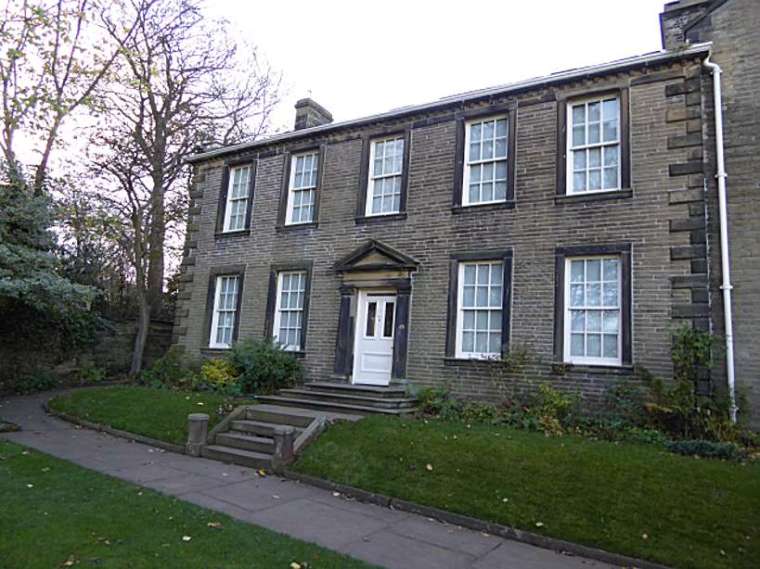
We visited the Bronte Parsonage Museum in Haworth a few weeks ago.

Bronte Museum sign P1010267
Bronte Museum sign


Bronte Parsonage Museum P1010266

BPM front P1010269

You can’t take photos inside the museum, so I bought the guide book and a booklet, The Brontes and Haworth to remind me of our visit and you can see some photos on the Bronte Society website. It’s a fascinating house – a recreation of the Brontes’ home, as well as a museum displaying memorabilia, manuscripts, books and artworks. There is so much to see and all in a smaller house (with small rooms) than I had imagined.

I knew that the Brontes wrote their stories and poems in tiny notebooks (about the size of a credit card) in small handwriting but seeing the original manuscripts I was amazed at just how very small it is! And standing next to the display cabinet containing Charlotte Bronte’s dress she wore to set out for her honeymoon tour in Ireland I could see she wasn’t very tall – certainly less than 5ft.

The museum contains some of the Brontes’ paintings and drawings and Emily’s mahogany artist’s box – they really were talented in more than one field. I was intrigued by a large cupboard with 12 panels on the door, each panel containing a painting of one of the 12 apostles. I was even more fascinated by it and wished I’d been able to take a photograph of the cupboard, when later on whilst re-reading  Jane Eyre I came across this description of a cabinet in a room on the third storey of Thornfield Hall:

the doors of a great cabinet opposite – whose front, divided into twelve panels, bore in grim design, the heads of the twelve apostles, each enclosed in its separate panel as in a frame …

According as the shifting obscurity and flickering gleam hovered here or glanced there, it was no the bearded physician, Luke, that bent his brow; now St John’s long hair that waved; and anon the devilish face of Judas, that grew out of the panel, and seemed gathering life and threatening a revelation of the arch-traitor – of Satan himself – in his subordinates form.

I realised that this was the cupboard I had seen in the Museum! I’d stood in front of it for some while wondering what it was as there is nothing in the guide book about it.  Seeing it at night by candlelight must have been very different from standing in a museum looking at it in daylight! Since then I’ve been unable to find out much about this cupboard, apart from a post on the Stubbs Family History blog, which explains how the Museum acquired the cupboard. And you can see a photograph of it here.

I now intend to read more of Charlotte Bronte’s novels and Mrs Gaskell’s biography of her friend, The Life of Charlotte Bronte, first published in 1857 – Charlotte had died in 1855, aged 38.
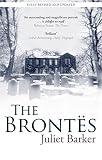
I’d also like to read a more modern biography, maybe Charlotte Bronte: a Passionate Life by Lyndall Gordon or The Brontes by Juliet Barker about the family.

What would you recommend?

Portrait in Sepia by Isabel Allende

I picked up Portrait in Sepia up in a bookshop four years ago. As I knew nothing about it or the author it joined the other to-be-read books until just recently.

The opening pages of this historical novel grabbed my attention, about Aurora del Valle’s birth in 1880 in San Francisco in the Chinese quarter and referring to family secrets:

I have come to know the details of my birth rather late in life, but it would have been worse not to discover them at all, they could have been lost forever in the cracks and crannies of oblivion. There are so many secrets in my family that I may never have time to unveil them all: truth is short-lived, watered down by torrents of rain. (page 3)

Portrait in Sepia is part of a trilogy, with The House of the Spirits and Daughter of Fortune, and maybe it would have helped if I’d read the other two books, but I thought there was plenty of background history to the characters and I had no problem in following the story and distinguishing the characters.

Summary from the back cover:

After her mother dies in childbirth, Aurora del Valle is raised by her grandmother in San Francisco, but despite growing up in this rich and privileged environment, Aurora is unhappy. Haunted by terrible nightmares and the inexplicable absence of many of her childhood memories, and finding herself alone at the end of a love affair, she decides to travel to Chile to discover what it was, exactly, all those years ago, that had such a devastating effect on her young life. 

Aurora is the narrator and this the story of her family and after giving details of her birth, Aurora goes back to 1862 beginning her story with details about her grandparents. This is not a book you read quickly as there is a lot of detail, a lot of 19th century history of Chile, its mix of nationalities, politics and wars – at first I felt I was drowning in detail, but once I settled into the rhythm of the writing I began to appreciate Allende’s style. It takes you right into the characters, seeing them through Aurora’s eyes – her Chinese grandfather, Tao Chi’en, her uncle Severo and her two grandmothers, Paulina and Eliza, who both play a large role in her life. And there are many other colourful characters and momentous events in this book.

It’s a book about love, loss, identity, betrayal and about family relationships. It’s a portrayal of the strengths and weaknesses of the characters and their struggle to survive. Aurora tells her family’s story through looking at photographs, snapshots in time, through her own disjointed, incomplete and vague memories of her childhood and through conversations with her family members. Whilst she was still very young her two grandmothers decided her future, thinking that time would erase the memory of the traumatic events she had seen, never realising that the scenes would live forever in her nightmares.

Portrait in Sepia explores the nature of memory, how each moment of our lives is so transitory and how the past becomes confused as we try to recapture the moments we’ve lived through. Through photographs we can keep memories alive. As Aurora discovered:

Every instant disappears in a breath and immediately becomes the past; reality is ephemeral and changing, pure longing. With these photographs and pages I keep memories alive; they are my grasp on a truth that is fleeting , but truth none the less; they prove that these events happened and that these people passed through my destiny. Thanks to them I can revive my mother who died at my birth, my stalwart grandmothers, and my wise Chinese grandfather, my poor father, and other links in the long chain of my family, all of mixed and ardent blood. (pages 303-4)

Reading a book like this inevitably leads me on to yet more books, because now I want to read the other two books in the trilogy.

November’s Books

I read 9 books in November, all of them fiction. Two are books from my TBR shelves, one is a re-read, two are library books, three are books I’ve bought recently and one is a review copy. The links are to my posts on the books.


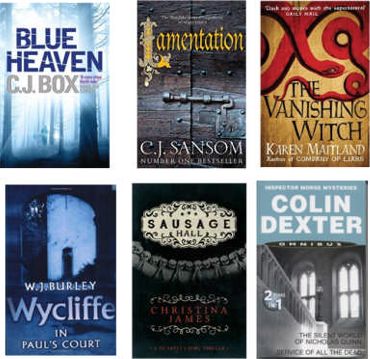
  1. Blue Heaven by C J Box – TBR. I loved it – it’s written in a style that appeals to me -straightforward storytelling, with good descriptions of locality and characters, secondly characters that are both likeable and downright nasty, but not caricatures, and finally the ending was what I hoped, and also dreaded it would be.
  2. Lamentation by C J Sansom – the sixth Matthew Shardlake book an ingenious crime mystery, full of suspense and tension, set in 1546, the last year of Henry VIII’s life.
  3. The Woods by Harlan Coben – see below.
  4. The Vanishing Witch by Karen Maitland – Library Book – set in Lincoln during the reign of Richard II. I liked the elements of the supernatural and suspicions of witchcraft in this book and the historical setting, but it just didn’t have the magic spark that I’d enjoyed in her other books that I’ve read.
  5. Wycliffe in Paul’s Court by W J Burley – Library Book – Wycliffe investigates two violent deaths at Paul’s Court. W J Burley was very good at creating believable people caught up in extraordinary situations. An enjoyable read.
  6. Dominion by C J Sansom – see below.
  7. Sausage Hall by Christina James – Review Book – set in the South Lincolnshire Fens, a crime mystery with a sinister undercurrent exploring the murky world of illegal immigrants, and a well researched historical element. I enjoyed it.
  8. Service of All the Dead by Colin Dexter – TBR –  a superbly constructed puzzle as Morse uncovers an intricate web of lies and deceit whilst he investigates the death of a churchwarden at St Frideswide church. Compelling reading! 
  9. Jane Eyre by Charlotte Bronte – a re-read, see below.

I’m always behind these days with reviews – so here are some brief notes about those books I haven’t reviewed:

The Woods by Harlan Coben – this was a free book on Kindle and as I hadn’t read anything by Coben I decided to see if I liked it. It”s a stand-alone mystery and I did like it. It’s fast paced, about the murder of two teenagers at a Summer Camp twenty years earlier – two other teenagers disappeared and were presumed dead. Paul Copeland, now a County Prosecutor, is asked to identify a dead body, who turns out to be one of the missing teenagers. His sister was the other missing person – is she still alive – and who was the murderer? Good characterisation and a good plot kept me guessing to the end.  A good choice.

I wasn’t too sure that I would like Sansom’s  Dominion, because I’m not very keen on alternative history, but I was pleased to find that I enjoyed it more than I thought I would. It’s set in 1952 in a Britain that had surrendered to Nazi Germany in 1940 after Dunkirk. And I finished it with relief that this nightmare scenario had never actually taken place.
Germany and Russia are still at war, whilst in Britain an underground resistance organization headed by Winston Churchill, who is now in hiding, is alone in opposing Nazi authoritarian rule. The streets are patrolled by violent Auxiliary Police and British Jews are dragged from their homes and sent to camps awaiting transportation to the Isle of Wight on their way to gas chambers in the East. Sansom has painted a scary alternate Britain, showing how people are ground down, almost inevitably, into accepting the prospect of racial genocide and eugenic sterilisation. It sent shivers down my spine.

It is by no means a perfect book, it’s too long for example and I thought the ending was rather unconvincing, but I gave it 5 stars on Goodreads.  Maybe 5 stars is a bit generous but each time I had to stop reading I couldn’t get it out of my mind and was keen to get back to it. It’s the ‘what if’ aspect and Sansom’s account of the dangers of nationalism that made it compelling reading for me.

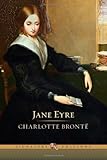
And finally Jane Eyre by Charlotte Brontë.  I first read this many years ago and have since seen TV versions of it. This time round I was struck by Jane’s independence of mind, her powers of reasoning and strength of character. It’s not just the romantic love story I read as a young teenager. The romance is still there of course, but the feminism of Charlotte Brontë expressed through Jane’s character is very evident to me now. I picked up the book as a result of visiting the Brontë Parsonage Museum at Haworth, which I intend to write about some time.
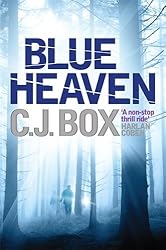
My favourite, the one that I enjoyed the most, is Blue Heaven by C J Box.

Looking Ahead

I rarely plan ahead which books I’m going to read, but as it’s 1 December tomorrow and not much reading time left in the year I thought I’d concentrate on reading from my to-be-read shelves. These are the books I think I’ll read:

Dec bks 2014

From the bottom up they are:

  • I’m currently reading Portrait in Sepia by Isabel Allende and finding it a bit of a struggle – mainly because the font is quite small and it’s difficult to see except in bright lighting – not good for reading in bed. This is historical fiction, a family epic set at the end of the nineteenth century in Chile and San Francisco.  Isabel Allende is a new-to-me author.
  • The Soul of Kindness by Elizabeth Taylor, according to the book jacket this is a study in self-deception of a young newly married woman who believes she is ‘the soul of kindness’ and yet she wrecks everyone’s life she comes in contact with. I’ve not read any of Elizabeth Taylor’s books before (the author, not the actress).
  • An Awfully Big Adventure by Beryl Bainbridge – set in 1950 this is also historical fiction. A Liverpool repertory theatre company are rehearsing its Christmas production of Peter Pan. The story centres around Stella, the assistant stage manager. I’ve enjoyed the Beryl Bainbridge books I’ve read so far, so I’m hoping this one is just as good.
  • And finally crime fiction, an Agatha Christie book because I haven’t read one of hers for a while. This is Hallowe’en Party, with Poirot and Ariadne Oliver in search of the killer of Joyce, a boastful thirteen-year-old found drowned in an apple-bobbing tub.

It remains to be seen if these are the books I’ll read in December!

Service of All the Dead by Colin Dexter

Colin Dexter 001

A question on the TV show Pointless about the novels of Colin Dexter reminded me I have a few of his books to read, Service of All the Dead being one of them – and it was one of the pointless answers too! So that gave me the push to read it.  My copy is a secondhand book – an Omnibus containing  The Silent World of Nicholas Quinn as well as Service of All the Dead.

It really is one of the most puzzling crime fiction books I’ve read – if not the most puzzling! CI Morse sums it up himself:

There are some extremely odd points in this case, Lewis – or rather there were – each of them in itself suggestive but also puzzling. They puzzled all of us, and perhaps still do to some extent, because by the time we’d finished we’d got no less than five bodies on our hands and we were never in a position to learn what any of the five could have told us. (page 295)

Morse was on holiday, bored and at a loose end, when, stepping off a bus near St Frideswide’s Church in Oxford, he saw a notice advertising a jumble sale at the church – it seemed to him pre-ordained that he should enter the church. This set in motion his fascination with the death of the churchwarden, killed in the church the previous year and his subsequent discovery of the deaths of four more people. His interest is enhanced by the attraction he feels for Ruth Rawlinson, who cleans the church.

Aided by Sergeant Lewis, he digs into the history of the churchwarden, the vicar and members of the church and uncovers an intricate web of lies and deceit. Morse acts on instinct and consequently both Lewis and myself were in the dark for a great part of this book. He proposes several motives for the murders and alternate scenarios of what had happened before untangling the complex mess. There are plenty of red herrings and twists and turns.

Even though I was lost in the plot I found the book compelling reading – it’s a superbly constructed puzzle. This is certainly not a police procedural in the normal sense – there is little account of forensic evidence for example. It is strong on character and on place. The scene of the murders is St Frideswide’s, a fictional church, possibly based a couple of Oxford churches, St Michael-by-the-North-Gate with a Saxon tower and St Mary Magdalen and it is there in the tower that Morse suffers from his great fear of heights.

Service of All the Dead was first published in 1979. I suppose I must have seen the TV version of this book, as I watched all the episodes and this one was shown in 1987 – I don’t remember it! Inevitably as I read it I could see John Thaw as Morse and Kevin Whately as Lewis.