Challenge Completed – What’s In a Name?

What's in a name 2015

I’ve now completed the What’s In A Name? Challenge, hosted by Charlie at The Worm Hole. It involved reading books from six categories. These are the books I read with links to my posts:

As with the other challenges I’m doing I try to meet the criteria by reading books I’ve been wanting to read for a while – and I succeeded with this challenge. And I read some really excellent books, especially The Burning and Turn of the Tide.

Thanks Charlie for keeping this challenge going!

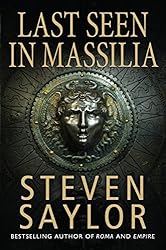
Last Seen in Massilia by Steven Saylor

 Last Seen in Massilia is the eighth book in Steven Saylor’s series of books Roma Sub Rosa, historical crime fiction set in ancient Rome, featuring an investigator called Gordianus the Finder. I’ve begun the series with this book, rather than with the first book, because it was in a pack of books I bought earlier this year from Barter Books. This one is not set in Rome, but in Massilia – modern day Marseilles. It’s 49BC during Caesar’s siege of the city. I liked it for it’s physical and historical setting but I think the crime element is secondary.

It begins as Gordianus is on his way to Massilia to look for his adopted son, Meto, who has been reported dead.  Massilia is surrounded, access extremely difficult, if not impossible and Gordianus and his son-in-law Davus join the Roman troops attempting to enter the city through a tunnel taking them underneath the city walls. An attempt that ends almost in disaster as the tunnel is flooded and they are almost drowned. Fortunately they are rescued by Heironymous, the elected scapegoat doomed to take on the sins of the people by throwing himself off the Sacrifice Rock.

Whilst he is unable to find out what has happened to Meto, he and Davus witness the fall of a young woman from the Sacrifice Rock. The question is was it suicide, did she just slip or was she pushed. All this is going on, although Gordianus doesn’t actually do much detective work, whilst the siege of the city comes to a fiery and dramatic end.

What I really liked was all the detail about Massilia – how it was governed – the hierarchy of theTimouchoi its ruling officials, its relationship to Rome, its traditions and customs. So it’s no surprise to me that Saylor has used the available sources for his book – Aristotle, Cicero, Strabo and Plutarch. For the details of the siege he used Caesar’s The Civil War, amongst other primary sources.

However, I am glad I read it and will look out for more books in the series:

Roma Sub Rosa
1. Roman Blood (1991)
2. Arms of Nemesis (1992)
3. Catilina’s Riddle (1993)
4. The Venus Throw (1995)
5. A Murder On the Appian Way (1996)
6. The House of the Vestals: The Investigations of Gordianus the Finder (1997)
7. Rubicon (1999)
8. Last Seen in Massilia (2000)
9. A Mist of Prophecies (2002)
10. The Judgement of Caesar (2004)
11. A Gladiator Dies Only Once: The Further Investigations of Gordianus the Finder (2005)
12. The Triumph of Caesar (2008)

I also have Roma by Steven Saylor – a book that has sat unread on my shelves for a few years now, unread so far mainly because it is so long. Maybe this year …

Reading challenges – Historical Fiction and What’s in a Name, category a book with a city in its title.

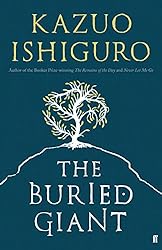
The Buried Giant by Kazuo Ishiguro

I had little idea what to expect before I began reading Kazuo Ishiguro’s latest novel The Buried Giant, except,  that is, that I had enjoyed the other three books by him that I’ve read. They are The Remains of the Day, a brilliant book, a beautiful portrait of both personality and  social class, set in an England that no longer exists,  a story of hopeless and repressed love; Never Let Me Go, a love story that both shocked and horrified me; and Nocturnes a book of five short stories in which Ishiguro explores ideas of love, music and the passing of time, with a touch of nostalgia and a sense of loss for what has gone or what could have been.

I knew that there have been mixed reviews of The Buried Giant and was keen to see for myself what it is like. I loved it. It is different from his other books, but still has some of the same themes I loved in them –   the themes of love and the sense of a time long gone. It is also about the passing of time, old age, the fallibility of memory and much more besides, in particular ethnic conflict and the devastating effect of vengeance and hatred. It is set in Britain after the death of the legendary King Arthur, after the Romans have left, and the wars between Saxons and Britons have ceased. But it is a cursed land swathed in a mist of forgetfulness.

Attempting to remember their lives together, an elderly couple, Beatrice and Axl, leave their village setting out on a journey to visit their son, who they barely remember. They encounter many hazards, strange and other-worldly. They meet a boatman in a ruined Roman villa, who ferries people to an island. He is under a duty to question those who wish to cross and will only allow a couple to travel together if they can demonstrate their abiding love for each other. But Axl and Beatrice are haunted by a dread that because of their memory loss they would fail such a test, and be separated for ever. How can they prove their love for each other when they can’t remember the past they’ve shared?

There are ogres, deadly pixies,  evil monks who keep a dreadful beast underground, Saxons – Wistan, a warrior and a young boy, and Sir Gawain entrusted by King Arthur to slay Querig, a she-dragon roaming the land, who by her breath has spread the mist of forgetfulness.

It is also shocking, as it reveals the hatred that works within people to make them want to destroy others.  Wistan urges the young boy, Edwin to hate all Britons because it was Britons under Arthur who  had slaughtered the invading Saxons:

We’ve a duty to hate every man, woman and child of their blood. So promise me this. Should I fall before I pass to you my skills, promise me you’ll tend well this hatred within your heart. And should it ever flicker or threaten to die, shield it with care till the flame holds again. (page 264)

It is this hatred that still drives people to commit atrocities, bringing out the worst in human nature. Whilst the past is forgotten, Wistan realises that the old wounds can’t heal whilst ‘maggots linger so richly‘, nor can ‘peace hold for ever built on slaughter and a magician’s trickery‘.

It has elements of fantasy, myth and legend, of allegory and adventure and the perils of a quest. It is mysterious, beguiling and slippery, hard to pin down in parts and startlingly clear in others. From a somewhat slow start it gripped my imagination and made me think, trying to pin down just what was happening as the prose is clear and yet ambiguous, in the same way that the mist obscuring the past at times lifted and dispersed a little before returning. Beatrice and Axl are the dominant characters, and I found their confusion as they realise they have forgotten their past and their distress as they contemplate spending eternity apart deeply moving. It is extraordinary and mesmerising! I think it is a book I’ll have to re-read!

This may not be the usual book of ghostly, gothic or classic horror of the categories for the R.I.P. X challenge, but it is certainly a fantastic book full of peril, mystery and suspense.

This Week in Books:16 September 2015

This Week in Books is a weekly round-up hosted by Lypsyy Lost & Found, about what I’ve been reading Now, Then & Next. A similar meme is run by Taking on a World of Words.

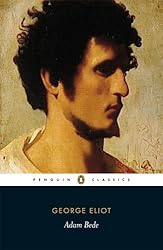
Now: Currently I’m reading two books – Adam Bede by George Eliot

I’ve now read about 60% of this book (now reading chapter XXX) and it is just beginning to get to the nitty-gritty.

Blurb

Carpenter Adam Bede is in love with the beautiful Hetty Sorrel, but unknown to him, he has a rival, in the local squire’s son Arthur Donnithorne. Hetty is soon attracted by Arthur’s seductive charm and they begin to meet in secret. The relationship is to have tragic consequences that reach far beyond the couple themselves, touching not just Adam Bede, but many others, not least, pious Methodist Preacher Dinah Morris. A tale of seduction, betrayal, love and deception, the plot of Adam Bede has the quality of an English folk song. Within the setting of Hayslope, a small, rural community, Eliot brilliantly creates a sense of earthy reality, making the landscape itself as vital a presence in the novel as that of her characters themselves.

and Last Seen in Massilia by Steven Saylor

Blurb:

As civil war between Caesar and Pompey engulfs the Roman world, Gordianus the Finder receives an anonymous message informing him of the death of his son Meto who has been acting as a double agent for Caesar. The search for Meto’s fate brings Gordianus to the besieged seaport of Massilia, which is stubbornly holding out against Caesar’s troops. As famine and slaughter threaten the blockaded city, Gordianus is drawn into the intrigues of exiled Romans and duplicitous Massilians. His only friend in the city, Hieronymous, has been made the doomed scapegoat elected by city officials to bear the sins of the populace and save them all from annihilation. Meanwhile, Gordianus is constantly frustrated in his efforts to find out what happened to his son – and when he witnesses the fall of a young woman from a precipice outside the city called the Sacrifice Rock, then the plot begins to thicken…

I’ve read the first four chapters so far, setting the scene in Massilia (modern day Marseilles).

Then – yesterday I finished The Buried Giant by Kazuo Ishiguro

Blurb:

The Romans have long since departed, and Britain is steadily declining into ruin. But at least the wars that once ravaged the country have ceased.

The Buried Giant begins as a couple, Axl and Beatrice, set off across a troubled land of mist and rain in the hope of finding a son they have not seen for years. They expect to face many hazards ‘“ some strange and other-worldly ‘“ but they cannot yet foresee how their journey will reveal to them dark and forgotten corners of their love for one another.

Sometimes savage, often intensely moving, Kazuo Ishiguro’s first novel in a decade is about lost memories, love, revenge and war.

This is a fascinating book and I’m currently sorting out my thoughts for my post later this week.

Next – impossible to predict right now with some many books begging to be read. It could be one of these:

or it could be something completely different (there are plenty more waiting to be read)! What would you choose and what have you been reading?

Stacking the Shelves: 12 September 2015

STSmall

Stacking The Shelves is all about sharing the books you are adding to your shelves. This means you can include ‘˜real’ and ‘˜virtual’ books (ie physical and ebooks) you’ve bought, books you’ve borrowed from friends or the library, review books, and gifts.

Even though I have plenty of TBR books I couldn’t resist adding a few books this week:

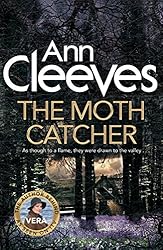
First on Kindle is The Moth Catcher by Ann Cleeves. This was first published this week and is the seventh and latest book in the Vera Stanhope series.  Set in a lonely valley in Northumberland, Patrick, a young ecologist is found dead in a ditch and a second body is found in the attic of the house that Patrick was looking after whilst the owners were away. I have started to read this already!


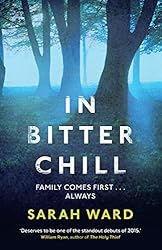
I’ve also downloaded In Bitter Chill by Sarah Ward. This is her debut book, published in June this year. Sarah Ward writes a blog reviewing crime fiction – Crimepieces, which I regularly read. She has also reviewed for Eurocrime and Crimesquad and is a judge for the Petrona Award for Scandinavian translated crime novels. In Bitter Chill is set in Derbyshire, where in 1978 two girls, Rachel and Sophie had gone missing. Rachel returned and when Sophie’s mother commits suicide thirty years later, she is determined to find out what had happened and the case is reopened.

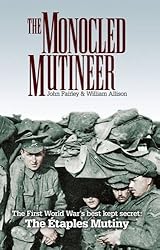
Lastly, I received  a copy of The Monocled Mutineer by John Fairly and William Allison for review courtesy of the Souvenir Press Ltd. With a new introduction by John Fairly this is the 2nd revised edition of the original book first published in 1979. I remember watching the 1986 BBC dramatisation of this with Paul McGann playing the role of Percy Toplis, the leader of an army mutiny in 1917 in Étaples in northern France ‘“ a story that has remained one of the best-kept secrets of the First World War. Although Toplis was named as the ringleader of the Mutiny, there are still a host of unanswered questions about him and his role, if any.

What books have you added to your shelves this week?

Two Lacey Flint books by Sharon Bolton

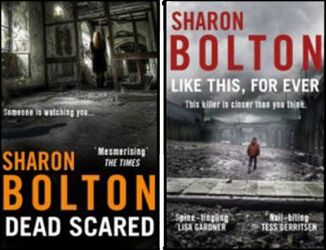
I’ve recently read Dead Scared, Sharon Bolton’s  second Lacey Flint book and Like This, For Ever, the third book in the series:

Bolton bks

Synopses from Sharon Bolton’s website:

Dead Scared

Someone is watching you…

When a Cambridge university student dramatically attempts to take her own life, DI Mark Joesbury realizes that the university has developed an unhealthy record of young people committing suicide in extraordinary ways.

Despite huge personal misgivings, Joesbury sends young policewoman DC Lacey Flint to Cambridge with a brief to work undercover, posing as a vulnerable, depression-prone student.

Psychiatrist Evi Oliver is the only person in Cambridge who knows who Lacey really is – or so they both hope. But as the two women dig deeper into the darker side of university life, they discover a terrifying trend…

And when Lacey starts experiencing the same disturbing nightmares reported by the dead girls, she knows that she is next.

Like This, For Ever (published as Lost in the US)

Twelve-year-old Barney Roberts is obsessed with a series of murders. He knows the victims are all boys, just like him. He knows the bodies were found on river banks nearby. And he’s sure the killer will strike again soon. But there’s something else, a secret he’d rather not know, a secret he is too scared to share . . .  And who would believe a twelve-year-old boy anyway?

Like This, For Ever is a twisty, addictive, up-all-night thriller from a writer who loves nothing more than to play with your mind.

Two perfect books for the RIP Challenge. they are both totally absorbing murder mysteries – maybe Like This, for Ever is even better than Dead Scared. I did have an inkling quite early on who was pulling Lacey’s strings in Dead Scared, but I just didn’t know how it was being done – nightmares, hallucinations, bizarre suicides and vulnerable students. It is terrifying in parts.

With Like This, For Ever I had no idea until very near the end who the killer was. It’s so full of red herrings and twists (more than in Dead Secret) that I swung from believing it could be this person to that, or thinking it can’t possibly be that person, or I do hope it’s not that one. It was one of the people I thought maybe it’s that one, but I quickly dismissed that idea.

Both books are full of believable and individual characters, plus there is the ongoing story of Lacey, her boss Mark Joesbury and psychiatrist Evi Oliver. I’d love to read the next book in the series soon – A Dark and Twisted Tide.

I first read Sharon Bolton’s books when she was writing under the name SJ Bolton, and I wondered why the name change.  The answer is here in this post on her blog . It’s long, so I’ll summarise – ‘SJ Bolton’ was the name her publishers suggested in 2006 in the manner of PD James and JK Rowling and she went along with it, the thinking being that men don’t buy books by a woman author. But she doesn’t have a middle name and chose ‘J’, confusing for people who knew her personally , and then more SJs appeared on the book shelves and she felt lost in the crowd. There was also the issue around the name ‘Sharon’, a name that can conjure up images of Pauline Quirke slouching around Chigwell in a shell suit. So  she now writes as Sharon Bolton and I for one am glad she does – it’s less anonymous as well as being a much more memorable name.

As well as being perfect for the RIP challenge, Dead Scared is a book I’ve owned for a while and so qualifies for the Mount To Be Read Challenge.