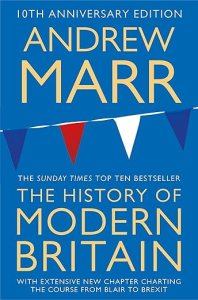
The History of Modern Britain by Andrew Marr

I’ve taken quite a long time (nearly two months) to read Andrew Marr’s The History of Modern Britain, which covers the post World War II period up to 2006, with an added introduction in the paperback edition written in 2008. This is a brief review of a very long and detailed book – too long and detailed for me to sum up meaningfully in a few paragraphs.

So, here is the blurb from the back cover:

This is an account of great political visions – and how they were defeated – and of the resilience, humour and stroppiness of the British public. From the Second World War onwards, Britain has been a country on edge: first of invasion, then of bankruptcy, then on the vulnerable front line of the Cold War, and later in the forefront of the great opening up of capital and migration now reshaping the world. This history follows all the political and economic stories, but deals too with comedy, cars, the war against homosexuals, Sixties anarchists, oil-men and punks, Margaret Thatcher’s wonderful good luck, the true heroes of British theatre, and the victory of shopping over politics.

I wanted to read this book after watching Andrew Marr’s BBC 2 series, History of Modern Britain, which was first shown in 5 episodes in 2007 –  but it was the EU Referendum that nudged me into reading it this year. Like many others, I’ve now become addicted to news and comment programmes, but my knowledge of modern history, even though, or maybe because, I’ve lived through a lot of it, is sketchy, so it was fascinating, if somewhat scary, to read about events I remembered or had half-forgotten.

It’s an obvious statement, but still true, that Britain has changed since 1945 to be almost unrecognisable today and inevitably it is still changing. This book shows how we were then and how we got to where we are today. It’s mainly a political and economic history, with short sections on social and cultural events thrown into the mix.

Despite its length and complexities it is a readable book, which doesn’t surprise me as Andrew Marr is a journalist, TV presenter and political commentator. He was born in Glasgow in 1959. He studied English at the University of Cambridge and has since enjoyed a long career in political journalism, working for the Scotsman, the Independent, the Daily Express and the Observer. From 2000 to 2005 he was the BBC’s Political Editor. He has written and presented TV documentaries on history, science and politics, and presents the weekly Andrew Marr Show on Sunday mornings on BBC1 and Start the Week on Radio 4.

  • Paperback: 672 pages
  • Publisher: Pan; Reprints edition (6 Mar. 2009)
  • Language: English
  • ISBN-10: 0330511475
  • ISBN-13: 978-0330511476
  • Source: my own copy

Reading challenges: Mount TBR Reading Challenge and Read Scotland.

Sandlands by Rosy Thornton

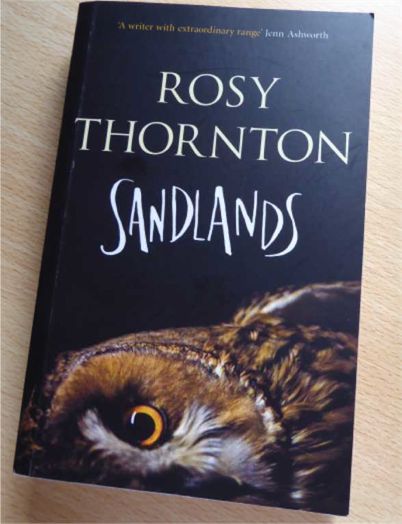
SandlandsSandlands is a beautiful collection of short stories that held me spellbound from start to finish. This is all the more extraordinary as I am not a great fan of short story collections. I often find that they leave me feeling that something is missing – either the storyline is not developed enough, or the characters are not convincing, or that they are just too trite or banal. In other words that they are disappointing.

Not so with Sandlands – I think this is a special collection of well written stories set in the Suffolk landscape, describing real people, and containing well- researched detail into myths and folklore, wildlife, and environmental changes that slips seamlessly into the fiction. They are just the right length for me, perfect little cameos each one complete and satisfying – that’s not to say that all the ends are neatly tied up, as some, such as Nightingale’s Return, about an Italian visiting the farm where his father had worked  as a prisoner of war, end leaving me wondering what happened next, or rather just what had happened in the past.

The individual stories are varied, some looking back to the past, some are sad leaving me with tears in my eyes, and some have a supernatural element. I loved all of them, but a few are outstanding, for example, Curlew Call in which a teenager spends time during her gap year living in an old house overlooking the the salt marshes, as a companion to Agnes, an old lady who is wheel-chair bound. She is fascinated by the landscape and the wildlife, in particular the curlews, calling out across the reed beds each evening, before she goes to sleep:

You wonder what they’re doing out there in the dark, sleepless and crying like that. And if you lie still and listen – really  listen – there’s something so pitiful about the sound, it could nearly break your heart. like someone whistling hopelessly over and over for a dog that’s lost. (pages 220 – 221)

Agnes paints, but not the usual East Anglian landscape of sky and clouds with a low horizon. I was really taken with the descriptions of her paintings, nearly all foreground, with reeds at the top and the rest of the painting taken up with the mudflats, showing the swirls and squiggles left by the tide. And the colours she’d used held my attention:

You think that mud is only grey and brown but when you look properly, the way Agnes had, you can see she’s right, and that it’s also the blackest black, and pure white, and it holds glints of red and gold and ochry yellow, and reflected blues and greens, and deep, imperial purple. (page 226)

As the story unfolds, so does the story of Agnes’ life.

And I finished reading the final story, Mackerel, with tears in my eyes when I came to the last paragraph, even though I had begun to realise what was inevitably the outcome. This is the story of a grandmother and her granddaughter, Hattie, set in a fishing village near the Suffolk sea. Ganny, as Hattie calls her has lived all her eighty nine years in the same place and is expert at handling and cooking fish.

Hattie, by way of contrast has an honours degree in marine ecology, has travelled the world, but also loves the Suffolk landscape and the world of her grandparents – the sights, smells and Ganny’s cooking, kippers, fish pie and above all the mackerel. This story is filled with images of Ganny filleting the mackerel, coating them in oatmeal to fry in butter, or to bake in greaseproof sprinkled with lemon or cider in a tight parcel. It made my mouth water reading about it.

As in Curlew Call, Ganny’s life unfolds and this story too is full of colour, this time of the sand instead of the mudflats:

This is a land of sand. The earth hereabouts is nothing but; it’s a wonder anything grows in it at all. On the common it’s a powder grey, soft as ash and lifted by the the slightest breeze, but on the roads it’s as golden yellow as any treasure island beach.

… You could almost fancy it the work of strange secret tides which rise in the night to cover the fields and lanes, then slip away before daylight to leave new spits and spars like a signature on the landscape. A land with the imprint of the sea. (page 256)

It’s impossible for me to do justice to these stories. If you like strong, atmospheric stories, stories that bring to life the world of the past, tying them to the present, stories of family life, of the natural world, of folklore and the mystery and wonder of it all then you’ll love this book as much as I did.

With grateful thanks to Rosy Thornton for sending me this lovely book to review. It’s published tomorrow. And she has also written full length novels that captivated as much as this collection – do read them. For more details see her website.

  • Paperback: 320 pages
  • Publisher: Sandstone Press Ltd (21 July 2016)
  • Language: English
  • ISBN-10: 191098504X
  • ISBN-13: 978-1910985045

First Chapter, First Paragraph

First chapterEvery Tuesday Diane at Bibliophile by the Sea hosts First Chapter First Paragraph Tuesday Intros, where you can share the first paragraph, or a few, of a book you are reading or thinking about reading soon.

I’m just about to start reading Moon Tiger by Penelope Lively. It won the Booker Prize in 1987.

It begins:

I’m writing a history of the world.’ she says. And the hands of the nurse are arrested for a moment; she looks down at this old woman, this ill old woman. ‘Well, my goodness, the nurse says. ‘That’s quite a thing to be doing, isn’t it?’ And then she becomes busy again, she heaves and tucks and smooths – ‘Upsy a bit, dear, that’s a good girl – then we’ll get you a cup of tea.’

Synopsis:

Claudia Hampton – beautiful, famous, independent, dying.

But she remains defiant to the last, telling her nurses that she will write a ‘history of the world . . . and in the process, my own’. And it is her story from a childhood just after the First World War through the Second and beyond. But Claudia’s life is entwined with others and she must allow those who knew her, loved her, the chance to speak, to put across their point of view. There is Gordon, brother and adversary; Jasper, her untrustworthy lover and father of Lisa, her cool conventional daughter; and then there is Tom, her one great love, found and lost in wartime Egypt.

What do you think?

Would you keep reading?

Favourite Books: 2007 -2010

Last year I enjoyed highlighting some favourite books for each month from 2011 ‘“ 2015 so much that I’ve decided to begin a new series of monthly posts looking back at some of my favourite books from the years 2007 – 2010. Some of my earlier posts are rather brief as I was finding my way on the blog.

I’m beginning with books I read in June in each of those years (click on the titles to see my original reviews) – three crime fiction and one memoir:

2007

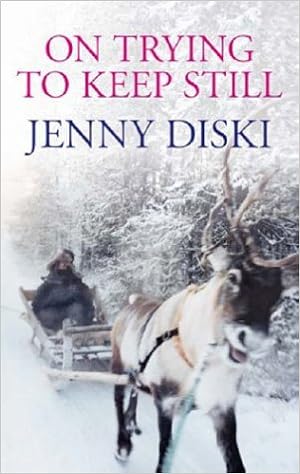
On Trying to Keep Still by Jenny Diski this book is a personal memoir about being still, being alone, wanting to be alone, phobias and the problems of coping with life and especially with ageing. It’s about experiencing an experience, becoming aware of experiencing the experience and so losing the experience.

She visited New Zealand, spent two months almost alone in a cottage in the country in Somerset and visited the Sámi people of Lapland.  She described her adventures in places at the opposite ends of the earth intermingled with personal insights and meditations on solitude and stillness, consciousness and belief systems. I found it a moving, amusing, thought-provoking and original book. It was my favourite book of the whole year!

Jenny Diski, who died in April this year was a prolific author of fiction, memoir and essays for whom no subject was taboo.

2008

Messenger of Truth: (the 4th Maisie Dobbs book) by Jacqueline Winspear, a detective story set in 1930/1 in England. The artist Nick Bassington-Hope has fallen to his death from the scaffolding whilst installing his work at an art gallery. The police believe it is an accident, but his twin sister Georgina isn’t convinced and hires Maisie Dobbs to investigate his death. Along with Nick’s death there is also the mystery of the missing piece of art work that was to be the centre of the exhibition.

Set in the  period, between the two World Wars, it reflects the great divide between the wealthy and the poor at that time. The lingering effects of the war are starkly and shockingly described in Georgina’s reminiscences about the treatment during the war of men suffering from shell-shock. An immensely satisfying read that I really enjoyed.

2009

A Judgement in Stone by Ruth Rendell: A Judgement In Stone portrays Eunice, an illiterate woman and a psychopath who does anything to stop anyone from finding out that she can’t read or write.  The opening sentences reveal that she killed her employers, the Coverdales. So, you know that the murder is going to happen and as  the reasons why it happens become clear, the tension builds relentlessly. Without doubt this is a disturbing and a scary book and in my opinion one of Ruth Rendell’s best books.

2010

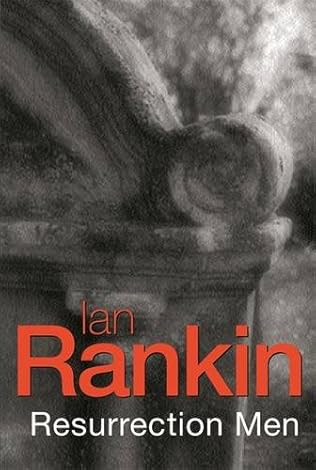
Resurrection Menbook cover of Resurrection Men by Ian Rankin: the thirteenth Inspector Rebus novel. This isn’t about body-snatchers (as I wondered it might be), but about the cops who need re-training, including Rebus. They’re at Tullialian, the Scottish Police College and they are a tough bunch.  To help them become team players ‘“ fat chance of that I thought ‘“ they’ve been given an old, unsolved case to work on. But Rebus was involved in the case at the time and begins to get paranoid about why he is on the course. It’s a tough, gritty story  with more than one story line. An excellent book.

I’ve really enjoyed all the Rebus books and am looking forward to the next one, the 21st, Rather Be the Devil, to be published on 3 November.

The Agatha Christie Blogathon

Agatha Christie blogathon

Little Bits of Classics and and Christina Wehner are running the Agatha Christie Blogathon during the weekend of September 16th-18th in honour of Agatha Christie’s 126th birthday on the 15th of September.

All things Agatha Christie are welcome – about her life, her writing style, her characters, her books, the movie adaptations of her books, tributes, retrospections ‘“ the more the better! Check out Christina’s blog to find out more!

Each day of the blogathon is dedicated to a different topic:

  • Friday the 16th ‘“ all things Hercule Poirot
  • Saturday the 17th ‘“ all things Miss Marple
  • Sunday the 18th ‘“ all the rest, including Agatha Christie or any other novels or movies not related to Poirot or Miss Marple.

I’m planning to write about some of Agatha Christie’s short stories.


TBR Snapshot

I found this idea on Brona’s Books – it’s TBR Snapshot a way of drawing my attention to my TBR books -, where you make piles of your books that spell out words. I like making lists/piles of books – there are piles around me as I type, and on the floor. So, here’s my first pile, spelling out my name in the titles:

Margaret in bk titlesI’ve had six of these books for years, so some are books I’d forgotten I owned (hangs head in shame), whereas three of them are books I’ve added this year and they are clamouring to be read very soon. But I shall probably start with Moon Tiger as that is also on my list of 20 books of Summer.

What do you think – would you recommend that I read any of these sooner than the others or are there some that I shouldn’t bother reading?

Brona is wondering whether other people would join in – as I have plenty of TBRs I would. In fact I have another pile of books with titles spelling out my blog’s name. Anyone else interested – pop over to Brona’s Books and let her know.