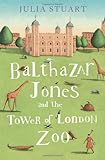
Balthazar Jones and the Tower of London Zoo by Julia Stuart

It’s been a while (2010) since I bought Balthazar Jones and the Tower of London Zoo and I was pleased when I finally got round to reading it to find that I enjoyed this quirky book, at times comical and at times poignant. It’s a mix of historical facts and odd characters, set in the present day at the Tower of London, but with a strangely old-fashioned feel to it. It’s the story of Beefeater Balthazar Jones and his wife Hebe, who live in the Salt Tower. Hebe works at London Underground’s Lost Property Office, full of weird and wonderful things.

It begins:

Standing on the battlements in his pyjamas, Balthazar Jones looked out across the Thames where Henry III’s polar bear had once fished for salmon while tied to a rope. The Beefeater failed to notice the cold that pierced his dressing gown with deadly precision, or the wretched damp that crept round his ankles. Placing his frozen hands on the ancient parapet, he tilted his head back, and inhaled the night. There it was again.

The undeniable aroma had fluttered past his capacious nostrils several hours earlier as he lay sleeping in the Tower of London, his home for the last eight years.

The Queen has decided that all the animals that have been given to her as gifts are to be moved from London Zoo to the Tower of London. This wasn’t a new idea as the ‘man from the palace’ explained to Balthazar Jones that animals had been kept at the Tower from the 13th century until the 1830s and the menagerie had been an immensely popular tourist attraction. The Queen is anxious not to offend the foreign rulers who have sent her the exotic animals and Balthazar, a collector of rare raindrops and the owner of a very ancient tortoise, is charged with taking care of them in the new royal menagerie at the Tower.

The supporting characters include the Reverend Septimus Drew, who writes erotica under the pen name Vivienne Ventress – he is in love, although he can’t bring himself to tell her, with Ruby Dore, the landlady of the Tower tavern, the Rack and Ruin, whose canary refuses to sing. There are the other Beefeaters, the Chief Yeoman Warder and the Ravenmaster who hates the intrusion of the Queen’s animals, which include an Etruscan shrew, a Komodo dragon, howler monkeys and a King of Saxony bird of paradise.

It’s not all eccentric characters and bizarre situations, there’s love and sorrow intermingled. Balthazar and Hebe had a son, Milo who died young and they are both still mourning his death. Balthazar, though is tormented by a terrible secret, which he can’t reveal to Hebe. Since Milo’s death they have drifted apart and Balthazar is devastated when Hebe leaves him. Will they get back together?  What is his secret and will he tell Hebe?

By the end of this book I was thoroughly absorbed into the world of the Tower of London, with all the irritations of living within circular walls, and the Lost Property Office of London’s Underground, where strange things were left such as a magician’s box used to saw glamorous assistants in two and a wooden box containing the remains of Clementine Perkins.  And, I wonder, do all the Beefeaters really have a ‘ruthless specimen of fungus that flourished on the back of their knees‘ as a result of the rain and ‘the damp from their abominable lodgings.‘?
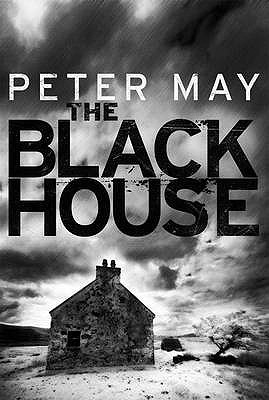
The Blackhouse by Peter May

I first became aware of Peter May’s books when I saw The Lewis Man in a bookshop when we were on holiday in Glencoe last September. I was drawn to it because of its title and its historical reference – a man found buried in a peat bog on the Isle of Lewis. But when I realised that it was the second in a trilogy I decided to read the first book first and it’s only been in these last few weeks that I’ve borrowed The Blackhouse from the library and read it.

The Blackhouse (Lewis Trilogy, #1)

As I was reading The Blackhouse I wasn’t sure how to categorise it. There’s a murder and a mystery, an investigation by the police, but most of the book is not really a detective story, or a police procedural. It’s very slow reading and I had to lower my expectations of getting to grips with solving the murder mystery, because that is not the main element of this book and actually it’s not too difficult to work out who the murderer is.

I liked it very much, although I nearly stopped reading when I got to the description of the post mortem – I don’t like gruesome! It was a particularly brutal killing. But I’m glad I carried on and settled into the rhythm of the book. I loved the dramatic setting on the Isle of Lewis in the Outer Hebrides and wished this book had a map as the geography of the island plays an important part in the story (I see the last book in the trilogy, The Chessmen, does have a map!). But Peter May’s descriptions convey the atmosphere and bring the scenes to life beautifully and vividly.

Detective Fin Macleod is seconded from the Edinburgh police force to help with the investigation into the murder in the village of Crobost on Lewis because it bears a resemblance to a similar murder in Edinburgh and Fin was born and brought up on Lewis, so he knows the people and speaks Gaelic. As the story unfolds, the narrative splits in two – one, set in the present day, follows the murder investigation (told in the third person) and the other, (told in the first person) as Fin recalls the events of his childhood and remembers his friends – some of whom are still living on Lewis. These include his best friend, Artair, his first girlfriend, Marsaili and the school bully (and murder victim) Angus Macritichie, known as Angel.

Fin’s memories are not all happy ones and include the time he took part in the traditional annual two week trip to An Sgeir, the rock fifty miles north-north-east of Lewis to harvest the guga, or young gannets. Twelve men from Crobost still carried on the four hundred year tradition, living rough on the rock, clambering over the cliffs to snare and kill the young birds. It’s in passages like these, that are vital to the plot and yet seemingly buried in Fin’s mind, that May excels.

The book gathers pace as it reaches its conclusion, in comparison to the almost leisurely story-telling of the earlier sections, as the drama and tension increase. Fin not only uncovers the identity of the murderer but also discovers things about himself either that he hadn’t known before or had buried deep within his mind. Things that turn his world upside down for ever.

I liked it so much that almost immediately I began The Lewis Man, which so far is equally as good.

After Flodden by Rosemary Goring

This year is the 500th anniversary of the Battle of Flodden between the forces of James IV of Scotland and Henry VIII of England. After Flodden by Rosemary Goring is the dramatic story of what happened after the battle on 9 September 1513. Well written, well researched this is a compelling and powerful book, bringing the characters and the Edinburgh and Borders of 1513 vividly to life. Once I started reading the book I didn’t want to stop. I read it quickly, devouring the pages, completely involved in this dramatic story.

I was swept away with the action, re-living the scenes through Rosemary Goring’s vivid descriptions €“ the court at Edinburgh, the wild Borderlands, the violence of the battle scenes and the interaction between the characters. It’s a brilliant book.

Louise Brenier is determined to find out what happened to her missing brother Benoit, was he killed in action, or was he captured? Interspersed with the story of Louise’s search for Benoit Brenier, her brother, are flashbacks to the Battle as the two sides gathered together and engaged in warfare, the political intrigue and danger always present.

There is Patrick Paniter, James’s secretary and right-hand man – full of remorse at the death of his king, and tormented by memories he would rather keep buried. Louise appeals to him for help, and when he tells her that Benoit must either be dead or a prisoner she sets off to search for him. Soon Gabriel, Viscount Torrance, a courtier and advisor to Paniter, joins her in her search, which takes them deep into the Border country, the stronghold of the Crozier clan and the retribution that Thomas Dacre, the Lord-Warden of the English Marches has vowed to impose.

After Flodden is due out in June 2013. I read an Advance Proof Copy supplied by Lovereading.co.uk.

FF monumentI’ve written about Flodden Field before, after our first visit to the Flodden Monument. The monument was erected in 1910 at the place where it was then thought that James IV fell in battle. However, more recent opinion is that this happened further south of the village, in the shallow valley close to the road at the foot of Branxton Hill.

There is a programme of events to commemorate this battle that led to the death of 15,000 Scots and English soldiers, 100 noblemen and the Scottish King, James IV. For more information about the battle and the Ecomuseum go to Flodden 1513. As the website explains the Ecomuseum links ‘together 12 sites from across north Northumberland, the Scottish Borders and Edinburgh, which have an intimate connection with the story of Flodden. These sites are all existing attractions, where access and interpretation are already available. They include churches, bridges, castles, museums and of course the battlefield itself.

Also have a look at Remembering Flodden 1513 – 2013, where the Stop Press News is that the One Show on BBC1 is featuring Flodden on Tuesday 30th May at 7pm – showing presenter and historian Dan Snow’s visit to the battlefield and castles of the borderlands.

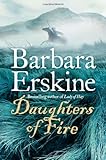
Daughters of Fire by Barbara Erskine

Daughters of Fire is historical time-slip fiction switching between the present day and the first century CE Britannia, a mix of historical fiction, fantasy and romance.  It was with relief that I finished reading it – relief, because although the story of Cartimandua, Queen of the Brigantes tribe is fascinating and that of historian Viv Lloyd Rees is initially interesting, the book is too long, and too wordy.

Daughters of Fire intermingles two stories, that of  Viv and Cartimandua. Viv has published a book on Cartimandua, a book using alternative as well as traditional historical sources – ie using legends, her dreams and visions as well as the writings of Roman historians. She has ‘borrowed’ an ancient cursed brooch from her boss, Professor Hugh Graham, who has criticised her book as fantasy. The rest of her story is their obsession with and struggle to gain control of the brooch.

Cartimandua, back in the first century is beset by enemies on all sides, Romans and  the leaders of the other tribes. It all goes from bad to worse when she betrays Caradoc (Caractacus), the leader of the Catuvellauni tribe, who led the tribes in resisting the Roman invaders and hands him over in chains to the Romans.

For me the essential story was good, but lost impact as it dragged on, drowned in words and by the repetition of the struggles between the characters. Because of this the ending was drained of any impact and suspense for me. I like time-slip stories, the supernatural and the paranormal, so that wasn’t a problem. And I liked the sections explaining Celtic beliefs – their belief in the immortality of the soul, in reincarnations and transmigration of the soul. As one of the characters said:

Remember the world he lived in was an animistic, rainbow world of links and connections which included vast echelons of spirits and gods and ancestors, people dead and people yet to be born, all of whom could be summoned to his aid. (page 258)

In the Author’s Note, Barbara Erskine emphasises that this is above all fiction:

In the absence of written information one has to make do with imagination, dreams and deductive techniques of a dubious nature! … (page 562)

and regarding Cartimandua:

We don’t know her tribe, or if she had children, and although far more is known about her life than that of he much more famous contemporary, Boudicca, she is still an enigma.

So, for all that is historically known about Cartimandua I refer the reader to the Roman historians.

For the truth of her life we must consult archaeology and the oracles.

The rest is silence. (page 562)

A couple of years ago I read Barbara Erskine’s book, The Warrior Princess, another time-slip book, which I also thought was too drawn out and would have been better if the plotting had been tighter. I own one more of her books, which I’ve yet to read – Sands of Time, a collection of short stories, described on the back cover as ‘spine-tingling‘ tales all with ‘a touch of the unexpected … suspense, romance, passion, unexpected echoes of the past.’ I hope, because these are short stories, they will be more succinct than the two books I have read.

This book qualifies for several challenges – Mount To-Be-Read 2013 (it’s been on my shelves for about 4 years), The Historical Fiction Reading ChallengeWhat’s in a Name 6 (in the Fire category) and Once Upon a Time VII (Fantasy).

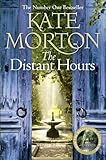
The Distant Hours by Kate Morton

I was hoping that The Distant Hours, Kate Morton’s third book would be as good as the first,The House at Riverton, which I loved. I’ve read her second book The Forgotten Garden, which disappointed me, because it was predictable and I thought it was a re-working of Frances Hodgson Burnett’s book, The Secret Garden. However, I think The Distant Hours is the least satisfying, which is a shame as it promised to be so good at the beginning and the story itself is fascinating …

A dilapidated castle, aristocratic twins, a troubled sister and a series of dark secrets cast a whispery spell … (from the back cover)

It begins with a creepy tale, The True History of the Mud Man, a children’s story written by Raymond Blythe, the owner of the castle. It begins:

Hush – Can you hear him?

The trees can. They are the first to know that he is coming.

Listen! The trees of the deep, dark wood, shivering and jittering their leaves like papery hulls of beaten silver; the sly wind, snaking through their tops, whispering that it will soon begin.

The trees know, for they are old and have seen it all before.

A tale which haunts the book. The dark secrets begin to surface when Edie Burchill’s mother receives a long-lost letter written fifty years earlier from one of the sisters at Milderhust Castle. Edie is intrigued but her mother is reluctant to talk about it and about the time that she was an evacuee at the castle during the war.

The story slips backwards and forwards in time between the 1990s and the Second World War and the characters and the descriptions of the settings are fine – up to a point. But the book moves at a snail’s pace over its 670 pages. There is just too much unnecessary detail, about things on the periphery that never go anywhere. There is so much that it stifles the narrative and the heartaches, betrayals and tragedies become a catalogue of events. I just wasn’t involved. But this is still an enjoyable book, if over long and not as good as her earlier books.

Mrs McGinty's Dead by Agatha Christie

Mrs McGinty 001

I think Agatha Christie enjoyed herself writing Mrs McGinty’s Dead, especially the character of the crime novelist, Ariadne Oliver. It was first published in 1952 and written not long after the end of the Second World War, reflecting the difficulties of finding employment and the changes for the post-war impoverished middle classes.

Hercule Poirot is rather bored, missing his friend Hastings and finding that his days are revolving around his meals: ‘One can only eat three times a day. And in between there are gaps.’ Even a newspaper report about the result of the McGinty trial doesn’t interest him: ‘It had not been an interesting murder. Some wretched old woman knocked on the head for a few pounds. All part of the senseless brutality of these days.

It is only when Superintendent Spence comes to him for help, convinced of the innocence of James Bentley, convicted of the murder and under sentence of death that Poirot agrees to reinvestigate the case. And so it is that he goes to the village of Broadhinny, treating it as a ‘challenge to the little grey cells of my brain.’

He investigates in his usual way, with method and logic, first of all by considering the motive and then looking at the characters of Mrs McGinty and James Bradley. He decides that the answer is to be found in the personality of the murderer.There is a sense of urgency, as the death penalty was still in force and there is little time left before James Bentley is due to be hanged. Poirot talks to Mrs McGinty’s neighbours and the people she worked for as a charlady and eventually solves the mystery, but not without a second murder and nearly getting killed himself.

It’s a lively book, the characters and dialogue moving the plot along smoothly. There are plenty of surprises and a lot of misdirection before the killer is revealed. The clues are all there and although I did pick up on the main clue, I picked the wrong person as the murderer.

As always, for me, there is more to the book than the puzzle of the murders, and in Mrs McGinty’s Dead there are several things, including the view Agatha Christie paints of life in an English village not long after the war (usually the setting for a Miss Marple mystery), the mix of characters, working class and middle class, the very amusing picture of the dreadful Bed and Breakfast, run by Major Summerhayes and his wife, Maureen, where Poirot stays in Broadhinny, and then there is Ariadne Oliver.

In portraying Ariadne I think Agatha Christie is revealing her feelings about writing about Poirot, a character she described in her Autobiography as ‘hanging round my neck, firmly attached there like the old man of the sea.’ Ariadne’s detective is a Finn, Sven Hjerson and she has been writing about him for thirty years:

 How do I know why I ever thought of the revolting man? Why a Finn when I know nothing about Finland? Why a vegetarian? Why all the  idiotic mannerisms he’s got? …

And people even write and say how fond of him you must be. Fond of him? If I met that bony, gangling, vegetable-eating Finn in real life, I’d do a better murder than any I’ve invented. (page 201)

She also reveals her feelings about playwrights adapting her plays (and about money for her books!):

So far it’s pure agony. Why I ever let myself in for it I don’t know. My books bring me quite enough money – that is to say the bloodsuckers take most of it, and if I made more, they’d take more. But you have no idea of the agony of having your characters taken and made to say things that they never would have said, and do things that they never would have done. And if you protest, all they say is that it’s “good theatre”. (page 125)

She also wrote in her Autobiography about the ‘terrible suffering you go through with plays, owing to the alterations made in them.'(page 448). I find it reassuring that she didn’t like the way dramatisations changed her books, because I don’t either, although I do like David Suchet as Poirot and Joan Hickson as Miss Marple.

There are references to real life murder cases. On the Sunday before her death, Mrs McGinty had been reading the Sunday Comet, which had an article on women victims of tragedies from the past. Poirot looks at these in detail, concluding that one of the women might have been in Broadhinny when the murder took place.

A short while ago I wrote a guest post for Alyce’s blog At Home With Books about the best and the worst of Agatha Christie’s works. Trying to decide between her numerous novels which one is the best is an impossible task, but I think that Mrs McGinty’s Dead is up there amongst the best of them.