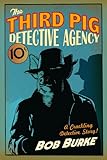
The Third Pig Detective Agency by Bob Burke

Reading The Third Pig Detective Agency by Bob Burke was a complete change of genre for me. It’s funny, a bit silly, a pastiche of American gumshoe crime fiction, and a fantasy  – indeed it’s a fairytale detective story. I did enjoy recognising all the fairy tale characters Bob Burke throws into the mix.

The Third Pig is Harry Pigg, who in his own words:

was the pig that built the house out of bricks while my idiot brothers took the easy route and went for cowboy builders and cheap materials.

Following his success at defeating the Big Bad Wolf, Harry became a detective, finding the two missing kids Hansel and Gretel and then identifying them as the murderers of the little old lady who lived in the gingerbread house.

But work for Harry had almost dried up, so when ‘an oriental gentleman the size and shape of a zeppelin‘, or in other words, Aladdin, the richest man in Grimmtown, accompanied by a sturdy white goat, none other than the eldest of the Gruff Brothers, demands his services, Harry can’t turn him down. Aladdin’s lamp had been stolen, an old battered lamp that he had kept under close guard, protected by hi-tech security and surveillance systems and Harry has to get it back for him. And so Harry sets out in pursuit of the lamp, aided or hindered by numerous characters, finding himself in all sorts of tricky and dangerous situations.

It’s a case of spot the characters from fairy tales and nursery rhymes and it’s most entertaining. Boy Blue, that lazy former shepherd tells Harry the lamp is rumoured to be a magic lamp, but Harry hates magic:

As a working detective it’s bad enough running the risk of being beaten up or thrown into a river with concrete boots on, without having to live with the possibility of being changed into a dung beetle or having a plague of boils inflicted on you. If you think humans were disgusting covered in boils, imagine how I might look.

And Harry just couldn’t have survived without the help of his Apprentice Gumshoe, Jack Horner, who rescues him several times.

There is no doubt that I’ll be reading more of Bob Burke’s books. the next one is The Ho Ho Ho Mystery which starts where The Third Pig Detective Agency ended when a very large lady dressed in black boots, bright red trousers and a hooded jacket came to see Harry and announced:

I need you to find my husband. He’s been kidnapped and it’s only two days to 25th December. If he’s not found soon we may have to cancel Christmas.

Carl’s Once Upon a Time VII challenge is coming to an end soon (21 June) and this is the fourth book I’ve finished. I may make five (my target for the challenge).

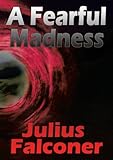
A Fearful Madness

I received A Fearful Madness by Julius Falconer as a free review copy through LibraryThing. I hadn’t come across any of Falconer’s books before but the LibraryThing Early Reviewers’ description interested me enough to request a copy:

A police investigation into the violent death of a part-time cathedral verger stalls for lack of incriminating evidence. However, three people have a close interest in clearing the matter up where the police have failed: the dead man’s sister, anxious to see justice done, and two of the police suspects, both released without charge but keen to clear their names.

Striking out on their own, each approaches the murder from a different perspective: book-trafficking on the black market; revenge by an extremist religious organisation for the dead man’s betrayal of them; and retaliation in a case of blackmail. The police continue to maintain that the murder was committed out of sexual anger, even though they have no proof apart from the circumstances of the verger’s death.

Eventually DI Moat and his assistant DS Stockwell, from the North Yorkshire Force, take a hand. Moat pays his predecessors in the investigation, both professional and amateur, the compliment of taking their findings seriously – but comes up with an idea of his own.

My view:

Julius Falconer uses language in a more formal way than many other modern authors. His sentences are carefully punctuated, his vocabulary is extensive (meaning there are some words I had to check in the dictionary – and one or two weren’t in my dictionary) and he uses many literary references and illusions. I like his style of writing, although in parts it does tend to be long-winded.

It’s a complex book, following each of the three investigations – some of which seem highly unlikely, but then they do say that truth is stranger than fiction.Two people had been suspected of murdering James Thwaites, the verger, but the police were unable to produce any evidence and the cases against them were dropped. It appeared he had been stealing rare and valuable books from the cathedral and selling them on the black market. I was intrigued by the book-trafficking business which on the one hand was highly organised involving the use of white van drivers, and on the other seemed remarkably lax!

A bearded man was seen outside Thwaites’s house on the evening of the murder and Matthias Biddulph, one of the original suspects, who had been in a relationship with Thwaites hires a private investigator to find him. Another possible motive for the murder is Thwaites’s involvement with an eccentric version of Christianity – the Anti-Church of Jesus Christ, set up in opposition to the Anglican Church, which his sister Serenity investigates.

For the most part, I rather enjoyed reading A Fearful Madness, although I had little idea how it would end – the verger’s will is of significance, but that only features towards the end of the book (unless I missed an earlier reference). I think this is possibly the weakest part of the book when the culprit confesses to the murder. Having said that, I liked it well enough to read more of Falconer’s books and have downloaded Jagger onto my Kindle.

Julius Falconer has written several books. Formerly, a teacher, he began writing detective novels in 2009. His website, with the sub-tile of Erudite Crime Novels for the Connoisseur,  includes details of his books and an account of The Falconer Style.

the letter JThis is my contribution to Kerrie’s Crime Fiction Alphabet for the letter J. In previous years I’ve contributed to the meme for each letter of the alphabet, but for this series I’m joining in only occasionally.

Cards on the Table by Agatha Christie

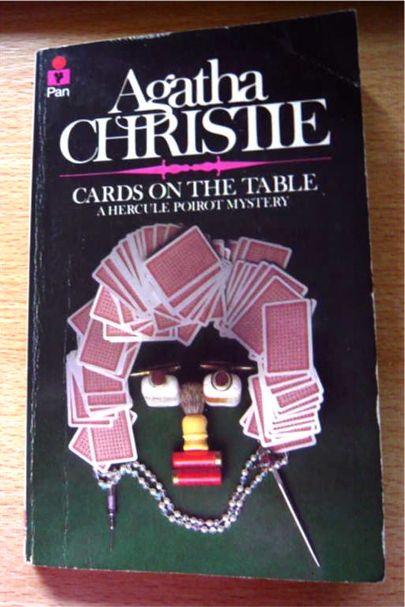
I think Cards on the Table is one of the best of Agatha Christie’s books. It was first published in 1936 and has been reprinted many times since then. My copy is a Pan Books edition published in 1951 with this cover:

Cards on the Table

From the back cover:

Mr Shaitana is a collector. He collects snuff boxes, Egyptian antiquities … and … murderers.

His murderers are of the very finest. Not the second rate individuals who are caught and convicted. Delighting in his role as a modern Mephistopheles, Shaitana gathers his four murderers for an evening of cards.

Before the evening ends, Mr Shaitana will himself be a murder victim. How very fortunate that he invited a fifth guest to his gathering, M. Hercule Poirot.

One of the things that pleased me about this book is Agatha Christie’s Foreword in which she states that it is not the sort of detective story where the least likely person is the one to have committed the crime. This story has just four suspects and any one of them ‘given the right circumstances‘ might have committed the crime. She goes on to explain that there are four distinct types, the motives are peculiar to each person and each would employ a different method. She concludes:

The deduction must, therefore, be entirely psychological, but it is none the less interesting for that, because when all is said and done it is the mind of the murderer that is of supreme interest.

All of which suits Poirot down to the ground as he considers the psychology of each of the four suspects, Dr Roberts, a very popular doctor who may have killed a patient or two, Mrs Lorimer, a first-class bridge player and a widow who husband died under suspicious circumstances, Major Despard, a daring character, an explorer who possibly killed a botanist whilst on an expedition up the Amazon, and Anne Meredith, a young woman, a timid and careful bridge player, who may have poisoned her employer.

Poirot is not on his own, also at the bridge party were Superintendent Battle, a stolid officer from Scotland Yard (he first appeared in The Secret of Chimneys), Colonel Race, a Secret Service agent (he first appeared in The Man in the Brown Suit), and Mrs Ariadne Oliver, writer of popular detective fiction, (meeting Poirot for the first time). It helps if you can play bridge to understand  how Poirot uncovered the murderer, but it’s not necessary – I managed with just a minimal memory of the card game, and it all hinges on the psychology of the characters anyway.

As Ariadne Oliver is used by Agatha Christie to convey some of her own opinions I wondered whether this description of her physical appearance was how she viewed herself:

… she was an agreeable woman of middle age, handsome in a rather untidy fashion with fine eyes, substantial shoulders and a large quantity of rebellious grey hair with which she was continually experimenting. One day her appearance would be highly intellectual – a brow with the hair scraped back from it and coiled in a large bun in the neck – on another Mrs Oliver would suddenly appear with Madonna loops, or large masses of slightly untidy curls. On this particular evening Mrs Oliver was trying out a fringe. (page 13)

I think there is no doubt that Ariadne’s views on writing and on the character of her detective are Agatha Christie’s own views. For ‘Finn’ in the extract quoted below read ‘Belgian’:

… I regret only one thing – making my detective a Finn. I don’t really know anything about Finns and I’m always getting letters from Finland pointing out something impossible that he’s said or done. (page 55)

And this must be from her own experience too:

I’m always getting tangled up in horticulture and things like that. People write to me and say I’ve got the wrong flowers all out together. As though it mattered – and, anyway, they are all out together in a London shop. (page 110)

And this about writing?:

One actually has to think, you know. And thinking is always a bore. And you have to plan things. And then one gets stuck every now and then, and you feel you’ll never get out of the mess – but you do! Writing’s not particularly enjoyable. It’s hard work, like everything else. …

Some days I can only keep going by repeating over and over to myself the amount of money I might get for my next serial rights. That spurs me on, you know. So does your bank-book when you see how much overdrawn you are. …

‘I can always think about things,’ said Mrs Oliver happily. ‘What is so tiring is writing them down. I always think I’ve finished, and then when I count up I find I’ve only written thirty thousand words instead of sixty thousand, and so then I have to throw in another murder and get the heroine kidnapped again. It’s all very boring.’ (pages 110 – 111)

But back to the mystery, Mr Shaitana is murdered whilst his guests are playing bridge. Two games were set up – one made up of the four people he considered were murderers and the other in a separate room made up of the four detectives or investigators of crime. Mr Shaitana sat by the fire in the room with the murderers. When the four detectives finished their game they return to the other room where they find the game still in progress and Mr Shaitana still sitting by the fire – stabbed in the chest with an ornamental dagger.

What follows is that each detective carries out their own investigations and as I read I swung from one suspect to the other, but I was never really sure who the culprit was. Poirot is his usual brilliant self even though at one point he is astonished and upset at the possibility that he might be wrong:

‘Always I am right. It is so invariable that it startles me. But now it looks as though I am wrong. And that upsets me. (page 163)

But was he wrong?

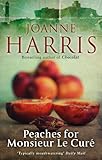
Peaches for Monsieur Le Curé by Joanne Harris

After I finished reading The Lollipop Shoes by Joanne Harris I was in two minds about reading her next book about Vianne Rocher Peaches for Monsieur Le Curé, but as I’d reserved it from the library and spurred on by other reviews I decided to read it. I was hoping I would like it more than The Lollipop Shoes.

From the book jacket:

When Vianne Rocher receives a letter from beyond the grave, she has no choice but to follow the wind that blows her back to the village in south-west France where, eight years ago, she opened up a chocolate shop. But Vianne is completely unprepared for what she finds there.Women veiled in black, the scent of spices and peppermint tea, and there, on the bank of the river Tannes, facing the square little tower of the church of Saint-Jerome, like a piece on a chessboard – slender, bone-white and crowned with a silver crescent moon – a minaret.

 Nor is it only the incomers from North Africa that have brought big changes to the community. Father Reynaud, Vianne’s erstwhile adversary, is now disgraced and under threat. Could it be that Vianne is the only one who can save him?

My view:

Peaches for Monsieur Le Curé is a diluted version of Chocolat; it is too long and drawn out for the story line. It’s told from two viewpoints, that of Vianne and Father Reynaud, but I found that this resulted in too much ‘telling’, too much explanation and repetition. This means that the storyline gets padded out with too much detail. It became predictable and I wanted it to end before it actually did. I read on to the end because I wanted to know what happened. Although I hadn’t foreseen the detail I had foreseen the end.

I should like it more than I did, because it is so similar to Chocolat, covering many of the same themes: fear of the outsider, religious conflict, intolerance and prejudice, with issues of gender and race. It’s also about how people interact and how their lives intersect and above all about the importance of communication, love, and understanding and respecting the others’ point of view. But, the magic is missing for me.

The Lollipop Shoes by Joanne Harris

ChocolatI read Chocolat by Joanne Harris in 2008 and loved it. Here’s an extract from my post at that time.

It’s the story about Vianne Rocher who arrives in Lansquenet-sous-Tannes, a place that is’ no more than a blip on the fast road between Toulouse and Bordeaux’ on Shrove Tuesday. She takes over the old bakery and transforms it into La Celeste Praline Chocolaterie Artisanale €“ in other words the most enticing, the most delicious and sensuous Chocolaterie, selling not only all sorts and types of chocolate treats but delicious chocolate drinks. Together with Anouk her daughter and Anouk’s imaginary friend Pantoufle the rabbit, she also transforms everyone’s life along the way.

It’s not just a story about a chocolaterie – it’s about fear of the outsider, prejudice against ‘these people’ €“ immigrants, vagrants, and gypsies; bigotry; fear of death, old age and illness; and fear that the Church will lose its purity and that the community will be corrupted by liberal and heretic beliefs. It’s also about how so many lives intersect and interact and above all about the importance of love and understanding in everyone’s life.

So, I had high expectations about the next two books about Vianne Rocher – The Lollipop Shoes (in the US this is published as The Girl With No Shadow) and Peaches for Monsieur Le Curé (in the US – Peaches for Father Francis). Maybe my expectations were too high because I was disappointed – neither book is as good, or as enchanting as Chocolat.

The Lollipop Shoes continues Vianne’s story four years later in Paris with Anouk and a second daughter Rosette. Blown there by the wind, Vianne now goes by the name of Yanne Charbonneau and Anouk, now eleven years old, is known as Annie. Rosette who is nearly four years old has an imaginary friend, a monkey called Bam. Yanne is now trying to live a ‘normal’ life, without using magic, trying to fit in with the people around them. However, her efforts are disrupted by the arrival of Zozie de l’Alba, the young lady with the shiny red shoes – the ‘lollipop’ shoes, Annie calls them. Zozie has no scruples and doesn’t hesitate to practise her own kind of magic, bewitching Annie with her spells and the power of her mind. Zozie’s magic though, is dark magic, evil and dangerous. She’s a stealer of lives and plans to take Vianne’s identity and make Annie her own.

As in Lansquenet-sous-Tannes, Yanne is living above a chocolaterie. This one in Montmarre is owned by Thierry le Tresset, ‘fifty-one; divorced, one son, a churchgoer, a man of rock’. He wants to marry Yanne, but she isn’t sure. Annie is having problems at school, fitting in with the other children and Rosette is a child living very much in her own world, she hardly speaks and communicates by signs. Is Bam just an imaginary friend or is there more to him?

This is really a story about good versus evil and where Chocolat was about the power of love, The Lollipop Shoes is about the strength and destructive power of evil. But there is something missing, there is no sparkle; it’s flat. The story is narrated by Annie, Zozie and Yanne and sometimes I found it difficult to decide which character was the narrator, and had to check the little symbol at the beginning of each chapter. Maybe it’s just me, because other people have really enjoyed this book – there are lots of 4 and 5 stars on both Goodreads and Amazon.

This book qualifies for two challenges – Mount To-Be-Read 2013 and Once Upon a Time VII (Fantasy).

Murder in the Mews by Agatha Christie

I don’t usually find short stories as satisfying as novels, but the stories in Murder in the Mews are good, mainly, I think, because with one exception they are novellas, longer than the average short stories. The collection was first published in 1937.

There are four stories about crimes solved by Hercule Poirot:

  •  Murder in the Mews – at first it looks as though a young widow, Mrs Allen has committed suicide, but as the doctor pointed out the pistol is in her right hand and the wound was close to her head just above the left ear, so it’s obvious that someone else shot her and tried to make it look like suicide. The plot is tightly constructed, with a few red herrings to misguide Poirot and Inspector Japp and a moral question at the end. The book begins on Guy Fawkes Day and I like this conversation between Poirot and Inspector Japp:

(J): ‘Don’t suppose many of those kids really know who Guy Fawkes was.’

(P): ‘And soon, doubtless, there will be confusion of thought. Is it in honour or in execration that on the fifth of November the feux d’artifice are sent up? To blow up an English Parliament, was it a sin or a noble deed?’

Japp chuckled. ‘Some people would say undoubtedly the latter.’ (page 7)


  • The Incredible Theft – Poirot is called in to investigate the theft of top secret plans of a new bomber from the home of a Cabinet Minister, Lord Mayfield, where a number of guests are gathered for a house party: Mrs Vanderlyn is an American siren who had formed friendships with ‘a European party’ (this was written in 1936). Air Marshall Sir George Carrington  wonders why she is there. Lady Julia Carrington, Sir George’s wife is a keen bridge player, who has ‘the most frightful overdraft’ and their son Reggie, fancies the French maid. Also present are Mrs Macatta MP, and Mr Carlile, Lord Mayfield’s private secretary. This is perhaps the weakest story in the collection.
  • Dead Man’s Mirror – a conventional murder mystery. Sir Gervase Chevenix-Gore is found dead in his locked study, shot through the head. The bullet had shattered the mirror on the wall behind his desk. Again it looks like suicide, but the question is why he should kill himself. Poirot considers it’s all wrong psychologically – Sir Gervase was known as The Bold Bad Baronet, with a huge ego, much like Poirot, considering himself to be a man of great importance. This is another story, complicated by family relationships. Things of interest I noted are that Poirot studies the footprints in the garden outside the study, Mr Satterthwaite (seen in later stories) makes an appearance, and on a personal note I wondered if this was Agatha Christie’s cynical view of divorce?

 I can’t see it makes a ha’p’orth of difference who you marry nowadays. Divorce is so easy. If you’re not hitting it off, nothing is easier than to cut the tangle and start again. (page 115)


  • Triangle at Rhodes – although this is the shortest story, not my preferred length, I think this is the best one in the book. It’s similar to her later book Evil Under the Sun in that it is about a love triangle and a crime of passion. Poirot is on holiday in Rhodes and observes the jealousy and passion between two couples as he sits in the sun on the beach. He foresees trouble ahead and is worried as he traces a triangle in the sand. There aren’t many people on holiday there and he wonders if he is imagining things , reproaching himself for being ‘crime-minded‘. But he is not wrong and Valentine Chantry, a famous beauty, married to a commander in the navy, a strong, silent man, is murdered.

These stories demonstrate some of Agatha Christie’s plot elements and endings – the locked room murder, the murderer conceals the motive, Poirot foresees murder, the clues (often odd clues) are there hidden or in plain sight, there are red herrings and bluffs, chance remarks that have significance, and the final denouement, explaining the solution to the mystery.