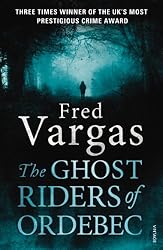
The Ghost Riders of Ordebec by Fred Vargas

I really enjoyed The Ghost Riders of Ordebec. It’s full of  eccentric and quirky characters, an intriguing mystery beginning with the death of an old woman, killed with breadcrumbs, then a car is burnt out with someone inside, and a pigeon is found with its legs tied together so it can’t fly.

But the main mystery Commissaire* Adamsberg has to solve is the strange tale a woman from Ordebec, a little village in Normandy, presents to him.

Blurb:

‘People will die,’ says the panic-stricken woman outside police headquarters.

She refuses to speak to anyone besides Commissaire Adamsberg. Her daughter has seen a vision: ghostly horsemen who target the most nefarious characters in Normandy. Since the middle ages there have been stories of murderers, rapists, those with serious crimes on their conscience, meeting a grisly end following a visitation by the riders.

Soon after the young woman’s vision a notoriously vicious and cruel man disappears. Although the case is far outside his jurisdiction, Adamsberg agrees to investigate the strange happenings in a village terrorised by wild rumours and ancient feuds.

My thoughts:

This is the 8th book in Fred Vargas’ series of Commissaire Adamsberg books. I’ve previously read two, so I’ve a bit of catching up to do. But although there are obviously events that I don’t know about (the appearance of a son, aged 28, that he hadn’t known about, for one thing) this doesn’t detract from the story. I loved all the strange characters – not just the odd people living in Ordebec, but also Adamsberg’s fellow police officers whom he describes as:

 … a hypersomniac who goes to sleep without warning, a zoologist whose speciality is fish, freshwater fish in particular, a woman with bulimia who keeps disappearing in search of food, an old heron who knows a lot of myths and legends, a walking encyclopaedia who drinks white wine non-stop — and the rest to match. (page 67)

And I also loved the medieval myths and legends forming the basis of the plot: the ghostly army that gallops along the Chemin de Bonneval, led by the terrifying Lord Hellequin.

Adamsberg is a thinker ‘ but a vague thinker ‘ he works mainly on intuition, and in this book his intuition and deductive reasoning have to work overtime. I was thoroughly immersed in this book, enjoying the humour as well as the mystery, intrigued to see how the crimes came together and how the pigeon was rescued. It’s original, and maybe not altogether plausible, but most definitely a treat to read.

Fred Vargas is the pseudonym of the French historian, archaeologist and writer Frédérique Audoin-Rouzeau.

*Commissaire is roughly the equivalent of a British Superintendent. His colleagues’ ranks in descending order are commandant, lieutenant and brigadier.

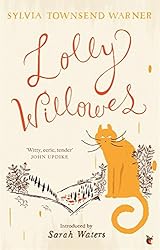
Lolly Willowes by Sylvia Townsend Warner

Lolly Willowes has been on my radar for a few years now and I’ve seen a few other bloggers have been reading it recently – Cath for one at Read Warbler.

From the back cover:

After the death of her adored father, Laura ‘Lolly’ Willowes settles into her role of the ‘indispensable’ maiden aunt of the family, wholly dependent, an unpaid nanny and housekeeper. Two decades pass; the children are grown, and Lolly unexpectedly moves to a village, alone. Here, happy and unfettered, she revels in a new existence, nagged only by the sense of a secret she has yet to discover.

And here is what I thought about it.

Published in 1926, Lolly Willowes is Sylvia Townsend Warner’s first novel. In the Introduction to this edition by Sarah Waters she states that it was an instant hit  with readers and critics and I can see why. On the surface it’s a gentle fantasy, but it’s not at all whimsical, and Sylvia Townsend Warner’s writing is beautiful, lovely lyrical descriptions of both town and country. It’s a book of two parts – the first about Lolly’s existence with her brother’s family in London, where she becomes increasingly disquiet and finds her self indulging in day dreaming about being

‘in the country, at dusk, and alone, and strangely at peace. … Her mind was groping after something that eluded her experience, a something that was shadowy and menacing, yet in some way congenial, a something that lurked in waste places, that was hinted at by the sound of water gurgling through deep channels and by the voices of birds of ill-omen. (page 67)

There’s a bit of a spoiler in this next paragraph.

The second part about her life in the little village of Great Mop, in the Chilterns in the Buckinghamshire countryside is in direct contrast, as she gradually regains the peaceful happy existence she had had growing up. But Great Mop is not just a sleepy backwater because as Laura discovers there are unusual forces at large and she finds herself with her neighbours at a night-time gathering dancing in a continual flux. Her life is changed forever as she meets Satan, who turns out to have a happy relationship with his servants and she enters into a new independence.

So this is a somewhat magical, mystical book and underlying the text is the changing position of women in society in the 1920s,  especially single women financially dependent on their male relatives, who previously were expected to remain within the family looking after elderly relatives, or as in Lolly’s case helping with looking after the children and the running of the household.  In moving away from her family Lolly asserts her independence and enjoys her single life as part of the village community.

So, it’s a book I really enjoyed, for its content, the characters and setting and last but not least Sylvia Townsend Warner’s style of writing. She went on to write more books and poetry, including these novels:

Lolly Willowes (1926)
Mr Fortune’s Maggot (1927)
The True Heart (1929)
This Our Brother (1930)
Summer Will Show (1936)
After the Death of Don Juan (1939)
The Corner That Held Them (1948)
The Barnards of Loseby (1954)
The Flint Anchor (1954)
The Cat’s Cradle (1960)

A Pale View of Hills by Kazuo Ishiguro

This is the cover of my copy of the book

A rather strange book; its ambiguous content left me wondering just what had happened and how to interpret it.

On the surface this is simply the story of a widow, Etsuko living in Britain, as she reminisces about her past life in Japan shortly after the war, living at the edge of the wasteland of Nagasaki. She is haunted by the past and by the suicide of her daughter, Keiko, who was never happy living in Britain. Her younger daughter, Niki, visits her and it is during this visit that Etsuko remembers a friendship she had had briefly with a mysterious woman, Saicho, once wealthy but now reduced to poverty, and her little daughter, Mariko.  Saicho often leaves Mariko to fend for herself, seemingly unconcerned about what she does and where she is, which troubles Etsuko, who is expecting her first daughter who I assume is Keiko.

There are parallels between Saicho and Etsuko. Just as Saicho is hoping to leave Japan with Frank, her American friend, so Etsuko (without her Japanese husband, Jiro; what happened to him is not explained) left Japan to live in Britain with her British husband. Their daughters are disturbed characters, unhappy, solitary and distant from their mothers.

As I read I began to wonder about Etsuko, especially when she says:

Memory, I realize, can be an unreliable thing; often it is heavily coloured by the circumstances in which one remembers, and no doubt this applies to certain of the recollections I have gathered here. (page 156)

To say much more would reveal too much of the story, but when I came to a sentence where the pronoun changes I was even more unsure just what was meant and what actually happened. This is a book I need to re-read in the light of its ambiguity.

However the events play out this is a beautifully written book, describing the countryside around and in Nagasaki after the Second World War, referring to life before the war, and how not only the landscape but also the people and traditions were altered in the aftermath of the atomic bomb. There is an awful lot packed within its 183 pages. It’s a fascinating story of loss, grief, guilt and shame.

A Pale View of Hills is Kazuo Ishiguro’s first novel. It won the 1982 Winifred Holtby Memorial Prize.

Mrs Jordan’s Profession by Claire Tomalin

Mrs. Jordan's Profession: The Actress and the Prince

I loved Mrs Jordan’s Profession: The Story of a Great Actress and a King, Claire Tomalin’s biography of Dora Jordan. It is both well researched and well written making it easy to read despite being packed with information, brilliantly bringing the late 18th and early 19th centuries to life as she tells the story of Dora and her relationship with the Duke of Clarence, later King William IV .  It’s based on material in the Royal Archives at Windsor; letters from Dora held at the Huntingdon Library, San Merino, California; various private family papers, letters and memorabilia, as well as numerous secondary sources from national and local libraries.  The resulting biography took her several years to complete.

Much of the information about Dora is taken from her own letters, written over 25 years, to her children and friends and many hundreds of those to the Duke of Clarence, the father of ten of her children (the FitzClarences) have survived. She was a remarkably strong character and an incomparable actress.

William, the Duke of Clarence and Dora Jordan were born into very different families – born in 1765 he was the third son of George III and Queen Charlotte,  and she was born in 1761, the daughter of Francis and Grace who although not legally married lived together as Mr and Mrs Bland.  He was not expected to succeed to the throne and as a boy served in the navy, later he was given a dukedom, an income and an estate. She became an actress, known as ‘Mrs Jordan’, although there was never a Mr Jordan. She made her stage debut in 1777 at the age of 15 and her first Drury Lane appearance in 1785. The two met and she became his mistress in 1790, eventually living together at Bushy House in Middlesex. Their relationship was a happy one until, as the years went by, William was put under pressure to find a suitable wife and, of course, marriage to Dora was out of the question. They separated in 1811 and she was heart broken.

There is so much in this book that fascinated me. The attacks in the press on their relationship were vicious and there were storms of abuse – as an actress and a prince they could not have private lives and the journalists and cartoonists were savage in their portrayal of the couple. The cartoons in particular amazed me. ‘Jordan’ was a common term for a chamber-pot, so her name came in very handily, and became an instantly recognisable visual symbol:

Sometimes it was put over the Duke’s head; sometimes he was shown standing in it, with her prettily draped round the edge, naked and mermaid-like. In other drawings the pot reverted to its domestic function under the bed; the words ‘Public jordan open to all parties’ were written round one of these. The most effective and cruellest was Gillray’s simple picture showing Dora as a giant chamber-pot, cracked and with a vagina-shaped hole into which the figure of William is disappearing, giving a nautical shout of pleasure as he does so. His braided coat is hanging on a peg to one side and her ankles and feet in dainty slippers appear below the pot. The caption reads ‘The Lubber’s Hole, alias the Cracked Jordan’, (page 123)

Dora comes across as a very likeable person, hard working, and devoted to her family. She was a talented and probably  the most popular actress of the time in Britain, based at the Theatre Royal, Drury Lane and also appearing in theatres throughout the country, acting throughout her pregnancies and often taking a baby with her on tour. Claire Tomalin writes

She was the best-loved and most admired comic actress of her time, hailed by fellow actors, critics and public alike as a uniquely gifted performer, fully the equal in comedy to Mrs Siddons in tragedy: for several decades they were generally referred to as the Muses of Comedy and tragedy. (page 3)

After she and the Duke separated the debts incurred by a son-in-law drawn on her account forced her to live abroad until they could be cleared, but she sank into illness and despair and died near Paris in 1816.

William succeeded to the throne in 1830, after the death of his older brother, George IV. One of the first acts of his reign was to commission a sculpture – he wanted a life-size representation of Dora, She had been dead for  fifteen years, so Francis Chantrey, the sculptor worked from portraits, finishing it in 1834. William’s intention was to place the statue in Westminster Abbey, but the Dean of Westminster refused to allow it and it remained in Chantrey’s studio. Eventually, after passing through several hands, the fifth Earl of Munster bequeathed it to the Queen and it is now in Buckingham Palace among the portraits of kings and queens in the Picture Gallery.

Like all good biographies Mrs Jordan’s Profession has an extensive bibliography, additional notes and an index. There are several photographs, family trees of and an appendix of Mrs Jordan’s Roles.

  • Paperback: 422 pages
  • Publisher: Penguin 1995
  • Language: English
  • ISBN-13: 978-0140159233
  • Source: I bought the book

Reading Challenges: Mount TBR Reading Challenge 2015, Non Fiction Reading Challenge 2015, TBR Pile Challenge 2015.

Even Dogs in the Wild by Ian Rankin

In Ian Rankin’s previous book Saints of the Shadow Bible Rebus was back on the police force, the rules on retirement age having changed. Now, two years later in Even Dogs In the Wild Rebus is on his second retirement – well almost. It seems they can’t do without him and when someone takes a potshot at retired gangster, Big Ger Cafferty DI Siobhan Clarke suggests they ask him to act in a ‘consultative capacity’ albeit not as a cop and with no warrant card or real powers and with no pay. Cafferty refuses to let the police in to talk to him – he’ll only speak to Rebus. That suits Rebus as he’s bored with being retired, each day the same as the one before.

It seems this is connected to the killing of David Menzies Lord Minton, a former Lord Advocate, who had been found beaten around the head and throttled. He had received a note: I’M GOING TO KILL YOU FOR WHAT YOU DID – as had Cafferty.

A second strand of the story concerns the warfare between two gangs, one from Glasgow, headed by Joe Stark, who have arrived in Edinburgh looking for a guy called Hamish Wright and whatever it is he has stolen from them, and the other from Edinburgh, headed up by Darrell Christie, Cafferty’s successor. DI Malcolm Fox, no longer in Professional Standards, is seconded to the team of undercover cops from Glasgow, surveilling Stark and his men.

And so a complicated scenario unfolds, with more deaths, and so many twists and turns that my mind was in a whirl as I tried to sort out all the characters. After a dramatic scene set in woods in the Fife countryside some years earlier, the story gathered pace and tension as the various elements came together. Who is the murderer, what connection does Cafferty have with Lord Minton, how does the gang warfare fit into the murders, who is the mole in the Glasgow gang, and what happened years ago in Acorn House, an assessment centre for children in care,  a sort of remand home?

It was intriguing to see Rebus and Cafferty working together, although never fully confiding in each other. They have had a complex relationship in the past, aggressive and hostile and yet at times they have worked together before.  Rankin, as usual, successfully combines all the elements of the crime mystery with the personal lives of the main characters and at the same time highlighting various current political and social issues, such as the involvement of public figures in child abuse cases and the effect this has on the individuals concerned and their families.

The title comes from The Associates song of the same name, released in 1982:

Even dogs in the wild
Could do better than this
Even dogs in the wild
Will care for
Whatever means most to them

It’s also interesting to look back over the Rebus books which I began reading eight years ago (to the month!). They cover his life as a detective beginning with Knots and Crosses, first published in 1987. Rebus, ex-army, SAS was then a Detective  Sergeant, aged 42. He was divorced and smoked and drank too much.  By the time of Even Dogs in the Wild in some respects he hasn’t changed much – still a loner, still drinking and smoking, but so much has happened that he has changed, both in his personal and professional life. I’ve read all the books, but I’ve not written about all of them and some of my posts are quite short. At one time I began summarising the books, listing the characters and crimes, but I didn’t get very far – maybe I’ll finish it one day.

I like the series as a whole and think this latest book stands well with the best of them.  The first Rebus book I read was Set in Darkness, the 11th book in the series. It was obvious that this featured characters that had been in the earlier books but I didn’t find it difficult to follow who was who and their relationships. Even so I decided I needed to start at the beginning and read them in sequence. And I think, for me at least, that works best, in order to fully understand the background and how the characters interacted and evolved.

Has Rebus had his day? He tells Fox

‘It feels like the end of a long song though – men like Cafferty and Joe Stark … and me too, come to that … we’re on our last legs. Our way of thinking seems … I don’t know.’

‘Last century?’

‘Aye, maybe.’ (p 243)

We’ll see. One nice touch throughout the book is the little dog, Brillo who seems to have adopted Rebus – but will Rebus settle for walks in the country with Brillo, and being a granddad?

Silver Lies by Ann Parker

From out of the black hole that is my Kindle came Silver Lies by Ann Parker, a new-to-me author. Books have been known to disappear for ever in there and this one had been languishing down in the depths for three years, so I thought it was time to read it. It looked as though it would be a bit different from other books I’ve been reading this year. Apart from True Grit I don’t think I’ve read any westerns for years and actually this one is not a typical western. It’s not a Cowboys and Indians type western at all but is set in 1879/80 in the silver-mining town of Leadville, Colarado in the heart of the Rocky Mountains. It probably fits in more with the crime fiction genre than with westerns, but it was the setting  that attracted me to it.

It’s a really good story beginning when Joe Rose, a silver assayer, facing a bleak future as the last of his money has gone and the hope of making his fortune in silver has disappeared, is found dead in Tiger Alley propped up behind the Silver Queen saloon. Inez Stannert’s husband Mark had won the saloon in a poker game and eight months before the story begins he had left her and their friend and business partner, Abe Jackson to run it on their own. Inez has no idea where he is and whether he’ll ever return.

Joe’s death is just the start of the mystery – was his death an accident or was he murdered and if so why?  Inez sets out to discover the truth and although his wife Emma has asked her to settle his affairs for her what is she keeping from Inez? Where is Mark and why did he leave? There is a new Reverend in town. Inez falls for his charms but is he to be trusted? She had him pegged as a gambler rather than a man of the cloth. And she doesn’t trust the new marshall either – ‘a thin man with the look of a hungry rattlesnake’. Inez knows he is ‘just a two-bit gunslinger from Texas’ hired by the ‘silver barons to keep the peace after last month’s lynching’. So it’s no wonder that she uncovers a web of deceit, counterfeit, blackmail and murder.

With plenty of memorable characters I could easily imagine I was in the silver rush town, a town where:

People rush in – from the East, from the West – and collide at the top of the Rockies. They’re looking for riches or looking to escape. And running. Everyone’s either from their past or running toward some elusive vision of the future. (location 5896)

Leadville was a colourful place, a boom-town, bustling with life -everything is there – the Silver Queen saloon and the Crystal Belle Saloon, Leadville’s leading parlor house, a brick built opera house, whose patrons ‘swelled the after-midnight crowds’ in the Silver Queen saloon, five banks and a small white church with a steeple.

Silver Lies won the Willa Award for Historical Fiction and the Colorado Gold Award and was chosen as best mystery of the year by Publishers Weekly and The Chicago Tribune.  For more information about Ann Parker and her books see her website.

I was completely engrossed in this book with its multi-layered and intricate plot that kept me guessing all the way through.  I hope to read more of this series:
  1. Silver Lies (2003)
  2. Iron Ties (2006)
  3. Leaden Skies (2009)
  4. Mercury’s Rise (2011)

Reading challenges: Mount TBR Reading Challenge 2015Historical Fiction Reading ChallengeColor Coded Challenge