Too Soon a Death by Janet O’Kane

Janet O’Kane’s second book Too Soon a Death follows on from No Stranger to Death, set in a fictional village in the Scottish Borders and continues the story of Doctor Zoe Moreland, a widow and one of the doctors at the local health centre. A boy’s body is discovered on the banks of the River Tweed, near the Chain Bridge, linking Scotland and England and Zoe is asked to help identify the body because he had a note in his clothing giving the health centre’s address and phone number – but he was not one of their patients.

Zoe is not without her own problems. I think this book reads well as a stand alone book, but it certainly helps to have read the previous book, which explains her current condition. At the beginning of Too Soon a Death she is still recovering from a vicious attack (details in No Stranger to Death) and is heavily pregnant.

As the events unfold, she receives anonymous phone calls and is followed by someone in a blue car, who at one point almost runs her down. Added to that her best friend Kate Mackenzie, a deaf genealogist, is having problems both with her ex-husband and a client, with disastrous results. Can Zoe trust a new acquaintance, the vet Patrick Dunin – she wonders who it is that keeps phoning him claiming his attention? A large, vicious looking dog attacks Zoe’s own dog and is savaging sheep. Where has he come from? And that is not all – Zoe has secrets in her own past that are finally revealed in this book.

In some respects Too Soon a Murder has a Midsomer Murders atmosphere, and a general ‘cosy’ feel, but it is not without violence. Its main focus, however, is on Zoe, how she is coping with her pregnancy, her plans for Keeper’s Cottage, which she has bought from Kate’s brother and her hopes to become a partner in the health centre. The crimes are investigated by DCI Erskine Mathers and Sergeant Trent, with Zoe’s assistance, although there are things she can’t tell the police because of patient confidentiality. It has a great sense of location (this may be helped because I know the area a little bit, living a few miles away on the English side of the Border), and the characters are well grounded and believable people, even the minor characters such as Margaret Howie, the practice receptionist, comes across as a character in her own right.

My thanks to Janet O’Kane for providing me with a copy to read and review. I’m looking forward to reading her third book, which she is currently writing.

Reading challenges: My first book for the Read Scotland Challenge –  a book set in Scotland.
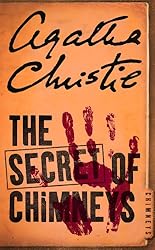
The Secret of Chimneys by Agatha Christie

In The Secret of Chimneys, Anthony Cade is drawn into a deadly conspiracy when he agrees to carry out an errand for his old friend, Jimmy McGrath. He has to deliver the manuscript memoir of Count Stylptich of Herzoslovakia to a firm of London publishers and to return a packet of letters to a blackmail victim.

It’s one of Agatha Christie’s early ‘thrillers’, first published in 1925. It is also the last full length crime novel of hers that I had left to read. I really thought I had read it but I think I was getting it mixed up with The Seven Dials Mystery, which features some of the same characters and is also set at Chimneys, a large country house, the home of Lord Caterham. The Secret of Chimneys is the first book in which Superintendent Battle of Scotland Yard appears. He is an intelligent officer, outwardly impassive and stolid, but who reaches his conclusions applying common sense. Later he appeared in four more of her novels – The Seven Dials Mystery, Cards on the Table, Murder is Easy and Towards Zero.

Agatha Christie declines to describe Chimneys, other than to say it is a ‘venerable pile‘ and that descriptions of it can be found in any guidebook. ‘It is also No. 3 in Historic Homes of England, price 21s. On Thursdays coaches come over from Middleham and view those portions of it which are open to the public. In view of all these facilities, to describe Chimneys would be superfluous.‘ (page 128)

The 1920s upper class life style is evident in the lavish breakfast that is laid on at Chimneys, set out on ‘half a score of heavy silver dishes, ingeniously kept hot by patent arrangements. Omelet, said Lord Caterham, lifting each lid in turn. Eggs and bacon, kidneys, devilled bird, haddock, cold ham, cold pheasant.’ (page 134)

I’m not going to attempt to summarise the plot of this book, other than to say that it revolves around political events in the fictitious Balkan state of Herzoslovakia, with attempts to reinstate its royal family, and also international crime concerning the theft of jewellery  by a thief known in Europe as ‘King Victor’. It reminds me of P G Wodehouse’s books, written in the same light and humorous style.  It is sheer escapism and although it is not one of my favourite of her books, it is an entertaining book.

Reading Challenges: Agatha Christie Reading Challenge, Mount TBR challenge and Golden Vintage Mystery Cover Challenge: Bloodstains

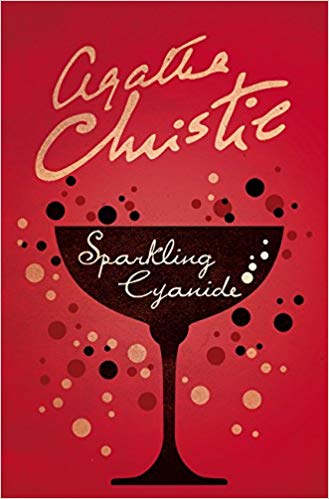
Sparkling Cyanide by Agatha Christie

Sparkling cyanideAC

Sparkling Cyanide (published as Remembered Death in America) was first published in 1945. It is a novel in which a crime is investigated a year after it was committed.

Rosemary, the wife of wealthy George Barton dies suddenly at her birthday party at a West End Restaurant, the Luxembourg, after drinking a glass of champagne laced with cyanide. Rosemary had been in a depressed and unhappy state of mind after having a bout of influenza.The official verdict was that she had committed suicide but a year on George, having received anonymous letters stating her death wasn’t suicide, is convinced that she was murdered. He arranges another party, this time for Iris, Rosemary’s younger sister, inviting the same guests, hoping to identify the murderer. But his plan goes awry, as after drinking a toast to Rosemary’s remembrance the party ends with yet another death.

Rosemary was a wealthy heiress in her own right and after her death her inheritance had passed to Iris. George had invited Colonel Race* to both parties, but he had been absent both times. He had known George since his boyhood but had only once met Rosemary, who he thought of as ‘a singularly lovely nit-wit – but certainly not a melancholic type‘. He helps Chief Inspector Kemp of Scotland Yard to investigate both deaths. As well as Iris and George the guests at the party were Ruth Lessing, George’s efficient secretary, and Rosemary’s friends, Anthony Browne, a man with a dubious past and a politician Stephen Farraday and his wife Sandra.

In a series of flashbacks Agatha Christie highlights each person and their relationships with Rosemary and it appears that each one, including George and Iris had a motive for killing her. I was convinced quite early on that one particular character had to be the murderer, but reading further on I began to have doubts, switching from one person to another. As it turned out I was right about my first suspect – Agatha Christie was expert at writing things that could be taken two ways. If I was right about the ‘who’ I couldn’t work out the ‘how’, particularly for the second death, but knew that where everyone sat at the round table was significant. When that was revealed I thought it was difficult to believe, which is why I don’t place it among her best books – but it’s still a very enjoyable read. And it was popular with the public achieving sales of thirty thousand in the first year of publication.

*Colonel Race – first appeared in The Man in the Brown Suit, also in Cards on the Table and Death on the Nile. His appearance in Sparkling Cyanide was his last. He was an agent working for the British Secret Service, often sent on difficult or sensitive missions. In this book he is over sixty, described as ‘a tall, erect, military figure with sunburnt face, closely cropped iron-grey hair, and shrewd dark eyes‘.

Reading Challenges: Mount TBR Reading Challenge and Vintage Mystery Cover Scavenger Hunt for the Golden Age in the category of ‘Bottle/Glass for drinking’.

Death Comes as the End by Agatha Christie

In 1944 Agatha Christie published Death Comes as the End and in 1945 Sparkling Cyanide, neither of them featuring Hercule Poirot or Miss Jane Marple. By chance these two books are the last full length crime fiction novels by Agatha Christie that I had left to read. There are plenty of short stories of hers that I still have to read and her Mary Westmacott novels as well as her plays, so it is not the end of my reading of her work.

Death Comes As The End

The idea to write a detective story set in Ancient Egypt came from a friend, Professor Stephen Glanville – Death Comes as the End was the result. It is set on the West bank of the Nile at Thebes in about 2000 BC. But in her Authors Note Agatha Christie explained that both time and place are incidental and any other time or place would have served as well. She based her characters and plot on some letters from a Ka priest in the 11th Dynasty:

The letters painted to perfection the picture of a living family: the father fussy, opinionated, annoyed with his sons who did not do as he said; the sons, one obedient but not obviously bright, and the other sharp-tempered, showy, and extravagant. The letters the father wrote to his two sons were about how he must take care of a certain middle-aged woman, obviously one of those poor relations who all through the ages live with families, to whom the heads of families are always kindly, whereas the children usually grow up disliking them because they are often sycophants and makers of mischief. (Agatha Christie’s Autobiography page 514)

From these letters she constructed her story, adding Renisenb, a daughter, Nofret, a concubine for Imhotep, the father, a spoilt younger son and a greedy but shrewd grandmother. He is besotted by Nofret who antagonises the family, setting Imhotep against them. Things come to a head after Nofret has manipulated Imhotep to disinherit his sons and marry her and she is found dead, apparently having fallen from a cliff. More deaths follow.

The mystery in this book is actually not too puzzling. For me, its interest lay in the setting and period details. Agatha Christie, according to her Autobiography had done a lot of reading from books lent to her by Glanville and had also bombarded him with questions about daily life and customs in the 11th Dynasty – such as what food did they eat, how did they cook it, did men and women eat together, what sort of rooms did they sleep in, where did they keep their linen, what sort of houses did they have, and so on?

The end result for me was of authenticity – it all came over as real, the characters were individuals, their relationships were convincing and although Agatha Christie wasn’t happy with the ending, which she changed on Glanville’s suggestion, I thought it was fine. And just as she had pleasure in writing it I had pleasure in reading it.

Reading Challenges: Agatha Christie Reading Challenge, Mount TBR Reading ChallengeVintage Cover Scavenger Hunt for the Golden Age in the category ‘A Green Object’.

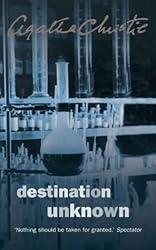
Destination Unknown by Agatha Christie

I had no great expectations when I began reading Agatha Christie’s Destination Unknown (first published in 1954) because I’ve not been keen on her stand-alone international intrigue/spy mysteries. But I thought it started very well and I was soon drawn into the story.
It’s the early 1950s and a number of scientists have disappeared, amongst them is Thomas Betterton, a brilliant nuclear scientist, who had discovered ZE Fission. The British Secret Service suspect that he and the other missing scientists have gone beyond the Iron Curtain, either kidnapped, or tempted by money or by the dream of an ideal world, working for the good of humanity. His wife, Olive, has no idea where he is, but sets off for Morocco, ostensibly on medical advice for a complete rest. However, the plane crashes and she is killed before she gets to her destination.

Hilary Craven, whose abundant red hair is similar to Olive’s, is intent on taking her own life, but she is recruited by Jessop, a British Secret Service Agent who persuades her that if she wants to kill herself she could help her country at the same time by impersonating Olive and thus trace Betterton. In doing so it leads her to a secret scientific complex hidden in the High Atlas mountains and a terrifying discovery.

It went over the top with a string of disasters, involving a faked air disaster, radio-active pearls, a leper colony, and secret laboratories all part of a vast organisation masterminded by a wealthy and powerful fanatic. And added to the international intrigue there is also a murder which is only revealed right at the end of the book. If the plot is bizarre and rather weak, and some of the characters are stereotypes, Hilary’s character is more convincing. And as in her other spy thrillers, Agatha Christie uses it as a vehicle for her own concerns about the state of the post-war world, decrying what she saw as the attempt to impose a world order and discipline, where individuality is suppressed. Hilary thinks she:

would rather have a world of kindly, faulty human beings, than a world of superior robots who’ve said goodbye to pity and understanding and sympathy. (page 102)

It’s a dangerous world where

Once you have got into that state of mind where the taking of human lives no longer counts, then if it is simpler to put a little explosive package under a seat in a plane than to wait about at the corner on a dark night and stick a knife in someone, then the package will be left and the fact that six other people will die also is not even considered. (pages 143-144)

Just as true today as in the 1950s!

I am nearing the end of reading Agatha Christie’s full length novels and now have just 2 left to read. Although Destination Unknown is not one of my favourites I did enjoy reading it – it moves quickly and kept me interested in its twists and turns. There’s a lot going on and it’s not easy to know who is telling the truth and who to trust.

****

Added on 15th January 2016:

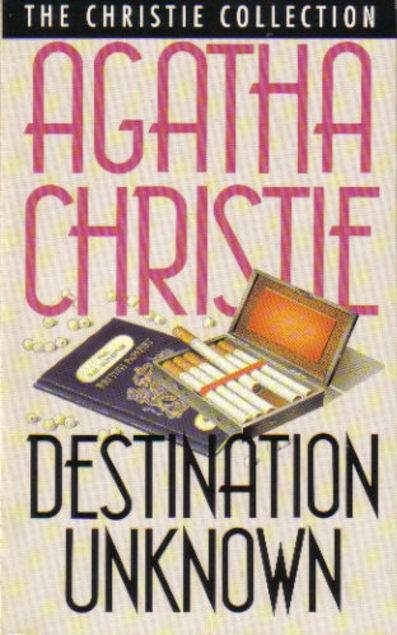
The edition of Destination Unknown that I read has this cover, fulfilling the cigarette/pipe category on the Golden Age Vintage Mystery Hunt card, as well as the Mount TBR Reading Challenge:

In Bitter Chill by Sarah Ward

I’ve made a great start to 2016 with the first book I’ve read this year. In Bitter Chill by Sarah Ward is her debut novel and it is excellent. I’ve been enjoying her book blog, Crimepieces, for a while now, so when I saw that she had published a book, I knew I had to read it. It will certainly be on my list of favourite books at the end of the year.

This is just the sort of book I love – excellent storytelling, moving smoothly between the past and the present as the secrets from the past gradually emerge, great characterisation and a superb location in the Derbyshire Peak District that Sarah Ward obviously knows very well. It is also a complex and puzzling mystery that kept me glued to the book.

In January 1978 two eight-year old girls, Rachel Jones and Sophie Jenkins were walking to school together when a strange woman offered them a lift in her car. Rachel is later found in Truscott Woods but Sophie was never found.  Move forward 30 years when Sophie’s mother commits suicide. Troubled by Yvonne Jenkin’s suicide, the police reopen the case – Superintendent Llewellyn who was on the original team asks DI Francis Sadler and his team, DC Connie Childs and DS Damian Palmer to see if there was anything that had been missed in 1978.

Rachel has very little memory of the kidnapping as she was drugged and she has nothing to add to the statement she made as a child. But prompted by Yvonne’s suicide she tries to remember what had happened and as she is a genealogist her research into her own family history proves to be invaluable. The questions are which child was the target, why was Rachel the only one to escape and what is the significance of her missing socks? The tension and mystery ramp up with a modern day murder, when Mrs Lander, one of the teachers at the girls’ school is found dead in the woods where Rachel was discovered 30 years earlier.

As I read I jotted down a few points that I thought were relevant. These were socks, illegitimacy, missing fathers and was Mrs Lander’s murder connected to the kidnapping and Yvonne’s suicide? It was only near the end of the book that I worked out why these points were relevant.

Connie was my favourite police officer and I liked the relationship between her and Sadler and the competition between her Sergeant Damian Palmer. I also liked the fact that although there are violent deaths in this book they are not described graphically. The weather gets colder and colder as the chilling events unfold and the devastating family secrets are revealed.

This is a powerful and well written crime fiction novel, one that I enjoyed immensely. I’m glad that there is to be a sequel, A Fragile Spring, which will be published later this year. I’m definitely looking forward to reading it.