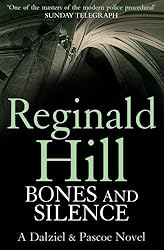
Bones and Silence by Reginald Hill

I found a lot to enjoy in Bones and Silence, Reginald Hill’s 11th book in his Dalziel and Pascoe series, first published in 1990.

Blurb (from the back cover):

When Detective Superintendent Andy Dalziel witnesses a bizarre murder across the street from his own back garden, he is quite sure who the culprit is. After all, he’s got to believe in what he sees with his own eyes. But what exactly does he see? And is he mistaken? Peter Pascoe thinks so.

Dalziel senses the doubters around him, which only strengthens his resolve. To make matters worse, he’s being pestered by an anonymous letter-writer threatening suicide. Worse still, Pascoe seems intent on reminding him of the fact.

Meanwhile the effervescent Eileen Chung is directing the Mystery Plays. And who does she have in mind for God? Dalziel of course. He shouldn’t have too much difficulty in acting the part …

My thoughts:

I liked all the complications of plot and sub-plots in this book and the interplay of the characters. It’s full of interesting characters and humour, but it is the plot that takes precedence. It is so tricky, with numerous red herrings and plot twists. Dalziel is positive that he saw Philip Swain shoot his wife; shooting her at close range, destroying much of her face and removing the top of her head. But Swain insists it was an accident – he was trying to stop her from killing herself and the gun went off. The only other witness, Greg Waterson, backs up Swain’s story – and then disappears.

My image of Dalziel comes from Warren Clark’s portrayal of him in the TV series because I watched the programmes before I read any of Hill’s books. To me Warren Clarke is Dalziel, just as David Suchet is Poirot. Dalziel is a larger than life character, speaks his mind and is never politically correct. He is is positive in his belief in Swain’s guilt even when everyone else thinks his wife’s death was an accident:

Andrew Dalziel, despite what his friends said, was no paranoiac. He did not believe himself to be infallibly perfect or unjustly persecuted. His great strength was that he walked away from his mistakes like a horse from its droppings, and as he himself once remarked, if you leave crap on people’s carpets, you’ve got to expect a bit of persecution.

But when he believed himself right, he did not readily accept evidence that he might be wrong, not while there was any stone left unturned. (page 242)

But it doesn’t help that Swain has been cast in the role of the devil opposite Dalziel’s God in the mystery play and the two are constantly sparring. The whole sub-plot of the mystery play is brilliant. Each Part of the book is headed by a quotation from the York Cycle of Mystery Plays, each one relevant to the events that follow. And the vision of Dalziel as God is so funny, especially when the fat man has to climb a narrow ladder up the back of a triple decker stage mounted on a flat car. Dalziel has to sit on a tiny platform over the upper deck, perched above polystyrene clouds.

Pascoe has recently returned to work after a period of sick leave, following an accident and, impatient to find evidence against Swain, Dalziel delegates the anonymous letters to Pascoe to discover who has been sending them. This sub-plot about the identity of the letter writer is the only part of the book that I’m not sure about. I had several thoughts about who it could be, but I was wrong and in the end when the author was revealed I wasn’t completely convinced that that character could have known all the information given in the letters. Still, it makes a dramatic conclusion to the book and came as a complete surprise to me.

Although Bones and Silence is a long book (524 pages) I read it quite quickly, completely absorbed in its mysteries and impressed both with the ingenuity of the plot and the quality of the writing. I really mustn’t leave it very long before I read some more of Reginald Hill’s books.

  • Paperback: 528 pages
  • Publisher: Harper (25 Jun. 2009)
  • Language: English
  • ISBN-10: 0007313128
  • ISBN-13: 978-0007313129
  • Source: I bought the book

Reginald Charles Hill FRSL (3 April 1936 ‘“ 12 January 2012) was an English crime writer, and the winner in 1995 of the Crime Writers’ Association Cartier Diamond Dagger for Lifetime Achievement.

Reading Challenges: Mount TBR Reading Challenge 2016 – a book I’ve owned for four years.

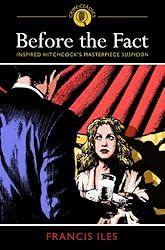
Before the Fact by Francis Iles

On the face of it Before the Fact is a straight forward story. It tells the tale of wealthy, intelligent but plain Lina McLaidlaw whose family are against her marriage to the handsome, charming and fascinating Johnnie Aysgarth; Lina’s father tells her Johnnie is a ‘rotter’. But right from the opening paragraph it’s obvious that Lina’s father is right. In fact Johnnie is much worse than her father realised:

Some women give birth to murderers, some go to bed with them, and some marry them. Lina Aysgarth had lived with her husband for nearly eight years before she realized that she was married to a murderer.

First published in 1932 by Francis Iles (* see below*), Before the Fact is a Golden Age crime fiction novel that is a psychological character study of its two main characters, Lina and Johnnie. It’s cleverly written. Lina slowly realises Johnnie’s true nature – that of a compulsive liar and gambler, a manipulative scoundrel who thinks nothing of being unfaithful, even of arranging a murder, or two.  But still she stays with him, trying to control and change him, believing his lies until she has to accept him for what he is, with disastrous consequences.

As Lina’s eyes are slowly opened I became exasperated at her naiveté, her acceptance of what she she has discovered about Johnnie. She comes across as a fool besotted by him and desperate for his love and attention, and even though her suspicions are aroused she still deliberately ignored all the warning signs, descending from panic, terror, horror and despair into passivity. She is maddening, a born victim and I began to wonder how it could possibly end. It was even more chilling than I had imagined.

*About the Author (copied from the publishers):

Frances Iles was a pseudonym of Anthony Berkeley Cox, who was born in 1893 in Watford. After serving in the army during the First World War, Berkeley worked as a journalist for many years before his first foray into the crime genre with The Layton Court Mystery (1925).

His two primary non-de-plumes were Francis Iles and Anthony Berkeley. As the former, he was a master of the psychological suspense genre, always with a wry humorous tenor to his writing; as the latter he acted as a trailblazer in the classic ‘Golden Age’ of crime and detective novels.

An intensely private man who always shunned publicity, Berkeley died in 1971.

As I read I marked a few passages that although not directly connected with the story I found interesting:

About artistic criticism – in particular female criticism:

If one did not happen to like a certain book, picture, or piece of music, one took it for granted that the book, picture, or piece of music was just bad; and the people who thought it was good, were, quite simply and plainly, mistaken. It never occurred to any female critic that a book might possibly be above her own level of intelligence (the men of course read only detective stories). (page 42)

on artists:

‘Aren’t artists intelligent?’ Lina asked innocently.

‘Of course they’re not. Most of them haven’t got the brains of a mouse. They just have this odd knack of being able to put things on canvas, and that’s all. They are the dullest of all the creators. Musicians are the nicest: you never hear a musician talk about himself at all. Then the really good authors. They don’t thrust their work down one’s throat; they’ve no need to. Then the second-rate authors, who do, and have. And then the painters, a long way bottom.’ (page 125)

I wonder who he was referring to?

And on murder:

When you incite a person to do something which both of you know will probably kill him – is that legally murder or not? (page 177)

Lina discusses this point with Isobel Sedbusk (based on Dorothy L Sayers), a writer of detective stories, thinking that it wasn’t ‘real murder, like giving the man poison, or shooting him, or anything like that.’ Isobel replies:

‘No, I’m inclined to doubt whether it would be murder, from the legal point of view. The legal definition of murder is ‘to kill with malice aforethought’. Still, you’ve got the malice aforethought all right. And if he knowingly incited the man to commit an act which would result in his death …’

Malice Aforethought – another novel by Francis Iles (published in 1931) begins with revealing the identity of the murderer. I shall have to read that one soon.

Reading Challenges:

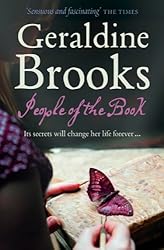
People of the Book by Geraldine Brooks

When I began reading People of the Book by Geraldine Brooks I wondered why I’d left it nearly eight years on my book shelves before I  got round to reading it. I loved it; it’s a real gem! It has joined the ranks of my favourite books and is definitely a book for keeping and (I hope) for re-reading.

How could I not love a book about books, in particular an ancient book, one that was thought to be lost or destroyed, a book that escaped burning by the Inquisition and the Nazis, a book that survived shelling during the Bosnian War in the 1990s, a book known as the priceless Sarajevo Haggadah – a medieval Jewish prayer book containing the illustrated traditional text of the Passover Haggadah which accompanies the Feast of Passover.

In Geraldine Brooks’ Afterword she explains that People of the Book is fiction, inspired by the true story of the Hebrew codex known as the Sarajevo Haggadah. Some of the facts are true to the haggadah’s known history but most of the plot and all of the characters are imaginary. She then goes on to define what is true and what is fictional, which I think is the best way of presenting historical fiction.

Australian Hanna Heath is a rare-book restorer and it’s not only the content of the haggadah that interests her, it is the hidden history of the book that captured her imagination and also mine. She finds tiny clues to its history as she restores the book – a fragment of an insect’s wing, wine stains, salt crystals and a tiny white hair – clues to unlock its mysteries. The story of the book is told in reverse chronological order beginning in 1996 and working back to 1480. Interwoven with each story is Hanna’s own story as she too discovers her roots. It’s a story too of love and war, of family relationships, of Anti-Semitism and of historical religious conflicts as the haggadah survived disaster after disaster. It’s also a novel about preserving the past, its culture and history for future generations. It has depth and breadth and is beautifully written. I was irresistibly engrossed in this book and full of wonder at its stories, reaching back in time from Sarajevo to Vienna, Venice, Tarragona to Seville in 1480 and also Hanna’s story from 1996 to 2002.

There are many descriptions of the haggadah throughout the book, all of which made me eager to know more about it. This is just one example from the chapter on wine stains set in Venice in 1609:

Aryeh released the catches, admiring the work of the silversmith. Each clasp, closed, was in the form of a pair of wings. As the delicate catch released – still smoothly after more than a century – the wings opened to reveal a rosette enfolded within. Aryeh saw at once that the book was a haggadah, but unlike any he had seen before. The gold leaf, the pigments … he stared at the illuminations, opening each page eagerly. He was delighted, yet a little disturbed, to see Jewish stories told in an art so like that of the Christians’ prayer books. (page 163)

And here, by way of contrast, is a description of Arnhem Land in the north east corner of Australia’s Northern Territory, where Hanna is working in the caves studying the Aboriginal rock art to document and preserve it before the uranium or bauxite companies blasted it into rubble:

I stepped out of the cave and blinked in the bright daylight. The sun was a big disc of brilliant madder, reddening the stripes of ore that ran through the sheer black-and-ocher rock face. Down below, the first shoots of new spear grass washed the plain in vivid green. Light silvered the sheets of water left behind by the previous night’s downpour. We’d moved into Gunumeleng – one of six seasons the Aborigines identified in a year that whites simply divided into Wet and Dry. Gunumeleng brought the first storms. In another month, the entire plain would be flooded. The so-called road, which was actually virtually a marginal dirt track, would be impassable. (pages 339-340)

I just had to know more about the Sarajevo Haggadah and found these illustrations (see Wikimedia Commons for more illustrations and these sites for more information –  WikipediaThe Times of Israel and About Haggadah:

Copies of Sarajevo Haggadah in parliament building – from Wikimedia Commons

The Sarejevo Haggadah, 15th century Spain – from Wikimedia Commons
Reading challenges: Mount TBR Reading Challenge 2016

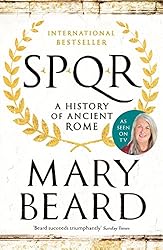
SPQR: A History of Ancient Rome by Mary Beard

Mary Beard is a Professor of Classics at Newnham College, Cambridge and is the Classics editor of the TLS. She is a fellow of the British Academy and a member of the American Academy of Arts and Sciences. And she writes a blog – A Don’s Life, which appears in The Times. I’ve enjoyed watching her TV programmes and so it doesn’t surprise me at all  that SPQR is just as entertaining and informative as the programmes – and very readable, even for someone, like me, who only has a smattering of knowledge about Roman history.
I took my time reading SPQR; some of it covered familiar ground and some was new to me. It’s a fascinating account of how Rome grew and sustained its position for so long, covering the period from the fourth century BCE when Rome was expanding from a small village, up to the moment in 212 CE when the emperor Caracalla made every free inhabitant of the Roman Empire a full Roman citizen.

The title, SPQR, is taken from the Roman catchphrase, Senatus Populusque Romanus meaning the Senate and People of Rome and it is on these two elements – the Senate and the People that Mary Beard concentrates, focussing on the city of Rome, on Roman Italy and also looking at Rome from the outside, from the point of view of those living in the wider territories of the Roman empire.

The book is not strictly chronological and begins with an event I know a bit about through reading Robert Harris’ Lustrum. It’s the Catiline conspiracy in 63 BC, which concerned a plot, or so it was rumoured to overthrow the Roman Empire and Cicero’s part in uncovering the plot and saving the state. Mary Beard begins with this event, because:

it is only in the first century BCE that we can start to explore Rome, close up and in vivid detail through contemporary eyes. An extraordinary wealth of words survives from this period: from private letters to public speeches, from philosophy to poetry – epic and erotic, scholarly and straight from the street.’ (location 143)

She highlights the effect Cicero had, not just on the politics of his own time but also on the language of modern politics. And it is from Cicero’s speeches, essays, letters, jokes and poetry and other Roman writers that we see the Roman world not just in 63 BCE but throughout the city’s history.

For the earlier period however, there are no contemporary accounts and so the early years of the city and of the earliest Romans has to be reconstructed  from individual pieces of evidence from fragments of pottery or letters inscribed on stone.

There are also, of course the myths and stories as well and Beard refers to these, such as the story of Romulus and Remus, who are said to have founded the city, told by Livy and several other Roman writers. Tradition has it that Romulus and his tiny community fought against their neighbours, the Sabines, and erected a temple on the site of the battle, which later became the Forum, but there is no archaeological evidence to identify the remains of this temple. Archaeology, in fact, only sketches what Rome in the earliest period was like and it is very different from the myths. Later Roman writers and modern historians alike have debated intensely the stories of Romulus and Remus, raising the questions of what it was to be Roman. And Beard states:

There is often a fuzzy boundary between myth and history … and … Rome is one of those cultures where the boundary is particularly blurred. … For a start there was almost certainly no such thing as a founding moment of the city of Rome. … Although Romans usually assumed that he [Romulus] had lent his name to his newly established city, we are now fairly confident that the opposite was the case: ‘Romulus’ was an imaginative construction out of ‘Roma’. ‘Romulus was the archetypal ‘Mr Rome.’ (locations 844 – 850)

From that point Beard goes on to discuss the basics of Roman culture, including the nature of Roman marriage, Roman slaves, the Republican system, the principle of freedom, or ‘libertas’, the changing definition of what it meant to be ‘Roman’, Roman domination of the Mediterranean, dictatorship, civil war, taxation, the modern Western system of timekeeping, the emperors and their imperial successes and military victories and the army – and so much more!

SPQR is an immense  achievement, covering 1,000 years of the history of Ancient Rome, and not only the history but also explaining Roman values, what they thought about themselves, and the way of life of both the People and the Senate.

  • Format: Kindle Edition
  • File Size: 22379 KB
  • Print Length: 608 pages
  • Publisher: Profile Books; Main edition (20 Oct. 2015)
  • Source: I bought it

Reading Challenges: Mount TBR 2016 – an e-book I’ve owned since November 2015

The Secret Hangman by Peter Lovesey

The Secret Hangman is the first book I’ve read by Peter Lovesey and as it’s the 9th in his Peter Diamond series I was hoping it would read OK as a stand alone book – it does. Peter Diamond is a Detective Superintendent with the Bath police.

Blurb:

Peter Diamond, the Bath detective, is having woman trouble. His boss wants him to find a missing person, the daughter of one of her friends in the choir. He is not enthusiastic. Another woman, who calls herself his Secret Admirer, wants to set up a meeting in a local pub. He tries ignoring her. Then there is sexy Ingeborg Smith, the ex-journo detective constable, distracting the murder squad from their duties. No one ignores Ingeborg.

Murder becomes a possibility when a woman’s body is found hanging from a playground swing in Sydney Gardens and a suspicious second ligature mark is found around her neck. Diamond investigates the victim’s colourful past. More hangings are discovered and soon he is certain that a secret hangman is at work in the city . . .

My thoughts:

Diamond’s wife had died three years earlier – as I haven’t read the earlier books I suppose this is a spoiler, but it is important to know this from the start of this book, because he is now beginning to recover from his grief and becomes rather too involved with an attractive woman he met by chance in a carpark. The story of their relationship runs parallel to the investigations into the hangings and the series of ram raids his boss wants him to investigate.

At first there doesn’t appear that there is any connection between the victims and the motive for killing them only becomes clear quite late on in the book. The only similarities are that the victims are all couples – the wives are killed first, followed a few days later by their husbands, and all the bodies are found in public places as though the killer wanted their deaths to be discovered and publicised.

It takes a while before Diamond cottons on to the identity of the killer – and I was there some time before him, but that didn’t spoil my enjoyment of the book. Diamond is not a brilliant detective. He is rather old-school, not above a bit of threatening behaviour (and more) to suspects, not bothered about upsetting his boss, nor is he comfortable with technology. But he is determined and thorough – I liked him and want to read more from the series.

Peter Lovesey is a British writer of historical and contemporary crime novels and short stories. He has written many books, not just the Peter Diamond series, but also a series of books featuring Sergeant Cribb, a Victorian-era police detective based in London – the full list of his books is on his website – there are plenty to read!

————

Reading challenges: Mount TBR Reading Challenge – a book I’ve owned for 7 years, and one I should have read ages ago, but well worth the wait.

The Legacy of Elizabeth Pringle by Kirsty Wark

I quoted an extract from the opening paragraph of The Legacy of Elizabeth Pringle by Kirsty Wark in an earlier post, whilst I was in the middle of the book. I finished reading it a few days ago and have been wondering what to write about it ever since. It’s one of those books that has received a mixed reception with some reviewers thinking it’s a well written book whereas others think it isn’t. I enjoyed it very much.

It’s a story centred on the lives of two women – Elizabeth Pringle and Martha Morrison. Elizabeth has lived all her life on the Isle of Arran and knowing that she is dying and has no living relatives, leaves her house, Holmlea in Lamlash, to Anna Morrison, a woman she had seen years before, pushing her daughter’s pram down the road outside. Anna Morrison, had fallen in love with the house and written to Elizabeth asking her to get in touch if she ever thought of selling it. But Anna is now suffering from dementia and it is her daughter, Martha who goes to Arran to see the house on her mother’s behalf.

What follows is a dual narrative moving between Elizabeth’s account in her own words of her life up to the present day and Martha’s current situation, told in the third person, as she meets the people Elizabeth knew, in particular, Saul, a Buddhist, Niall, a young man who is passionate about gardening, and Catriona his sister who runs a hotel on the island. It’s a deceptive book in that it appears that not much happens and it is gentle and leisurely paced, but it is actually packed with events, some of them dramatic and devastating in their effect on the characters’ lives. And it has a vivid sense of place and of Arran’s history, which I loved.

I much preferred Elizabeth’s story beginning when she was just four and her father went off to fight in the First World War; her relationship with her mother; her life as a teacher and her love life. I found the ending of her life very moving. Martha’s story seems rather pat, everything falls into place a bit too easily – especially her relationship with her mother and sister and the instant friendships she makes on the island.

It’s a book about family, relationships, especially mother/daughter/sister relationships, about happiness, love and heartbreak, old age, memories and the contrast between life in the early part of the twentieth century and the present. It’s strong on description, which is important to me as I like to visualise the locations – and I had no difficulty at all with that in this book.

All in all, I was captivated by this story.

Kirsty Wark is a journalist, broadcaster and writer who hosts a variety of BBC programmes. Her home has always been Scotland and her family’s connection to Arran goes back over many years.

————-

Reading Challenges: Mount TBR Reading Challenge – a book I’ve had for two years, and Read Scotland 2016 – a book by a Scottish author and set in Scotland.