Six Degrees from Lincoln in the Bardo to Iris

I love doing Six Degrees of Separation, a monthly link-up hosted by Kate at Books Are My Favourite and Best. Each month a book is chosen as a starting point and linked to six other books to form a chain. A book doesn’t need to be connected to all the other books on the list, only to the one next to it in the chain.

This month the chain begins with Lincoln in the Bardo by George Saunders, a book I haven’t read.

Lincoln in the Bardo

It’s about Abraham Lincoln and the death of his eleven year old son, Willie, at the dawn of the Civil War. Willie finds himself trapped in a transitional realm – called, in Tibetan tradition, the bardo – and as ghosts mingle, squabble, gripe and commiserate, and stony tendrils creep towards the boy, a monumental struggle erupts over young Willie’s soul.

Moving from a fictional and highly original book by the looks of it my chain goes next to a biographical account of Lincoln:

Team of Rivals: The Political Genius of Abraham Lincoln

Team of Rivals: the Political Genius of Abraham Lincoln, a biography of Abraham Lincoln and others, by  Doris Kearns Goodwin, a book I bought after watching the film, Lincoln, which is loosely based on this book covering the final four months of Lincoln’s life. Goodwin examines his relationships with three men he selected for his cabinet, all of whom were opponents for the Republican nomination in 1860: William H. Seward, Salmon P. Chase, and Edward Bates.

Body Parts: Essays on Life-Writing

Writing biography is the subject of Body Parts: Essays on Life Writing by Hermione Lee, a collection of essays on Shelley,  T S Eliot, J M Coetzee, Jane Austen, Eudora Welty  and Virginia Woolf, to name but a few. Lee explores the relation of biography to fiction and history and of the connection of writers’ lives to their works.

So my next link is a collection of essays by Virginia Woolf –

The Death of the Moth and Other Essays

The Death of the Moth and Other Essays, originally published in 1942 by Leonard Woolf. Virginia had been getting together essays, which she proposed to publish in the autumn of 1941, or the spring of 1942. She had left behind her many essays, sketches and short stories, some of which had been previously published in newspapers, which he decided were worth republishing and in this book he also included some of those previously unpublished.

The title essay is a meditation on the nature of life and death seen through the perspective of a moth. It flies by day, fluttering from side to side of a window pane. As the day progresses the moth tires and falls on his back. He struggles vainly to raise himself. Woolf watches, realising that it is useless to try to do anything to help and ponders the power of death over life.

Moths provide the next link  – to a novel, The Behaviour of Moths by Poppy Adams.

Behavior Of Moths

This is the story of two sisters, Ginny and Vivi. Vivi, the younger sister left the family mansion 47 years earlier and returns unexpectedly one weekend. Ginny, a reclusive moth expert has rarely left the house in all that time.  What happens when they meet again is shocking to both of them. It’s a story full of mystery and suspense as it is revealed that the two have very different memories of their childhood and the events of the past. Two events in particular affected their lives. One was when Vivi, aged 8, fell from the bell tower and nearly died. The story alternates between the past and the present as Ginny recalls their lives.

Bell‘ is the next link in my chain – to Iris Murdoch’s novel The Bell, a book with an impending sense of evil and menace. It looks at the angst and self-denial of the relationship between religion and sex.

The Bell

A lay community lives next to an enclosed order of nuns, a new bell is being installed and then the old bell, a legendary symbol of religion and magic  is retrieved from the bottom of the lake. The legend of the bell is that it fell into the lake after a 14th century Bishop had cursed the Abbey when a nun was discovered to have a lover and had drowned herself.

And my final link is to a book about the author of The Bell, Iris Murdoch – Iris: A Memoir by John Bayley.

Iris: A Memoir of Iris Murdoch

I first read this in 2003. It’s a very loving and touching account. Iris died in February 1999 after suffering from Alzheimer’s Disease. Bayley explained how he had coped emotionally and practically with the illness that beset the woman he loved and cherished.

Writing this post as disrupted my reading because I got Bayley’s book off the shelves and began reading it again. He writes in such a warm and affectionate way that I’ve decided to read it right away.

For once there is no crime fiction in my chain! It contains books pondering the nature of life and death, beginning with a meditation on the death of Willie Lincoln and ending with a memoir of the life of Iris Murdoch.

Next month (March 3, 2018), the chain begins with a controversial book that Kate reports had everyone talking in the nineties – The Beauty Myth by Naomi Wolf. Everyone that is, apart from me – I don’t know anything (yet) about this book.

My Week in Books: 31 January 2018

This Week in Books is a weekly round-up hosted by Lypsyy Lost & Found, about what I’ve been reading Now, Then & Next.

IMG_1384-0

A similar meme,  WWW Wednesday is run by Taking on a World of Words.

Now:

Victoria: A Life

I’m still reading Victoria: a Life by A N Wilson (I began reading it last October!) and am now in Part 7 – I hope to finish it today, just 72 pages left. I’ve just read about the wedding of George, Duke of York to Princess May of Teck (later King George VI and Queen Mary) and this is Archbishop Benson’s description of Victoria. Just picture the scene:

I could scarcely believe my eyes when the Queen entered the Chapel by the lower end. There she was alone and began to walk up alone. … On she came, looking most pleasant, slightly amused, bowing most gracefully to either side as she came, her black silk almost covered with wonderful lace, and lace and a little crown with chains of diamonds on her head, walking lame and with a tallish stick. She looked Empire, gracious Empire … (page 503)

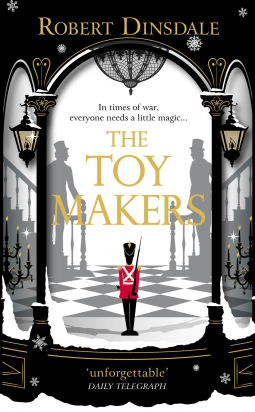
I’m also reading The Toymakers by Robert Dinsdale, to be published on 8th February 2018. So far I’m completely taken with this fascinating and imaginative novel.

Blurb:

Do you remember when you believed in magic?

It is 1917, and while war wages across Europe, in the heart of London, there is a place of hope and enchantment.

The Emporium sells toys that capture the imagination of children and adults alike: patchwork dogs that seem alive, toy boxes that are bigger on the inside, soldiers that can fight battles of their own. Into this family business comes young Cathy Wray, running away from a shameful past. The Emporium takes her in, makes her one of its own.

But Cathy is about to discover that the Emporium has secrets of its own…

Then:

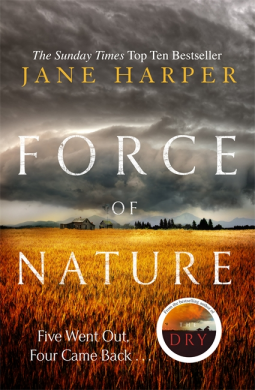
The last book I finished is Force of Nature by Jane Harper, which  will be published on 8 February 2018. I loved it and will post my review on 12 February 2018 as part of the blog tour .

Blurb:

FIVE WENT OUT. FOUR CAME BACK…

Is Alice here? Did she make it? Is she safe? In the chaos, in the night, it was impossible to say which of the four had asked after Alice’s welfare. Later, when everything got worse, each would insist it had been them.

Five women reluctantly pick up their backpacks and start walking along the muddy track. Only four come out the other side.

The hike through the rugged landscape is meant to take the office colleagues out of their air-conditioned comfort zone and teach resilience and team building. At least that is what the corporate retreat website advertises.

Federal Police Agent Aaron Falk has a particularly keen interest in the whereabouts of the missing bushwalker. Alice Russell is the whistleblower in his latest case – and Alice knew secrets. About the company she worked for and the people she worked with.

Far from the hike encouraging teamwork, the women tell Falk a tale of suspicion, violence and disintegrating trust. And as he delves into the disappearance, it seems some dangers may run far deeper than anyone knew.

Next:

I’d like a change from non-fiction and crime fiction, so I’m thinking of reading Loitering with Intent by Muriel Spark. Tomorrow marks the 100th anniversary of her birth – so it seems appropriate to read one of her books.

Loitering With Intent

Blurb (Goodreads):

Would-be novelist Fleur Talbot works for the snooty Sir Quentin Oliver at the Autobiographical Association, whose members are at work on their memoirs. When her employer gets his hands on Fleur’s novel-in-progress, mayhem ensues when its scenes begin coming true.

Have you read any of these books?  Do any of them tempt you? 

My Week in Books: 24 January 2018

This Week in Books is a weekly round-up hosted by Lypsyy Lost & Found, about what I’ve been reading Now, Then & Next.

IMG_1384-0

A similar meme,  WWW Wednesday is run by Taking on a World of Words.

Now:

Victoria: A Life

I’m still reading Victoria: a Life by A N Wilson (I began reading it last October!) and am now in Part 6 (it’s in 7 parts). It is now 1883, the Queen is sixty four and ‘increasingly obese‘, so different from the young girl of eighteen who had ascended the throne in 1837. This biography is fascinating, with many excerpts from Victoria’s personal letters and diaries.

Then:

The last book I finished is The Confession by Jo Spain, which will be published tomorrow, 25 January 2018. I was quickly gripped by this book in which you know who the killer is right from the start. But the killer insists he didn’t know the victim and neither did he know what had come over him as he battered him to death – it was as though he’d been possessed. (My review is here.)

Next:

Force of Nature by Jane Harper, which  will be published on 8 February 2018.

Blurb:

FIVE WENT OUT. FOUR CAME BACK…

Is Alice here? Did she make it? Is she safe? In the chaos, in the night, it was impossible to say which of the four had asked after Alice’s welfare. Later, when everything got worse, each would insist it had been them.

Five women reluctantly pick up their backpacks and start walking along the muddy track. Only four come out the other side.

The hike through the rugged landscape is meant to take the office colleagues out of their air-conditioned comfort zone and teach resilience and team building. At least that is what the corporate retreat website advertises.

Federal Police Agent Aaron Falk has a particularly keen interest in the whereabouts of the missing bushwalker. Alice Russell is the whistleblower in his latest case – and Alice knew secrets. About the company she worked for and the people she worked with.

Far from the hike encouraging teamwork, the women tell Falk a tale of suspicion, violence and disintegrating trust. And as he delves into the disappearance, it seems some dangers may run far deeper than anyone knew.

Have you read any of these books?  Do any of them tempt you? 

Queen Victoria and John Brown


Victoria progress Jan 2018

I’ve been reading Victoria: a Life by A N Wilson and writing an occasional post as I’m reading this long book.

One of the things that interests me is Victoria’s relationships with the men around her – such as with Albert, Lord Melbourne, Gladstone and Disraeli. But there is also her relationship with John Brown. Years ago I saw the excellent film Mrs Brown with Judi Dench as Queen Victoria and Billy Connolly as John Brown and I was wondering what Wilson would make of their relationship.

She first met John Brown when he was one of the gillies at Balmoral in 1848. He also worked in the stables. In 1864, still grieving for Albert, Victoria found Balmoral a place that brought consolations. In the happy days of her marriage she had taken a great shine to John Brown.

By the end of 1864, Princess Alice, who had noticed that rides in the pony cart at Balmoral were almost the only things which made her mother half cheerful, recommended that they brought Brown to England. She put the idea to Dr Jenner and to Colonel Phipps, Keeper of the Privy Purse. They both agreed that it was an admirable idea. So it was, in December 1864, that John Brown came to Osborne House.

From now onwards, Brown would be he constant companion. At Osborne, he brought in her correspondence at 10 am, and took her for a morning ride. This was repeated in the afternoon. At Balmoral, he stayed with her while she did her correspondence and took it upon himself to post her letters. At Windsor, he would stand guard in the corridor outside her room, ‘fending off’, as one courtier put it, ‘even the highest in the land’.

The very qualities which others found irritating in Brown were ones which made him an ideal companion for Queen Victoria. (page 286)

Brown was humorous, abrasive with pompous courtiers, but above all he treated her like a human being and was devoted to her. But the amount of time he spent with the Queen alarmed the Establishment and the Court – his lack of side, his directness and his breeziness, all of which Victoria liked, offended them:

And of course they suspected him of sleeping with her. Lord Stanley, Foreign Secretary in his father Lord Derby’s Third Cabinet, asked in his journal, ‘Why is the Queen penny wise and pound foolish? Because she looks after the browns and lets the sovereigns take care of themselves.’ (pages 321-2)

Wilson considers that whatever the situation was between them, Victoria’s infatuation with Brown and his unruly behaviour at Court were enough to cause the scandal:

‘It was the talk of all the Household,’ said that notoriously unreliable tittle-tattler Wilfrid Scawen Blunt, ‘that he was “the queen’s stallion” … he was a fine man physically, though coarsely made and had fine eyes (like the late Prince Consort’s, it was said) and the Queen, who had been passionately in love with her husband, got it into her head that somehow the prince’s Spirit had passed into Brown and after four years of widowhood, being very unhappy allowed him all privileges … She used to go away with him to a little house in the hills where, on the pretence that it was for protection and to “look after the dogs”, he had a bedroom next to hers, ladies in waiting being put at the other end of the  building … [There could be] no doubt of his being allowed every conjugal privilege.’ (page 323)

Scawen Blunt’s tittle-tattle was not proven.

Despite having worked on the subject of Queen Victoria for many years Wilson concluded that he felt unable to make up his mind about the nature of the Queen’s relationship with Brown. His instinct is

to believe that it was what it appears in her letters to Vicky: namely an embarrassingly close monarch-and-servant relationship.Brown meant it when he said he would die for her, and the Queen meant it when she called him her ‘treuer’ Brown. If I were forced to say what did or did not happen, I would point out the impossibility of carnal relations between them in her early days of widowhood, when she was plainly fixated on the memory of Albert, and he was plainly no more than her Highland servant. (page 325)

But then Wilson records the words of Lewis Harcourt, who was the son of Gladstone’s Home Secretary and Chancellor of the Exchequer quoting from Lady Ponsonby in 1885 – wife of the Queen’s Private Secretary who

… ‘told the Home Secretary a few days ago that Miss Macleod declares that her brother Norman Macleod confessed to her on his deathbed that he had married the Queen to John Brown and … had always bitterly regretted it. Miss Macleod could have no object in inventing such a story, so that one is almost inclined to believe it, improbable as it sounds.  (page 326)

Norman Macleod was the Minister at Crathie, on the edge of the Balmoral estate, where the Royal Family worshipped.

However, the truth about their relationship remains a mystery – there was a file containing all the letters from John Brown to Queen Victoria  but they were destroyed (page 422). After Victoria’s death, her daughter Princess Beatrice copied her diaries and censored them as she did so and Bertie went round rooms at both Windsor and Buckingham Palace ‘destroying as he went‘. ‘Busts and statues of John Brown were smashed. (His statue at Balmoral was removed to a remote corner of the estate.)’ (page 574)

Christmas at Windsor 1860

Victoria: A Life

I’ve been reading Victoria: a Life by A N Wilson and just before Christmas I read the section on Victoria and Albert’s Christmas in 1860:

The last Christmas before tragedy broke up the family was that of 1860, and it was a happy one. Even Albert and Victoria, everlastingly on the lookout for faults in the Prince of Wales, were pleased with their eldest son. He had just fulfilled his first major public engagement on his own – a four-month tour of Canada and the United States. (page 242)

In the United States Bertie had been an instant social success and Victoria acknowledged that he had qualities she would never possess. So Bertie was welcomed to Windsor that Christmas,

… where bright winter sunshine lit up castle windows thick with crystalline hexagons of frost, where the lakes were frozen so thickly that the young could play ice hockey, and where the Prince Consort, always at his happiest during these days of the year, supervised the hanging of giant Christmas trees from the ceiling, festooned with candles and decorations. (page 245)

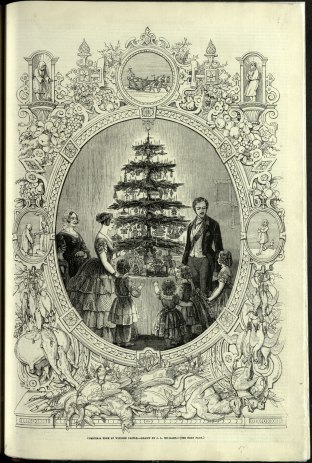
(Queen Victoria and Prince Albert had popularised the German custom of decorating fir trees at Christmas time, which had originally been introduced into England by Queen Charlotte, the wife of King George III.)

illustrated-christmas-PP_7611-001
Christmas Tree at Windsor Castle’, from Supplement to the Illustrated London News December 1848.

… the great German Christmas was celebrated, as it happened for the last time. The presents were arranged, each on a separate table for every recipient … the dinner was eaten … cold baron of beef, brawn, game pies, stuffed turkey, wild boar’s head, always the prince’s favourite, with a particular German sauce, which Öhm, the chef at Coburg, had invented – mince pies, bonbons of all kinds. (page 243-4)

In years to come Victoria, ‘in her bleak widowhood’, remembered that last happy Christmas with Albert. It was the last time they enjoyed thick snow together.

She tenderly listed the dates when he had taken her for a ride in a sledge – ‘in Brighton in ’45, in Jan and Feb 47, in 55 … and then for the last time December 27, 1860 at Windsor when Louis was still there. ‘My angel always drove me from a seat behind, sitting astride with his feet in large boots – he wore a fur coat with fur gloves – and he enjoyed it so much’. (page 244)

Victoria: a Life by A N Wilson

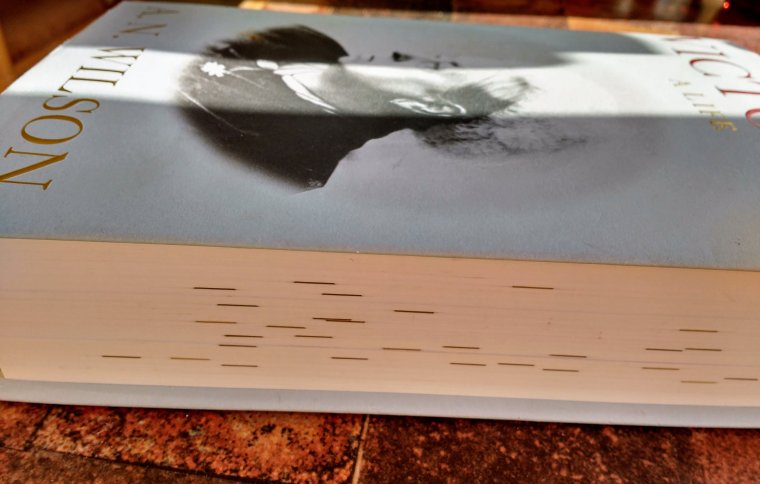
I’m reading Victoria: a Life by A N Wilson very slowly – not because it’s a difficult read or because it’s boring, because it isn’t, but simply because it’s a hardback book and very heavy and cumbersome to hold.

Victoria P1020318

As it’s taking me so long I’ve decided I need to jot down a few quotations that strike me as I’m reading rather than waiting until I’ve read the whole book.

Where I’m up to – Victoria has become Queen, set free from the constraints of her childhood and it is Lord Melbourne (Victoria’s Lord M) who prepared her for the ceremonial initiation of the Coronation and groomed her for her role as Head of State. Wilson reflects on her relationship with Melbourne and other male figures in her life thus:

The defining fact in Victoria’s personal mythology would seem to have been her marriage to Prince Albert; but there is no finished truth about a human being, and to see her as the besotted wife and grief-stricken widow of the German prince is only one truth about the Queen. She lived for eighty years, and was married for a mere quarter of that time. In many ways, we can say that we see her most clearly being herself in those platonic male friendships which were based on shared humour: with Lord Melbourne, with Disraeli and to a lesser extent with Dean Davidson and Lord Salisbury. The elements of humour and independence are present in her more mysterious relationship with John Brown. One sees her at her vigorous, independent and humorously selfish best in these friendships. The first, and in some ways the sweetest, was that with Lord M. (page 85)

When the crown was placed on Victoria’s head, all the peers and peeresses donned their coronets and after the Coronation Victoria wrote in her journal:

‘My excellent Lord Melbourne who stood very close to me throughout the ceremony was completely overcome at this moment and very much affected. He gave me such a kind (and I may say fatherly) look.’

and when the moment came to do homage,

‘he knelt down down and kissed my hand, he pressed my hand, and I grasped his with all my heart, at which he looked up with his eyes filled with tears and seemed much affected.’ (page 87)

I love these extracts from Victoria’s journal.