ABC Wednesday: D is for Degas

Edgar Degas (1834 – 1917) was a French artist and is perhaps most well known for his paintings of dancers; ballerinas were his favourite subject:

This is The Dance Class, oil on canvas, 1874 (the Metropolitan Museum of Modern Art). Here the dancers are in various poses at the end of a rehearsal. You can see the exhaustion on their faces and in their figures – see the girl at the front scratching her back, the girls at the back sunk to the floor, and the girl on the right, her arms folded, shoulders rounded and her head drooping down. I love the contrast between them and the rigid figure of the ballet master.Their flimsy tutus stand out so well against the hard diagonal floorboards.

I also like painting L’Absinthe, also called The Absinthe Drinker, A Sketch of a French Café,  or Figures at Café. It’s oil on canvas, 1876 (Musée D’Orsay). It’s a melancholy painting of a forlorn couple in the Café de la Nouvelle-Athènes in Paris.

They are drowning their sorrows. She is drinking absinthe, ‘the Green Fairy’, a lethal drink that was later banned. She is seen staring into space, sad, and desolate, lost in her own world. He is also in his own world, detached, his head turned away from her, as though they aren’t together. Degas’s models for the painting were Ellen Andre, an actress and Marcellin Desboutin, an engraver and artist. They were both annoyed by the painting, which depicted them as alcoholics and Degas had to state publicly that they were not.

I like it just because it tells a tale. It is so expressive and the detail is so fine, the slump of her shoulders, her air of exhaustion and his desire not to be there come over to me so powerfully. It gives the impression that Degas painted this from real life, but actually he painted it in his studio, with the pair carefully posed.

An ABC Wednesday post.

Art Books

I was looking for a book on drawing trees this morning. I knew I had one, but wasn’t sure where it was and had to spend some time searching for it. I should be more organised, but my problem is that each time I look at an art book I never put it back in the same place. So I got them all out (and found the book I wanted today). I hadn’t realised we’d got so many!

These are the ‘How to draw’ books:

and books on watercolour painting:

and just three specifically on pastel:

It’s the art group this afternoon, so I will actually be drawing/painting this afternoon and not, as D said, just reading about it!

ABC Wednesday: B is for …

Beata Beatrix by Dante Gabriel Rossetti c. 1863, (Tate Britain)Dante Gabriel Rossetti  was one of the original members of the Pre-Raphaelite Brotherhood. Beata Beatrix was inspired by Dante’s poem La Vita Nuova about his love for Beatrice, but it is actually a painting about Rossetti’s wife, Lizzie, mourning her death.

In 1850 Rossetti had fallen in love with Lizzie Siddal, a milliner’s shop assistant, who had agreed to pose for William Deverell, another member of the Brotherhood. She became a favourite model of all the members, including posing for hours in a tepid bath as Millais’s Ophelia. Rossetti, though, became increasingly possessive about her and they lived together and eventually married in 1860. But he gave her a hard time, neglecting her and was unfaithful. They lived in dark, cold and  damp rooms at Chatham Place, near Blackfriars Bridge. Lizzie’s health deteriorated. She was frail and depressed, and became addicted to laudanum. After her child was stillborn, Rossetti came home late one night in 1862 he found her dead, with an empty phial by her side. The official verdict was accidental death but to Rossetti it felt like suicide (which was illegal and immoral at the time and would have barred her from a Christian burial).

Rossetti’s portrait mourns Lizzie’s the death, showing her in a ecstatic, trance-like state. The haloed red dove, the messenger of Love, carrying a flower has become the messenger of Death and the flower is a poppy, the symbol of sleep and death and also the source of opium (laudanum), the drug which killed her.

I think this is such a beautiful, powerful painting ‘“ Rossetti described it saying Lizzy was ‘˜rapt from earth to heaven‘.

Linked to ABC Wednesday.

Library Loot

It’s been ages since I did a Library Loot post. These reflect the variety of books that I enjoy. For more details about the books click on the links which take you to Amazon UK:

  • D H Lawrence – Daughters of the Vicar. This is a novella written in 1911. I’d never come across this before and thought it looked interesting. It has a foreword by Anita Desai – she writes that ‘here in the little story, Daughters of the Vicar (could any title be more redolent of the England of its time?) we have the essential D H Lawrence – the little contained world in a mossy valley of coal-veined hills from which that D H Lawrence grew’.
  • Kate Atkinson – Started Early, Took My Dog. This is the fourth Jackson Brodie book, described by The Times as ‘A comic novel of great wit and virtuosity.’ I’ve been meaning to get this since it came out a couple of years ago.
  • Edna O’Brien – The Country Girls. This was first published in 1960 and it’s set in a country village in Ireland in the early 1960s – a period piece now. Her books then were both successful and scandalous. In her native Ireland she was considered irreligious.
  • Guilty Consciences: a Crime Writers’ Association Anthology, edited by Martin Edwards (himself a successful crime fiction writer and blogger). I had to borrow this collection of short stories from some of my favourite crime fiction authors.
  • Peter James – Looking Good Dead. Even though I’ve had a couple of Peter James’s books for a few years I’d never read them, until I started Dead Simple (the first Detective Superintendent Grace book) this week. I’m hooked – it’s really good. So when I saw this in the library today I was delighted – it’s the second of his Roy Grace books!
  • M R Hall – The Flight. Another series of crime fiction that I like – this is the fourth in Hall’s Coroner Jenny Cooper series. I’ve read the first and the third – Jenny Cooper is a coroner who acts as a detective. Again, another series that has me captivated.

And finally, two books on a subject that is equally as absorbing as reading and blogging – painting:

Both books include demonstrations and advice on techniques, types of paint and pastels, and composition. I just need to get painting – and reading!

ABC Wednesday: A is for The Artist’s House at Argenteuil

Another round of ABC Wednesday began today. Amazingly it’s been going for around 5 years and this is Round 11.

A is for The Artist’s House at Argenteuil by Claude Monet, one of my favourite Impressionist paintings. It’s oil on canvas painted in 1873, now held in the Art Institute of Chicago.

Monet moved to Argenteuil in 1871 and lived there until 1877. This was a prolific period for him – he was happy and well-off during that time. It was whilst he was living there that he developed a passion for gardening, influenced by fellow artist Gustave Caillebotte. This painting shows the first house he lived in at Argenteuil, with beds of red, white and blue flowers in front of the house, a creeper covering much of the wall and potted plants in large blue and white tubs on the gravel drive.

I especially like this painting because of the colours and also the figures adding personality – the little child with a hoop is Monet’s five-year old son, Jean, whilst his wife, Camille is seen in the doorway.

Saturday Snapshot: Dewars Lane

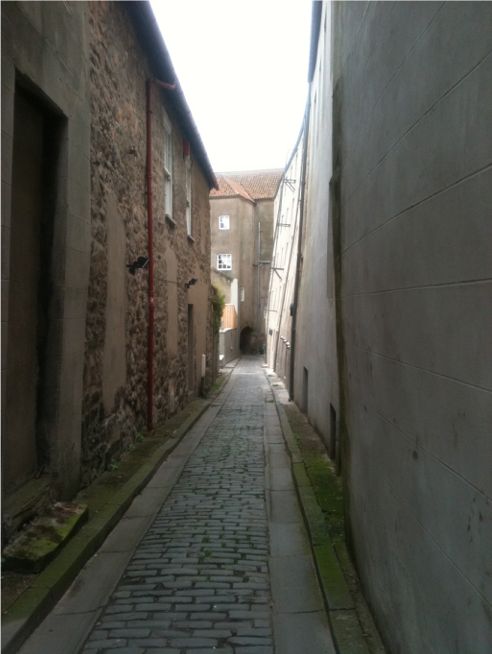
Berwick-upon-Tweed is an interesting English town near the border with Scotland, with three bridges crossing the Tweed. There are the Elizabethan Town Walls, Ramparts, Barracks, a ruined castle and quaint passageways like Dewars Lane, which dates back to medieval times. This is what it looks like today.

Dewars Lane, Berwick

The white building on the right at the end of the passageway is now a Youth Hostel, Art Gallery and Bistro. It was built in 1769 and was originally a granary. Its fantastic tilted walls are the result of a fire in 1815, after which it was propped up rather than being rebuilt. It was used for storing grain up until 1985 and was then left unoccupied, gradually becoming derelict. It has recently been restored by the Berwick Preservation Trust.

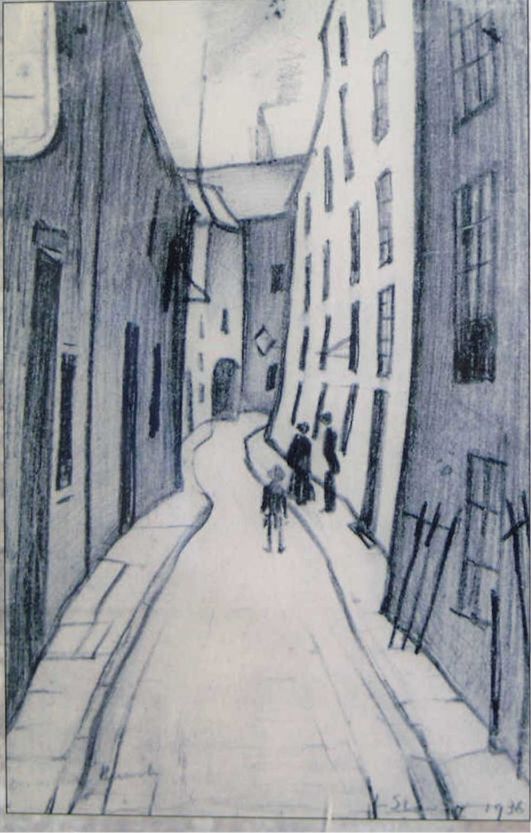
The artist L S Lowry sketched it in 1936  on one of his many visits to the town and it is now part of the town’s Lowry Trail. Below is Lowry’s pencil drawing of the Lane.

Lowry Dewars Lane

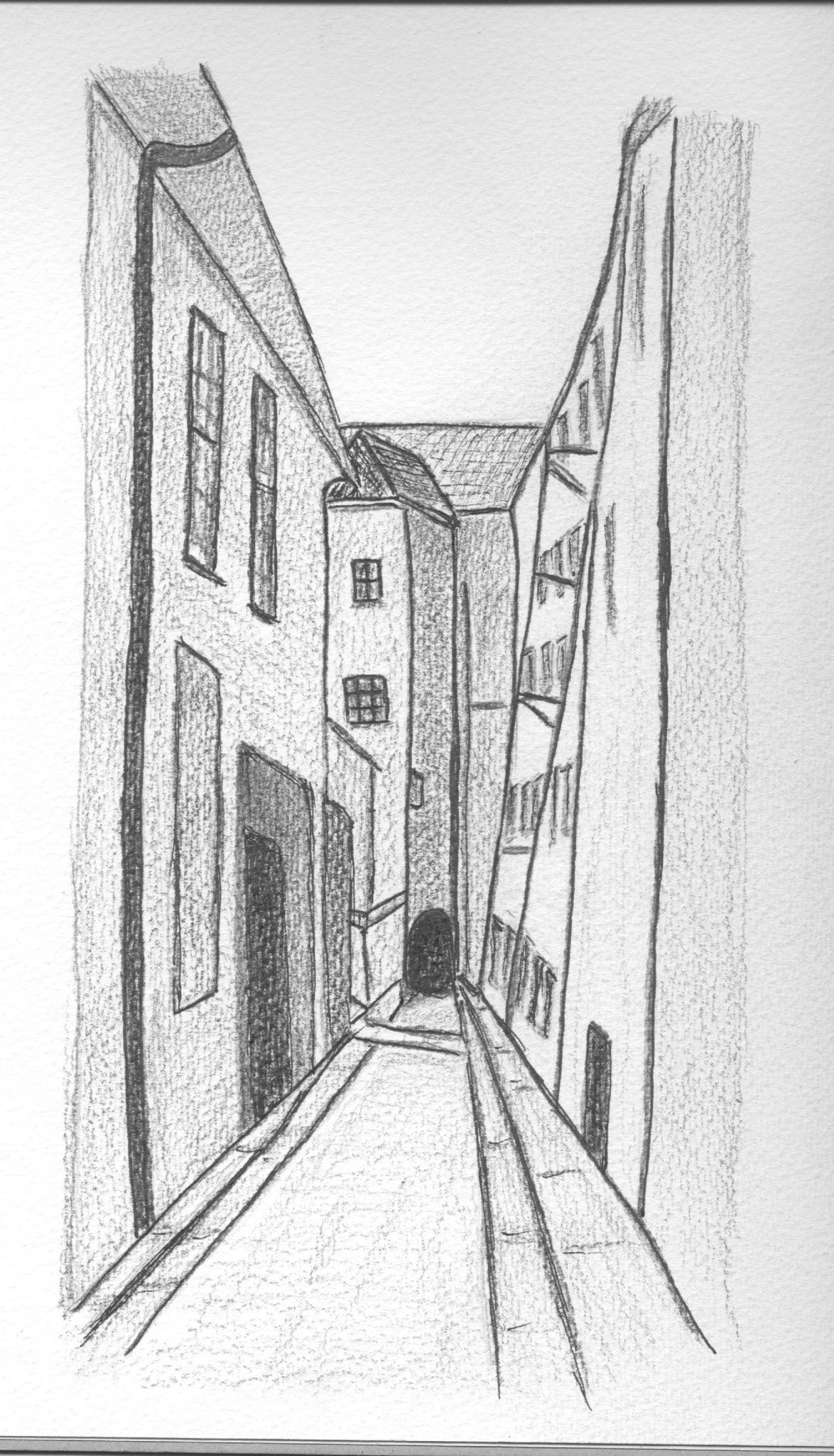
And here is my sketch:

Dewars Lane 001

See more Saturday Snapshots on Alyce’s blog At Home With Books.