Death Comes as the End by Agatha Christie

In 1944 Agatha Christie published Death Comes as the End and in 1945 Sparkling Cyanide, neither of them featuring Hercule Poirot or Miss Jane Marple. By chance these two books are the last full length crime fiction novels by Agatha Christie that I had left to read. There are plenty of short stories of hers that I still have to read and her Mary Westmacott novels as well as her plays, so it is not the end of my reading of her work.

Death Comes As The End

The idea to write a detective story set in Ancient Egypt came from a friend, Professor Stephen Glanville – Death Comes as the End was the result. It is set on the West bank of the Nile at Thebes in about 2000 BC. But in her Authors Note Agatha Christie explained that both time and place are incidental and any other time or place would have served as well. She based her characters and plot on some letters from a Ka priest in the 11th Dynasty:

The letters painted to perfection the picture of a living family: the father fussy, opinionated, annoyed with his sons who did not do as he said; the sons, one obedient but not obviously bright, and the other sharp-tempered, showy, and extravagant. The letters the father wrote to his two sons were about how he must take care of a certain middle-aged woman, obviously one of those poor relations who all through the ages live with families, to whom the heads of families are always kindly, whereas the children usually grow up disliking them because they are often sycophants and makers of mischief. (Agatha Christie’s Autobiography page 514)

From these letters she constructed her story, adding Renisenb, a daughter, Nofret, a concubine for Imhotep, the father, a spoilt younger son and a greedy but shrewd grandmother. He is besotted by Nofret who antagonises the family, setting Imhotep against them. Things come to a head after Nofret has manipulated Imhotep to disinherit his sons and marry her and she is found dead, apparently having fallen from a cliff. More deaths follow.

The mystery in this book is actually not too puzzling. For me, its interest lay in the setting and period details. Agatha Christie, according to her Autobiography had done a lot of reading from books lent to her by Glanville and had also bombarded him with questions about daily life and customs in the 11th Dynasty – such as what food did they eat, how did they cook it, did men and women eat together, what sort of rooms did they sleep in, where did they keep their linen, what sort of houses did they have, and so on?

The end result for me was of authenticity – it all came over as real, the characters were individuals, their relationships were convincing and although Agatha Christie wasn’t happy with the ending, which she changed on Glanville’s suggestion, I thought it was fine. And just as she had pleasure in writing it I had pleasure in reading it.

Reading Challenges: Agatha Christie Reading Challenge, Mount TBR Reading ChallengeVintage Cover Scavenger Hunt for the Golden Age in the category ‘A Green Object’.
Destination Unknown by Agatha Christie

I had no great expectations when I began reading Agatha Christie’s Destination Unknown (first published in 1954) because I’ve not been keen on her stand-alone international intrigue/spy mysteries. But I thought it started very well and I was soon drawn into the story.
It’s the early 1950s and a number of scientists have disappeared, amongst them is Thomas Betterton, a brilliant nuclear scientist, who had discovered ZE Fission. The British Secret Service suspect that he and the other missing scientists have gone beyond the Iron Curtain, either kidnapped, or tempted by money or by the dream of an ideal world, working for the good of humanity. His wife, Olive, has no idea where he is, but sets off for Morocco, ostensibly on medical advice for a complete rest. However, the plane crashes and she is killed before she gets to her destination.

Hilary Craven, whose abundant red hair is similar to Olive’s, is intent on taking her own life, but she is recruited by Jessop, a British Secret Service Agent who persuades her that if she wants to kill herself she could help her country at the same time by impersonating Olive and thus trace Betterton. In doing so it leads her to a secret scientific complex hidden in the High Atlas mountains and a terrifying discovery.

It went over the top with a string of disasters, involving a faked air disaster, radio-active pearls, a leper colony, and secret laboratories all part of a vast organisation masterminded by a wealthy and powerful fanatic. And added to the international intrigue there is also a murder which is only revealed right at the end of the book. If the plot is bizarre and rather weak, and some of the characters are stereotypes, Hilary’s character is more convincing. And as in her other spy thrillers, Agatha Christie uses it as a vehicle for her own concerns about the state of the post-war world, decrying what she saw as the attempt to impose a world order and discipline, where individuality is suppressed. Hilary thinks she:

would rather have a world of kindly, faulty human beings, than a world of superior robots who’ve said goodbye to pity and understanding and sympathy. (page 102)

It’s a dangerous world where

Once you have got into that state of mind where the taking of human lives no longer counts, then if it is simpler to put a little explosive package under a seat in a plane than to wait about at the corner on a dark night and stick a knife in someone, then the package will be left and the fact that six other people will die also is not even considered. (pages 143-144)

Just as true today as in the 1950s!

I am nearing the end of reading Agatha Christie’s full length novels and now have just 2 left to read. Although Destination Unknown is not one of my favourites I did enjoy reading it – it moves quickly and kept me interested in its twists and turns. There’s a lot going on and it’s not easy to know who is telling the truth and who to trust.

****

Added on 15th January 2016:

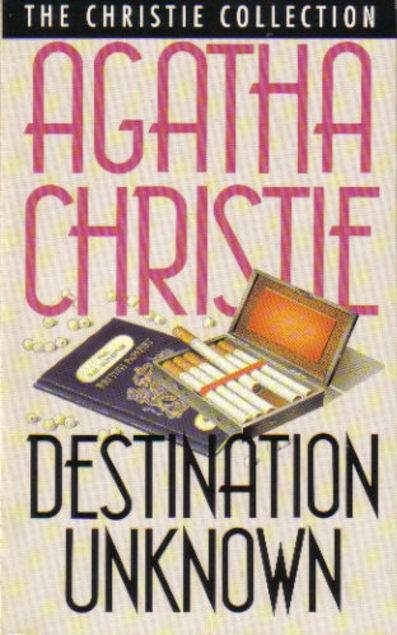
The edition of Destination Unknown that I read has this cover, fulfilling the cigarette/pipe category on the Golden Age Vintage Mystery Hunt card, as well as the Mount TBR Reading Challenge:

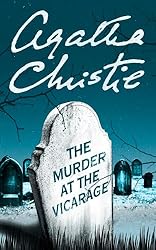
The Murder at the Vicarage by Agatha Christie

Ingenious! That’s what I thought when I’d finished reading The Murder at the Vicarage. Although Agatha Christie had written short stories featuring Miss Marple this is the first full length Miss Marple story, published in 1930.
I’ve been reading my way through Agatha Christie’s crime fiction for a few years now, totally out of order, which is why I’ve only just got round to reading The Murder at the Vicarage. I’d picked up along the way on the fact that Miss Marple uses her knowledge of people to help her solve the mysteries she investigates. And it is in this book that her use of analogy is made absolutely explicit, as she considers who could have killed Colonel Prothero, the unpopular churchwarden, found in the vicar’s study shot through the head. She comes up with seven suspects, all based on examples of human behaviour she has observed in the past.

Miss Marple is not the popular figure she appears in the later books as not everybody likes her. The vicar does, liking her sense of humour, and describing her as ‘a white-haired old lady with a gentle appealing manner’, whereas his wife describes her as ‘the worst cat in the village. And she always knows everything that happens – and draws the worst inference from it.

But it is very helpful to know what is going on in St Mary Mead, about Dr Stone, a well-known archaeologist superintending the excavation of a barrow on Colonel Protheroe’s land and about Mrs Lestrange, a mysterious woman who has recently moved to the village and also about who was coming and going to the vicarage and when.

It’s also helpful to have a a plan of St Mary Mead, showing where the main characters live, and plans of the layout of the vicarage and the vicar’s study, where the murder occurred.

After one of the suspects confesses to the murder Inspector Slack, who shows his contempt for Miss Marple, thinks the case is closed, but Miss Marple is puzzled – the facts seem to her to be wrong. The Murder at the Vicarage has an intricate plot, is full of red herrings and was impossible for me to unravel, but Miss Marple with her knowledge of ‘Human Nature’ solves the mystery.

I enjoyed this book very much, but Agatha Christie writing her Autobiography years later, wasn’t all that pleased with it. She thought it had too many characters and too many sub-plots; she is probably right. But she thought that the main plot was sound and that the village was as real to her as it could be. It’s real to me too.

Agatha Christie Reading Challenge Update

agatha_christie_rcIt’s been a while since I’ve written about where I’m up to in reading my way through Agatha Christie’s crime fiction novels and short stories.  In fact it’s been months since I last read an Agatha Christie book!

The list of the books I’ve already read is on this page. I still have many of the short stories to read but just four novels!!

I’m aiming to read these four remaining novels by the end of this year:

  1. The Murder at the Vicarage – (Miss Marple)
  2. Death Comes as the End
  3. Sparkling Cyanide (Colonel Race)
  4. Destination Unknown

Appointment with Death by Agatha Christie

Agatha Christie’s Appointment with Death, set in the Middle East was first published in 1938 after her final pre-war visit to the area. It seemed right to read this book straight after I’d finished reading Come, Tell Me How You Live in which Agatha Christie wrote about her life on archaeological expeditions in Syria with her husband Max Mallowan.

The novel begins in Jerusalem where the Boyton family are sightseeing. There are two stepsons, one is married, a daughter and a step daughter. Mrs Boynton is a malignant and malicious tyrant who enjoyed exercising her power over her family, who all hated and yet obeyed her. Dr Gerard, a French psychologist, also a tourist remarks that

… she rejoices in the infliction of pain – mental pain, mind you, not physical. That is very much rarer and very much more difficult to deal with. She likes to have control of other human beings and she likes to make them suffer.

The Boyntons and Dr Gerard travel on through the Judean desert to Petra. Also in the group are Jonathan Cope, a family friend, Sarah King, a newly qualified doctor, Lady Westholme, a member of Parliament and Miss Annabel Pierce, a former nursery governess. The beginning of the book is taken up with relating their journey to Petra and the complicated relationships between the characters. It comes to a climax when Mrs Boynton is found dead.

The remainder of the book covers the investigation into her death. Colonel Carbury is in charge and although it appears that Mrs Boynton, who suffered from heart trouble had died overcome by the heat and strain of travelling, he is not satisfied and he has an idea that the family killed her. He enlists the help of Hercule Poirot, who was also in Jerusalem at the same time as the Boyntons and had overheard part of a conversation, ‘You do see, don’t you, that she’s got to be killed.’ He was sure he would recognise that voice again – and he did.

Poirot is his usual confident (arrogant) self, convinced he can solve the mystery and he does through questions, analysis and psychological reasoning. I didn’t work it out myself though.

This is a quick, easy read, with a lot of dialogue in a relatively short book (less than 200 pages). I enjoyed it, although it’s not one of my favourite Agatha Christie books.

I’m including it in Bev’s Color Coded Challenge as the main colour of the cover of my copy is brown. It’s one of the remaining few novels I have left to read for Kerrie’s Agatha Christie Reading Challenge.

Come, Tell Me How You Live by Agatha Christie Mallowan

Agatha Christie had visited the Middle East in 1929 travelling on the Orient Express to Istanbul and then on to Damascus and Baghdad. She visited the excavations at Ur and returned there the following spring where she met archaeologist Max Mallowan – by the end of the summer they had decided to marry, which they did on 11 September 1930. 

Come Tell Me How You Live: an archaeological memoir is her answer to her friends’ questions about what life was like when she accompanied Max on his excavations in Syria and Iraq in the 1930s.
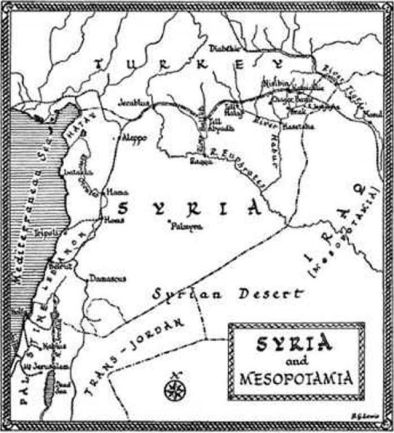
She began writing it before the Second World War and then laid it aside. After four years of the war she picked it up again, using her notes and diaries to complete this memoir, writing about her life with  Max Mallowan and his team excavating the ancient sites at Chagar Bazar, Tell Brak and other sites in the Habur and Jaghjagha region in what was then north western Syria. This map shows the area they were working in:

Syria 1930s

She wrote in the Epilogue  (written in 1944) that in remembering and recording that time it had been

… not a task, but a labour of love. Not an escape to something that was, but the bringing into the hard work and sorrow of today of something imperishable that one not only had but still has!

For I love that fertile country and its simple people, who know how to laugh and how to enjoy life, who are idle and gay, and who have dignity, good manners, and a great sense of humour, and to whom death is not terrible.

Inshallah, I shall go there again, and the things that I love shall not have perished from this earth.

With regard to her statement about death earlier in the book Agatha Christie had explained the difference between the Western and Oriental attitudes to life and death:

Accustomed as we are to our Western ideas of the importance of life, it is difficult to adjust our thoughts to a different scale of values. And yet to the Oriental mind it is simple enough. Death is bound to come – it is as inevitable as birth; whether it comes early or late is entirely at the will of Allah. And that belief, that acquiescence, does away with what has become the curse of our modern day world – anxiety. (page 96)

The emphasis in the book is on the everyday life on a dig and Agatha took an active part, helping to catalogue, label and clean the items they found as well as taking photographs and developing them. She also found time to spend on writing her books. So, although she gives a detailed account of how they worked, how they employed workmen for the excavations and servants who looked after Max and his team of archaeologists, there is not much about what they found.

Although she described the local people in her Epilogue as people, who know how to laugh and how to enjoy life, who are idle and gay, and who have dignity, good manners, and a great sense of humour, she also recorded their disputes:

Quarrelling is, in any case, almost continuous. All our workmen have hot tempers, and all carry with them the means of expressing themselves – large knives, bludgeons, and a kind of mace or knobkerry. Heads are cut open, and furious figures are entangled with each other in fierce struggles … page 86

And she also recorded this chilling statement:

We come to the question of religions generally – a very vexed question in this particular part of the world, for Syria is full of fiercely fanatical sects of all kinds, all willing to cut each other’s throats for the good cause! (page 166)

How sad and horrified she would be if she could see Syria today, but in the light of the extract above I don’t think she would have been too surprised! And sadly the places she loved are no longer the same. Here is her description of the shrine Sheikh ‘Ada near Mosul

There  can be, I think, no spot in the world so beautiful  or so peaceful. You wind far up into the hills through oak trees and pomegranites (sic), following a mountain stream. The air is fresh and clear and pure. …

And then suddenly, you come to the white spires of the Shrine. All is calm and gentle and peaceful there. Gentle-faced custodians bring you refreshments and you sit in perfect peace, sipping tea. (page 109)

Compare that with the description in The Guardian last August of the area as ‘hell on earth‘.

This book is written with love and humour – for example Agatha’s description of buying clothes for her visit to Syria because her last year’s summer clothes  are Shrunk, Faded and Peculiar – and too tight everywhere.  In the Foreword she stated that it is a book full of everyday doings and happenings with ‘no beautiful descriptions of scenery, no treating of economic problems, no racial reflections, no history.‘ I think she was under estimating her writing, because this little book has all that and more. I loved it.