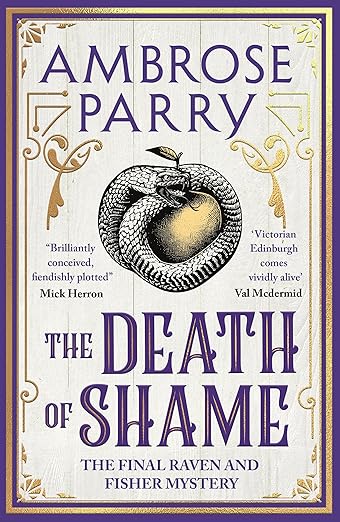
The Death of Shame by Ambrose Parry

Canongate Books| 5 Jun. 2025| 427 pages| e-book| Review copy| 5*

Description:

1854, Edinburgh.
Respectable public faces hide sordid private sins.

Apprentice Sarah Fisher is helping to fund Dr Will Raven’s emerging medical practice in exchange for being secretly trained as a medic, should the rules barring women ever change. Sarah needs no instruction in the inequalities that beset her gender, but even she has her eyes opened to a darker reality when a relative seeks her help in searching for her missing daughter. Annabelle Banks was promised a situation in a prestigious household, but there has been no word from her since she left home, and the agency that arranged her position says she never appeared.

Sarah’s inquiries lead her to reforming campaigners trying to publicise the plight of the hundreds of girls ensnared in Edinburgh’s houses of assignation. Sarah learns how young women are lured, deceived, trafficked and raped, leaving them ruined in the eyes of a society obsessed with moral purity, and where virginity is prized as a lucrative commodity.
Drawing upon real historical events, The Death of Shame takes Raven and Sarah into a treacherous labyrinth of exploitation, corruption, high-level complicity and Victorian-style revenge porn.

Ambrose Parry is the pseudonym of crime fiction author, Chris Brookmyre and Marisa Haetzman, a consultant anaesthetist. The combination of a crime fiction writer and an anaesthetist works excellently in Ambrose Parry’s novels. The research into the history of medicine is extensive, making this book a combination of historical fact and fiction, a tale of murder and medical matters, with the social scene, historical and medical facts slotting perfectly into an intricate murder mystery. 

The Death of Shame by Ambrose Parry is the 5th and final Raven and Fisher book. Dr Will Raven is no longer working with Dr Simpson (a real historical person, renowned for his discovery of chloroform) but is setting up his own medical practice with the financial assistance of Sarah Fisher. Sarah, who began working as a housemaid for Dr Simpson, then as a nurse, has ambitions to train as a doctor, something rarely possible for women in her position. So secretly Will is training her as his apprentice to become a doctor.

It’s set in 1854, when Will and his wife, Eugenie have two children, as she is struggling to bond with her children suffering from postnatal depression. The book begins with the death of her father, himself an eminent doctor with a wealthy practice. It appears he committed suicide but Eugenie can’t accept that and asks Will to investigate. Meanwhile Sarah has also been asked to investigate the disappearance of her young niece who has disappeared after leaving home to start a job in Edinburgh.

The plot is complicated and although you could read this as a standalone book as there is some background to what has happened in the earlier books, I really think it’s better to have read them – and they are well worth reading. Will and Sarah’s separate investigations take them into dark and desperate places dealing with blackmail, murder, suicide, abortion, rape, female exploitation, and prostitution. The position of women and girls in society and the dangers they faced are centre stage.

I always enjoy reading the Historical Notes at the end of the Raven and Fisher books and this one is no exception. It gives the factual background and sources that Ambrose Parry used and information about the real life people who are included in the book as well as Dr Simpson, such as Henry Littlejohn, Edinburgh’s police surgeon who served as Medical Officer for Health and medical advisor to the Crown, and Emily Blackwell, one of the pioneers of women in medicine.

This is a great ending to the series but I’d like to think this is not the end of their stories – I’d love to read more about them! In the meantime there is a short story, The Apple Falls Not Far by Ambrose Parry, a digital exclusive short story from the world of Raven and Fisher to read – more about that in a later post.
Nonfiction November:Week 4- Mind Openers

Throughout the month of November, bloggers Liz, Frances, Heather,  Rebekah and Deb invite you to celebrate Nonfiction November with us.

Week 4 (11/18-11/22) Mind Openers: One of the greatest things about reading nonfiction is the way it can open your eyes to the world around you—no plane ticket required. What nonfiction book or books have impacted the way you see the world in a powerful way? Is there one book that made you rethink everything? Is there a book that, if everyone read it, you think the world would be a better place? (Rebekah)

Ultra Processed People: Why Do We All Eat Stuff That Isn’t Food … And Why Can’t We Stop? by Chris van Tulleken, who has impressed me on numerous TV programmes on diet and nutrition.

About the Author: ‘He is an infectious diseases doctor at the Hospital for Tropical Diseases in London. He trained at Oxford and has a PhD in molecular virology from University College London where he is an Associate Professor. His research focuses on how corporations affect human health, especially in the context of child nutrition, and he works with UNICEF and the World Health Organization in this area. As one of the BBC’s leading broadcasters, his work has won two BAFTAs. He lives in London with his wife and two children.’

I kept hearing about ultra processed food (UPF), but had little idea what exactly it is, so when I saw this book I thought it would be ideal – and it is! It is absolutely fascinating, a real eye opener, and it has changed what I think about what I eat! For a long time I have checked the labels on food packaging without actually realising what all those additives are, nor how the food has been processed. For example it has definitely put me off eating crisps and Pringles. It is shocking!

But it’s not easy to give a simple definition of what UPF is! A very short definition is that ‘if it’s wrapped in plastic and has at least one ingredient that you wouldn’t usually find in a standard home kitchen, it’s UPF.’ (page 5) It’s the processing that is the problem and the additives that are used - such as emulsifiers, flavour enhancers and sweeteners – and it is addictive.

Description from Amazon: An eye-opening investigation into the science, economics, history and production of ultra-processed food.

It’s not you, it’s the food.

We have entered a new ‘age of eating’ where most of our calories come from an entirely novel set of substances called Ultra-Processed Food, food which is industrially processed and designed and marketed to be addictive. But do we really know what it’s doing to our bodies?

Join Chris in his travels through the world of food science and a UPF diet to discover what’s really going on. Find out why exercise and willpower can’t save us, and what UPF is really doing to our bodies, our health, our weight, and the planet (hint: nothing good).

For too long we’ve been told we just need to make different choices, when really we’re living in a food environment that makes it nigh-on impossible. So this is a book about our rights. The right to know what we eat and what it does to our bodies and the right to good, affordable food.

There are chapters on such subjects as why we can’t control what we eat, how our bodies really manage calories and about will power, how UPF hacks our brains, destroys traditional diets and how it is addictive.

I highlighted so much in this book and I think the simplest way of writing about it is to post some of those passages to give you an idea what is in the book that convinced me to cut out eating ultra-processed food (UPF) as much as possible. It’s not easy as so much is now ultra-processed!

Page 5: UPF now (2023) makes up as much as 60% of the average diet in the UK and the USA.

Page 6: a vast body of data has emerged in support of the hypothesis that UPF damages the human body and increases rates of cancer, metabolic disease and mental illness, that it damages human societies by displacing food cultures and driving inequality, poverty and early death, and that it damages the planet.

Page 153 – 154: most UPF is reconstructed from whole food that has been reduced to its basic molecular constituents which are then modified and re-assembled into food-like shapes and textures and then heavily salted, sweetened, coloured and flavoured. … without additives these base industrial ingredients would probably not be recognisable as food by your tongue and brain: ‘It would be almost like eating dirt’.

Page 189: the basic construction materials of UPF are industrially modified carbs, fats and proteins, and the processes they are put through remove all the chemical complexity. The intensity of ultra-processing means that vitamins are destroyed (or deliberately removed in the case of bleaching), fibre is reduced, and there’s a loss of functional molecules like polyphenols. The result is lots of calories but very little other nutrition. … we may be eating more food to compensate for becoming increasingly deficient in micronutrients. … modern diets lead to malnutrition even as they cause obesity.

I could go on and on, but read this book and see for yourself if it makes you think about what you are actually eating. It is a brilliant book!

10 Books of Summer – Wrap Up

Cathy’s summer reading challenge ends tomorrow. I opted for the 10 book version. I revised my original list but still didn’t manage to read all 10. But I did read 7 of them and reviewed 5. I also read the first story in Daphne du Maurier’s short story collection and will read the rest maybe for the R.I.P. Challenge that started yesterday.

  1. On Beulah Height by Reginald Hill 
  2. Darkside by Belinda Bauer 
  3. Ruined Stones by Eric Reed
  4. The Woman in Cabin 10 by Ruth Ware
  5. Absent in the Spring by Agatha Christie
  6. Camino Island by John Grisham  – review to follow
  7. Cecile is Dead by Georges Simenon – review to follow
  8. Don’t Look Now and other stories by Daphne du Maurier – I’ve read the first story

The two I haven’t read are:

  1. Appleby’s End by Michael Innes – I’ve started it but I’m not impressed so far!
  2. Coffin Road by Peter May – I will definitely read this one – possibly also one for the R.I.P. Challenge.

10 Books of Summer – Update

I’m taking part in Cathy’s summer reading challenge and opted for the 10 book version, starting on 1 June 2018 and running until 3 September 2018. One of the joys of this challenge is that you can change your list at any time!

With just over a week left this is my revised list, showing the books I’ve read so far, with links to my posts:

  1. On Beulah Height by Reginald Hill 
  2. Darkside by Belinda Bauer 
  3. Ruined Stones by Eric Reed
  4. Camino Island by John Grisham  – review to follow
  5. The Woman in Cabin 10 by Ruth Ware
  6. Absent in the Spring by Agatha Christie
  7. Appleby’s End by Michael Innes
  8. Cecile is Dead by Georges Simenon
  9. Don’t Look Now and other stories by Daphne du Maurier – I’ve read the first story
  10. Coffin Road by Peter May


Absent in the Spring by Mary Westmacott (Agatha Christie)

img_20180809_0727129331

⭐⭐⭐⭐⭐

I love Agatha Christie’s crime fiction but I’ve held back from reading her other books written under the name of Mary Westmacott, not sure just what to expect. So, I was very glad to find that Absent in the Spring is just as good as her other books and I was thoroughly absorbed in the story of Joan Scudamore who was stranded in the desert, after visiting her daughter in Baghdad.

Agatha Christie managed to keep the true identity of Mary Westmacott a secret for fifteen years! Absent in the Spring is the one book she wrote that  satisfied her completely – and having now read it I can see why. She wrote the book in just three days in 1944. It had ‘grown inside‘ her for six or seven years. She had visualised all the characters and they were there ready for her to write about them and she just had to get it down on paper, writing in a ‘white heat‘, without interruptions until it was finished, leaving her exhausted. She slept for more or less twenty-four hours afterwards. She took the title from Shakespeare’s sonnet that begins ‘From you I have been absent in the spring.’ (Sonnet 98)

It is a great example of an unlikeable character that makes fascinating reading – you don’t have to like a character to love a book. In her Autobiography she wrote that it was:

… the picture of a woman with a complete image of herself, of what she was, but about which she was completely mistaken. Through her actions, her feelings and thoughts this would be revealed to the reader. She would be, as it were, continually meeting herself, not recognising herself, but becoming increasingly uneasy. What brought about this revelation would be the fact that for the first time in her life she was alone – completely alone – for four or five days. (page 516)

The novel is set in Mesopotamia (corresponding to today’s Iraq, mostly, but also parts of modern-day Iran, Syria and Turkey) in a railway rest-house at Tel Abu Hamid on the Turkish border, where Joan is stranded, delayed by floods – no trains or vehicles can get through to Mosul, her next stop on her journey home to London. There are no other travellers there, only an Arab boy and an Indian servant who brings her meals, but who speak little English and there is nowhere to go, except to walk in the desert.

At first she occupies herself writing letters and reading the two books she has with her, The Power House by John Buchan and Memoirs of Lady Catherine Dysart. Then she starts thinking about herself and gradually relives her past life, all the time with a growing feeling of unease and anxiety as she reinterprets her past. She wonders, for the first time in her life what she is really like and what other people think of her, with that unsettling, anxious feeling that she is not the person she thought she was. And she resolves to put things right when she returns home.

She is jolted out of her complacency  and self deception as she remembers how Rodney had looked as she watched him leave Victoria Station:

Suddenly, in the desert,with the sun pouring down on her, Joan gave a quick uncontrollable shiver.

She thought, No, no – I don’t want to go on – I don’t want to think about this …

Rodney, striding up the platform, his head thrown back, the tired sag of his shoulders all gone. A man who had been relieved of an intolerable burden …

Really, what was the matter with her? She was imagining things, inventing them. Her eyes had played a trick on her.

Why hadn’t he waited to see the train pull out?

She was imagining – Stop, that didn’t make it any better. If you imagined a thing like that, it meant that such an idea was already in your head.

And it couldn’t be true – the inference that she had drawn simply could not be true.

She was saying to herself (wasn’t she?) that Rodney was glad she was going away …

And that simply couldn’t be true! (pages 55-56)

It really is a most remarkable book. On the surface it is a simple story, but in fact it is a complex and in-depth character study, with a growing sense of tension. The setting adds to the uneasiness as Joan walks in the desert to get away from the rest-house, with its refuse dump of tins enclosed by a tangle of barbed wire,  and a space where skinny chickens run about squawking loudly and with clouds of flies surrounding the area. There is a twist at the end of the book, which I had begun to anticipate as I approached the final pages, which rounded it off very well. An excellent book.

Now, I really must get hold of her other Mary Westmacott books!

My copy is a paperback, published by Fontana, 2nd impression 1983, 192 pages. This is the 4th book for my 10 Books of Summer 2018 Challenge.

Catching Up: Darkside by Belinda Bauer & The Woman in Cabin 10 by Ruth Ware

Once more I’m behind with reviews of some of the books I’ve read in the past few weeks, so here are some brief notes on two of them that fall into the 10 Books of Summer Reading category.

Darkside by [Bauer, Belinda]

5*

Darkside  is Belinda Bauer’s second novel, set in Shipcott on Exmoor a few years after the events in her first novel, Blacklands. Some of the characters in Blacklands also appear in Darkside, but only in minor roles and I think that Darkside can easily be read as a standalone novel. Shipcott is an isolated village and young PC Jonas Holly is the only policeman in the area covering seven villages and a large part of Exmoor. When Margaret Priddy is killed his inexperience means that has to call in the Taunton Homicide team, led by DCI John Marvel.

Jonas and Marvel clash and Jonas, undermined by as number of anonymous notes accusing him of failing to do his job, tries to keep out of Marvel’s way. More murders follow as Jonas, whose wife Lucy has been diagnosed with MS, is struggling to hold everything together. I liked the characterisation, the description of the setting and the twisty, turning plot. Like Blacklands, Darkside is full of a dark, brooding atmosphere and suspense. I had my suspicions about the identity of the murderer but it was only as I was getting near to the end of the book that I began to think I could possibly be right.

The Woman in Cabin 10

3*

The Woman in Cabin 10 by Ruth Ware didn’t satisfy me as much as Darkside. I liked the beginning of the book. The main character, journalist Lo Blacklock takes the opportunity to fill in for her boss on a luxury press launch on a boutique cruise ship and hopes it will help her recover from a traumatic break-in at her flat. But woken in the night by a scream from cabin 10 next to hers she believes a woman was thrown over board, only to discover that the ship’s records show that cabin 10 was unoccupied. Lo is exhausted from lack of sleep, overwrought with anxiety and dependent on pills and alcohol to see her through. She fails to convince anyone that she is telling the truth.

So far so good. I thought the setting on a luxury cruise ship worked well for this type of locked room mystery. But then as I read on I felt the book was too drawn out, I wasn’t convinced by the plot and in places I found it hard to believe. I wanted to know how it would end  and it is easy reading, so I kept turning the pages. But the final chapter left me cold – tying up the ends in a facile way.