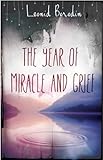
The Year of Miracle and Grief by Leonid Borodin

I received my copy of The Year of Miracle and Grief by Leonid Borodin, translated into English by Jennifer Bradshaw, for review from the publishers, Quartet Books. It’s a new edition due to be published in November, a beautiful little book – just 192 pages, and a pleasure to read.

Synopsis adapted from Quartet Books website:

Nearly thirty years after its first publication in English, in November Quartet Books will publish a brand new English edition of a classic fairytale, The Year of Miracle and Grief by Leonid Borodin. A twelve-year-old boy, the son of teachers, finds magic, mystery, romance, and sadness at beautiful Lake Baikal in Siberia. Deep in Siberia lies the second largest and deepest lake on earth, Lake Baikal. When a small boy arrives on its banks, he is amazed by the beauty of the lake and surrounding mountains. As this astonishment yields to inquisitiveness, he begins to explore the fairytale of the area.  

My view:

This book combines the elements of fantasy and reality, so much so that the narrator is convinced that he is not a spinner of yarns, but that he is relating what actually happened in his childhood. Writing 25 years later, he is now free to tell the tale. And it is a magical and grief stricken tale, a tale of love, forgiveness and suffering!

As he explores the area he is fascinated by Lake Baikal and Dead Man’s Crag, a high bare crag except for a pine tree on its peak, a pine tree with just four branches, two pointing up towards the sky and two larger ones pointing down along the trunk. Despite warnings not to climb the Crag he does just that and it is there that he meets a woman sitting on a throne of stone in a niche hollowed out of the rock. This is Sarma, a wrinkled old woman, so old it was impossible to imagine anyone older:

Her hermetically sealed lips were supported by a large jutting chin which came up to meet her nose, and her eyes were so deeply sunk into the network of wrinkles that the old woman seemed to be blind. She was wearing flowing sky-blue clothes, and this flowing blue enveloped her from head to foot; only her hands, encased in sky-blue gloves reaching to the elbow, contradicted the impression that the blue cocoon contained only a head. (pages 44-5)

She is a descendent of the Great Sibir (the origin of the name Siberia). She flooded Prince Baikolla’s valley, the Valley of the Young Moon, creating Lake Baikal, and guards the cave/underground castle where she holds the Prince and his daughter Ri captive, bewitched by a spell because the Prince had killed her son. But she allows the boy to enter the cave where he falls in love with Ri and begs Sarma to release her. What follows is a dramatic transformation in the boy’s life.

Borodin was a Christian and a Soviet dissident. He was born in 1938 in Irkutsk, near Lake Baikal and both his parents were teachers, like the boy in his book. He was imprisoned twice and wrote A Year of Miracle and Grief whilst in prison. It contains Christian elements focussing on the nature of forgiveness and suffering. He won the 2002 Solzhenitsyn Prize and died in 2011.

Other elements of this book are the landscape, the lake and the mountains and the miracle that takes place in experiencing the beauty of the world, the transformation of your thoughts, feelings and your entire being ‘into a sensation of total rapture in the presence of a miracle.’ (page 8).

Saturday Snapshots

A few weeks ago I posted about the Attack of the Sparrows on the House Martins’ nest. A couple of weeks later the house martins all left and flew off to spend the winter in Africa. Each year they use our house as a building site for their nests. They are beautiful little birds and I love to see them flying high in the sky above our house and the chicks as they poke their heads out of the nest waiting to be fed.

It’s illegal to remove their nests whilst they are building or using them as they’re protected under the Wildlife and Countryside Act 1981 and you could get fined up to £5,000 and/or a 6 month prison sentence for every bird, egg or nest destroyed. And as they’re on the Amber list (because of recent decline in numbers) the RSPB is encouraging people to help them nest.

Well, they didn’t need any encouragement from us and built four nests in the eaves of our house. One was above the living room window, so you can imagine the mess their droppings made on the window and window sill. But now they’ve gone David has taken the nests down and cleaned up the mess they left behind, so he could sadolin the soffits and fascias. The nests came away mainly in one piece. My photos show how they’re constructed – mainly of mud and sticks formed into a cup shape.

House Martins nest P1010917

House Martins nest P1010918For more Saturday Snapshots see Melinda’s blog A West Metro Mommy Reads.

Library Loot

Library LootLibrary Loot is a weekly event co-hosted by Claire from The Captive Reader and Marg from The Adventures of an Intrepid Reader that encourages bloggers to share the books they’ve checked out from the library. To participate, just write up your post and link it using the Mr. Linky any time during the week. And of course check out what other participants are getting from their libraries.

It’s been a while since I did a Library Loot post and as I’ve got quite a pile of books out right now I thought I’d do one today.

Libr Loot Oct 13

There are three books I have on loan that I’m thinking of taking back to the library without finishing reading, all of which I’ve renewed a few times – Dominion by C J Sansom, The Assassin’s Prayer by Ariana Franklin and The Idea of Perfection by Kate Grenville. It’s a shame because I’ve enjoyed other books by these authors, but each time I start reading these books I lose interest and put them down and am in no hurry to pick them up again. Of course, it could just be that it’s not the right time for me to read these books.

I have actually got up to page 154 in The Assassin’s Prayer, which has 414 pages and maybe it’s just me at the moment but it seems so boring, with Adelia, Henry II’s anatomist accompanying his daughter to Sicily, lusting after Bishop Rowley and once more regretting refusing to marry him.

I haven’t read much of Dominion, but have gone off the idea of reading an alternative history of what could have happened if Britain had made peace with Germany in 1940. Similarly with The Idea of Perfection, the beginning chapters are just not interesting me – too much about bridges. It may be the large print edition that’s putting me off too.

I have finished Elly Griffith’s Dying Fall which I enjoyed despite its being written in the present tense. It’s the fifth of her Ruth Galloway books. In this book Ruth travels from her home in Norfolk up to the north of England – Lancashire, to be precise Blackpool, Lytham, Pendle, Preston and Fleetwood – because Dan Golding a friend from university has died in a house fire. He had written to her just before his death with news of an amazing find. It turns out that Dan was murdered and Ruth and Inspector Harry Nelson are instrumental in discovering the truth. It’s yet another book I’ve read about the whereabouts of King Arthur’s Bones – this time it seems he’s the Raven King. A satisfying if undemanding read.

Then there are the books I haven’t started yet, although I have dipped into them. They are:

In the Woods by Tana French – a while back book bloggers were writing enthusiastically about this book, so when I saw it on the shelf I thought I’d see if I like it too. It’s a psychological thriller, so I hope it’s not too scary!

Two Cornish mysteries by Carola Dunn – Manna from Hades and Valley of the Shadow, Cornish village murder mysteries, featuring Eleanor Trewynn recently widowed who runs a charity shop from the ground floor of her house. They’re set in Port Mabyn a fictional village sometime in the 1960s and 70s. I’ve read and enjoyed a few of the Daisy Dalrymple books set in the 1920s, so I’m hoping these will be good too.

Brideshead Revisited by Evelyn Waugh, described on the jacket as Waugh’s most celebrated novel mourning the passing of the aristocratic world Waugh knew in his youth. I missed this when it was serialised on TV and I’ve not seen the film either, so I thought I should read this.

And last but not least a non-fiction book –  Britain’s Last Frontier: a Journey along the Highland Line by Alistair Moffat. The Highland Line marks the furthest north the Romans advanced, dividing the country geologically and culturally, marking the border between Highland and Lowland, Celtic and English-speaking, crofting and farming. This won’t be a quick read as it includes history, myth and anecdote as Moffat makes a journey both in imagination and geographically tracing the route of the Line.  I hope I’ll be able to renew this book.

A Murder is Announced by Agatha Christie

A Murder is Announced was first published in 1950. My copy is in a collection of four Miss Marple stories – A Miss Marple Quartet. I particularly like this cover, showing Joan Hickson as Miss Marple.

Synopsis from Amazon:

The villagers of Chipping Cleghorn, including Jane Marple, are agog with curiosity over an advertisement in the local gazette which reads: ‘A murder is announced and will take place on Friday October 29th, at Little Paddocks at 6.30 p.m.’ A childish practical joke? Or a hoax intended to scare poor Letitia Blacklock? Unable to resist the mysterious invitation, a crowd begins to gather at Little Paddocks at the appointed time when, without warning, the lights go out.

Of course it isn’t a practical joke and someone is murdered. But the mystery is to identify the victim – it’s not as straight forward as it first appears and there are plenty of red herrings. I vaguely remembered seeing the TV version (with Joan Hickson, perfect as Miss Marple) years ago and although I couldn’t remember who did it knew that I had to pay close attention to the detail of where people were sitting or standing in the room at the Little Paddocks when the lights went out. But even though I read it very carefully I was still baffled. It all hinges on family relationships and details of the characters’ identities which are so skilfully hidden that I was kept guessing until very near the end.

It’s not without flaws, some of the characters are a bit sketchy, and some of the novel borders on farce, with Miss Marple imitating a dead person’s voice whilst hiding in a broom cupboard and Mitzi, the highly strung and paranoid cook, a refugee from Germany, screaming like a siren and insisting that the police will take her away and torture her. Still, I wish her recipe for the chocolate cake ‘Delicious Death’ had been revealed.

What I really like about A Murder is Announced is the picture it paints of life in post-war Britain, showing how society was in the process of change. Miss Marple is her usual brilliant self, now seeming very old with ‘snow white hair and a pink crinkled face and very soft innocent blue eyes’, chattering and fluttering, but still as sharp and observant as ever. As she explains the world has changed since the war when everyone knew who everybody was. But now people come and settle in a village and all you know of them is what they say of themselves – you don’t know who they really are! And so, she compares them to the people she does know, people in her village of St Mary Mead, which helps to throw light on the mystery. It’s a layered mystery involving past illness, identities, and questions of inheritance.

A Bookish Meme

I’ve taken part in this meme a couple of times in the past. So I when I saw it again on Irene’s blog, she found it on Carrie’s blog, I thought I’d have a go too.  Here are my answers using the titles of the books I’ve read so far this year.

In school I was: Quiet 

People might be surprised I’m: The English Spy

I will never be: The Hobbit

My fantasy job is: Searching for the Secret River

At the end of a long day I need: The Hand that First Held Mine

I hate it when: Mrs McGinty’s Dead

Wish I had: The Kashmir Shawl

My family reunions are: A Time of Gifts

At a party you’d find me with: The Birthday Boys

I’ve never been to: The Black House

A happy day includes: Wildwood: an Journey Through Trees

Motto I live by: Not the End of the World

On my bucket list: Treasure Island

In my next life, I want to be: Cat Among the Pigeons

Saturday Snapshots

It’s been wet this week – too wet to do much gardening. This has encouraged the Ink Caps to grow. They seemed to spring up over night.

It first appears as just a small white mushroom which then grows into a cylinder with a pretty black frill:

Coprinus Comatus 1

But it soon opens out:

Inkcap P1010900and eventually, having released its spores it looks like this, and then it dissolves:

Coprinus Comatus 3

It’s also known as Lawyer’s Wig and Shaggy Mane. Apparently, it is edible, but I don’t fancy eating it.

For more Saturday Snapshots see Melinda’s blog West Metro Mommy Reads.