Book Beginning: A Sight for Sore Eyes by Ruth Rendell

The library van came round this week and I borrowed another Ruth Rendell book: A Sight for Sore Eyes, first published in 1998. I don’t really check what the book is about when it’s one by Ruth Rendell, as I usually enjoy her books. This one begins:

They were to hold hands and look at one another. Deeply, into each other’s eyes.

‘It’s not a sitting,’ she said, ‘it’s a standing. Why can’t I sit on his knee?’

He laughed. Everything she said amused him or delighted him, everything about her captivated him from her dark-red curly hair to her small white feet. The painter’s instructions were that he should look at her as if in love and she at him as if enthralled. This was easy, this was to act naturally.

This could be the opening to a love story, but this is a Ruth Rendell book and I’m expecting it to be something darker and more mysterious. Indeed, the information on the back cover warns that this is ‘Masterfully spooky. Don’t read this alone.’

For more Book Beginnings see Gilion’s blog Rose City Reader.

2013 Historical Fiction Reading Challenge Wrap Up

Historical FictionHistorical fiction is one of my favourite genres and so this year I joined Historical Tapestry’s Challenge. I was aiming for the Medieval level (to read 15 books), but really hoping to make it to the Ancient History level (to read 25+ books).

I reached the Ancient History level!

Here are the books I read with links to my reviews:

  1. The Lacuna by Barbara Kingsolver
  2. The Redemption of Alexander Seaton by Shona MacLean
  3. Death at Wentwater Court by Carola Dunn
  4. The Kashmir Shawl by Rosie Thomas
  5. The Distant Hours by Kate Morton
  6. Daughters of Fire by Barbara Erskine
  7. The Winter Garden Mystery by Carola Dunn
  8. After Flodden by Rosemary Goring
  9. Sarah Thornhill by Kate Grenville
  10. The Owl Killers by Karen Maitland
  11. Barnaby Rudge by Charles Dickens
  12. Falling Angels by Tracy Chevalier
  13. Tamburlaine Must Die by Louise Welsh
  14. The Bookman’s Tale by Charlie Lovett
  15. To Kill a Mockingbird by Harper Lee
  16. The Red Coffin by Sam Eastland
  17. Silver:Return to Treasure Island by Andrew Motion
  18. The English Spy by Donald Smith
  19. The Birthday Boys by Beryl Bainbridge
  20. The Pillars of the Earth by Ken Follett
  21. The Death Maze by Ariana Franklin
  22. Relics of the Dead by Ariana Franklin
  23. My Antonia by Willa Cather
  24. Once Upon a Castle by Alan S Blood
  25. The Shooting Party by Isabel Colegate
  26. Gone With the Wind by Margaret Mitchell
  27. Julius by Daphne Du Maurier

My favourites are:

The Redemption of Alexander Seaton by Shona MacLean and To Kill a Mockingbird by Harper Lee.

My Kind of Mystery Challenge

Here is yet another reading challenge for 2014 – the My Kind of Mysery challenge which is being hosted by Riedel Fascination, who explains her idea:

Mystery needs no murder! Hidden passageways, ancient places, eerie phenomenon€¦ ‘Dan Brown’ meets Nancy Atherton! Gothic greats of the 1960s-1980s, modern releases. I am launching a reading challenge that welcomes the lot: tutorials, mystery author biographies, fiction€¦ Any form of mystery and its authors fit my all-encompassing theme.

Keep an eye out for fun riddles to solve throughout the year!

The categories are:

Any format.
Any demographic

Non-adult must be published by 1990 or earlier.
Limitless length.
A short story, compilations; bring them to the table!
Reviews wanted.
A link to Goodreads, Book Depository€¦ just to show you finished. One line is fine.

Catch your breath: we launch February 1st, 2014 €“ February 28th, 2015!

I’ve gone through my list of unread crime fiction/mystery books and found I have over 40! So, I’ve decided to go for the category ‘Lost Artifacts’.

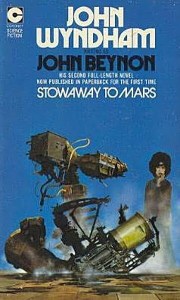
Stowaway to Mars by John Wyndham

Stowaway to Mars by John Wyndham writing as John Beynon, was first published in 1936 as Planet Plane (Newnes Limited, London), then serialised in the periodical The Passing Show as Stowaway to Mars, where it was described as:

an epic serial of the greatest exploration of all … by the man who writes half a century ahead of all the others.

It is set in 1981 when an international prize of £1,000,000 was being offered to the first man to complete an interplanetary journey. Dale Curtance, a British millionaire adventurer takes up the challenge and builds a rocket, the Gloria Mundi. With his crew of four men he blasts off from Salisbury Plain, his destination the planet Mars. Once free of the Earth’s atmosphere they discover a stowaway, a woman, Joan Shirning, the daughter of a professor! She has a strange tale to tell of a machine that her father found, which they believe came from Mars. Having landed on Mars they encounter what appears to be a planet occupied by ‘intelligent self-contained machines’. They claim Mars to be part of the British Commonwealth of Nations, a claim later disputed by the Russians when a second rocket lands.

My copy was published in 1972, with a foreword  stating how right John Beynon was in anticipating the international rivalry for the space race.

Stowaway to Mars is a novel of its time, the male crew members discuss what should be done with their stowaway – they can’t just chuck her overboard, as they would a man! They have a condescending attitude to women thinking that her ‘highest duty is motherhood’. She can be creative, concentrate on producing children rather than machines, because women :

simply have not got the imagination to see the machines as we see them, but they have the power to be jealous of them. … There is nothing good they can say for it. It’s noisy, it’s dirty, it’s ugly, it stinks: and anyway it’s only a jumble of metal bits – what can be really interesting in that? (page 98)

There is a lot of discussion about The Machine and its relationship with Humanity, what it means and what use is made of it. Man’s survival depends on his adaptability and must be willing to break with the past. The reason to venture into space is thought to be to make us wiser, to seek knowledge. Wyndham refers to earlier science fiction writers, such as J J Astor’s Journey in Other Worlds, written in 1894 where he states that ‘the future glory of the human race lies in the exploration of at least the Solar System.’ And Dale and his companions speculate about what they will find on Mars:

It’ll be amusing … to see which of the story-tellers was nearest the truth. Wells, with his jelly-like creatures, Weinbaum, with his queer birds, Burroughs, with his menageries of curiosities, or Stapleton, with his intelligent clouds? And of the theorists, too. Lowell, who started the canal irrigation notion, Lutyen, who said that the conditions are just, but only just, sufficient for life to exist at all. (page 67)

Even though this book is so obviously dated and contains quite lengthy sections theorising about machines, and the existence of life on other planets, I did enjoy it immensely. I really liked the descriptions of Mars, including its history and the reason for the construction of the canals, and the interplay between the characters, although some of them are only sketchily drawn and I couldn’t distinguish between them very easily.

The book ends on an intriguing note, referring to a subsequent tale. To say more would spoil the ending, at least it would have done for me. I don’t think Wyndham actually wrote a sequel, although there is a short story, Sleepers of Mars which deals with the Russians left  stranded on Mars.

John Wyndham’s (1903 – 1969) full name was John Wyndham Parkes Lucas Beynon Harris, and he wrote under several different pseudonyms – John Beynon, John Beynon Harris,  Wyndham Parkes, Lucas Parkes and Johnson Harris.

I’ve had this book for a few years, so it qualifies for Bev’s Mount TBR Challenge and it is the second book I’ve read for Carl’s Science Fiction Experience. It was a really good read and it has got me so interested in finding out more about the history of science fiction itself!
A Year of Reading Agatha Christie: 2013

Agatha ChristieThe Agatha Christie Reading Challenge is run by Kerrie at Mysteries in Paradise. I don’t think of it as a Challenge €“ it’s really a reading project, as it is quite simply to read Agatha Christie’s books. I’m not reading them in order of publication but as I come across them.

As I wrote in a guest post on Alyce’s blog for her series of Best and Worst earlier this year, Agatha Christie has long been one of my favourite writers. I first read some of her books as a teenager, but over the last four years or so I’ve been reading as many of her books that I can find.

She wrote over 100 novels, short story collections and plays and she is one of the best-selling (if not the best-selling) novelists of all time, well known for her crime fiction featuring Hercule Poirot and Miss Marple and other detectives, both amateur and police.

I like many things about her writing. Her style is light, humorous at times, but her writing can be dark creating a tense and menacing atmosphere. Her plots are often ingenious, intricate, complicated puzzles, with the clues scattered throughout the texts. Some of her characters are clearly defined and fully rounded, some are lightly sketched, and others are comic characters, caricatures presented satirically or even farcically. Her settings are often country houses in idyllic English villages, but also in exotic locations in the Middle East as in her archaeological mysteries.

The full list of the 55 novels and short stories that I’ve read is on my Agatha Christie Reading Challenge page. This year I’ve read 9 of her books:

My favourite this year is Cards on the Table, but they all make fascinating reading.

Cards on the Table

  1. Cat Among the Pigeons  (Poirot)
  2. Mrs McGinty’s Dead (Poirot and Ariadne Oliver)
  3. Murder in the Mews (Poirot 4 short stories)
  4. Cards on the Table (Poirot)
  5. Third Girl (Poirot)
  6. Ten Little Niggers aka And Then There Were None
  7. A Murder is Announced (Miss Marple)
  8. N or M? (Tommy and Tuppence)
  9. Ordeal by Innocence

I’ve also read two biographies:

  1. Agatha Christie: an English Mystery by Laura Thompson
  2. Agatha Christie at Home by Hilary Macaskill

There are still plenty of Agatha Christie’s books for me to read. The following books are the ones I own and will be reading next year (not necessarily in this order):

  • They Do It With Mirrors (Miss Marple)
  • The Moving Finger (Miss Marple)
  • Miss Marple and Mystery: Complete Short Stories
  • Poirot Investigates (short stories)
  • The Golden Ball (short stories)
  • Complete Parker Pyne (short stories)
  • The Adventure of the Christmas Pudding (short stories)

The Cupboard by Rose Tremain

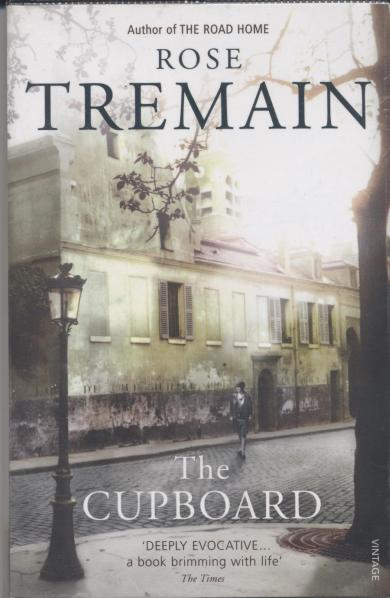
I’ve never read any of Rose Tremain’s books, but when I saw The Cupboard on the library van’s shelves the plainness of the title and the photo on the cover interested me, because they just didn’t seem to match.

The Cupboard 001

I took it off the shelf and read the back cover, where the newspaper critics’ quotations are glowing with praise for Rose Tremain: ‘one of the finest writers in English’ from the Daily Telegraph, ‘Rose Tremain’s fiction is my gold standard’, from The Independent on Sunday’, and ‘Miss Tremain has fashioned the totality of one life – and conveyed the evanescence of all human existence’ from the Sunday Telegraph. So I thought I should have a look inside the book, where I see that Rose Tremain has won many prizes for her books.

But it was the opening paragraph that really caught my attention and is the reason I borrowed the book:

At the age of eighty-seven, Erica March died in a cupboard. She wrapped her body in a chenille tablecloth, laid it out neatly under a few skirts and dresses that still hung on the clothes rail and put it to death very quietly, pill by pill.

Now that makes me want to read on to find out why she did that! Not the accolades or the awards, but the words.

For more Book Beginnings see Gilion’s blog Rose City Reader.