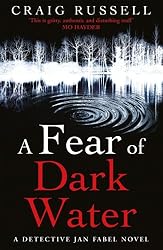
A Fear of Dark Water by Craig Russell

Once more I’m trying to catch up writing about the books I’ve read recently so this is just a short post about A Fear of Dark Water by Craig Russell. It’s the sixth book in the series featuring Jan Fabel, the head of Hamburg’s Murder Commission, but it’s only the second one that I’ve read (I previously read the seventh book, The Ghosts of Altona). Craig Russell has now joined my list of favourite authors and I think Fabel now equals Rebus as one of my favourite police detectives.

In A Fear of Dark Water a massive storm hits Hamburg, flooding the city, just as a major environmental summit is about to start.  A serial rapist and murderer is still at large in the city and when the flood waters recede a headless torso is found washed up. Initially it’s thought to be another victim of the killer, who had dumped his victims’ bodies in waterways around the city.

But there’s more to it than that as Fabel’s investigations dig up a secret environmental organisation/cult called ‘Pharos’, that demands its members hand over all their wealth to it, and with an aggressive and hostile approach to criticism. Fabel is drawn into the high-tech world of cyberspace, particularly the Virtual Dimension site, where people create personalities who only exist in cybre-space and who only interact through the internet – a world unfamiliar to Fabel, who denies he is technophobic, insisting he is a traditionalist.

This is a fast paced and complex, multi-layered crime novel that I thoroughly enjoyed and that kept me guessing right to the end.

The Author

Born in Fife, Craig Russell served for several years as a police officer in Scotland, before becoming an advertising copywriter and later creative director. His Fabel novels were inspired by his long-standing interest in the language, culture and people of Germany.

In addition to his Jan Fabel books Craig Russell also writes the Lennox thrillers set in 1950s Glasgow and I hope to get round to reading those too.

Mrs Jordan’s Profession by Claire Tomalin

Mrs. Jordan's Profession: The Actress and the Prince

I loved Mrs Jordan’s Profession: The Story of a Great Actress and a King, Claire Tomalin’s biography of Dora Jordan. It is both well researched and well written making it easy to read despite being packed with information, brilliantly bringing the late 18th and early 19th centuries to life as she tells the story of Dora and her relationship with the Duke of Clarence, later King William IV .  It’s based on material in the Royal Archives at Windsor; letters from Dora held at the Huntingdon Library, San Merino, California; various private family papers, letters and memorabilia, as well as numerous secondary sources from national and local libraries.  The resulting biography took her several years to complete.

Much of the information about Dora is taken from her own letters, written over 25 years, to her children and friends and many hundreds of those to the Duke of Clarence, the father of ten of her children (the FitzClarences) have survived. She was a remarkably strong character and an incomparable actress.

William, the Duke of Clarence and Dora Jordan were born into very different families – born in 1765 he was the third son of George III and Queen Charlotte,  and she was born in 1761, the daughter of Francis and Grace who although not legally married lived together as Mr and Mrs Bland.  He was not expected to succeed to the throne and as a boy served in the navy, later he was given a dukedom, an income and an estate. She became an actress, known as ‘Mrs Jordan’, although there was never a Mr Jordan. She made her stage debut in 1777 at the age of 15 and her first Drury Lane appearance in 1785. The two met and she became his mistress in 1790, eventually living together at Bushy House in Middlesex. Their relationship was a happy one until, as the years went by, William was put under pressure to find a suitable wife and, of course, marriage to Dora was out of the question. They separated in 1811 and she was heart broken.

There is so much in this book that fascinated me. The attacks in the press on their relationship were vicious and there were storms of abuse – as an actress and a prince they could not have private lives and the journalists and cartoonists were savage in their portrayal of the couple. The cartoons in particular amazed me. ‘Jordan’ was a common term for a chamber-pot, so her name came in very handily, and became an instantly recognisable visual symbol:

Sometimes it was put over the Duke’s head; sometimes he was shown standing in it, with her prettily draped round the edge, naked and mermaid-like. In other drawings the pot reverted to its domestic function under the bed; the words ‘Public jordan open to all parties’ were written round one of these. The most effective and cruellest was Gillray’s simple picture showing Dora as a giant chamber-pot, cracked and with a vagina-shaped hole into which the figure of William is disappearing, giving a nautical shout of pleasure as he does so. His braided coat is hanging on a peg to one side and her ankles and feet in dainty slippers appear below the pot. The caption reads ‘The Lubber’s Hole, alias the Cracked Jordan’, (page 123)

Dora comes across as a very likeable person, hard working, and devoted to her family. She was a talented and probably  the most popular actress of the time in Britain, based at the Theatre Royal, Drury Lane and also appearing in theatres throughout the country, acting throughout her pregnancies and often taking a baby with her on tour. Claire Tomalin writes

She was the best-loved and most admired comic actress of her time, hailed by fellow actors, critics and public alike as a uniquely gifted performer, fully the equal in comedy to Mrs Siddons in tragedy: for several decades they were generally referred to as the Muses of Comedy and tragedy. (page 3)

After she and the Duke separated the debts incurred by a son-in-law drawn on her account forced her to live abroad until they could be cleared, but she sank into illness and despair and died near Paris in 1816.

William succeeded to the throne in 1830, after the death of his older brother, George IV. One of the first acts of his reign was to commission a sculpture – he wanted a life-size representation of Dora, She had been dead for  fifteen years, so Francis Chantrey, the sculptor worked from portraits, finishing it in 1834. William’s intention was to place the statue in Westminster Abbey, but the Dean of Westminster refused to allow it and it remained in Chantrey’s studio. Eventually, after passing through several hands, the fifth Earl of Munster bequeathed it to the Queen and it is now in Buckingham Palace among the portraits of kings and queens in the Picture Gallery.

Like all good biographies Mrs Jordan’s Profession has an extensive bibliography, additional notes and an index. There are several photographs, family trees of and an appendix of Mrs Jordan’s Roles.

  • Paperback: 422 pages
  • Publisher: Penguin 1995
  • Language: English
  • ISBN-13: 978-0140159233
  • Source: I bought the book

Reading Challenges: Mount TBR Reading Challenge 2015, Non Fiction Reading Challenge 2015, TBR Pile Challenge 2015.

Even Dogs in the Wild by Ian Rankin

In Ian Rankin’s previous book Saints of the Shadow Bible Rebus was back on the police force, the rules on retirement age having changed. Now, two years later in Even Dogs In the Wild Rebus is on his second retirement – well almost. It seems they can’t do without him and when someone takes a potshot at retired gangster, Big Ger Cafferty DI Siobhan Clarke suggests they ask him to act in a ‘consultative capacity’ albeit not as a cop and with no warrant card or real powers and with no pay. Cafferty refuses to let the police in to talk to him – he’ll only speak to Rebus. That suits Rebus as he’s bored with being retired, each day the same as the one before.

It seems this is connected to the killing of David Menzies Lord Minton, a former Lord Advocate, who had been found beaten around the head and throttled. He had received a note: I’M GOING TO KILL YOU FOR WHAT YOU DID – as had Cafferty.

A second strand of the story concerns the warfare between two gangs, one from Glasgow, headed by Joe Stark, who have arrived in Edinburgh looking for a guy called Hamish Wright and whatever it is he has stolen from them, and the other from Edinburgh, headed up by Darrell Christie, Cafferty’s successor. DI Malcolm Fox, no longer in Professional Standards, is seconded to the team of undercover cops from Glasgow, surveilling Stark and his men.

And so a complicated scenario unfolds, with more deaths, and so many twists and turns that my mind was in a whirl as I tried to sort out all the characters. After a dramatic scene set in woods in the Fife countryside some years earlier, the story gathered pace and tension as the various elements came together. Who is the murderer, what connection does Cafferty have with Lord Minton, how does the gang warfare fit into the murders, who is the mole in the Glasgow gang, and what happened years ago in Acorn House, an assessment centre for children in care,  a sort of remand home?

It was intriguing to see Rebus and Cafferty working together, although never fully confiding in each other. They have had a complex relationship in the past, aggressive and hostile and yet at times they have worked together before.  Rankin, as usual, successfully combines all the elements of the crime mystery with the personal lives of the main characters and at the same time highlighting various current political and social issues, such as the involvement of public figures in child abuse cases and the effect this has on the individuals concerned and their families.

The title comes from The Associates song of the same name, released in 1982:

Even dogs in the wild
Could do better than this
Even dogs in the wild
Will care for
Whatever means most to them

It’s also interesting to look back over the Rebus books which I began reading eight years ago (to the month!). They cover his life as a detective beginning with Knots and Crosses, first published in 1987. Rebus, ex-army, SAS was then a Detective  Sergeant, aged 42. He was divorced and smoked and drank too much.  By the time of Even Dogs in the Wild in some respects he hasn’t changed much – still a loner, still drinking and smoking, but so much has happened that he has changed, both in his personal and professional life. I’ve read all the books, but I’ve not written about all of them and some of my posts are quite short. At one time I began summarising the books, listing the characters and crimes, but I didn’t get very far – maybe I’ll finish it one day.

I like the series as a whole and think this latest book stands well with the best of them.  The first Rebus book I read was Set in Darkness, the 11th book in the series. It was obvious that this featured characters that had been in the earlier books but I didn’t find it difficult to follow who was who and their relationships. Even so I decided I needed to start at the beginning and read them in sequence. And I think, for me at least, that works best, in order to fully understand the background and how the characters interacted and evolved.

Has Rebus had his day? He tells Fox

‘It feels like the end of a long song though – men like Cafferty and Joe Stark … and me too, come to that … we’re on our last legs. Our way of thinking seems … I don’t know.’

‘Last century?’

‘Aye, maybe.’ (p 243)

We’ll see. One nice touch throughout the book is the little dog, Brillo who seems to have adopted Rebus – but will Rebus settle for walks in the country with Brillo, and being a granddad?

My Week in Books: 11 November 2015

This Week in Books is a weekly round-up hosted by Lypsyy Lost & Found, about what I’ve been reading Now, Then & Next. A similar meme,  WWW Wednesday is run by Taking on a World of Words.

Now: Currently I’m reading two books: Even Dogs in the Wild by Ian Rankin. I’d like to finish this today.

BlurbHands in his pockets, Rebus turned to face Cafferty.
They were old men now, similar builds, similar backgrounds. Sat together in a pub, the casual onlooker might mistake them for pals who’d known one another since school.
But their history told a different story.

Retirement doesn’t suit John Rebus. He wasn’t made for hobbies, holidays or home improvements. Being a cop is in his blood.

So when DI Siobhan Clarke asks for his help on a case, Rebus doesn’t need long to consider his options.

Clarke’s been investigating the death of a senior lawyer whose body was found along with a threatening note. On the other side of Edinburgh, Big Ger Cafferty – Rebus’s long-time nemesis – has received an identical note and a bullet through his window.

Now it’s up to Clarke and Rebus to connect the dots and stop a killer.

Meanwhile, DI Malcolm Fox joins forces with a covert team from Glasgow who are tailing a notorious crime family. There’s something they want, and they’ll stop at nothing to get it.

It’s a game of dog eat dog – in the city, as in the wild.

I’m also reading  Mrs Jordan’s Profession: the Story of a Great Actress and a King by Claire Tomalin, which I’ve been reading very slowly for a few weeks now. I hope to finish it soon. I’m up to 1812/13 when Dora and Prince William have parted and Dora is trying to come to terms with her new situation and pick up the pieces of her life. It’s very moving.

Blurb: Acclaimed as the greatest comic actress of her day, Dora Jordan lived a quite different role off-stage as lover to Prince William, third son of George III. Unmarried, the pair lived in a villa on the Thames and had ten children together until William, under pressure from royal advisers, abandoned her. The story of how Dora moved between the worlds of the eighteenth-century theatre and happy domesticity, of her fights for her family and her career makes a classic story of royal perfidy and female courage.

Then: I recently finished A Fear of Dark Water by Craig Russell. This is the sixth Jan Fabel book, but can be read as a stand-alone. Russell is now one of my favourite authors. This book is so good I raced through it.

Blurb: Just as a major environmental summit is about to start in Hamburg, a massive storm hits the city. When the flood waters recede, a headless torso is found washed up.

Initially, Jan Fabel of the Murder Commission fears it may be another victim of a serial rapist and murderer who stalks his victims through internet social network sites, then dumps their bodies in waterways around the city.

But the truth of the situation is far more complex and even more sinister. Fabel’s investigations lead him to a secretive environmental Doomsday cult called ‘Pharos’, the brainchild of a reclusive, crippled billionaire, Dominik Korn.

Fabel’s skills as a policeman are tested to their utmost as he finds himself drawn into an unfamiliar, high tech world of cyberspace, where anyone can be anybody or anything they want. And he quickly realises that he is no longer the hunter, but the hunted.

I’ll write more about this book in a later post.

Next: always tentative choices as when the time comes I may choose other books, but right now I’m thinking of reading Nagasaki: Life after Nuclear War by Susan Southard, a book that follows the lives of five teenage survivors of the atomic bombing of the civilian population of Nagasak from 1945 to the present day Southard. She  unveils the lives they have led, their injuries in the annihilation of the bomb, the dozens of radiation-related cancers and illnesses they have suffered, and the humiliating and frightening choices about marriage they were forced into as a result of their fears of the genetic diseases that may be passed through their families for generations to come.

And as I like to have both a non-fiction and a fiction book on the go together I may read A Pale View of the Hills by Kazuo Ishiguro, which has post-war life in Japan as its backdrop to a story of memory, suicide, and psychological trauma.

Color Coded Challenge 2015 – Completed

Colour coded

I’ve completed the Color Coded Challenge hosted by Bev at My Readers Block by reading nine books in different colour categories. The colour may either be named in the title or it may appear as the dominant colour for the cover of the book.

Here is what I read with links are to my posts on the books:

1. A book with ‘Blue‘ or any shade of Blue (Turquoise, Aquamarine, Navy, etc) in the title/on the cover. Blue Mercy by Orna Ross (Kindle)

2. A book with ‘Red‘or any shade of Red (Scarlet, Crimson, Burgundy etc) in the title/on the cover. Five Red Herrings by Dorothy L Sayers

3. A book with ‘Yellow‘or any shade of Yellow (Gold, Lemon, Maize, etc.)in the title/on the cover. The Golden Age of Murder by Martin Edwards

4. A book with ‘Green‘or any shade of Green (Emerald, Lime, Jade, etc) in the title/on the cover. Green Darkness by Anya Seton

5. A book with ‘Brown‘or any shade of Brown (Tan, Chocolate, Beige, etc) in the title/on the cover. Appointment with Death by Agatha Christie ‘“ brown cover

6. A book with ‘Black‘or any shade of Black (Jet, Ebony, Charcoal, etc) in the title/on the cover. Gray Mountain by John Grisham

7. A book with ‘White‘or any shade of White (Ivory, Eggshell, Cream, etc) in the title/on the cover. The Man in the Wooden Hat by Jane Gardam ‘“ white cover

8. A book with any other colour in the title/on the cover (Purple, Orange, Silver, Pink, Magneta, etc.). Silver Lies by Ann Parker (Kindle)

9. A book with a word that implies colour (Rainbow, Polka-dot, Plaid, Paisley, Stripe, etc.). House of Shadows by Nicola Cornick

Silver Lies by Ann Parker

From out of the black hole that is my Kindle came Silver Lies by Ann Parker, a new-to-me author. Books have been known to disappear for ever in there and this one had been languishing down in the depths for three years, so I thought it was time to read it. It looked as though it would be a bit different from other books I’ve been reading this year. Apart from True Grit I don’t think I’ve read any westerns for years and actually this one is not a typical western. It’s not a Cowboys and Indians type western at all but is set in 1879/80 in the silver-mining town of Leadville, Colarado in the heart of the Rocky Mountains. It probably fits in more with the crime fiction genre than with westerns, but it was the setting  that attracted me to it.

It’s a really good story beginning when Joe Rose, a silver assayer, facing a bleak future as the last of his money has gone and the hope of making his fortune in silver has disappeared, is found dead in Tiger Alley propped up behind the Silver Queen saloon. Inez Stannert’s husband Mark had won the saloon in a poker game and eight months before the story begins he had left her and their friend and business partner, Abe Jackson to run it on their own. Inez has no idea where he is and whether he’ll ever return.

Joe’s death is just the start of the mystery – was his death an accident or was he murdered and if so why?  Inez sets out to discover the truth and although his wife Emma has asked her to settle his affairs for her what is she keeping from Inez? Where is Mark and why did he leave? There is a new Reverend in town. Inez falls for his charms but is he to be trusted? She had him pegged as a gambler rather than a man of the cloth. And she doesn’t trust the new marshall either – ‘a thin man with the look of a hungry rattlesnake’. Inez knows he is ‘just a two-bit gunslinger from Texas’ hired by the ‘silver barons to keep the peace after last month’s lynching’. So it’s no wonder that she uncovers a web of deceit, counterfeit, blackmail and murder.

With plenty of memorable characters I could easily imagine I was in the silver rush town, a town where:

People rush in – from the East, from the West – and collide at the top of the Rockies. They’re looking for riches or looking to escape. And running. Everyone’s either from their past or running toward some elusive vision of the future. (location 5896)

Leadville was a colourful place, a boom-town, bustling with life -everything is there – the Silver Queen saloon and the Crystal Belle Saloon, Leadville’s leading parlor house, a brick built opera house, whose patrons ‘swelled the after-midnight crowds’ in the Silver Queen saloon, five banks and a small white church with a steeple.

Silver Lies won the Willa Award for Historical Fiction and the Colorado Gold Award and was chosen as best mystery of the year by Publishers Weekly and The Chicago Tribune.  For more information about Ann Parker and her books see her website.

I was completely engrossed in this book with its multi-layered and intricate plot that kept me guessing all the way through.  I hope to read more of this series:
  1. Silver Lies (2003)
  2. Iron Ties (2006)
  3. Leaden Skies (2009)
  4. Mercury’s Rise (2011)

Reading challenges: Mount TBR Reading Challenge 2015Historical Fiction Reading ChallengeColor Coded Challenge