The Black Friar by S G MacLean

The Black Friar by S G MacLean is one of those books that has the power to transport me to another time and place. I was totally absorbed, convinced I was back in England in the 17th century.
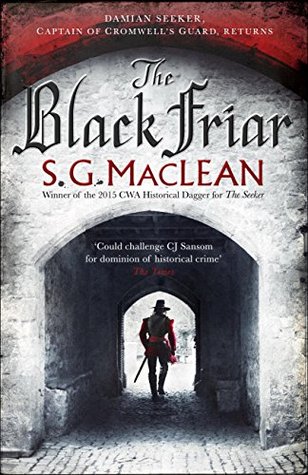
The Black Friar (Damian Seeker, #2)

It is the second book in the Damian Seeker series, historical crime fiction set in 1655 during the Interregnum under Oliver Cromwell, the Lord Protector. Damian Seeker, Captain of Cromwell’s Guard, works for Thurloe, Cromwell’s Chief Secretary and spy master, in charge of the security of the regime. It’s a complex mystery, particularly as there are various factions and religious sects plotting rebellion against Cromwell.

A body, presumed by his black robe to be that of a Dominican friar, is found bricked up in a wall in Blackfriars, once a monastery and now a derelict building gradually falling into the River Fleet. But this was no friar, as Seeker recognised him as Carter Blyth one of Thurloe’s undercover agents, who had been working in the Netherlands, observing the Royalists colluding with foreign powers. As far as Seeker knew he had been killed in Delft three months earlier. Seeker’s task is to find why he had been killed and who killed him. He discovers that Blyth under Thurloe’s orders had in fact infiltrated a group of Fifth Monarchists who wanted to overthrow Cromwell and had been living with the Crowe family, members of the group, under the name of Gideon Fell.

It’s a complicated and intricate tale as Seeker, helped by Nathaniel Crowe, tries to discover what Blyth had been doing, and what trail he was following. There are missing children, whose whereabouts Blyth had been investigating, and plots to overthrow Cromwell as well as plots to reinstate Charles Stuart as King.

Although The Black Friar is the second book in the series, (the first is The Seeker, which I haven’t read) I think it works well as a stand-alone book. The characterisation is strong and I particularly like Damian Seeker, a man both respected and feared, and a man to trust.

I also like the way S G MacLean has based her book on solid historical research (she has an M.A. and Ph.D. in History from the University of Aberdeen) and weaves real historical figures into the story, such as the poet John Milton, now an old blind man, the Secretary of Foreign Tongues and the diarist Samuel Pepys, an Exchequer clerk, who though very personable was ‘prone to drink and some lewdness.’ It all brings to life the atmosphere and tenor of the 1650s. I loved it.

My thanks to Netgalley and Quercus books for my copy of this book. It is due to be published on 6 October.

The Classics Club Spin Result

The result of the Classics Club Spin is No. 1 which for me is Silas Marner by George Eliot. I am so pleased – I wanted a short book and lo and behold this is a short book!

Although the shortest of George Eliot’s novels, Silas Marner is one of her most admired and loved works. It tells the sad story of the unjustly exiled Silas Marner – a handloom linen weaver of Raveloe in the agricultural heartland of England – and how he is restored to life by the unlikely means of the orphan child Eppie.

Silas Marner is a tender and moving tale of sin and repentance set in a vanished rural world and holds the reader’s attention until the last page as Eppie’s bonds of affection for Silas are put to the test.

First published in 1861 as Silas Marner: the Weaver of Raveloe, George Eliot described it as ‘a story of old-fashioned English life’.

Classics Club Spin

The Classics Club

I was just thinking another Classics Club Spin would be nice and it appeared!

The Spin rules:

  •  List any twenty books you have left to read from your Classics Club list.
  • Number them from 1 to 20.
  • On Monday the Classics Club will announce a number.
  • This is the book to read by 1 December 2016.

I decided to organise my list in page number order from short to enormous.  I want to read all of them at some time but right now as I have a backlog of other books that I want to read before December, I hope that one of the shorter books (that is numbers 1 – 4) is chosen!

  1. Silas Marner by George Eliot – 176 pages
  2. All Quiet on the Western Front by Erich Maria Remarque
  3. Sweet Thursday by John Steinbeck
  4. Orlando by Virginia Woolf
  5. North and South by Elizabeth Gaskell
  6. The Black Robe by Wilkie Collins
  7. Love in the Time of Cholera by Gabriel Garcia Marquez
  8. The Forsyte Saga (The Man of  Property) by John Galsworthy
  9. Oliver Twist by Charles Dickens
  10. The Return of the Native by Thomas Hardy
  11. Far from the Madding Crowd by Thomas Hardy
  12. One Hundred Years of Solitude by Gabriel Garcia Marquez
  13. Framley Parsonage (Barsetshire Chronicles, #4) by Anthony Trollope
  14. Mary Barton by Elizabeth Gaskell
  15. Wives and Daughters by Elizabeth Gaskell
  16. Lorna Doone: A Romance of Exmoor by R D Blackmore
  17. Martin Chuzzlewit by Charles Dickens
  18. Nicholas Nickleby by Charles Dickens
  19. Little Dorrit by Charles Dickens
  20. Parade’s End by Ford Maddox Ford – 914 pages


Six Degrees of Separation: From Extremely Loud and Incredibly Close to The Wasp Factory

Six Degrees of Separation is a monthly link-up hosted by Kate at Books Are My Favourite and Best. On the first Saturday of every month, a book is chosen as a starting point and linked to six other books to form a chain. A book doesn’t need to be connected to all the other books on the list, only to the one next to it in the chain.

This month’s chain begins with:

Extremely Loud and Incredibly Close by Jonathan Safran Froer. I read this book when I saw it was the starting point for this chain because I thought it sounded rather different and possibly challenging as it isn’t traditional storytelling. It’s about a boy whose father is killed in the September 11th attacks on the World Trade Centre. Oskar is is trying to discover the facts about his father’s death and also to solve the mystery of a key he discovers in his father’s closet. I liked it enormously.

My chain:

extremely-loud

Little Boy Lost by Marghanita Laski is the first book in this chain – in this a father is looking for his son. I loved this book about life after the Second World War when Hilary Wainwright is searching for his son, lost during the War. Hilary had left France just after his wife, Lisa, had given birth to John. Lisa, unable to leave France, worked for the Resistance, but was killed by the Gestapo and her son disappeared. A friend tells him he may have found the boy, living in an orphanage in rural France and Hilary sets out to discover if the boy is really his son. It is emotional, heart-wrenching and nerve-wracking, full of tension, but never sentimental.

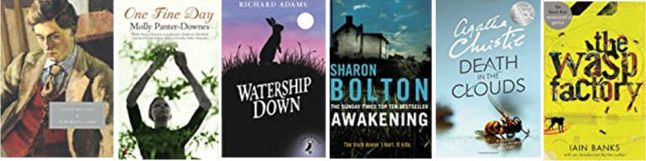
That leads me on to One Fine Day by Mollie Panter-Downes – a beautiful, poetic novel also set after the Second World War, this time about England in 1946.  Mollie Panter-Downes so beautifully captures the essence of the English countryside and the changes in society in the aftermath of war. 

Another book with lovely descriptions of the English countryside is Watership Down by Richard Adams, which I read many years ago. It’s about a community of rabbits who sensing danger in their warren decide to leave in search of a peaceful home and they encounter many dangers and obstacles on the way to their unknown destination.

Awakening by S G Bolton, also features animals. This is crime fiction about Clare Benning, a wildlife vet who would rather be with animals than with people. A a man dies following a supposed snake bite and Clare who is an expert on snakes helps discover the truth about his death. If you don’t like snakes this book won’t help you get over your phobia! The setting is very dark and atmospheric.  

Death in the Clouds by Agatha Christie is also crime fiction, but it’s a kind of locked room mystery, the ‘˜locked room’ being a plane on a flight from Paris to Croydon, in which Hercule Poirot is one of the passengers. In mid-air, Madame Giselle, is found dead in her seat. It appears at first that she has died as a result of a wasp sting (a wasp was flying around in the cabin) but when Poirot discovers a thorn with a discoloured tip it seems that she was killed by a poisoned dart, aimed by a blowpipe.

Wasps provide the last link – it has to be The Wasp Factory by Iain Banks, described as ‘a Gothic horror story of quite exceptional quality … quite impossible to put down‘.  This book has been on my TBR shelves for a few years – it’s time I read it, but I’m not sure I’ll like it. By all accounts it’s a book you either hate or think is brilliant. I’m a bit squeamish, so I may have to abandon it. Here’s the blurb from the back cover:

‘Two years after I killed Blyth I murdered my young brother Paul, for quite different reasons than I’d disposed of Blyth, and then a year after that I did for my young cousin Esmerelda, more or less on a whim. That’s my score to date. Three. I haven’t killed anybody for years, and don’t intend to ever again. It was just a stage I was going through.’

Enter – if you can bear it – the extraordinary private world of Frank, just sixteen, and unconventional, to say the least.

I really enjoyed making this chain (actually there were a couple of other ways I could have made it).  There are books about a father and his son, books set just after the Second World War, books featuring animals (rabbits and snakes), and two books with wasps; books set in New York, England and France; and in different genres. I’ve read all of them, except for The Wasp Factory, which I may or may not read!

And thank you Kate for introducing me to Extremely Loud and Incredibly Close, a book I hadn’t heard of and think is one of the most fascinating books I’ve read.

Books Read in September 2016

Today is the last day of September and as I shan’t finish any of the books I’m currently reading today, my total for the month is eight books – all fiction.

I wrote posts about five of them. Three are books from my TBR piles (books I owned before 1 January this year), one is a library book, two are review books and two are books I bought this year:

  1. The Wench is Dead by Colin Dexter (TBR) – an Inspector Morse book in which he investigates the account of death of Joanna Franks in 1859. An enjoyable book.
  2. The Girl on the Train by Paula Hawkins – a psychological thriller in which Rachel spots a couple from the train window and sees a shocking event. I was not enthralled.
  3. Partners in Crime by Agatha Christie (Tommy & Tuppence short stories) (TBR). I  enjoyed reading them, because they are written with a light touch, and a sense of humour and fun.
  4. Sunshine on Scotland Street by Alexander MCall Smith (LB) – This is an easy read, meandering from one character to the next. It has a light, humorous tone that I enjoyed, along with thoughts about friendship, religion, spirituality and happiness.
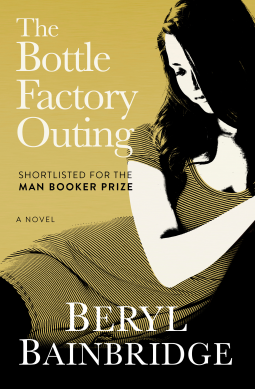
  5. The Bottle Factory Outing by Beryl Bainbridge (RB) – I enjoyed this immensely. It is a tragicomedy, the story of two unlikely friends, Freda and Brenda.  I was completely taken by surprise at the bizarre twist at the end, which I thought was brilliant.

I  shall write a review of The Black Friar by S G MacLean (RB) later next week.

Here are some brief notes of the other two books:

Extremely Loud and Incredibly Close by Jonathan Safran Foer – I enjoyed this unusual story about a boy whose father is killed in the September 11th attacks on the World Trade Centre. Oskar is is trying to discover the facts about his father’s death and also to solve the mystery of a key he discovers in his father’s closet by attempting to search for which of the 162 million locks in New York it might open.

Oskar is an extremely bright nine-year old, most likely on the Autism Spectrum. The narrative, streams of consciousness in parts, switches between Oskar and his grandparents, touches on the bombing of Dresden during the Second World War where his grandparents were living and on the bombing of Hiroshima. The text is interspersed with what at first appear to be random photos. I thought it was fascinating and moving without being sentimental.

A Prayer for Owen Meany by John Irving – I have mixed feelings about this book, parts of it are brilliant, fascinating and funny, but parts of it are tedious and boring. It is about Owen Meany, a very small boy with a strange voice who believes his life is directed by God, and his friend Johnny Wheelwright. Owen accidentally kills Johnny’s mother during a baseball game, setting in motion most of the rest of the story. Johnny doesn’t know who his father is and the two boys try to discover his identity. One of the main themes of the book is the conflict between faith and doubt.

It begins quite slowly and there were times when I was about to give up reading it, but then it picked up pace and grabbed my attention – such as the scenes where Owen plays the part of Baby Jesus in a church nativity, which is hilarious, and the Ghost of the Future (the Ghost of Christmas Yet to Come)  in a performance of A Christmas Carol. But I got increasingly irritated by the capitalisation of everything Owen said and of the enormous amount of description of everything in the minutest detail – and I normally enjoy descriptive writing! Even so, I just had to read to the end, intrigued to find out what would happen.

My favourite book, the book I enjoyed the most, is The Bottle Factory Outing by Beryl Bainbridge.

31556087

The Bottle Factory Outing by Beryl Bainbridge

I’ve recently read The Bottle Factory Outing by Beryl Bainbridge and I enjoyed it immensely.

It is the story of two unlikely friends, Freda and Brenda. Their relationship is the central focus of this book – it’s basically a friendship of convenience as they are complete opposites. Their backgrounds and personalities are very different. They met by chance in a butcher’s shop, where Brenda having left her drunken brute of a husband and a mad mother-in-law was in floods of tears. They share a room and work together in an Italian wine factory in London, gluing labels onto the bottles. Freda is sixteen stone, with blonde hair and blue eyes, Brenda has reddish shoulder-length stringy hair, with a long thin face and short sighted eyes who never looks properly at people. The difference between them is epitomised in Bainbridge’s description,

At night when they prepared for bed Freda removed all her clothes and lay like a great fretful baby, majestically dimpled and curved. Brenda wore her pyjamas and her underwear and a tweed coat.

Brenda desperately tries to escape the the amorous attentions of Rossi, the factory manager – as Freda says Brenda is a born victim, who’s asking for trouble. But it’s not just Brenda who runs into trouble. Freda, who is in love with Vittorio, the trainee manager and nephew of the factory owner, organises a factory outing in the hope that she can seduce him, but the outing goes from bad to worse.The van arranged to take them to a stately home fails to turn up so only those who can fit into two cars set off, then there are fights at Windsor Castle, and a bizarre visit to a safari park. Passions rise, tempers flare, barrels of wine are consumed and it ends in violence and tragedy.

The book begins as a comedy, but then continues with an uneasy undercurrent as the outing gets under way before descending into a dark tragedy that is surreal and farcical and also desperately sad.  Beryl Bainbridge’s writing, so easily readable, is rich in descriptions. The book is superbly paced; the tension rises in an atmosphere of seediness, and frustration, before reaching an unbelievable and grotesque climax.  I had no idea how Bainbridge could draw this story to an end and was completely taken by surprise at the bizarre twist at the end, which I thought was brilliant. It’s savagely funny, full of pathos, touching moments, frustrations, shame, stress and unhappiness, all combining to make this a most entertaining book.

Beryl Bainbridge (1932 ‘“ 2010) was made a Dame in 2000. She wrote 18 novels, three of which were filmed, two collections of short stories, several plays for stage and television, and many articles, essays, columns and reviews. Five of her novels were nominated for the Booker Prize, but none of them won it. Years ago before I began writing BooksPlease I read two of her books, historical novels, one being According to Queenie, published in 1999, a novel about the life of Samuel Johnson as seen through the eyes of Queeney, Mrs Thrale, and the other Master Georgie, published in 1998, set in the Crimean War telling the story of George Hardy, a surgeon.

Since then I have read three more of her books and loved each one –  A Quiet Life, published in 1976, a semi-autobiographical novel, using her own childhood and background as source material; An Awfully Big Adventure, another semi-autobiographical novel set in 1950, based on Beryl Bainbridge’s own experience as an assistant stage manager in a Liverpool theatre, published in 1989 and shortlisted for the Booker Prize; and The Birthday Boys, a novel about Captain Scott’s last Antarctic Expedition, published in 1991.

The Bottle Factory was inspired by Beryl Bainbridge’s experience working part time in a bottle factory in 1959. It was first published in 1974 and was shortlisted for the Man Booker Prize in that year.

Thanks to the publishers, Open Road Integrated Media, via NetGalley for my copy of this ebook edition, featuring an illustrated biography of Beryl Bainbridge including rare images from the author’s estate. It’s due to be released in the US on 4 October.

Amazon US link