Maigret’s Holiday by Georges Simenon

I am way behind with writing about the books I’ve read, so I thought it’s best to start catching up by writing about the last book I finished, whilst it is still relatively fresh in my mind.
Rating: 5 out of 5.

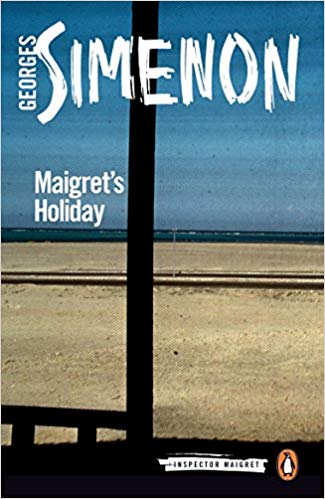
Maigret’s Holiday, translated by Ros Schwartz, is one of Penguin Classics’ new translations of the entire series of Georges Simenon’s Maigret novels. This edition was published 4 February 2016. It was first published in French as Les Vacances de Maigret in 1948 (the 28th book in the series) and has previously been published in translations as No Vacation for Maigret and A Summer Holiday.

It is August; Maigret and his wife are on holiday in the seaside town of Les Sables d’Olonne. On their first evening they’d eaten a huge dish of freshly caught mussels and they’d both been ill. Maigret quickly recovered but next day on the beach Madame Maigret complained of vague pains and their second night she developed a fever. Admitted to hospital the next day, she was still there nine days later after an emergency operation for acute appendicitis. When a young woman in room 15 in another ward died, Maigret was unable to resist investigating the circumstances of her death, especially as he had received an anonymous note that had been slipped into his pocket; the words irritated him:

For pity’s sake, ask to see the patient in room 15.

The young woman had died after being flung from a moving car. Of course, it is not a straightforward death and the mystery deepened with the disappearance of her brother.

Maigret visited his wife everyday for half an hour. But he was bored with his routine as he strolled around the resort, along the promenade, Le Remblai, feeling he couldn’t go and sit alone on the vast beach among all the mothers and their children. He wandered from stall to stall in the covered market and stopped at cafes and various favourite places for a glass of white wine or of Calvados. Each afternoon he went to the Brasserie du Remblai, overlooking the beach, where a group of important men, including the local chief inspector of police, Monsieur Mansuy, met to play bridge. Maigret sat and watched them play. And it is through Mansuy that Maigret learns about the local characters, which proves essential for him in solving the mystery.

I loved the way Simenon sets the scene. His writing is direct and lucid with just the right amount of description. I could imagine myself in Les Sables d’Olonne, walking on the narrow cobblestone streets and going into the hospital with its atmosphere that reminded Maigret of his childhood when he was a choirboy – ‘the purity of silence had a quality that cannot be found anywhere other than a convent.’ A hospital where the nurses were nuns.

Maigret relieved his boredom by investigating the mystery surrounding the patient in room 15. He gradually peeled back the layers and without him, no one would have had any idea what had really happened or why. Maigret worked methodically and thoroughly, as he tried to understand the locals and their reactions to the police. In the end he painstakingly visited the shops and cafes asking questions and realised that there was at least one other person in danger. But he knew nothing about that person, not even whether it was a man or a woman and he couldn’t guess their age or profession. As he got closer to the solution he became agitated, so much so that it seemed to him that he was no longer breathing, as he tried to avert a further tragedy.

I thoroughly enjoyed reading this book. It is perfectly paced, building in intensity and complexity, over just 199 pages. A note about the author reveals that Simenon acknowledged that he and his fictional detective shared an important characteristic:

My motto, to the extent that I have one, has been noted often enough, and I’ve always conformed to it. It’s the one I’ve given to old Maigret, who resembles me in certain points … ‘understand and judge not.’

I think that is exactly what Maigret does in this book.
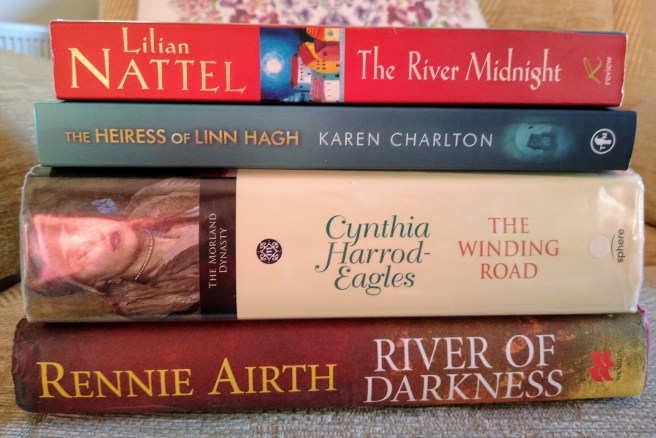
Bookshelf Travelling: 11 July 2020

Judith at Reader in the Wilderness hosts Bookshelf Travelling for Insane Times. Judith hasn’t posted on her blog since June 23 and I’m hoping that she’s OK and that, rather than anything else, it’s an internet problem, as where she lives high winds cause branches and trees to topple on power lines.

One of my favourite genres is historical fiction, including historical crime fiction. I don’t arrange my books by genre, so these books are shelved with the rest of my fiction in author order. For this week’s post I’ve picked out just four novels, none of which I’ve read yet.

From the bottom up:

River of Darkness by Rennie Airth is a book recommended by fellow book blogger Ann at Café Society. It’s the first novel in his John Madden trilogy, published in 1999. It was shortlisted for four crime fiction awards and won the Grand Prix de Littérature Policière in France. My copy is a hardback, in good condition, that I got from Barter Books in Alnwick.

It is 1921 and a terrible discovery has been made at a manor house in Surrey – the bloodied bodies of Colonel Fletcher, his wife and two of their staff. The police seem ready to put the murders down to robbery with violence, but DI Madden from Scotland Yard sees things slightly differently.

Next up is The Winding Road by Cynthia Harrod-Eagles, a big hardback of 662 pages, that I bought in a library sale. There are 35 books in the Morland Dynasty series and I haven’t read any of them. This is the 34th book in the series, so I am hoping it will read well as a standalone. It’s set in the 1920s, the Jazz Age is in full swing in New York, the General Strike is underway in London, the shadows are gathering over Europe and the Wall Street Crash brings the decade to an end.

The Heiress of Linn Hagh by Karen Charlton is another book I got from Barter Books. This is set in 1809 in Northumberland and it’s a spin-off novel from Catching the Eagle, which features Detective Stephen Lavender and Constable Woods. A beautiful young heiress disappears from her locked bedchamber at Linn Hagh. The local constables are baffled and the townsfolk cry ‘witchcraft’.

The heiress’s uncle summons help from Detective Lavender and his assistant, Constable Woods, who face one of their most challenging cases: The servants and local gypsies aren’t talking; Helen’s siblings are uncooperative; and the sullen local farmers are about to take the law into their own hands. Lavender and Woods find themselves trapped in the middle of a simmering feud as they uncover a world of family secrets, intrigue and deception in their search for the missing heiress.

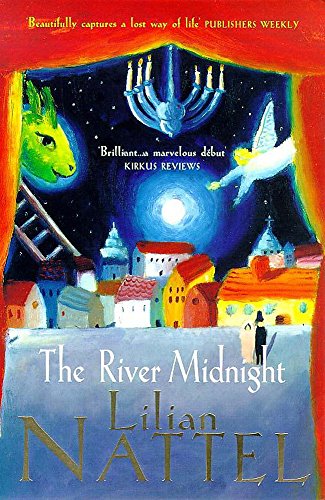
And finally on top of the pile is The River Midnight by Lilian Nattel, a Canadian author I found through reading her blog, Lilian’s Journal. I found this paperback copy in a secondhand bookshop – The Old Melrose Tea Rooms and Bookshop, tucked away down a little lane between the Eildon Hills and the River Tweed, about two miles from Melrose in the Scottish Borders. The bookshop is upstairs in the barn.

The River Midnight is about the fictional village of Blaska, a small Jewish community in Poland at the turn of the 20th century, when Poland was under Russian occupation. It is told from the perspective of a group of women, including Misha, the midwife, Hannah-Leah, the butcher’s wife, and Faygela, who dreams of the bright lights of Warsaw.
Myth meets history and characters come to life through the stories of the women’s lives and prayers, their secrets, and the intimate details of everyday life.

I love the cover of this book – different from the cover available on Amazon.

I’d love to hear from you if you’ve read any of these books, or are tempted by any of them.

My Friday Post: The Luminaries by Eleanor Catton

Every Friday Book Beginnings on Friday is hosted by Gillion at Rose City Reader where you can share the first sentence (or so) of the book you are reading, along with your initial thoughts about the sentence, impressions of the book, or anything else the opener inspires.

My choice this week is The Luminaries by Eleanor Catton, one of my TBRs. I’ve had this book for 3 years and decided to read it now after watching (recorded) the first episode of the TV series.

It begins:

MERCURY IN SAGITTARIUS

In which a stranger arrives in Hokitika; a secret council is disturbed; Walter Moody conceals his most recent memory; and Thomas Balfour begins to tell a story.

I am confused this is not like the start of the TV adaptation at all.

Also every Friday there is The Friday 56, hosted by Freda at Freda’s Voice.

30879-friday2b56

These are the rules:

  1. Grab a book, any book.
  2. Turn to page 56, or 56% on your eReader. If you have to improvise, that is okay.
  3. Find any sentence (or a few, just don’t spoil it) that grabs you.
  4. Post it.
  5. Add the URL to your post in the link on Freda’s most recent Friday 56 post.

Page 56:

Over the past fortnight Balfour had kept his silence on the subject of Lauderback’s encounter with the dead man, Crosbie Wells, though the circumstances of the hermit’s death held a considerable amount of curiosity for him; he had not discussed Anna Wetherall, the whore on the road, at all

I am now read on past this passage and am on page 65 and even more confused – some of the characters are the same in book and TV, but I no longer know who is who!

I resorted to Google and discovered an article in the Radio Times that explained it to me – MAJOR CHANGES HAVE BEEN MADE – Eleanor Catton has adapted her own novel for the screen – and she’s reframed the story from a new perspective:

For one thing, there’s the total absence of Walter Moody from the first four episodes. That’s in stark contrast to the book, which memorably begins with the arrival of Scottish lawyer Mr Moody in the smoking room of the Crown Hotel in Hokitika.

So, now I have a dilemma – shall I carry on reading the book or watching the TV series?

The book blurb:

It is 1866, and Walter Moody has come to make his fortune upon the New Zealand goldfields. On arrival, he stumbles across a tense gathering of twelve local men, who have met in secret to discuss a series of unsolved crimes. A wealthy man has vanished, a whore has tried to end her life, and an enormous fortune has been discovered in the home of a luckless drunk. Moody is soon drawn into the mystery: a network of fates and fortunes that is as complex and exquisitely patterned as the night sky.

The Luminaries is an extraordinary piece of fiction. It is full of narrative, linguistic and psychological pleasures, and has a fiendishly clever and original structuring device. Written in pitch-perfect historical register, richly evoking a mid-19th century world of shipping and banking and goldrush boom and bust, it is also a ghost story, and a gripping mystery. It is a thrilling achievement and will confirm for critics and readers that Catton is one of the brightest stars in the international writing firmament.

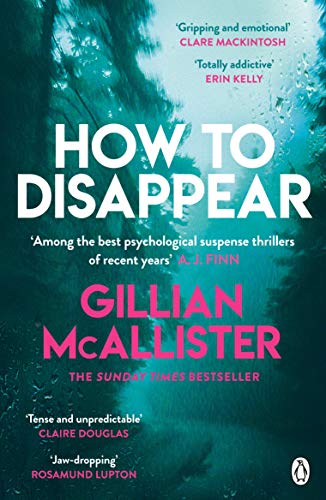
How to Disappear by Gillian McAllister

I’ve read three books by Gillian McAllister and enjoyed each one so I was delighted when I saw that she has a new book, How To Disappear published today. But, I have mixed feelings about this book, because although it is so tense in parts and is compulsive reading – I really wanted to know what happens next – I did have difficulty in suspending my disbelief for a large part of it. I liked the originality of the story – a murder mystery that is not a police procedural or an amateur detective story, but the story of a family devastated by their experience of being in witness protection. Although I’ve seen TV dramas about witness protection I’ve never read a novel before about it.

Blurb:

What do you do when you can’t run, and you can’t hide?

Lauren’s daughter Zara witnessed a terrible crime. But speaking up comes with a price, and when Zara’s identity is revealed online, it puts a target on her back. The only choice is to disappear. To keep Zara safe Lauren will give up everything and everyone she loves, even her husband. There will be no goodbyes. Their pasts will be rewritten. New names, new home, new lives. The rules are strict for a reason. They are being hunted. One mistake – a text, an Instagram like – could bring their old lives crashing into the new. They can never assume someone isn’t watching, waiting.

As Lauren will learn, disappearing is easy. Staying hidden is harder…

I thought it began well, although, it’s written in the present tense, often a stumbling block for me, setting the scene and establishing the characters. Zara is fourteen when she witnesses the murder of a homeless man by two teenagers. A year later she gives evidence as Girl A, to protect her identity, at the trial of two teenage footballers. But it all goes wrong, the boys are freed and after the trial a search is on to discover her identity and make her pay for what she did. As the situation escalates she is forced to go into witness protection.

This is a dark, intense story about what happened next, and going into more detail about what led up to the murder. It’s told from the four main characters’ viewpoints – Zara, Lauren her mother, Aidan her stepfather and his daughter Ruby. It moves along at quite a good pace, although sometimes I thought it was a bit repetitive about long hot baths or lack of a long hot bath, comfort eating cakes, and compulsive shopping.

The main themes of the book are about witness protection, parenting and family relationships. Gillian McAllister explains in her Author’s Note that there are many blanks she was unable to fill in, ‘due to the UK’s protection service not wishing to reveal their secrets’ to her. She hopes it is ‘believable despite basically having … made it up.’ I found it believable up to a point, but it was the characters’ behaviour that I found so far-fetched. However, it certainly made me wonder how I would cope in witness protection, faced with being unable to contact the family I’d left behind in anyway for fear of the consequences. But, most of all, I didn’t enjoy reading it, and for me that is important when I’m reading a novel. It left me drained – and the ending felt so contrived that it really spoiled the whole book for me.

This was not an easy book for me to review, especially as I was expecting to enjoy it as much as her earlier books!

  • Format: Kindle Edition
  • File Size: 1560 KB
  • Print Length: 480 pages
  • Publisher: Penguin (9 July 2020)
  • Source: Review copy
  • My rating: 2

My thanks to the publishers, Penguin for my review copy via NetGalley.

Top Ten Tuesday: Authors Whose Books I’ve Read the Most

Top Ten Tuesday is a weekly meme created by The Broke and the Bookish and now hosted by Jana at That Artsy Reader Girl. For the rules see her blog. This week’s topic is  Authors Whose Books I’ve Read the Most.

My list is of the authors whose books I’ve read the most since I began my blog. I’ve linked them to their pages on the Fantastic Fiction website. They are a mix of crime fiction and historical fiction.

  1. Agatha Christie
  2. Ian Rankin
  3. Ann Cleeves
  4. Peter Robinson
  5. Andrew Taylor
  6. Robert Harris
  7. Elly Griffiths
  8. Georges Simenon
  9. Daphne du Maurier
  10. Sharon Bolton

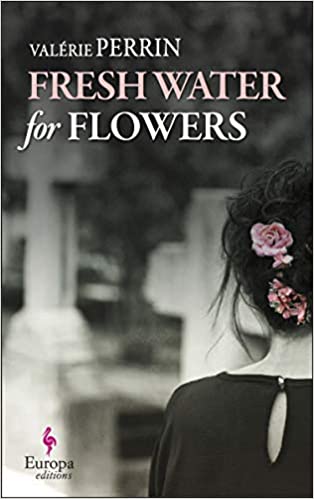
Fresh Water for Flowers by Valerie Perrin

I finished reading  Fresh Water for Flowers by Valérie Perrin a while ago, so this is just a brief post which really doesn’t do justice to this beautifully written book, translated from the French by Hildegarde Serle. It will be published by Europa Editions on 7 July 2020. My copy is an uncorrected proof from NetGalley.

This is a story of love and loss – and hope. Violette, the caretaker at a cemetery in a small town in Bourgogne, is a character I really warmed to; she is optimistic, brave, creative and caring. This is very much a character driven story, and full of original and quirky characters, such as the three gravediggers – Nono, Gaston and Elvis. But it is also a story with a mystery at the heart of it – as Julien Seul, the policeman is delving into his mother’s past, intrigued by her wish to have her ashes scattered far from her home and on the grave of a stranger.

It is also an emotional and moving story about Violette, her estranged husband, Phillippe, his miserable parents and their young daughter, Leonine. What happened to Leonine is especially tragic. But this a story full of warmth and happiness and life in the cemetery is full of surprises and joy. It is not what I expected to be and I am so pleased I’ve read it.

I haven’t said very much about the plot – so here is the publishers’ description:

A POIGNANT RUNAWAY BESTSELLER full of French charm and memorable characters, Fresh Water for Flowers is Valérie Perrin’s English debut.

Violette Toussaint is the caretaker at a cemetery in a small town in Bourgogne. Casual mourners, regular visitors, and sundry colleagues—gravediggers, groundskeepers, and a priest—visit her to warm themselves in her lodge, where laughter, companionship, and occasional tears mix with the coffee she offers them. Her life is lived to the rhythms of their funny, moving confidences.

Violette’s routine is disrupted one day by the arrival of Julien Sole—local police chief—who insists on scattering the ashes of his recently deceased mother on the gravesite of a complete stranger. It soon becomes clear that Julien’s inexplicable gesture is intertwined with Violette’s own difficult past.

With Fresh Water for Flowers, Valérie Perrin has given readers an intimately told story that tugs on the heartstrings about a woman who believes obstinately in happiness, despite it all. A number one bestseller in France, Fresh Water for Flowers is a heartwarming and tender story that will stay will readers for years after the final page is turned.

My thanks to the publishers and NetGalley for an uncorrected proof copy.