Library Loot

Library LootLibrary Loot is a weekly event co-hosted by Claire from The Captive Reader and Marg from The Adventures of an Intrepid Reader that encourages bloggers to share the books they’ve checked out from the library. To participate, just write up your post and link it using the Mr. Linky any time during the week. And of course check out what other participants are getting from their libraries.

It’s been a while since I did a Library Loot post and as I’ve got quite a pile of books out right now I thought I’d do one today.

Libr Loot Oct 13

There are three books I have on loan that I’m thinking of taking back to the library without finishing reading, all of which I’ve renewed a few times – Dominion by C J Sansom, The Assassin’s Prayer by Ariana Franklin and The Idea of Perfection by Kate Grenville. It’s a shame because I’ve enjoyed other books by these authors, but each time I start reading these books I lose interest and put them down and am in no hurry to pick them up again. Of course, it could just be that it’s not the right time for me to read these books.

I have actually got up to page 154 in The Assassin’s Prayer, which has 414 pages and maybe it’s just me at the moment but it seems so boring, with Adelia, Henry II’s anatomist accompanying his daughter to Sicily, lusting after Bishop Rowley and once more regretting refusing to marry him.

I haven’t read much of Dominion, but have gone off the idea of reading an alternative history of what could have happened if Britain had made peace with Germany in 1940. Similarly with The Idea of Perfection, the beginning chapters are just not interesting me – too much about bridges. It may be the large print edition that’s putting me off too.

I have finished Elly Griffith’s Dying Fall which I enjoyed despite its being written in the present tense. It’s the fifth of her Ruth Galloway books. In this book Ruth travels from her home in Norfolk up to the north of England – Lancashire, to be precise Blackpool, Lytham, Pendle, Preston and Fleetwood – because Dan Golding a friend from university has died in a house fire. He had written to her just before his death with news of an amazing find. It turns out that Dan was murdered and Ruth and Inspector Harry Nelson are instrumental in discovering the truth. It’s yet another book I’ve read about the whereabouts of King Arthur’s Bones – this time it seems he’s the Raven King. A satisfying if undemanding read.

Then there are the books I haven’t started yet, although I have dipped into them. They are:

In the Woods by Tana French – a while back book bloggers were writing enthusiastically about this book, so when I saw it on the shelf I thought I’d see if I like it too. It’s a psychological thriller, so I hope it’s not too scary!

Two Cornish mysteries by Carola Dunn – Manna from Hades and Valley of the Shadow, Cornish village murder mysteries, featuring Eleanor Trewynn recently widowed who runs a charity shop from the ground floor of her house. They’re set in Port Mabyn a fictional village sometime in the 1960s and 70s. I’ve read and enjoyed a few of the Daisy Dalrymple books set in the 1920s, so I’m hoping these will be good too.

Brideshead Revisited by Evelyn Waugh, described on the jacket as Waugh’s most celebrated novel mourning the passing of the aristocratic world Waugh knew in his youth. I missed this when it was serialised on TV and I’ve not seen the film either, so I thought I should read this.

And last but not least a non-fiction book –  Britain’s Last Frontier: a Journey along the Highland Line by Alistair Moffat. The Highland Line marks the furthest north the Romans advanced, dividing the country geologically and culturally, marking the border between Highland and Lowland, Celtic and English-speaking, crofting and farming. This won’t be a quick read as it includes history, myth and anecdote as Moffat makes a journey both in imagination and geographically tracing the route of the Line.  I hope I’ll be able to renew this book.

A Murder is Announced by Agatha Christie

A Murder is Announced was first published in 1950. My copy is in a collection of four Miss Marple stories – A Miss Marple Quartet. I particularly like this cover, showing Joan Hickson as Miss Marple.

Synopsis from Amazon:

The villagers of Chipping Cleghorn, including Jane Marple, are agog with curiosity over an advertisement in the local gazette which reads: ‘A murder is announced and will take place on Friday October 29th, at Little Paddocks at 6.30 p.m.’ A childish practical joke? Or a hoax intended to scare poor Letitia Blacklock? Unable to resist the mysterious invitation, a crowd begins to gather at Little Paddocks at the appointed time when, without warning, the lights go out.

Of course it isn’t a practical joke and someone is murdered. But the mystery is to identify the victim – it’s not as straight forward as it first appears and there are plenty of red herrings. I vaguely remembered seeing the TV version (with Joan Hickson, perfect as Miss Marple) years ago and although I couldn’t remember who did it knew that I had to pay close attention to the detail of where people were sitting or standing in the room at the Little Paddocks when the lights went out. But even though I read it very carefully I was still baffled. It all hinges on family relationships and details of the characters’ identities which are so skilfully hidden that I was kept guessing until very near the end.

It’s not without flaws, some of the characters are a bit sketchy, and some of the novel borders on farce, with Miss Marple imitating a dead person’s voice whilst hiding in a broom cupboard and Mitzi, the highly strung and paranoid cook, a refugee from Germany, screaming like a siren and insisting that the police will take her away and torture her. Still, I wish her recipe for the chocolate cake ‘Delicious Death’ had been revealed.

What I really like about A Murder is Announced is the picture it paints of life in post-war Britain, showing how society was in the process of change. Miss Marple is her usual brilliant self, now seeming very old with ‘snow white hair and a pink crinkled face and very soft innocent blue eyes’, chattering and fluttering, but still as sharp and observant as ever. As she explains the world has changed since the war when everyone knew who everybody was. But now people come and settle in a village and all you know of them is what they say of themselves – you don’t know who they really are! And so, she compares them to the people she does know, people in her village of St Mary Mead, which helps to throw light on the mystery. It’s a layered mystery involving past illness, identities, and questions of inheritance.

A Bookish Meme

I’ve taken part in this meme a couple of times in the past. So I when I saw it again on Irene’s blog, she found it on Carrie’s blog, I thought I’d have a go too.  Here are my answers using the titles of the books I’ve read so far this year.

In school I was: Quiet 

People might be surprised I’m: The English Spy

I will never be: The Hobbit

My fantasy job is: Searching for the Secret River

At the end of a long day I need: The Hand that First Held Mine

I hate it when: Mrs McGinty’s Dead

Wish I had: The Kashmir Shawl

My family reunions are: A Time of Gifts

At a party you’d find me with: The Birthday Boys

I’ve never been to: The Black House

A happy day includes: Wildwood: an Journey Through Trees

Motto I live by: Not the End of the World

On my bucket list: Treasure Island

In my next life, I want to be: Cat Among the Pigeons

Saturday Snapshots

It’s been wet this week – too wet to do much gardening. This has encouraged the Ink Caps to grow. They seemed to spring up over night.

It first appears as just a small white mushroom which then grows into a cylinder with a pretty black frill:

Coprinus Comatus 1

But it soon opens out:

Inkcap P1010900and eventually, having released its spores it looks like this, and then it dissolves:

Coprinus Comatus 3

It’s also known as Lawyer’s Wig and Shaggy Mane. Apparently, it is edible, but I don’t fancy eating it.

For more Saturday Snapshots see Melinda’s blog West Metro Mommy Reads.

What's In A Name 6 Challenge: Completed

WIName 6

I’ve completed the What’s in a Name 6 challenge hosted by Beth Fish Reads, which runs between January 1 and December 31, 2013. The idea is to read one book in each of the Challenge categories.

I like this Challenge which has no theme linking the books, except that it is based purely on the book title.  Each category is complete in itself, so it is ideal to use to whittle down my to-be-read books or to include new books or books from the library. It’s worked well, although I didn’t read most of the books I’d listed in my sign-up post, but four of the books are from my TBR shelves – so that’s a good thing.

The books I read (linking to my posts on the books):

1. A book with up or down (or equivalent) in the title: Falling Angels by Tracy Chevalier (from TBR books) – I was fascinated by this book! It has depth both of characterisation and of themes €“ family relationships, in particular that of mother and daughter, attitudes towards death and mourning, the change in social codes, the perils of being an unmarried mother and the beginnings of the women’s movement. I should have got round to reading it ages ago.

2. A book with something you’d find in your kitchen in the title: Dead Water by Ann Cleeves (a new book) – I loved this latest book in Ann Cleeve’s Shetland series, featuring Detective Jimmy Perez as he investigates the death of journalist Jerry Markham, found drifting in a yoal, a traditional Shetland boat in Aith marina.  Cleeves writes with clarity, so that you can easily picture the people and the places she describes.

3. A book with a party or celebration in the title: The Birthday Boys by Beryl Bainbridge (from TBR books) – another great novel that I loved, this is about Captain Scott’s last Antarctic Expedition. It gets inside each man’s mind, vividly describing the events as they progressed to the South Pole and the terrible conditions they had to endure. Beryl Bainbridge’s imagination and research combined make this a dramatic heroic story and an emotional roller-coaster set in the beautiful but deadly dangerous frozen landscape of the Antarctic.

4. A book with fire (or equivalent) in the title: Daughters of Fire by Barbara Erskine (from TBR books) – historical time-slip fiction switching between the present day and the first century CE Britannia, a mix of historical fiction, fantasy and romance. I was a bit disappointed with this book as although the essential story was good, it dragged on, drowned in words and by the repetition of the struggles between the characters. Because of this the ending was drained of any impact and suspense for me.

5. A book with an emotion in the title: The Case of the Curious Bride by Erle Stanley Gardner (from TBR books) – a Perry Mason book, which I thought was far-fetched and unsatisfactory as Perry resorts to trickery, fooling everyone.

6. A book with lost or found (or equivalent) in the title: The Lost Symbol by Dan Brown (a new acquisition on Kindle) – pure escapist reading, this is a breathtaking race over 24 hours as Robert Langdon follows the clues, to rescue the his friend, Peter Solomon, a Mason. Not great literature but great entertainment.

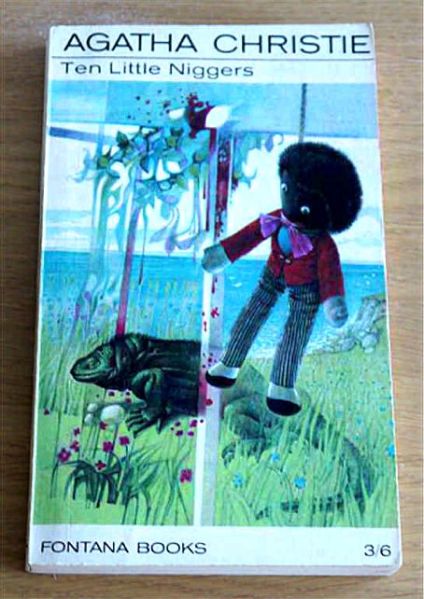
Ten Little Niggers by Agatha Christie

I wondered when I began to write this post whether to use the current title, And Then There Were None, for this book, but chose to use its original title, Ten Little Niggers as that is the title of my copy, a 1968 reprint of its first publication in the UK in 1939. Because of its offensive title it was first published in the US a few months later in 1940 as And Then There Were None.

Ten Little Niggers

Description from the back cover:

10 people are invited to a fabulous mansion on Nigger Island off the coast of Devon. Though they all have something to hide, they arrive hopefully on a glorious summer evening… But soon a series of extraordinary events take place: the island is suddenly bathed in a most sinister light .. panic grips the visitors one, by one … by one… by one…

Eight people are invited to the island (based on a real island – Burgh Island off the south west coast of Devon). They are met by the butler and housekeeper/cook who explain that the owner, Mr Owen (U.N.Owen) has been delayed but has left instructions for their reception. In each of their rooms is a framed copy of the rhyme about the ten little nigger boys who all met their death. On their first evening they sit down to dinner in good spirits until, without any warning they hear a Voice accusing each of them (including the butler and housekeeper) of having caused the deaths or murdered a number of people. From that point onwards, one by one they are found dead, corresponding to the deaths in the rhyme and one by one a china figurine on the dining room table mysteriously disappears.

As the weather worsens they are stranded on the island and unable to leave or to get help from the mainland. Agatha Christie has created not only a ‘locked room’ type of mystery but also a mystery full of suspense, as the guests try to identify Mr U N Owen and become increasingly suspicious of each other. Their fear is further amplified by the house itself, which surprisingly is not an old Gothic house full of creaking wood and dark shadows –

But this house was the essence of modernity. There were no dark corners – no possible sliding panels – it was flooded with electric light – everything was new and bright and shining. There was nothing hidden in this house, nothing concealed. It had no atmosphere about it.

Somehow, that was the most frightening thing of all …

They exchanged good-nights on the upper landing. Each of them went into his or her own room, and each of them automatically, almost without conscious thought, locked the door … (page 52)

Despite their precautions the deaths continue, and each time no one sees or hears anything. I’d marked the page with the rhyme and kept flipping back to it to check how the next victim was going to meet with death, as I tried to work out who the murderer was and how he/she was able to carry out the murders unobserved. What makes it more tense for the reader (or at least for me) is the technique Agatha Christie makes of revealing the thoughts of the remaining characters, but without letting on who the thinker is.

In 1943 Agatha Christie adapted the book into a play, changing the ending, and there have been several film versions, none of which I’ve seen, so I didn’t know who the murderer was, although I knew the outline of the plot. Part way through the book I thought – ah, there is only one person who could be the murderer and I was right. I must re-read the book sometime to see if there were any clues, because if there were I missed them. My idea was based on the probability of that character being the murderer rather than any specific clues.

It is an ingenious mystery, revolving around the concepts of guilt and justice. There was no doubt that each of the victims had committed murder or caused/influenced the death of another person. But did the punishment fit the crime and could it ever be justified? As the murderer explains in an epilogue there were varying degrees of guilt among the victims and those whose guilt was lightest were killed off first!

This is possibly the most famous of Agatha Christie’s books. In her Autobiography Agatha Christie wrote that she had written the book because it was so difficult to do and the idea fascinated her. I found it fascinating too, but as an exercise and a puzzle rather than as a novel. Writing about the play and the book she stated:

I don’t say it is the play or the book of mine I like best, or even that I think it is my best, but I do think in some ways that it is a better piece of craftsmanship than anything else I have written. (page 489 of An Autobiography)

I agree.