Saturday Snapshots: Wych Elm

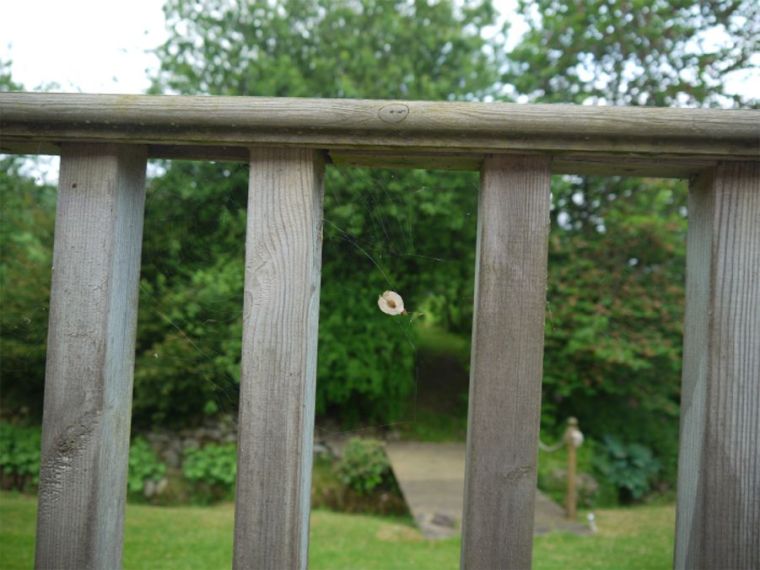
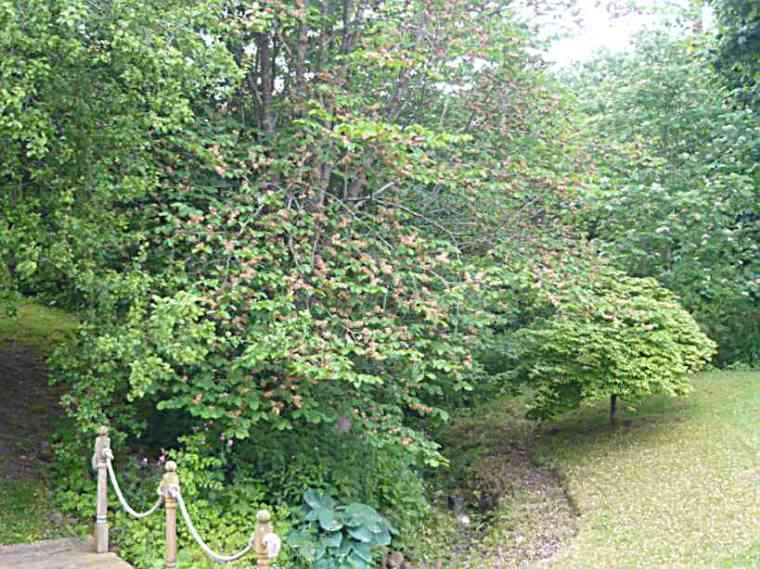
We have a wych elm in the back garden. This year it’s been absolutely full of seeds, many more than usual:

Wych elm P1080810

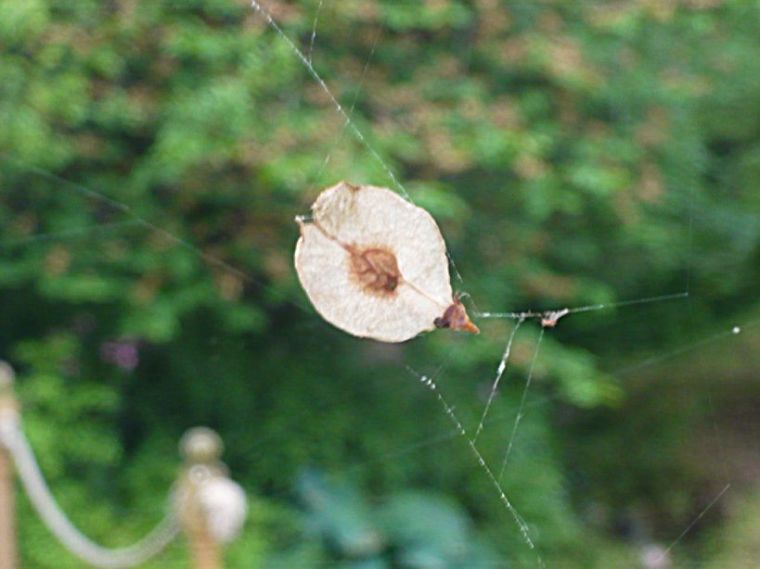
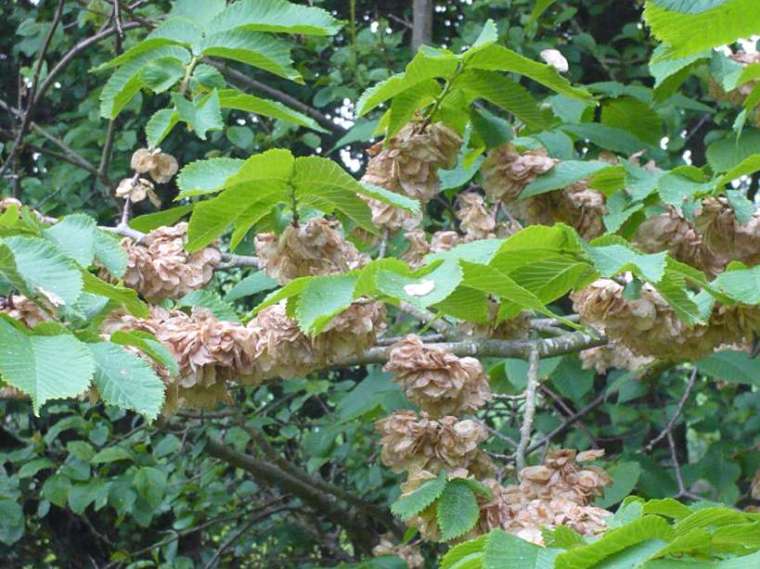
The seeds have been blowing all over the garden, covering the lawn and borders. They grow in clusters:Wych elm P1080813One got caught in a cobweb:

Wych elm seed P1010780Here it is in close-up:

Wych elm seed P1080809Wych Elms are hardy trees and have greater resistance to Dutch elm disease than other elms. The name ‘wych’ comes from an Anglo-Saxon word meaning pliable and refers to the tree’s twigs. Its wood has many uses, including underground water pipes (in the past), boat building and the seats of chairs – it’s also the traditional wood used for coffins.

I love trees – and they are good for you:

A garden without trees is as hard to envisage as an art gallery with pictures. Trees soften the landscape. They provide shade in the summer and protection during the winter. A screen of trees around the house can provide enough wind-shelter to reduce by a tenth the energy consumption in the home. Their canopy of leaves acts as a highly effective pollution filter, absorbing many of the major atmospheric pollution gases, including carbon monoxide, nitrogen and sulphur dioxide. Research also reveals that we are happier and more relaxed when we are in leafy surroundings … (The Therapeutic Garden by Donald Norfolk page 105)

For more Saturday Snapshots see Melinda’s blog West Metro Mommy Reads.

Click on the photos to enlarge.

Mount TBR: June Checkpoint

Mount TBRIt’s time for the second quarterly check-in post for the Mount TBR Challenge 2013.  Bev asks:

1. Tell us how many miles you’ve made it up your mountain (# of books read).  If you’re really ambitious, you can do some intricate math and figure out how the number of books you’ve read correlates to actual miles up Pike’s Peak, Mt. Ararat, etc.
  • I’ve read just a quarter of my target – 12 books, reaching Pike’s Peak, so I’m not looking too good to reach Mount Ararat, that is, to read 48 books from my own bookshelves.

These are the books I’ve read:

  1. The Case of the Curious Bride by Erle Stanley Gardner
  2. The Lacuna by Barbara Kingsolver
  3. Cat Among the Pigeons by Agatha Christie
  4. Small Kindnesses by Fiona Robyn
  5. The Hobbit by J R R Tolkien
  6. The Distant Hours by Kate Morton
  7. Daughters of Fire by Barbara Erskine
  8. Balthazar Jones and the Tower of London Zoo by Julia Stuart
  9. The Lollipop Shoes by Joanne Harris
  10. The Owl Killers by Karen Maitland
  11. Kissing the Gunner’s Daughter by Ruth Rendell
  12. Barnaby Rudge by Charles Dickens
2.
What has been your most difficult read so far.  And why?  (Length?  Subject matter?  Difficult style?  Out of your comfort zone reading?)
  • That has to be The Lacuna by Barbara Kingsolver. Although it began and ended well, I got bored several times in the middle. I felt there was something missing, the personal elements that brought the story to life for me were few and far between; I couldn’t feel involved and just wanted it to end. I persevered because it has had such good reviews and recommendations, but sadly it dragged for me.
Which book (read so far) has been on your TBR mountain the longest? Was it worth the wait? Or is it possible you should have tackled it back when you first put it on the pile? Or tossed it off the edge without reading it all?
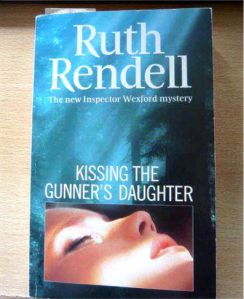
  • This is Kissing the Gunner’s Daughter by Ruth Rendell, which I’ve had for about 20 years! It was well worth the wait and I thoroughly enjoyed reading it.

Kissing the Gunner's Daughter by Ruth Rendell

I’ve read only a few of Ruth Rendell’s Detective Chief Inspector Wexford books, although I must have watched all the TV dramatisations, with George Baker playing the part of Wexford. The books are set in Kingsmarkham, a fictional English town. The first of these, From Doon with Death, is also her first novel and was published in 1964. The full list of her books is on Fantastic Fiction.
Kissing the Gunner's Daughter

Kissing the Gunner’s Daughter (first published in 1992) is the fifteenth book in the series. It begins with the shooting of Sergeant Martin of Kingsmarkham CID whilst he was standing in a queue at the local bank. This seemed to trigger a chain of more murders as a few months later Wexford and Burden are faced with solving the brutal murders of author Davina Flory, her husband and daughter, shot dead at Tancred House. Only Daisy, her granddaughter survived, and wounded in the shoulder she had crawled to the phone to call for help. Her account of what happened is understandably confused. They had all been eating their dinner when they heard noises of someone upstairs. She only saw one of the intruders:

‘He came in …’ Her voice went dead, automatic machine tones. ‘Davina was still sitting there. She never got up, she just sat there but with her head turned towards the door. He shot her in the head, I think. He shot my mother. I don’t know what I did. It was so terrible, it was like nothing you could imagine, madness, horror, it wasn’t real, only it was – oh, I don’t know … I tried to get on to the floor. I heard the other one getting a car started outside. The one in there, the one with the gun, he shot me and I don’t know, I don’t remember … (page 70)

I had my suspicions quite early on in the book about the murder, but it was only intuition – I couldn’t put my finger on the reason for my thoughts. As I read on I thought I was wrong, as Ruth Rendell added more and more detail, and I was lost in all the red herrings she introduced. But then I began to suspect that I might have been right after all.This is an excellent book, both for the mystery element and for the characterisation, even the lesser characters stand out as real people.

I like Wexford, a detective with a happy marriage, although his relationship with his daughters, especially the younger daughter, Sheila is not so good. He hates her fiancé, author Augustine Casey, and this forms an interesting sub plot in which Rendell expresses her views on literary scene poseurs and post-modernist literature. Casey is an ‘extreme post-modernist‘ who ‘had already written at least one work of fiction without characters.‘ (page 97) Dora says that Casey is a very clever man, perhaps a genius and Wexford responds:

God help us if you’re going to call everyone who was shortlisted for the Booker prize a genius. (page 95)

I did not want to put this book down and just wish that it hadn’t sat unread on my bookshelves for about 20 years (including being hidden away for a few years due to being double shelved). But then I wouldn’t have had the pleasure of reading it now – I think it’s much better than some of Ruth Rendell/Barbara Vine’s later books.

A note on the title:

Kissing the Gunner’s Daughter’ is a phrase derived from a tradition in the Royal Navy, as Wexford explains:

It means being flogged. When they were going to flog a man in the Royal Navy they first tied him to a cannon on deck. Kissing the gunner’s daughter was therefore a dangerous enterprise. (page 340)

A dangerous enterprise indeed not only for the victims but also for the culprits, one of whom took enormous risks. (And my intuition proved partly right in the end.)
Once Upon a Time VII – Quest Completed

Once upon a time VII

Carl’s  Once Upon a Time VII has now ended and I completed Quest the First

which was to read at least 5 books that fit somewhere within the Once Upon a Time categories of fantasy, or folklore, or fairy tales, or mythology. I read a mixture, four of which were books I’ve been meaning to read for ages.

  1. The Hobbit by J R R Tolkien – a fantasy adventure story of Bilbo Baggins’s quest to recover the dwarves’ treasure stolen by Smaug the dragon and regain possession of the Lonely Mountain. Fantastic!
  2. Daughters of Fire by Barbara Erskine – a time slip novel focussed on the legends surrounding Cartimandua, a Celtic queen. This was a bit of a disappointing read.
  3. The Lollipop Shoes by Joanne Harris – a story about good versus evil, the power of the mind and the use of spells, but lacking the charisma of Chocolat, and not as good!
  4. The Third Pig Detective Agency by Bob Burke – a fairytale detective story, in which the third little pig, Harry is faced with recovering Aladdin’s lamp. I really enjoyed reading this.
  5. The Owl Killers by Karen Maitland – a tale of witchcraft and pagan superstition, full of tension and suspense, that kept me guessing to the end.

Hobbit & Pig

My favourite out of these is The Hobbit, followed by The Third Pig Detective Agency, and I think these two books were the best choices for the Once Upon a Time theme.

Greenshaw's Folly: a Miss Marple Mystery

Agatha Christie’s Marple last night was Greenshaw’s Folly. I saw in the Radio Times that it was based on Christie’s short story of the same name and so I read it before watching the programme. It’s less than 20 pages and I wondered how the script writers were going to make it last 2 hours, even with the advert breaks. Well, of course, they padded out with other plot elements and characters. And there are more murders, and some farcical scenes with policemen running wild – all a bit of a mess really, but lightly done.

Greenshaw’s Folly is a house, visited by Raymond West (Miss Marple’s nephew), who does not appear in the TV version and Horace Bindler, a literary critic (an undercover reporter in the TV version). It’s an unbelievable architectural monstrosity, built by a Mr Greenshaw. Raymond explained:

‘He had visited the chateaux of the Loire, don’t you think? Those turrets. And then, rather unfortunately, he seems to have travelled in the Orient. The influence of the Taj Mahal is unmistakeable. I rather like the Moorish wing,’ he added, ‘and the traces of a Venetian palace.’ (extract from the short story)

The short story is compact, whereas the TV version is packed with poisonings, ghosts, locked rooms, concealed identities, and so on. But apart from that, I’m not going to try to compare the TV show to the short story as there are so many differences that they are really two separate entities. And both are enjoyable in their own way. Julia Mackenzie is nearly right as Miss Marple, not as good as Joan Hickson, but then who could be. I just wish the sweet smile was toned down a little. The rest of the cast included Fiona Shaw, Julia Sawalha, Joanna David, Judy Parfitt, Robert Glenister and Jim Moir (aka Vic Reeves). All were very good, especially Bobby Smalldridge as Archie Oxley (Mrs Oxley’s young son who does not appear in the short story).

Greenshaw’s Folly was first published in the Daily Mail 3 – 7 December 1956 and is included in Miss Marple and Mystery The Complete Short Stories.

I see that one of the plot elements involving the use of atropine and its antidote has been taken from one of the other stories in this collection, The Thumb Mark of St Peter, first published in 1928. I think the script writers must have had great fun with these stories.

Saturday Snapshots: Loch Ness

My Saturday Snapshots are some more photos from our last holiday in Scotland. We had been to Inverness and decided to drive back to Coylumbridge along the road following the western shore of Loch Ness. We stopped and went down these steps from the road.Loch Ness steps P1080650It was a calm peaceful scene – no sign of anything on the loch – not a monster in sight.Loch Ness P1080647There are a few interpretation boards by the side of the road above Loch Ness. They are not in very good condition now, a bit dirty, but you can still read them. The one below states that St Columba is said to have seen the monster in the 6th century, that ospreys fish in the loch and that seals sometimes visit chasing salmon and trout. What I didn’t know is that a Wellington bomber had crashed in the loch during a snowstorm in 1940.

Loch Ness Interpr Board P1080651

The next board states that the loch is 38km long and up to 238m deep, rivers feeding into the loch generate hydro-electricity that was first used industrially in 1895 for smelting  aluminium. This board includes information about the Caledonian Canal, which links Inverness in the north to Fort William about 60 miles to the south. The canal, constructed by Thomas Telford and completed in 1822, is really a system of four canals linking to the lochs, one of which is Loch Ness.Loch Ness Interpr Bd P1080653I think it’s time for some new interpretation boards to replace these old and grubby ones!

For more Saturday Snapshots see Melinda’s blog West Metro Mommy Reads