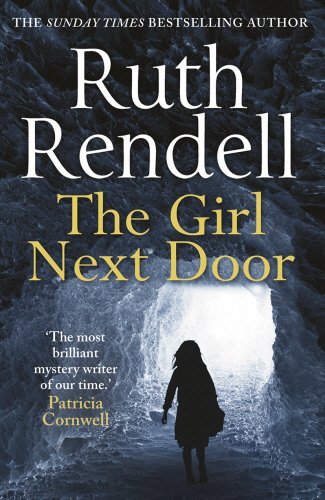
The Girl Next Door by Ruth Rendell

Rating: 5 out of 5.

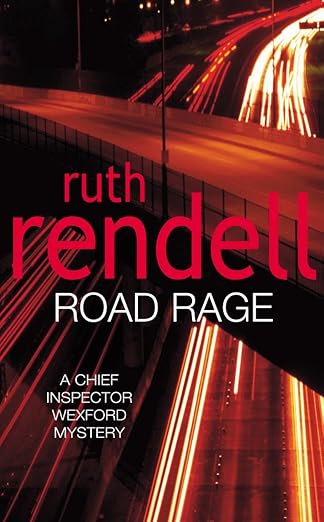
Ruth Rendell, Lady Rendell of Babergh, also known as Barbara Vine, who died aged 85 in 2015, was a literary phenomenon. From 1964, when Inspector Reginald Wexford first appeared in From Doon With Death, she wrote more than sixty novels, including police procedurals, standalone and psychological mysteries plus numerous books of short stories. Many of them were adapted for television or made into feature films.

The Girl Next Door by Ruth Rendell, is one of my TBRs, a book that’s been sitting on my bookshelves since 2016. It’s one of her later novels, a stand-alone book, first published in 2014, a year before her death.

Description from Amazon UK

Beneath the green meadows of Loughton, Essex, a dark network of tunnels has been dug. A group of children discover them. They play there. It becomes their place.

Seventy years on, the world has changed. Developers have altered the rural landscape. Friends from a half-remembered world have married, died, grown sick, moved – or disappeared.

Work on a new house called Warlock uncovers a long buried grisly secret: the bones of two severed hands are discovered in a box, and an investigation into a long-buried crime of passion begins.

The friends, who played together as children, begin to question their past. And a weary detective, more concerned with current crimes, must investigate a case of murder.

The book begins just before the second world war when Woody killed his wife and her lover when he discovered they were having an affair. He then cut off their hands, a right hand and a left that they had held together, and put them in a biscuit tin, which he buried in a tunnel, where the local children played.

Time moves on to 1944. Ruth Rendell describes a garden where the neighbourhood children play:

The garden was not beautiful. It had no flowering trees, no roses, no perfumed herbs. Tunnels they called it at first. The word ‘qanat’, an impossible word, was found by Daphne Jones and adopted by the rest of them. It meant, apparently, a subterranean passage for carrying water, in some oriental language. They liked it because it started with a q without a u. Their schoolteachers had taught them that no word could ever start with q unless followed by u, so Daphne’s idea appealed to them and the tunnels became qanats. (pages 13 – 14)

Time moves on again and we meet up with the children as adults in their seventies, when the skeletal hands have been discovered. The qanats were actually the foundations of a house called Warlock in Loughton, twelve miles north of London and most of the children, are now still living in the area. When they read the newspaper report about the discovery of the hands they get together and reminisce about their childhood and playing in the tunnels, wondering whose hands had been buried.

This is when the book expands into a study of ageing as well as murder mystery:

As you get older, you forget names: those you studied with, lived next door to, the people who came to your wedding, your doctor, your accountant and those who cleaned your house. Of these people’s names you forget perhaps half, perhaps three quarters. Then whose names do you never forget, because they are incised on the rock of your memory? Your lovers (unless you have been promiscuous and there are too many) and the children you went to your first school with. You remember their names unless senility steps in to scrape them off the rock face. (page 17)

It’s quite a long book, nearly 350 pages in a small font in my copy and Ruth Rendell takes time to describe these old friends’ lives and reveals their relationships, their loves and losses and those of their own children and grandchildren as well as their regrets, and bereavements. I felt I really got to know them as real people. Long buried secrets rise to the surface, and old passions are reignited.

From the beginning we know the identity of the murderer, Woody and that of his wife Anita, but not that of the man, whose hand had held Anita’s. At times I thought I’d worked out who it was but when his identity was revealed it wasn’t who I thought it was – it was more complicated than I’d realised. And who is ‘the girl next door‘? I did work that out correctly. It is in some places a bleak novel, and all the characters’ lives have changed by the end of the book. It’s a book that really gripped me and drew me on to find out more. And I really enjoyed how it shows the changes that have taken place in society from the 1930s onward.

I’ve read several of Ruth Rendell’s standalone books and I think this is one of her best. I’ve also read some of her Inspector Wexford books and those she wrote under the name of Barbara Vine.

The Girl Next Door by Ruth Rendell: Book Beginnings & The Friday 56

Every Friday Book Beginnings on Friday is hosted by Gillion at Rose City Reader where you can share the first sentence (or so) of the book you are reading. You can also share from a book you want to highlight just because it caught your fancy.

I’m featuring The Girl Next Door by Ruth Rendell, one of my TBRs, a book that’s been sitting on my bookshelves since 2016. It’s one of her later novels, a stand-alone book.

Chapter One:

He was a handsome man. A handsome boy, his mother called him, because she started praising his looks when he was five.

Also every Friday there is The Friday 56, hosted by Freda at Freda’s Voice, but she is taking a break and Anne at My Head is Full of Books has taken on hosting duties in her absence. You grab a book and turn to page 56 (or 56% of an eBook), find one or more interesting sentences (no spoilers), and post them.

Unlike other users of Baldwin’s Hill, who were afraid of pregnancy or, in the case of the girls, of not being virgins when they were married, he and Daphne went ‘all the way’, as the phrase had it. She didn’t get pregnant, though he had done nothing to prevent it.

Description from Amazon UK

Beneath the green meadows of Loughton, Essex, a dark network of tunnels has been dug. A group of children discover them. They play there. It becomes their place.

Seventy years on, the world has changed. Developers have altered the rural landscape. Friends from a half-remembered world have married, died, grown sick, moved – or disappeared.

Work on a new house called Warlock uncovers a long buried grisly secret: the bones of two severed hands are discovered in a box, and an investigation into a long-buried crime of passion begins.

The friends, who played together as children, begin to question their past. And a weary detective, more concerned with current crimes, must investigate a case of murder.

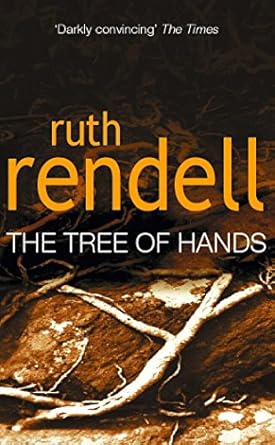
The Tree of Hands by Ruth Rendell

Rating: 5 out of 5.

Description from Amazon UK

When Benet was about fourteen, she and her mother had been alone in a train carriage – and Mopsa had tried to stab her with a carving knife. It has been some time since Benet had seen her psychologically disturbed mother. So when Mopsa arrives at the airport looking drab and colourless in a dowdy grey suit, Benet tries not to hate her. But when the tragic death of a child begins a chain of deception, kidnap and murder in which three women are pushed to psychological extremes, family ties are strained to the absolute limit…

The Tree of Hands by Ruth Rendell is one of my TBRs. It’s a book I bought nine years ago from Barter Books in Alnwick. I don’t know why I haven’t read it before now as it is really good – one of the best books I’ve read this year, and one of her best standalone books. I read it this year as one of my 20 Books of Summer.

Why I enjoyed it so much is that it thoroughly gripped me and made me want to read on and on. It’s a psychological thriller, full of suspense, with several twists and turns that made me unsure how it would end. I was delighted by the final twist!

Benet’s son, James aged four dies from croup whilst in hospital soon after Mopsa, her mother with a history of mental illness, comes to visit. Meanwhile Carol, a young widow with three kids, two of them in care, is living nearby with Barry, her younger boyfriend. He adores her but she doesn’t want to marry him, content for him to do all the housework and look after Jason her two year old son when he is not being looked after by babysitters. The trouble starts when Mopsa kidnaps Jason and brings him back to Benet as a replacement for James.

The tree of hands in the title is taken from the collage on the hospital playroom wall:

On the white paper base sheet had been drawn a tree with a straight brown trunk and branches and twigs, and all over the tree, on the branches, nestling among the twigs, protruding like fungus from the trunk, were paper hands. All were exactly the same shape, presumably cut out by individual children using a template of an open hand with the fingers spread slightly apart. (page 46)

Benet found them horrible, as though the hands were begging for relief, or freedom, or oblivion. She thought there was a mad quality about them, ‘all the hands upraised, supplicating, praying.’ And she fell forward in a faint when the doctor told her James had died.

This is a dark and disturbing book about what happens to Jason, Benet, Carol and Barry. It’s well written and I could easily visualise the characters and the setting. It’s emotionally challenging and it both fascinated and horrified me in equal measure. It won the CWA Silver Dagger Award in 1984, an award given annually by the Crime Writers’ Association of the United Kingdom since 1960 for the best crime novel of the year. 

NB I’m currently reading Rendell’s The Girl Next Door because I enjoyed The Tree of Hands so much.

First Chapter First Paragraph: End in Tears by Ruth Rendell

Every Tuesday First Chapter, First Paragraph/Intros is hosted by Vicky of I’d Rather Be at the Beach sharing the first paragraph or two of a book she’s reading or plans to read soon.

This week’s book is End in Tears by Ruth Rendell, one of the books for my 10 Books of Summer Challenge.

End In Tears (Inspector Wexford, #20)


When he lifted it off the seat the backpack felt heavier than when he had first put it into the car. He lowered it on to the soft ferny ground. Then he got back into the driving seat to move the car deep into a cave made by hawthorn bushes and brambles, and the hop vines which climbed over everything in this wood. It was late June and the vegetation was very dense and luxuriant.

Blurb (Goodreads):

The twentieth book to feature the classic crime-solving detective, Chief Inspector Wexford.

A lump of concrete dropped deliberately from a little stone bridge over a relatively unfrequented road kills the wrong person. The young woman in the car behind is spared. But only for a while…

A few weeks later, George Marshalson lives every father’s worst nightmare: he discovers the murdered body of his eighteen-year-old daughter on the side of the road.

As a man with a strained father-daughter relationship himself, Wexford must struggle to keep his professional life as a detective separate from his personal life as husband and father. Particularly when a second teenage girl is murdered – a victim unquestionably linked to the first – and another family is shattered…

What do you think? Would you keep reading?

I’ve had this book for about three years and I think I’ve started it once before – the opening chapter looks familiar. I’ve had mixed reactions to Ruth Rendell’s books, preferring the ones she’s written under the name, Barbara Vine. It may be one I’ll pass on – if you’ve read it do let me know what you think.

A – Z of TBRs: G, H and I

I have been neglecting my TBRs this year and have been reading mainly new books and library books.So here is the third instalment of my A – Z of TBRs, a series of posts in which I take a fresh look at some of my TBRs to inspire me to read more of them by the end of the year. These TBRs are all physical books – I’ve not included e-books.

I’m enjoying searching my shelves – finding books I’d forgotten were there (the disadvantage of shelving books behind others).

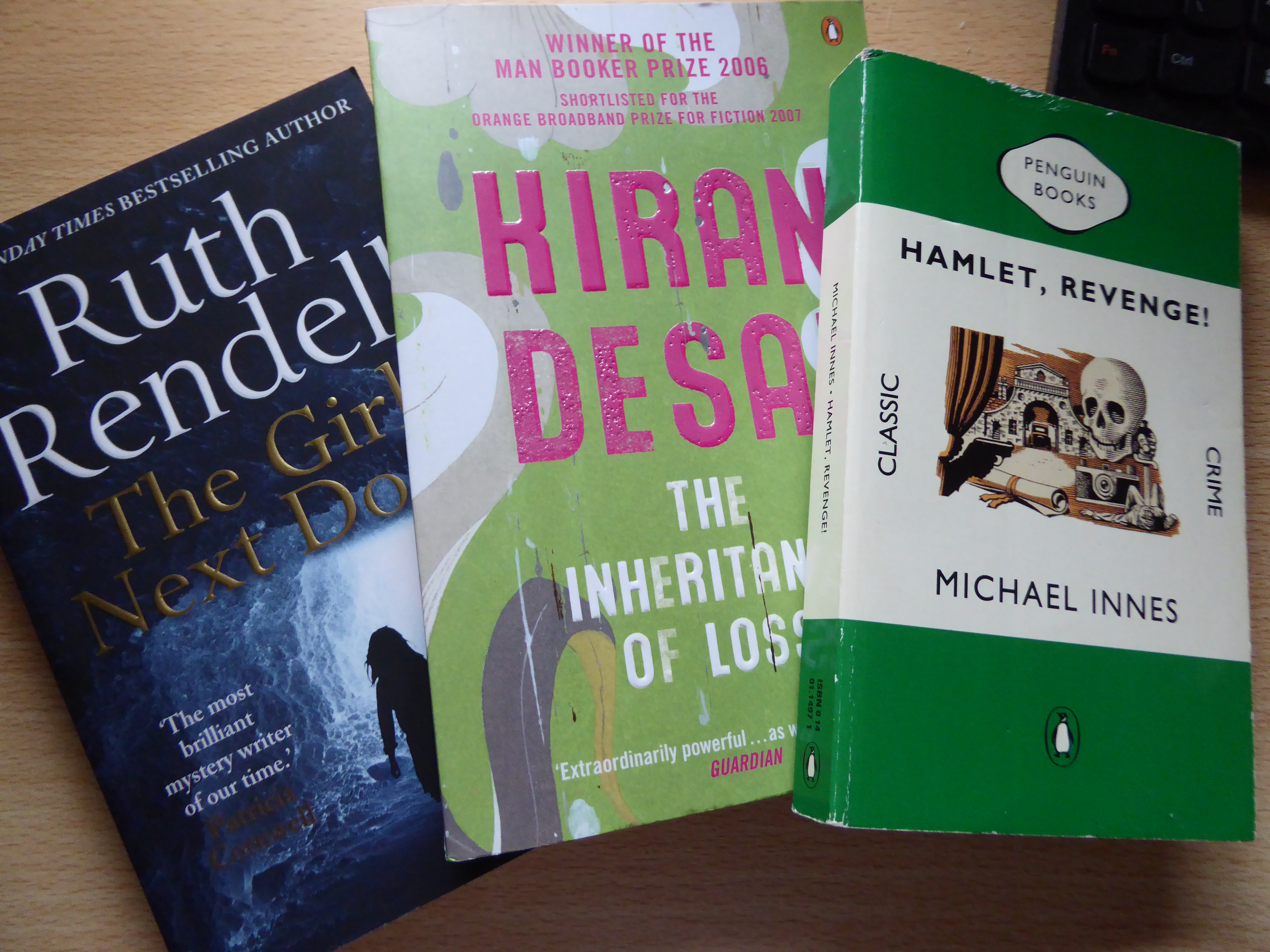
a-z tbrs ghi P1020304


G is for The Girl Next Door by Ruth Rendella book I’ve had for just over a year. When a new house is being built a long buried secret is uncovered – a tin box is found in an earthen tunnel. It contained two skeletal hands, one male and one female.

Their garden was not beautiful. It had no flowering trees, no roses, no perfumed herbs. Tunnels, they called it at first. The word ‘qanat’, an impossible word, was found by Daphne Jones and adopted by the rest of them. It meant, apparently, a subterranean passage for carrying water in some oriental language. They liked it because it started with a q without a u. Their scholteachers had taught them that no word could ever start with a q unless it was followed by u, so Daphne’s idea appealed to them and the tunnels became qanats. In time to come the qanats became their secret garden. (pages 14 -15)

HHamlet, Revenge! by Michael Innes (on my TBR shelves since May 2015). This is a green Vintage Penguin, first published in 1937, and in this edition in 1961, about a murder planned to take place in the middle of a private performance of Hamlet.

It had begun as a family frolic. And now, although it would not be publicly reported, the dramatic critics were coming down as if to an important festival. Professors were coming to shake learned respectable bald heads over a fellow-scholar’s conception of an Elizabethan stage. Aged royalty  was coming to be politely bewildered. Most alarming of all, ‘everybody’ was coming – for the purpose no doubt, of being where ‘everybody’ was. And even if it was a select and serious everybody – a known set before whom a Lord Chancellor might mime without misgiving – it was still a crowd, and its actions were unpredictable. (page 28)

IThe Inheritance of Loss by Kiran Desai, a book I’ve had for just over 10 years! It won the Man Booker Prize in 2006. This is set in India, in a dilapidated mansion high in the Himalayas, the home of three people each dreaming of another time – a retired judge, Sai, his granddaughter and a cook.

In Kalimpong, high in the northeastern Himalayas where they lived – the retired judge and his cook, Sai and Mutt – there was a report of new dissatisfaction in the hills, gathering insurgency, men and guns. It was the Indian Nepalese this time, fed up with being treated like the minority in a place where they were the majority. They wanted their own country, or at least their own state, in which to manage their own affairs. Here, where India blurred into Bhutan and Sikkim, and the army did pull-ups and push-ups, maintaining the tanks with khaki paint in case the Chinese grew hungry for more territory than Tibet, it had always been a messy map. The papers sounded resigned. A great amount of warring, betraying, bartering had occurred; between Nepal, England, Tibet, India, Sikkim, Bhutan; Darjeeling stolen from here, Kalimpong plucked from there – despite, ah, despite the mist charging down like a dragon, dissolving, undoing, making ridiculous the drawing of border. (page 9)

What do you think? Do you fancy any of them? 

One reason I haven’t read these books yet is that they’re all in such a small font!

No Man’s Nightingale by Ruth Rendell

Last month I read books from my own shelves for the Mount TBR Reading Challenge (books owned before 1 January 2016) and the 20 Books of Summer Challenge, but then the urge to read other books took over, mainly because I’ve been adding books to my shelves. For the time being I won’t be reading for the Mount TBR Challenge as I have several books that I’ve acquired this year that I want to read first.

One of them is Ruth Rendell’s No Man’s Nightingale.

Blurb:

The woman vicar of St Peter’s Church may not be popular among the community of Kingsmarkham. But it still comes as a profound shock when she is found strangled in her vicarage.

Inspector Wexford is retired, but he retains a relish for solving mysteries especially when they are as close to home as this one is. So when he’s asked whether he will assist on the case, he readily agrees.

But why did the vicar die? And is anyone else in Kingsmarkham in danger? What Wexford doesn’t know is that the killer is far closer than he, or anyone else, thinks.

My thoughts:

I like Wexford, so I was predisposed to like this book (who in my mind looks like George Baker in the TV Wexford series) and I did enjoy it, although not as much as some of her other books.

Maxine Sams has several cleaning jobs, including cleaning for Reg and Dora Wexford – she talks all the time and regales Wexford with stories about her family, interrupting his reading of Gibbons’ Decline and Fall of the Roman Empire, which she thinks is a holiday guide to Rome. One of Maxine’s clients is the Reverend Sarah Hussain – and it is Maxine who finds her body, lying on the living room floor. She had been strangled.

Wexford, although enjoying his retirement, is pleased when Detective Superintendent Mike Burden asks if he would like to be involved as a consultant in the investigation into Sarah’s murder. It’s interesting to see how Wexford approaches this as he does not agree with Burden’s methods, thinking he has too many team meetings and ignores things Wexford would have concentrated on, nor can he express his opinions openly. And he isn’t sure just what he should or should not report back to Burden. As most of the book is written from Wexford’s point of view we can see how his mind works and the way he views his former colleagues and society in general and I was glad to see that as a retired person he is portrayed with an agile and observant mind.

There are plenty of red herrings and sub-plots that had me wondering as I read. At times it was rather confusing and I noticed a few continuity problems. Various issues are raised, not just the position of the elderly in society, but also questions of race and gender, religious intolerance, rape, single mothers and family relationships. I liked Wexford’s thoughts on The Decline and Fall of the Roman Empire, his musings on religion – he is a’committed atheist’ ( I don’t remember that from earlier books) and the self-doubt he reveals. I also liked the comic elements as Wexford tries to escape from Maxine’s non-stop chatter.

Overall I enjoyed the book, but think I prefer Ruth Rendell’s standalone books and those she wrote under the name of Barbara Vine.