Gallows View by Peter Robinson

Gallows View: DCI Banks (Inspector Banks 1)

This year marks the 30th anniversary of the first Inspector Banks bookGallows View by Peter Robinson* (see below). I’ve read some of the later Banks books, totally out of order, which doesn’t seem to matter as I think they work well as stand alone books.

Inspector Alan Banks has been in Eastvale in the Yorkshire Dales for six months, having relocated from London. He has now got used to the slower pace of life and is working well with his colleagues. Sandra, his wife, has also settled well in Eastvale, making friends with Harriet and joining the local photography club.

There’s a peeping tom in the area, targeting young, blonde women, following them as they leave the pub and then watching as they undress for bed and there is also spate of break-ins by two balaclava-wearing thugs who rob old ladies and vandalize their homes. It’s clear quite early in the book that the two thugs are teenagers, Trevor Sharp and his friend, Mick Webster, who progress from robbing old ladies to burgling more prosperous homes when their owners are away from home, guided by Mick’s older brother, Lenny.

The main mystery is that of Alice Matlock, an old woman, living on her own, who is is found dead in her ransacked house in Gallows View, a row of old terraced  cottages. Her body was discovered by her friend, Ethel Carstairs, lying on her back, having fractured her skull on the corner of a table while falling backwards – or had she been pushed? Was she also a victim of Trevor and Mick, could it have been the peeping tom, or was someone else responsible? It might have just been an accident – she was old and her bones were brittle.

Dr Jenny Fuller, a psychologist at York University, has been brought in to help by providing a profile for the peeping tom case. Banks, a happily married man, is immediately attracted to her. They work well together, although Sandra, his wife, is rather suspicious at first about their relationship when she discovers that Dr Fuller is a young, attractive redhead.

It’s a good start to the series, which has now reached 24 books. It has quite a relaxed pace, with a complex and well constructed plot. The characters are convincing and realistic, and I like Banks, a hard working dedicated detective who gets on well with his boss, Superintendent Gristhorpe, who likes to build dry stone walls in his spare time.

As well as the crimes Robinson also explores a number of other issues – for example, feminism and gender, and education, comparing comprehensives and grammar schools. One thing that really dates it is the frequent mention of smoking in pubs!

As with other detective novels that have since been adapted for TV there are differences from the books. Peter Robinson explains on his website he has no power in the TV universe, and he thinks of the Banks books and the TV series as parallel universes. The characters are clearly meant to be different versions of the same person; they look different, have different personalities and meet different fates in different worlds.

  • Format: Kindle Edition
  • File Size: 826 KB
  • Print Length: 324 pages
  • Publisher: Pan; Reprints edition (21 Aug. 2009)
  • Source: I bought the e-book
  • My Rating: 4*

Gallows View is a book I’ve owned for over 2 years, so it qualifies for Bev’s Mount TBR Challenge.

*Peter Robinson later wrote a novella, Like A Virgin published in a short story collection, The Price of Love, which is about his last case in London just before he moved to Yorkshire.

Caedmon’s Song by Peter Robinson

Peter Robinson writes the Inspector Banks books, but he has also written short stories and a couple of standalone books including Caedmon’s Song, described as a psychological thriller.

Summary (from Peter Robinson’s website)

One warm June night, a university student called Kirsten is viciously attacked in a park by a serial killer. He is interrupted, and Kirsten survives, but in a severe physically and psychologically damaged state. As the killer continues, leaving a trail of mutilated corpses, Kirsten confronts her memories and becomes convinced not only that she can, but that she must remember what happened. Through fragments of nightmares, the details slowly reveal themselves. Interwoven with Kirsten’s story is that of Martha Browne, a woman who arrives in the Yorkshire coastal town of Whitby with a sense of mission. Finally, the two strands are woven together and united in a startling, chilling conclusion. 

My thoughts

Overall I liked Caedmon’s Song, but I wouldn’t describe it as a thriller, even though the attack on Kirsten is particularly vicious. It is set mainly in Whitby a seaside town in Yorkshire. The ruins of Whitby Abbey, Bram Stoker’s inspiration for Dracula, stand on the East Cliff overlooking the North Sea, with St Mary’s Church and Caedmon’s Cross nearby. I wondered as I began reading whether Martha’s visit to Whitby had any connection to Dracula, but although these places are described as she finds her way around the town they are just incidental to the plot.

Then I began to wonder about the connection between Kirsten and Martha because Robinson drops in quite a few clues early on in the book, which become explicit in the second half of the book. So, the links between them are quite easy to see, which disappointed me at first and lessened the tension. I wasn’t too convinced either by how Kirsten discovered her attacker’s identity and even considering the horrific details of her injuries I didn’t really feel sympathetic towards her as she comes across as rather cold-blooded. But as the narrative developed I began to enjoy the story and to wonder how it would end.

Kirsten considers whether she is a ‘born victim‘ or not, questioning her actions on the night of the attack, and wondering whether she had been inviting destruction. Her conclusion is that she wasn’t at all clear about it, but felt that it was her destiny, that she had been chosen as her attacker’s nemesis. All she knew was that she had to find him and face him. The ending is dramatic, but what would happen next is left open.

In his afterword Peter Robinson (written in 2003 when a new edition was published) explains that he had the idea for writing Caedmon’s Song in the late 1980s after he had written the first four Inspector Banks novels. He had felt he needed a change and wanted to write a novel in which the police played a subsidiary role. Then in September 1987 when he saw Whitby as he approached it on the coast road the idea for the setting and opening of the book came to him:

There lay Whitby, spread out below. The colours seemed somehow brighter and more vibrant than I remembered: the greens and blues of the North Sea, the red pantile roofs. Then the dramatic setting of the lobster-claw harbour and the two opposing hills, one capped with a church, the other with Captain Cook’s statue and the massive jawbone of a whale. I knew immediately that this was where the story had to take place, and that it began with a woman getting off a bus, feeling a little travel-sick, trying the place on for size. (pages 326-7)

I feel a trip to Whitby coming on – a place I’ve been wanting to visit for some years now.

Amazon UK link

  • Paperback: 336 pages
  • Publisher: Pan; Reprints edition (1 Aug. 2013)
  • Language: English
  • ISBN-10: 1447225473
  • ISBN-13: 978-1447225478
  • Source : I bought the book
  • Rating: 3*

Reading challenges: Mount TBR Reading Challenge 2017

Dry Bones That Dream by Peter Robinson: Book Notes

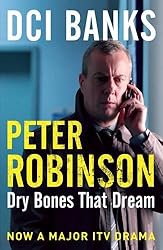
I read Peter Robinson’s DCI Banks books set in the Yorkshire Dales, every now and then, so I’m reading them totally out of order. It doesn’t seem to matter. Dry Bones That Dream is the 7th book in the series and the cover of my copy shows  Stephen Tompkinson as Banks. I don’t remember seeing this one on ITV, but I probably did as I see from the list of episodes in Wikipedia that it was broadcast in 2012.

Dry Bones That Dream was first published in the UK in 1995 and in the US later in as Final Account.

Summary from Peter Robinson’s website:

One May evening, two masked gunmen tie up Alison Rothwell and her mother, take Keith Rothwell, a local accountant, to the garage of his isolated Yorkshire Dales farmhouse, and blow his head off with a shotgun. Why? This is the question Detective Chief Inspector Alan Banks has to ask as he sifts through Rothwell’s life. Rothwell was generally known in the area as a mild-mannered, dull sort of person, but even a cursory investigation raises more questions than answers. When Banks’s old sparring partner, DS Richard ‘Dirty Dick’Burgess, turns up from the Yard, the case takes yet another unexpected twist, and Banks finds himself racing against time as the killers seem to be dogging his footsteps. Only after he pits his job against his sense of justice does he discover the truth. And the truth leads him to one of the most difficult decisions of his career.

My Thoughts:

I read this quite quickly, even though it’s just over 350 pages, in between mammoth gardening sessions (more about that later maybe). It really centres around identity and unearthing the secrets the characters have kept hidden from their family and friends. There’s also money-laundering and international and political shenanigans involved.

Much of the book revolves around Banks and his relationships, with family, colleagues and the people he interviews in connection with Keith Rothwell. Banks seems to be at a pivotal moment in his personal life. As usual with the DCI Banks books  we are told what music Banks listens to which got a bit monotonous for me and the descriptions of what each character looked like and the clothes they were wearing didn’t add anything to the plot. I did have an inkling about the truth about Rothwell’s murder but thought I was being too fanciful and that it was an unlikely scenario – it wasn’t. But I did enjoy reading it anyway even with these drawbacks.

Playing With Fire by Peter Robinson

I wrote about the opening of Playing With Fire in my Tuesday post.  I’ve watched the TV version of DCI Banks, (although I don’t remember this seeing this particular one) but there are changes in the televised versions and to my mind the books are better – but then I always think that.

Synopsis (from the back cover)

In the early hours of a cold January morning, two narrow boats catch fire on the dead-end stretch of the Eastvale canal. When signs of accelerant are found at the scene, DCI Banks and DI Annie Cabbot are summoned. But by the time they arrive, only the smouldering wreckage is left, and human remains have been found on both boats.

The evidence points towards a deliberate attack. But who was the intended victim? Was it Tina, the sixteen-year-old who had been living a drug-fuelled existence with her boyfriend? Or was it Tom, the mysterious, lonely artist?

As Banks makes his enquiries, it appears that a number of people are acting suspiciously: the interfering ‘lock-keeper’, Tina’s cold-hearted step-father, the wily local art dealer, even Tina’s boyfriend . . . Then the arsonist strikes again, and Banks’s powers of investigation are tested to the limit . .

My thoughts

I’ve been reading Peter Robinson’s DCI Banks books totally out of order and as I began this one I thought that I’d read the next book in the series a few years ago. One of the benefits of writing a book blog is that I can look back and see what I thought about a book just after I’d read it, instead of having to rack my brain trying to remember. On checking back (nearly five years ago!) I found that I had indeed read the next book – Strange Affair and had thoroughly enjoyed it.

I liked Playing With Fire too, although maybe not quite as much as Strange Affair. It’s a complicated plot and at times I had to remind myself who the various characters were. I did get a bit fed up with reading about what music Banks is playing but I liked the way his relationship with Annie Cabbot is portrayed and the insights into how his mind works.

I thought I’d spotted who the killer was quite early on and was pleased to see at the end that I was right, although I thought Banks should also have spotted it earlier!

Crime Fiction Alphabet: Letter R

This week I’ve chosen Peter Robinson‘s Bad Boy to illustrate the letter R in Kerrie’s Crime Fiction Alphabet.

Bad Boy is Peter Robinson’s 19th book in his Inspector Banks series, but I don’t think you have to have read the previous 18 because it functions OK as a stand-alone, as quite a lot of the back-story is included.

Description from the back cover:

Banks isn’t back, and that’s the problem.

If DCI Alan Banks had been in his office when his old neighbour came calling, perhaps it would have turned out differently.

Perhaps an innocent man would still be alive.

And perhaps Banks’s daughter wouldn’t be on the run with a wanted man.

But Banks is on holiday, blissfully unaware of the terrible chain of events set in motion by the discovery of a loaded gun in a young woman’s bedroom, and his daughter’s involvement with the ultimate bad boy . . .

My thoughts:

There’s not much more for me to write about this book. I didn’t think it was as interesting as the earlier ones of his that I’ve read. For one thing there’s not much of a mystery for Banks to solve and for another I didn’t like the graphic descriptions of violence it contains. It’s a police procedural to a certain extent, except of course, that Banks doesn’t actually always follow the set procedures.

Banks does come back from his holiday, down to earth with a vengeance as he sets out to rescue Tracy, his daughter from the wanted man, Jaff, the ‘bad boy’.

DI Annie Cabot obligingly gives a definition of a ‘bad boy’:

A bad boy is unreliable, and sometimes he doesn’t show up at all, or if he does, he’s late and moody, he acts mean to you and he leaves early. He always has another fire in the iron, somewhere else to be. But always while you’re waiting for him you can’t really concentrate on anything else, and you have at least one eye on the door in case he’s the next one to walk in the room, even though you might be seeing someone else, and when you’re with him your heart starts to beat a little faster and your breath catches in your chest. (page 163)

As for Banks, there are some interesting insights into his personality. He realises that he is ‘a stranger‘ to happiness, and that he has a restless nature which precluded happiness. If he wasn’t restless he either felt a vague sadness which was occasionally punctured with anger or irritation. He also realises that he hadn’t been a good parent, but he had felt inadequate and awkward with Tracy as she was growing up, not knowing how to communicate with her.

But, Banks is on the side of law and order, despite not always sticking to procedure:

If there was one part of the job Banks hated more than any other, it was that feeling of impotence and ineffectiveness he often felt by having dedicating himself to upholding the law, following the rules. He cut corners from time to time, like everyone, had occasionally acted rashly and even, perhaps, illegally, but on the whole, he was on the side of the virtuous and the good. (page 322)

And are there hints at the end about Banks’s future? He says he is ‘getting a bit tired of it all, to be honest.’ Do I sense that Peter Robinson is getting a bit tired of Banks too?

  • Paperback: 448 pages
  • Publisher: Hodder Paperbacks; 1st edition (28 April 2011)
  • Language: English
  • ISBN-10: 0340836970
  • ISBN-13: 978-0340836972
  • Source: Library book
  • My Rating: 3/5

The Hanging Valley by Peter Robinson: a Book Review

There are 20 books in Peter Robinson’s Inspector Banks series (listed at Fantastic Fiction). I’ve read a few of them, completely out of order, but it doesn’t seem to matter too much as each one stands alone, although I suspect I’d get a better idea of Banks’s personal life if I had read them in order!

The Hanging Valley is the fourth one in the series.

Synopsis (from the back cover):

A faceless corpse is discovered in a tranquil, hidden valley below the village of Swainshead. And when Chief Inspector Alan Banks arrives, he finds that no-one is willing to talk. Banks’s frustration only grows when the identity of the body is revealed. For it seems that his latest case may be connected with an unsolved murder in the same area five years ago. Among the silent suspects are the Collier brothers, the wealthiest and most powerful family in Swainsdale. When they start use their influence to slow down the investigation, Inspector Alan Banks finds himself in a race against time…

My view:

As well as the Collier brothers, there are other suspects, including John Fletcher, a taciturn farmer, Sam Greenock and his wife Katy who own the local Bed and Breakfast guest house. There’s something not quite right about Katy, she’s obviously troubled and hiding something, and she is dominated by Sam. As I read on I thought the killer was first one character, then another and never really worked out who it was until quite near the end. I enjoyed the puzzle.

Detective Chief Inspector Alan Banks had been transferred to Eastvale from London two years earlier and is still getting to know the area. He’d moved from London because of the sheer pressure of the job and the growing confrontation between the police and citizens in the capital had got him down. Crime in Eastvale had been slack until this murder happened. And it’s complicated, the locals close ranks and Banks has to work hard to get information, first of all to discover who the victim was and why he had been killed. The trail leads him abroad to Toronto before Banks discovers the truth.

The Hanging Valley is rich in description, both of the Yorkshire Dales and of Toronto. (Peter Robinson was born in Yorkshire and now lives in Toronto.) The hanging valley sounds a beautiful spot, a small, secluded wooded valley with unusual foliage:

… the ash , alders and sycamores … seemed tinged with russet, orange and earth brown. It seemed … like a valley out of Tolkien’s ‘Lord of the Rings’.

… the valley clearly had a magical quality. It was more luxuriant than the surrounding area, its ferns and shrubs more lush and abundant, as if, Neil thought, God had blessed it with a special grace. (page 5)

All of which makes the discovery of the corpse so shocking, with its flesh literally crawling. So, I enjoyed this book on two levels – the mystery and the writing itself. I did think, though, that it could have been shorter and more concise, and some of the characters were rather indistinguishable which is why I rated it 3/5.

  • Paperback: 324 pages
  • Publisher: Pan; New edition (8 Nov 2002)
  • Language English
  • ISBN-10: 0330491644
  • ISBN-13: 978-0330491648
  • Source: I bought it