Top Five Tuesday:Top 5 series I will finish in 2025

Top 5 Tuesday was created by Shanah at Bionic Book Worm, and it is now being hosted by Meeghan at Meeghan Reads. For details of all of the latest prompts for January to March, see Meeghan’s post here.

Today the topic is Top 5 series I will finish in 2025. Which series are you planning to finish (or finish to most recent publication) in 2025?

I have many series on the go. These five crime fiction novels are just the tip of the iceberg! I’m not saying I’ll finish these series this year, but I’m hoping I’ll make some progress with them this year.

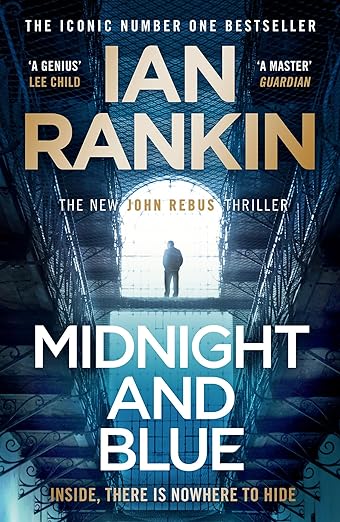
Ian Rankin’s Inspector Rebus series. There are 25 and I’ve read 24 – just one more to read, Midnight and Blue. This is the latest book in the series, so this is the only series that I will finish this year.

Reginald Hill’s Dalziel and Pascoe novels. There are 24 books in the series and I’ve read 16.

Peter Robinson’s Inspector Banks series. There are 28 and I’ve read 20.

Ann Cleeves’ Vera Stanhope books. There are 11 and I’ve read 9.

Georges Simenon’s Inspector Maigret books – there are 75 and I’ve read 16. It’ll take me ages to finish this series – if I ever do!

Mini Reviews

I’ve been reading almost non-stop and not pausing long enough to write proper reviews, so it’s time for a brief look at some of the books I’ve read. These notes are not as detailed as I usually write, but when you read quickly this is the result!

Friend of the Devil by Peter Robinson, the 17th DCI Banks book 4*

Inspector Alan Banks and his team, the Western Area Major Crimes Squad, investigate the murder of 19-year-old Hayley Daniels who was found raped and strangled in the Maze, a tangle of narrow alleys behind Eastvale’s market square, after a drunken night on the town with a group of friends. There are plenty of suspects and it’s a matter of looking at who was where and when to find the murderer. It wasn’t who I thought it was.

DI Annie Cabbot, on loan to the Eastern area, is assigned to look into the murder of Karen Drew, a quadriplegic, who was found dead in her wheelchair on a seaside cliff. It’s only when Annie discovers the real identity of Karen Drew, that the question of why anyone would want to murder a quadriplegic, becomes clear. But who could have done it? Annie has to revisit an earlier case to find the culprit.

Although this can be read as a stand-alone novel, part of the enjoyment in reading the series in order is that you see the development of the main characters and their relationships over the years. The books are basically police procedurals but along the way there’s a lot about Alan and Annie as people rather than police officers. I have become fond of the regular characters in these books.

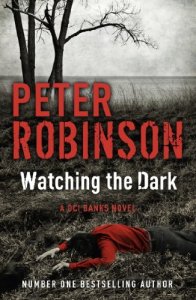
Watching the Dark by Peter Robinson, the 20th DCI Banks book 4.5*

This is the description on Goodreads: DCI Alan Banks reluctantly investigates DI Bill Quinn with Inspector Joanna Passero. Quinn, convalescing at St Peter’s Police Treatment Centre, was killed by a crossbow on the tranquil grounds, and left compromising photos. Quinn may be disreputable, linked to a vicious crime in Yorkshire and to a cold case – English Rachel Hewitt 19 vanished in Estonia six years ago.

Banks is not happy about this investigation, not only at the murder of one of their own officers, but because of the involvement of Joanna Passero who seems to him to be determined to prove that Quinn was a corrupt cop.

The team’s investigations lead them to a group smuggling illegal immigrants from Eastern Europe into the UK, taking Banks and Passero to Tallin in Estonia, whilst Annie heads the investigation in the UK. It’s remarkably complex. It’s also long, with many twists and turns, and it became too repetitive in the middle of the book, which is why I haven’t given it 5 stars. But I did enjoy it more than Friend of the Devil, especially the setting in Estonia. Robinson’s books are all definitely grounded in their settings, whether they’re in Yorkshire, Estonia, or elsewhere.

I have now read 20 of the 28 DCI Banks books.

I think the setting in Estonia means I can add Watching the Dark to the Wanderlust Bingo card in Central/Eastern Europe square.

Catching Up

This year has been a good time for reading books, but not a good time as far as writing reviews goes and I am way behind. This is my third set of mini reviews in an attempt to catch up with the backlog.

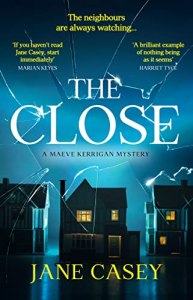
The Close by Jane Casey 2*

I read The Close because I’ve read and previously enjoyed Jane Casey’s Maeve Kerrigan books. Maeve is a Detective Sergeant with the Metropolitan Police – in the first six books she was a detective constable. She and her boss Detective Inspector Josh Derwent are the two main characters. They have a confrontational working relationship and their spiky relationship is a recurring theme in the books.  They are all police procedurals, fast-paced novels, with intriguing and complex plots. I thought that the Maeve/Josh relationship took a significant turn in the 9th book and I wondered what would happen next!

But it was simply disappointing. Maeve and Josh went undercover, carrying out surveillance in Jellicoe Close, whilst posing as a couple. As the synopsis describes it there are some dark secrets behind the neat front doors, and hidden dangers that include a ruthless criminal who will stop at nothing. What I really did not expect was that this would result in their relationship becoming such an abusive one.

Piece of My Heart by Peter Robinson 4*

I really enjoyed this book, the 16th Inspector Banks, but I think it reads well as a standalone book. This is the summary from Amazon:

As volunteers clean up after a huge outdoor rock concert in Yorkshire in 1969, they discover the body of a young woman wrapped in a sleeping bag.

She has been brutally murdered. The detective assigned to the case, Stanley Chadwick, is a hard-headed, strait-laced veteran of the Second World War. He could not have less in common with – or less regard for – young, disrespectful, long-haired hippies, smoking marijuana and listening to the pulsing sounds of rock and roll. But he has a murder to solve, and it looks as if the victim was somehow associated with the up-and-coming psychedelic pastoral band the Mad Hatters.

In the present, Inspector Alan Banks is investigating the murder of a freelance music journalist who was working on a feature about the Mad Hatters for MOJO magazine. This is not the first time that the Mad Hatters, now aging rock superstars, have been brushed by tragedy.

Banks finds he has to delve into the past to find out exactly what hornets’ nest the journalist inadvertently stirred up
.

This must be one of the longest of the Inspector Banks books, helped along by Robinson’s descriptive writing of the countryside which I love, and also details of the music Banks listens to (in this case a lot of 1960s music). He also goes into detail describing what each character looks like and the clothes they are wearing. I liked the movement between the two time periods, which highlights the differences in police procedure.

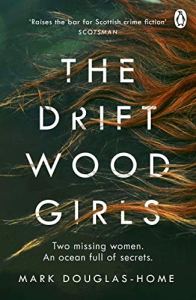
The Driftwood Girls by Mark Douglas-Home 4*

This is the synopsis on Goodreads:

Kate and Flora have always been haunted by a mystery – their mother, Christine, vanished without trace when they were children. But now Kate has a more urgent problem: Flora has disappeared too. In desperation, she searches Flora’s house, and finds a scrap of paper with a name scribbled on it: Cal McGill.

Cal is a ‘sea detective’: an expert in the winds and the tides, and consequently adept at finding lost things – and lost people. Can Cal find Flora?

And might he even know the secret of what happened to their mother, all those years ago . . . ?

My thoughts:

I enjoyed reading the first three Sea Detective novels, my favourite being The Malice of Waves, the 3rd book. So I was expecting to enjoy The Driftwood Girls, the 4th book. Cal McGill is an oceanographer who tracks floating objects, including dead bodies, using his knowledge of tides, winds and currents to solve mysteries no-one else can. I was disappointed as the sea detection plays only a small part in this book. It’s unevenly paced, introducing several seemingly unconnected characters and for a while I found it difficult to distinguish between them, having to keep checking back who was who. In the earlier books I noted that Cal is a strong independent character, but in this he seems to have become even more of a loner in this book, even more remote and withdrawn.

It certainly isn’t as gripping as the other books, but I did want to find out how it would end. It was only in the second part of the book that I began to get an idea of what was happening with each set of characters and how they could be connected. Thus the plot consists of several stories interwoven and told through several points of view. It is complicated and convoluted and as the plot unfolds it all ties together too neatly, in my opinion, with too many coincidences and improbabilities.

The settings are the best parts as it has a great sense of location, whether it is in Scotland or Texel, the most southerly and largest of the West Frisian Islands lying off the Dutch mainland between the North and Wadden Seas. The characters on Texel, particularly Olaf, are the most intriguing and for most of the book I had no idea how they were relevant to the rest of the characters. Olaf, like Cal is a loner, spending his days beachcombing and making driftwood figures with no mouths from the flotsam washed up on the beach.


Mini Reviews

This year has been a good time for reading books, but not a good time as far as writing reviews goes and I am way behind. So before I forget about them here are some notes about four of the backlog:

On the Beach by Nevil Shute 5*

I read this because I loved A Town Like Alice. It’s described on Goodreads as follows:

After the war is over, a radioactive cloud begins to sweep southwards on the winds, gradually poisoning everything in its path. An American submarine captain is among the survivors left sheltering in Australia, preparing with the locals for the inevitable. Despite his memories of his wife, he becomes close to a young woman struggling to accept the harsh realities of their situation. Then a faint Morse code signal is picked up, transmitting from the United States and the submarine must set sail through the bleak ocean to search for signs of life. On the Beach is Nevil Shute’s most powerful novel. Both gripping and intensely moving, its impact is unforgettable.

I think this is a terrifying and incredibly sad book, and yet it all seems low key. People go about their everyday lives but set against the background that the world is about to end. It was first published in 1957 and is set sometime in the early 1960s about a group of people living in Melbourne and on the USS submarine, Scorpion, as they await the arrival of deadly radiation spreading towards them from the Northern Hemisphere, following a nuclear war the previous year. It is slow moving, focusing on the individual characters and on the differing ways they deny or accept what is happening. How will they live the remaining few months ahead of them and how will they face the end of their lives? It’s a powerful book, well written and full of fascinating characters.

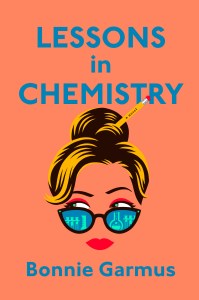
Lessons in Chemistry by Bonnie Garmus 4*

I enjoyed this book but not as much as I’d expected. It’s described on Goodreads as ‘Laugh-out-loud funny, shrewdly observant, and studded with a dazzling cast of supporting characters‘. But although I found parts of it amusing I didn’t laugh out loud. It’s about Elizabeth Zott, covering her life from the early 1950s through to the 1960s. She is a scientist, an independent single mother, who having lost her job, found herself as ‘the star of America’s most beloved cooking show Supper at Six. Elizabeth’s unusual approach to cooking (“combine one tablespoon acetic acid with a pinch of sodium chloride”) proves revolutionary. But as her following grows, not everyone is happy. Because as it turns out, Elizabeth Zott isn’t just teaching women to cook. She’s daring them to change the status quo.

I found Elizabeth quite an unlike able character and couldn’t warm to her. The book is full of exaggeration and hyperbole – examples are Elizabeth’s daughter Madeleine who at the age of four could read Nabakov and Six Thirty, the dog who was so clever and kind, worrying about Elizabeth and Madeleine. I don’t think we’re meant to take this as realistic – it’s a larger-than-life world with a semi-magic-realist strand and all just that bit over the top. In a complete contrast to the whimsy there’s a brutal rape, the death of Calvin, Elizabeth’s husband, abuse, abandonment, bullying and sexism thrown into the mix. Then there’s Elizabeth’s TV cookery show – I enjoyed the details of this more than the rest of the book. The ending is a bit of a let down and a bit rushed.

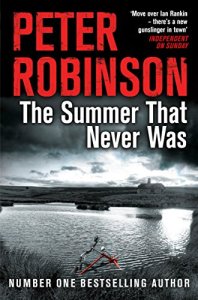
The Summer That Never Was by Peter Robinson 4*

This is crime fiction, the 13th Inspector Banks book. I’m gradually reading through the whole series. This is Goodread’s description:

A skeleton has been unearthed. Soon the body is identified, and the horrific discovery hits the headlines . . .

Fourteen-year-old Graham Marshall went missing during his paper round in 1965. The police found no trace of him. His disappearance left his family shattered, and his best friend, Alan Banks, full of guilt . . .

That friend has now become Chief Inspector Alan Banks, and he is determined to bring justice for Graham. But he soon realises that in this case, the boundary between victim and perpetrator, between law-guardian and law-breaker, is becoming more and more blurred . . .

What I particularly liked about this one is that it gives an insight into Banks’s childhood, as he investigates the murder of his childhood friend. The book alternates between this case and that of a present day case, that of the disappearance of another schoolboy, Luke Armitage, the son of an ex-football player. DI Annie Cabbot is in charge of that investigation. Although this can be read as a stand-alone novel, part of the enjoyment in reading the series in order is that you see the development of the main characters and their relationships over the years. There are now 27 books in the series with the 28th, Standing in the Shadows, due to be published in June 2023.

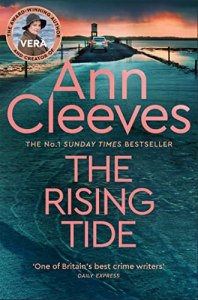
The Rising Tide by Ann Cleeves 5*

More crime fiction, this is the 10th Vera Stanhope mystery novel. I love the Vera books and this one is no exception. Ann Cleeves is a superb storyteller. Her books are deceptively easy to read,  moving swiftly along as the tension rises. They are layered, cleverly plotted and above all convincing.

The Rising Tide is set on the Holy Island of Lindisfarne, a tidal island just off the coast of Northumberland, only accessible across a causeway when the tide is out. Ann Cleeves explains whilst the background to the novel is real any specific places on the island or the nearby coast are fictional. I’ve visited the island several times and know just how fast the tide comes in over the causeway. If you’ve watched the TV series it shows Vera crossing the causeway in her Land Rover in the opening titles.

It has a complex plot and plenty of twists and turns as DCI Vera Stanhope and her team investigate the death of Rick Kelsall who was discovered hanged from the rafters of his small bedroom on Holy Island. He is one of a group of friends who have met for a reunion each year on the island for the past fifty years. It appears to be suicide but Vera is convinced that it is murder and that the clue to his death lies in the past. I was kept guessing almost to the end as the secrets from the past are revealed.

These notes don’t do just justice to the books but I enjoyed all of them, even Lessons in Chemistry. My favourite though is The Rising Tide and I wish I’d written more detail about it just after I read it!
Book Beginnings & The Friday 56: The Summer That Never Was by Peter Robinson

Every Friday Book Beginnings on Friday is hosted by Gillion at Rose City Reader where you can share the first sentence (or so) of the book you are reading. You can also share from a book you want to highlight just because it caught your fancy.

One of the books I’m currently reading is The Summer That Never Was by Peter Robinson, the 13th Inspector Banks book, following on from Aftermath. I am really enjoying it, so far, which is a relief as I really disliked Aftermath.

My Book Beginning:

Trevor Dickinson was hung over and bad-tempered when he turned up for work on Monday morning

Also every Friday there is The Friday 56, hosted by Freda at Freda’s Voice, where you grab a book and turn to page 56 (or 56% of an eBook), find one or more interesting sentences (no spoilers), and post them.

Page 56:

‘Did he have many friends?’

‘He made quite a few around here,’ Joan answered. She looked at her mother. ‘Who was there Mum?’

‘Let me remember. There was the Banks lad, of course, they were very close, and David Grenfell and Paul Major. And Steven Hill.’

Blurb

A skeleton has been unearthed. Soon the body is identified, and the horrific discovery hits the headlines.

Fourteen-year-old Graham Marshall went missing during his paper round in 1965. The police found no trace of him. His disappearance left his family shattered, and his best friend, Alan Banks, full of guilt.

That friend has now become Detective Chief Inspector Alan Banks, and he is determined to bring justice for Graham. But he soon realizes that in this case, the boundary between victim and perpetrator, between law-guardian and law-breaker, is becoming more and more blurred.

What do you think, does it appeal to you? What are you currently reading?

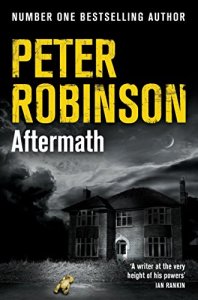
Aftermath by Peter Robinson – a brief review

A house of horror. A despicable serial killer. Banks’s darkest case.

When a concerned neighbour calls the police to number 35 The Hill after a domestic disturbance, the two constables are led to a truly horrific scene. They unwittingly uncover an elusive serial killer known as the Chameleon. With the killer finally in custody it appears the nightmare is over.

Not for Banks though. Too many questions remain unanswered at the house of horrors. And then they discover there are more bodies than victims. Is the Chameleon killer just one monster of many? Banks must solve his darkest case yet

Aftermath is the 12th book in Peter Robinson’s Inspector Banks series. The synopsis does not indicate the real nature of this book. There is much more to it than ‘truly horrific’. I agree that it is Banks’ darkest case in the series so far, but it is more than that. I didn’t like it right from the start; there is too much violence and graphic detail for me. It is harrowing and deeply disturbing with some scenes of physical abuse, child abuse, and rape. However the characters are well written and the story is gripping and despite hating it I read all 512 pages.

I’ve read some of the later books in the series and don’t remember that any of them were as dark and disturbing as this one, so I’m hoping the next book in the series, The Summer That Never Was, is not like Aftermath.

  • ASIN ‏ : ‎ B003DWC6NQ
  • Publisher ‏ : ‎ Pan; New Edit/Cover edition (4 Sept. 2008
  • Print length ‏ : ‎ 512 pages
  • My Rating: 3* not for the storyline but for the writing
  • Source: I bought the e-book