Normal Rules Don’t Apply by Kate Atkinson – Eleven interconnected stories, where everything is changing, where nothing is quite as it seems.
Six Stories and an Essay by Andrea Levy – This collection opens with an essay about how writing has helped Andrea Levy to explore and understand her heritage. She explains the context of each piece within the chronology of her career and finishes with a new story, written to mark the centenary of the outbreak of the Great War in 1914.
I also borrowed two other books:
The Gardener by Salley Vickers – Previously I’ve read five books by Vickers, and enjoyed them, especially Miss Garnet’s Angel and Mr Golightly’s Holiday. The last one I read was The Librarian, which I thought was rather underwhelming. I hope this one is better.
Nine Lives by Peter Swanson – I haven’t read any of Swanson’s books, but keep seeing them on book blogs and thought I’d see if I like this one.
It’s time again for Six Degrees of Separation, a monthly link-up hosted by Kate atBooks Are My Favourite and Best. Each month a book is chosen as a starting point and linked to six other books to form a chain. A book doesn’t need to be connected to all the other books on the list, only to the one next to it in the chain.
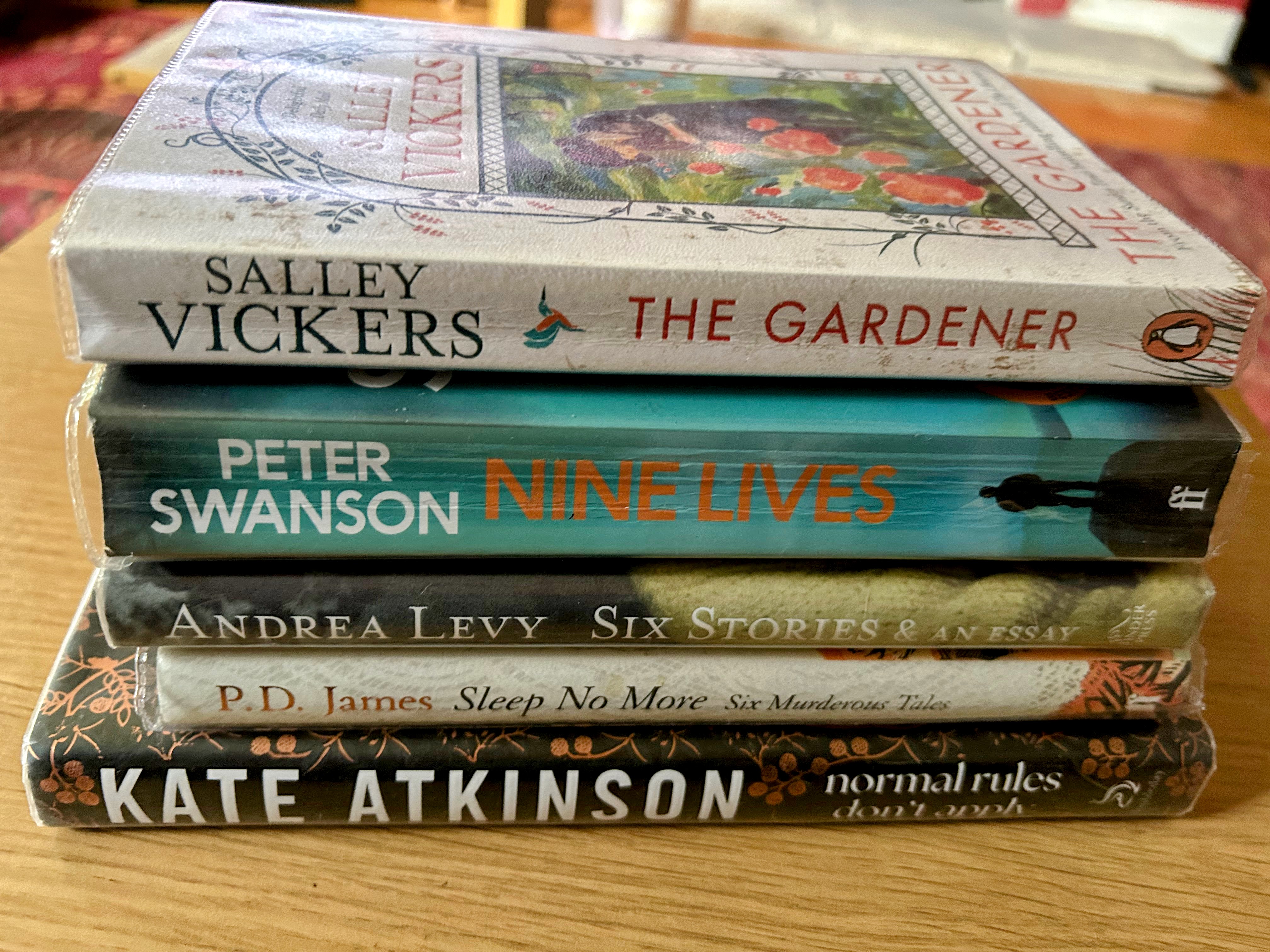
This month we start with All Fours by Miranda July, shortlisted for the Women’s Prize for Fiction 2025 and several other awards. I haven’t read it and probably won’t. This is Amazon’s description:
A semi-famous artist turns forty-five and gives herself a gift – a cross-country road trip from LA to New York, without her husband and child. But thirty minutes after setting off, she spontaneously exits the freeway, beds down in a nondescript motel – and embarks on the journey of a lifetime.
Miranda July’s second novel confirms the brilliance of her unique approach to fiction. With July’s wry voice, perfect comic timing, unabashed curiosity about human intimacy, and palpable delight in pushing boundaries, All Fours tells the story of one woman’s quest for a new kind of freedom. Part absurd entertainment, part tender reinvention of the sexual, romantic, and domestic life of a forty-five-year-old female artist, All Fours transcends expectation while excavating our beliefs about life lived as a woman. Once again, July hijacks the familiar and turns it into something new and thrillingly, profoundly alive.
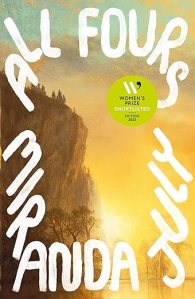
First link: I have read another book that was shortlisted for the previous year’s Women’s Prize for Fiction – Restless Dolly Maunder by Kate Grenville.
Dolly Maunder is born at the end of the 19th century, when society’s long-locked doors are just starting to creak ajar for determined women. Growing up in a poor farming family in rural New South Wales, Dolly spends her life doggedly pushing at those doors. A husband and two children do not deter her from searching for love and independence.
This is the fictionalised life story of Kate Grenville’s maternal grandmother, Sarah Catherine Maunder, known as Dolly. She was not only restless but also clever and determined – she knew what she wanted and she did her best to achieve it.
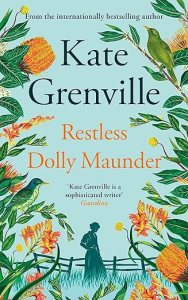
Second link: One of my favourite books by Kate Grenville is One Life: My Mother’s Story, her biography of Nance Russell, based on Nance’s memories, making it much more than a factual account of a person’s life. It’s a book that casts light not only on Nance’s life but also on life in Australia for most of the 20th century. Nance was born in 1912 and died in 2002, so she lived through two World Wars, an economic depression and a period of great social change. Nance wasn’t famous, the daughter of a rural working-class couple who became pub-keepers, but she was a remarkable woman.
It’s a vivid portrait of a real woman, a woman of great strength and determination, who had had a difficult childhood, who persevered, went to University, became a pharmacist, opened her own pharmacy, brought up her children, and helped build the family home. She faced sex discrimination and had to sell her pharmacy in order to look after her children at home.
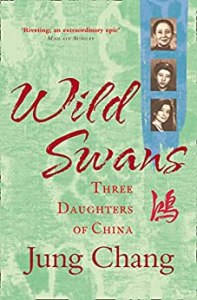
Third link: Wild Swans: Three Daughters of China by Jung Chang, a family memoir – the story of three generations of women in Jung Chang’s family – her grandmother, mother and herself, telling of their lives in China up to and during the years of the violent Cultural Revolution. Her family suffered atrociously, her father and grandmother both dying painful deaths and both her mother and father were imprisoned and tortured. She casts light on why and how Mao was able to exercise such paralysing control over the Chinese people. His magnetism and power was so strong and coupled with his immense skill at manipulation and his ability to inspire fear, it proved enough to subdue the spirit of most of the population; not to mention the absolute cruelty, torture and hardships they had to endure.
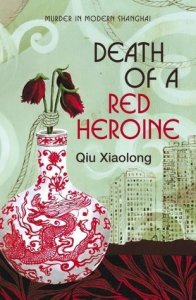
My fourth link moves from a memoir to crime fiction in Death of a Red Heroine by Qiu Xiaolong, the first book featuring Chief Inspector Chen. Chen is a reluctant policeman, he has a degree in English literature and is a published poet and translator. This is as much historical fiction as it is crime fiction. There is so much in it about China, its culture and its history before 1990 – the Communist regime and then the Cultural Revolution in the 1960s – as well as the changes brought about in the 1990s after the massacre of Tiananmen Square. This does interfere with the progress of the murder investigation as Chen has to cope with the political ramifications and consequently there are several digressions and the pace is slow and lacking tension. As Chen is a poet as well as a policeman there are also references to Chinese literature.
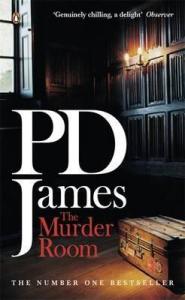
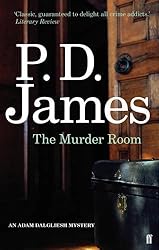
Fifth link: Another fictional Chief Inspector who writes poetry is Adam Dalgleish in The Murder Room by P D James. The Murder Room itself is in the Dupayne Museum, displaying the most notorious murder cases of the 1920s and 30s, with contemporary newspaper reports of the crimes and trials, photographs and actual exhibits from the scenes of the murders. These were actual crimes and not fictional cases made up by P D James.
The novel begins, as Adam Dalgleish visits the Dupayne in the company of his friend Conrad Ackroyd who is writing a series of articles on murder as a symbol of its age. A week later the first body is discovered at the Museum and Adam and his colleagues in Scotland Yard’s Special Investigation Squad are called in to investigate the killing, which appears to be a copycat murder of one of the 1930s’ crimes.
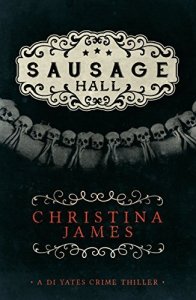
Another crime fiction writer with the surname James is my sixth link: Sausage Hall by Christina James, the third novel in the DI Yates series. It has a sinister undercurrent exploring the murky world of illegal immigrants, and a well researched historical element. It’s set in the South Lincolnshire Fens and is an intricately plotted crime mystery, uncovering a crime from the past whilst investigating a modern day murder. Sausage Hall is home to millionaire Kevan de Vries, grandson of a Dutch immigrant farmer. I liked the historical elements of the plot and the way Christina James connects the modern and historical crimes, interwoven with the history of Kevan’s home, Laurieston House, known to the locals as ‘Sausage Hall’ and the secrets of its cellar.
My chain is made up of novels shortlisted for the Women’s Prize for Fiction, a biography, a memoir and three murder mysteries. It travels from New York to the UK via Australia and China.
Where does your chain end up, I wonder?
Next month (July 5, 2025), we’ll start with the 2025 Stella Prize winner, Michelle de Kretser’s work of autofiction, Theory & Practice.
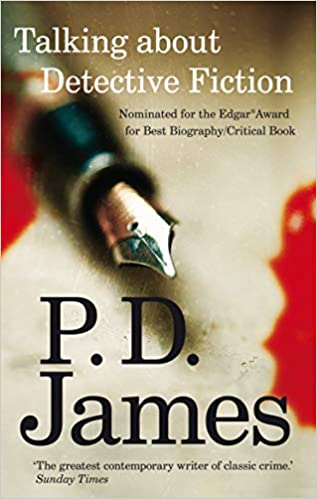
Faber & Faber| 2010| 160 pages| Paperback|My Own Copy| 4*
From the birth of crime writing with Wilkie Collins and Dostoevsky, through Conan Doyle to the golden age of crime, with the rise of Agatha Christie, Ngaio Marsh and Margery Allingham, P. D. James brings a lifetime of reading and writing crime fiction to bear on this personal history of the genre. There are chapters on great American crime writers – the likes of Patricia Highsmith, Raymond Chandler and Dashiel Hammett. James also discusses many of her favourite famous detectives, from Sherlock Holmes to Philip Marlowe.
P.D. James, the bestselling author of Death Comes to Pemberley, Children of Men and The Murder Room, presents a brief history of detective fiction and explores the literary techniques behind history’s best crime writing.
I do like reading books about books and as crime fiction is one of my favourite genres I wanted to read Talking About Detective Fiction by P D James. In December 2006 she was asked to write the book by the Bodleian Publishing House, in aid of the Library. It’s a personal account and being a short book doesn’t go into much detail about any of the writers. It’s an overview of mostly British authors, with just one chapter, entitled Soft-centred and Hard-boiled in which she writes about the differences between the hard-boiled school of American fiction and some of the Golden Age writers.
I’m familiar with the work of most of the authors in this book, but there are some James mentions I haven’t read, such as Dashiell Hammett, who wrote short stories featuring the Continental Op and Sam Spade, who also appears in one full-length novel, The Maltese Falcon. James’ favourite of the hard-boiled writers was Kenneth Millar, who wrote under the pseudonym of Ross Macdonald, novels featuring private detective Lew Archer. But she didn’t give the details of any of his books.
The structure of the book is rather loose and meandering. Although it is divided into eight chapters, the works of some, such as Agatha Christie and Dorothy L Sayers appear in several chapters spread across the book as a whole. The book needs an index to draw the separate entries together! I think the parts I enjoyed the most are those in which James writes about her own methods of working, and the chapter on Telling the Story: Setting, Viewpoint and People.
There is a short bibliography and list of suggested reading at the end of the book. Throughout the book there are several cartoons, which add an amusing touch.
Finally, you need to be aware if you haven’t read The Murder of Roger Ackroyd that without any warning, she gives away not just a little spoiler, but the identity of the murderer! I was amazed!
I love doing Six Degrees of Separation, a monthly link-up hosted by Kate atBooks Are My Favourite and Best. Each month a book is chosen as a starting point and linked to six other books to form a chain. A book doesn’t need to be connected to all the other books on the list, only to the one next to it in the chain.
This month (April 6, 2019), the chain begins with Ali Smith’s award-winning novel, How to be Both.
‘How to be Both is a novel all about art’s versatility. Borrowing from painting’s fresco technique to make an original literary double-take, it’s a fast-moving genre-bending conversation between forms, times, truths and fictions. There’s a Renaissance artist of the 1460s. There’s the child of a child of the 1960s. Two tales of love and injustice twist into a singular yarn where time gets timeless, structural gets playful, knowing gets mysterious, fictional gets real—and all life’s givens get given a second chance.’ (Goodreads)
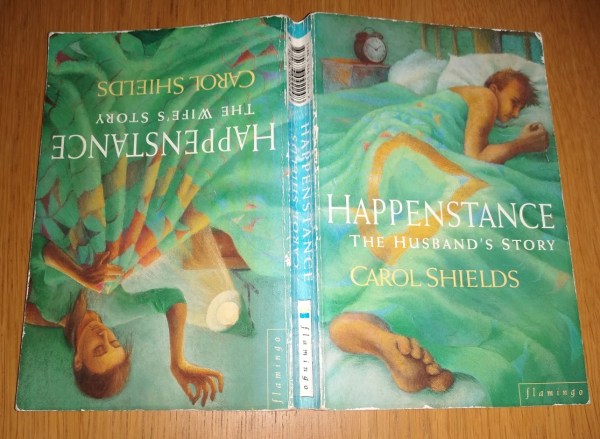
I haven’t read this book but I’d like to sometime. I see that there are two versions: one begins with the contemporary story, the other with the 15th-century story. This reminded me of Carol Shields’ book Happenstance, two stories about the same five-day period – one from Jack Bowman’s point of view, and the other from his wife, Brenda’s. They’re printed in the same book in an unusual format of containing two books in one, either can be read first – then turn the book upside down and read the other story.
My next link is a bit of a jump – from the character Brenda in Happenstance I immediately thought of Brenda Blethyn, who plays Vera in Ann Cleeves’s books. One of these books is Silent Voicesin which D I Vera Stanhope finds a dead body in the sauna room of her local gym. The victim, a woman had worked in social services – and was involved in a shocking case involving a young child.
Social Services also feature in Fair of Face by Christina James. Ten year old Grace is being fostered when her foster mother and her baby are found dead in their beds. Social Services are asked to work with the police, in order to question Grace and her friend Chloe, a child from a troubled family.
Another author with the name James, is P D James, also a crime writer. An Unsuitable Job for a Woman is a Cordelia Gray detective story in which she takes on an assignment from Sir Ronald Callander, a famous scientist, to investigate the death of his son, Mark who had been found hanged in suspicious circumstances. Mark had left Cambridge University without completing his degree and had taken a job as a gardener.
My next link is to Agatha Christie’s Cat Among the Pigeons, set mainly in an exclusive and expensive girls’ school, Meadowbank, in England. Some new staff members have been appointed, including Adam Goodman, ahandsome young gardener.
My final link is to another school, the Marcia Blaine School for Girls in Muriel Spark’s novel, The Prime of Miss Jean Brodie. Marcia Blaine is a traditional school where Miss Brodie’s ideas and methods of teaching are viewed with dislike and distrust. The Head Teacher is looking for ways to discredit and get rid of her. The girls in her ‘set’ fall under her spell, but one of them betrays her, ruining her teaching career.
Different formats, the name ‘Brenda’, Social Services, authors’ surname ‘James’, gardeners, and girls’ schools all linkHow To Be Both to The Prime of Miss Jean Brodie.
Except for The Prime of Miss Jean Brodie the books in my chain are all crime fiction and apart from How To Be Both I’ve read all the books in the chain – clicking on the titles takes you to my posts, where they exist.
Next month (May 4, 2019), the chain will begin with Jane Harper’s debut best-seller, The Dry.
The Murder Room by P D James is one of the last of the Adam Dalgleish books, first published in 2003 . Although I’ve not read many of the books I’ve watched most (if not all) of the TV adaptations, but I don’t remember watching this one.
The Murder Room itself is in the Dupayne Museum, displaying the most notorious murder cases of the 1920s and 30s, with contemporary newspaper reports of the crimes and trials, photographs and actual exhibits from the scenes of the murders. These were actual crimes and not fictional cases made up by P D James.
The novel begins, as Commander Adam Dalgleish visits the Dupayne in the company of his friend Conrad Ackroyd who is writing a series of articles on murder as a symbol of its age. A week later the first body is discovered at the Museum and Adam and his colleagues in Scotland Yard’s Special Investigation Squad are called in to investigate the killing, which appears to be a copycat murder of one of the 1930s’ crimes.
The Murder Room is not a quick read. It begins slowly with a detailed description of the main characters and it is only after 150 or so pages that the first murder occurs, so by that time I had a good idea of who might be killed but not of the culprit as many of the characters could all have had the motive and opportunity. There are two more killings before Dalgleish reveals the culprit.
More used to fast paced murder mysteries initially I was impatient with this slow start but soon settled into P D James’ approach and appreciated the depth of the intricate plot. The setting is fascinating and the characters are convincing, so much so that I was hoping the second victim wouldn’t be one of my favourite characters.
The lease on the Museum is up for renewal and not everyone wants it to continue – as one of the characters says:
It’s the past … it’s about dead people and dead years … we’re too obsessed with our past, with hoarding and collecting for the sake of it.
There is the Dupayne family – Marcus and Caroline both actively involved in running the Museum, and their brother Nigel, who is a psychiatrist, and his daughter Sarah; the Museum staff – Muriel Godby in charge of the Museum’s day to day running, Tally Clutton the housekeeper, James Calder-Hale, the curator who used to work for MI5; Marie Strickland, a volunteer calligraphist; and Ryan Archer, the handyman and gardener.
I liked the interaction between Dalgleish and D I Kate Miskin, and between Dalgleish and Emma Lavenham who is finding their relationship increasingly frustrating. I enjoyed the book and found it absorbing and testing of both my powers of deduction and vocabulary.
I don’t usually like sequels to books written by a different author, but I think I’ll have to make an exception for this one. It’s set six years after the events of Pride and Prejudice, Jane Austen’s tale of romance and social advancement and sees Darcy and Elizabeth’s marriage thrown into disarray when Lydia Wickham arrives unannounced and declares her husband has been murdered.
For more information see this BBC page after P D James’s talk on Radio 4 the other day, although she declined to give any further details saying, “It’s rather secret at the moment, because it’s something entirely new.”



 BooksPlease