Sunday Salon – Current Books

I finished reading The Fall by Simon Mawer yesterday. It is the story of Rob Dewar and Jamie Matthewson from their childhood up to Jamie’s death 40 years later. But it’s also the story of their parents and how their lives are interlinked. I found it enthralling, one of those books that make me want to look at the ending to see how it all turns out. I managed to stop myself, however, and read impatiently to the end anxious to know what actually happened between them all.

It moves between the two generations beginning in the present day, when Rob hears on the news that Jamie, a renowned mountaineer has fallen to his death in Snowdonia. No one is sure whether it was an accident or suicide. Then it moves  back 40 years to the time when the two boys met, both fatherless – Jamie’s dad, Guy went missing when climbing Kangchenjunga and Rob’s parents are divorced, and back yet further again to 1940 when Guy Matthewson met the boys’ mothers – Meg (later calling herself Caroline) and Diana. And so  the drama unfolds in the mountains of Wales and the Alps, culminating on the North Face of the Eiger.

The Fall is not just a gripping account of the dangers of rock climbing and mountaineering, but it’s also a love story, with the intricacies of relationships, and love, loss and betrayal at its core. The love stories and the climbing scenes are both shown through the imagery of falling with all its ambiguities – actual falls, falling in love, falling pregnant and falling from grace. It’s beautifully written, capturing not only the mountain landscape but also London during the Blitz. This is the second excellent book by Mawer that I’ve read, even though it has a rather predictable ending.

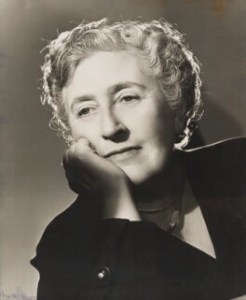
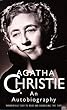
I’m still reading Agatha Christie’s  An Autobiography and will be for some time as it is long and detailed – 550 pages printed in a very small font, which makes it impossible for me to read it in bed. But it is fascinating. It’s not just an account of her life but is full of her thoughts and questions about the nature of life and memory:

I am today the same person as that solemn little girl with pale flaxen sausage-curls. the house in which the spirit dwells, grows, develops instincts and tastes and emotions and intellectual capacities, but I myself, the true Agatha, am the same. I do not know the whole Agatha. The whole Agatha, so I believe, is known only to God.

So there we are, all of us, little Agatha Miller, and big Agatha Miller, and Agatha Christie and Agatha Mallowan proceeding on our way – where? That one doesn’t know – which of course makes life exciting. I have always thought life exciting and I still do. (page 11)

I’ll be writing more about Agatha Christie on Wednesday for my contribution to the Agatha Christie Blog Tour.

Agatha Christie Blog Tour

On 15 September 2010 Agatha Christie would have been 120 years old.

Over at the ACRC Blog Carnival we are taking part in world wide celebrations with a blog carnival tour from 1-30 September 2010.

My contribution will be on 22 September. The schedule for the blog tour is at the Agatha Christie Reading Challenge site, where you can check out what the other participants write each day.

Teaser Tuesday – 4.50 from Paddington

Teaser Tuesdays is a weekly bookish meme, hosted by MizB of Should Be Reading.

Share a couple or more sentences from the book you’re currently reading. You also need to share the title of the book that you’re getting your ‘teaser’ from €¦ that way people can have some great book recommendations if they like the teaser you’ve given!


This week one of the books I’m reading is 4.50 from Paddington by Agatha Christie, in which a woman is killed on a train and then her body can’t be found. Miss Marple gets involved. As she is by now a frail old lady told by her doctor to take things easy she enlists the help of Lucy Eyelesbarrow in finding out what actually happened. This works out very well, mainly because of Lucy’s thoroughness and Miss Marple’s powers of deduction.  This is how she thinks about it:

Of course, I am somewhat handicapped by not actually being on the spot. It is so helpful, I always feel, when people remind you of other people – because types are alike everywhere and that is such a valuable guide.

One is inclined to guess – and guessing would be very wrong when it is a question of anything as serious as murder. All one can do is to observe the people concerned – or who might have been concerned – and see of whom  they remind you. (page 121)

Book Beginnings on Friday

Book Beginnings on Friday is a meme hosted by Becky at Page Turners. Anyone can participate; just share the opening sentence of your current read, making sure that you include the title and author so others know what you’re reading. If you like, share with everyone why you do, or do not, like the sentence.

I’m just about to start reading 4.50 From Paddington by Agatha Christie. The first sentence is:

Mrs McGillicuddy panted along the platform in the wake of the porter carrying her suitcase.

I like this sentence because it paints a picture and I know immediately that Mrs McGillicuddy is not a young or a fit woman, as she’s out of breath, or she’s running late for the train. The next few sentences pad out the picture of a woman who is short and stout, carrying a large quantity of parcels as a result of Christmas shopping. So I also know that it is most likely to be December and as she has been shopping she is most likely to be going home and she’s probably tired out.

As this is an Agatha Christie book I know there’ll be a murder and I also know from the blurb that she is about to witness the murder on a passing train through the train window. Now I just need to get reading.

Agatha Christie Reading Challenge: My Progress

The Agatha Christie Reading Challenge is an open-ended challenge to read all of Agatha Christie’s books and short stories, run by Kerrie at Mysteries in Paradise. I first read some of Christie’s books when I was a teenager and hadn’t read any for years until I borrowed a copy of The Crooked House from my local library three years ago. This reminded me of how much I had enjoyed her books and set me off reading them again. Over the years I must have read a good number of them but had never kept any records of what I read at the time.

So when I saw that Kerrie was running this challenge I decided to join in. It’s one of the best challenges out, for me at least, because all you have to do is read Agatha Christie’s books at your own pace and link to the Agatha Christie Carnival once a month. There’s no pressure to meet any deadlines – if you haven’t read any Christie books for the Carnival that’s OK and you just carry on reading when you like.

I’m not even trying to read them in the order they were published, even though Kerrie and some others are, because I’m reading books I already own or books that I find in librarys and/or bookshops. So far I’ve read 17 and 2 collections of her short stories – I’ve listed them on a separate page.

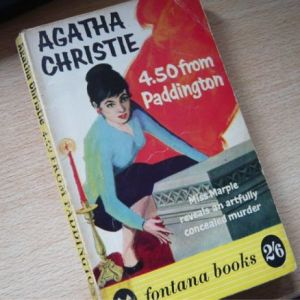
My latest find is 4.50 from Paddington, which I received from Juxtabook as part of my prize in her recent competition. Catherine described this book as a ‘rather aged paperback’ and it is, but then it is 50 years old, published in 1960 for just 2/6 (in old money). It may be old and faded, but because it was published soon after Agatha Christie wrote it, it has a contemporary feel about it. I’ve watched so many TV and film versions, with different actors playing the part of Miss Marple, some more successfully than others that it’s interesting to see this book. I’m not sure who the woman on the front cover is meant to portray – surely not Miss Marple?

And this is the back cover – really that’s all the blurb you need to capture your interest.

This will be my next Agatha Christie book to read.

Death on the Nile by Agatha Christie: Book Review

Death on the Nile is a pre-Second World War novel, first published in 1937. It shows Agatha Christie’s interest in Egypt and archaeology and also reflects much of the flavour and social nuances of the pre-war period. In it she sets a puzzle to solve –  who shot Linnet Doyle, the wealthy American heiress? Although the novel is set in Egypt, an exotic location, it is essentially a ‘locked room mystery’, as the characters are passengers on the river-steamer SS Karnak, cruising on the Nile. Amongst them is the famous Hercule Poirot, a short man dressed in a white silk suit, a panama hat and carrying a highly ornamental fly whisk with a sham amber handle ‘a funny little man (pages 37 – 38). Linnet is the girl who has everything, good looks and wealth:

A girl with golden hair and straight autocratic features ‘a girl with a lovely shape’ (page 3). She was used to being looked at, being admired, to being the centre of the stage wherever she went. (page 41)

Linnet has recently married Simon Doyle, who was previously engaged to her friend, Jacqueline. This sets in motion a series of events that results in Linnet’s death. When Jacqueline follows them on their trip down the Nile she is the obvious suspect, driven by her jealousy of Linnet. Also on board are an imperious American, Miss Van Schuyler, her niece Cornelia Robson and Miss Bowers, her companion; a novelist Mrs Salome Otterbourne and her daughter, Rosalie; Mrs Allerton and her son, Tim; Linnet’s American solicitor, an excitable Italian archaeologist, a radical English socialist and a young English solicitor.

Poirot is on holiday, but he finds himself discussing the nature of criminals and motives for murder with Mrs Allerton. He says the most frequent motive is money:

that is to say gain in its various ramifications. Then there is revenge, and love, and fear ‘and pure hate, and benefice’. (page 83)

The motive in this case seems straightforward, looking at who gains from Linnet’s death, but this is a complicated plot (when is one of Christie’s books not complicated?) and following on from Linnet’s murder, her maid is also found dead, Linnet’s pearls are missing, several characters are not what them seem and with the arrival of Colonel Race, a member of the British Secret Service, it seems there is also an international murderer and agitator on board. Poirot knew

that Race was a man of unadvertised goings and comings. He was usually to be found in one of the out-posts of Empire where trouble was brewing. (page 120)

It does seem a very unlikely plot, dependent on precise timing, but Poirot works his way through the significant facts and arrives at the truth. He tells Race that

This is a crime that need audacity, swift and faultless execution, courage, indifference to danger and a resourceful, calculating brain. This crime wasn’t safe! It hung on a razor edge, It needed boldness. (page 272)

All in all, an enjoyable puzzle to solve, most of which I’d worked out along with Poirot.