Agatha Christie on Individuality

This morning I was reading more of Agatha Christie’s Autobiography. It feels as though I’m listening to her as she recalls her life and in this morning’s chapter she was talking about individuality and writing. She said that even though you admire certain writers and may wish to write like them, you know you can’t:

If I could write like Elizabeth Bowen, Muriel Spark or Graham Greene, I should jump to high heaven with delight, but I know that I can’t, and it would never occur to me to attempt to copy them. I have learnt that I am me, that I can do the things, that as one might put it, me can do, but I cannot do the things that me would like to do. As the Bible says, ‘Who by taking thought can add one cubit to his stature?’ (page 422)

So it’s no good me wanting  to write like she did!

She went on to list the things she couldn’t do:

  • she was never good at games
  • she was not a conversationalist
  • she couldn’t draw or paint
  • she couldn’t model or do any kind of sculpture
  • she couldn’t hurry without getting rattled
  • she couldn’t say what she meant easily – she could write it better

and then the things she could do:

  • she could write
  • she could be a reasonable musician, but not a professional one
  • she could improvise when in difficulties

and things she didn’t like:

  • crowds
  • being jammed up against people
  • loud voices
  • noise
  • protracted talking
  • parties, especially cocktail parties
  • cigarette smoke and smoking generally
  • any kind of drink except in cooking
  • marmalade
  • oysters
  • lukewarm food
  • grey skies
  • the feet of birds, or the feel of birds altogether
  • and most of all – the taste and smell of hot milk

finally, things she did like:

  • sunshine
  • apples
  • almost any kind of music
  • railway trains
  • numerical puzzles and anything to do with numbers
  • going to the sea
  • bathing and swimming
  • silence
  • sleeping
  • dreaming
  • eating
  • the smell of coffee
  • lilies of the valley
  • most dogs
  • going to the theatre

Apart from a few exceptions we like and dislike most of the same things – I do like a glass of wine for example, I’m useless at numerical puzzles, can’t do sudoku (I bet she’d have liked that), I’m not fond of swimming, and I like cats as well as dogs.

Agatha Christie on Poirot

These are some of Agatha Christie’s thoughts on creating Hercule Poirot, taken from her Autobiography.

She had decided to write a detective story whilst working in a hospital dispensary during World War 1. Surrounded by poisons it seemed natural that death by poisoning would be the method. She then decided who should be poisoned, who would be the poisoner, when, where and how. And then who should be the detective? She was steeped in the Sherlock Holmes tradition but decided she had to invent a detective of her own and he had to have a friend as a ‘kind of butt or stooge’. He had to be unique, a character that hadn’t been used before. She considered a schoolboy, or a scientist, but when she remembered the Belgian refugees who were living in a colony in Tor that is who she settled on.

She decided her detective should be a Belgian – a refugee and a retired police officer and only later realised what a mistake she had made:

What a mistake I made there. The result is that my fictional detective must be well over a hundred by now.

Anyway, I settled on a Belgian detective. I allowed him to grow slowly into his part. He should have been an inspector, so that he would have a certain knowledge of crime. He would be meticulous, very tidy, I thought to myself, as I cleared away a good many untidy odds and ends in my own bedroom. A tidy little man, I could see him as a tidy little man, always arranging things, liking things in pairs, liking things square instead of round. And he should be very brainy – he should have little grey cells of the mind – that was a good phrase: I must remember that – yes he would have the little grey cells. (page 263 -4)

And then he had to have a name, rather a grand name. She wondered about calling her little man Hercules but his last name was more difficult. She didn’t know how the name Poirot came to her – whether it just came into her head or whether she saw it in a newspaper or written down somewhere, but it didn’t go with Hercules; eventually she decided that it should be Hercule – Hercule Poirot. So, The Mysterious Affair at Styles was conceived and eventually published. She was jubilant – her book was going to appear in print. She didn’t know that this was the start of her long  writing career and that

Hercule Poirot, my Belgian invention, was hanging round my neck, firmly attached there like the old man of the sea. (page 285)

Because  Poirot had been quite a success in The Mysterious Affair at Styles she was encouraged to use him again and then she realised that she was tied to both Poirot and his Watson: Captain Hastings.

I quite enjoyed Captain Hastings. He was a stereotyped creation, but he and Poirot represented my idea of  a detective team. I was still writing in the Sherlock Holmes tradition, eccentric detective, stooge assistant, with a Lestrade-type Scotland Yard detective, Inspector Japp – and now I added a ‘human foxhound’, Inspector Giraud, of the French police. Giraud despises Poirot as being old and passé.

Now I saw what a terrible mistake I had made in starting with Hercule Poirot so old – I ought to have abandoned him after the first three or four books, and begun with someone much younger. (page 290)

Poirot, whatever Agatha Christie thought of him is one of her most famous characters, vying in popularity with Miss Marple. Each time I read on of the 33 novels he appears in or see him portrayed by David Suchet (who is Poirot for me) I think he is my favourite. But then I’m equally as fond of Miss Marple (Joan Hickson fitted the part to perfection) and she too is my favourite. I can’t pick one over the other – they are both outstanding creations.

A Caribbean Mystery by Agatha Christie: Book Review

In Agatha Christie’s A Caribbean Mystery, published in 1964  Miss Marple is on holiday, arranged for her by her nephew Raymond West after her doctor had prescribed sunshine. Whilst staying at the Golden Palm Hotel on the fictitious island of  St Honoré, she is listening to Major Palgrave droning on about his life, reliving days when he’d been happy. He was about to show her a photo of a murderer when he stares over her shoulder and sees someone, stops his story and hastily returns the photo to his wallet. Then hours later he is found dead. Miss Marple suspects he didn’t just die in his sleep and investigates his death, involving old Mr Rafiel, a man who looked on the point of death himself, and who delighted in contradicting anything anyone else said.

She also wants to find out about the murderer the Major had mentioned. The question she needs answered was who was it the Major saw that disturbed him so much. Once again it is her knowledge of human nature, gleaned from living in peaceful St Mary Mead that leads her to uncover the truth. She considers the other guests at the hotel in turn, and not sure whether the murderer was a man or a woman everyone is a suspect, from the elderly Canon Prescott and his sister, a thin severe-looking woman to the hotel owners, a young couple, Molly and Tim Kendal. There are plenty of misleading false trails and hidden relationships to discover before the murderer is revealed.

This is not my favourite Agatha Christie but it’s still an entertaining book, which I enjoyed. I didn’t guess who the murderer was until quite near the end, but that is not a bad point. I liked the descriptions of the island and Miss Marple’s thoughts and observations on human nature. At the beginning Raymond mistakenly thinks his Aunt Jane has her head buried in the sand, living in an idyllic rural life when it is real life that matters. Jane silently disagrees:

People like Raymond were so ignorant. In the course of her duties in a country parish, Jane Marple had acquired quite a comprehensive knowledge of the facts of rural life. She had no urge to talk about them, far less to write about them – but she knew them. Plenty of sex, natural and unnatural. Rape, incest, perversion of all kinds. (Some kinds, indeed, that even the clever young men from Oxford who wrote books didn’t seem to have heard about. (page 9)

Agatha Christie on …

I’ve been reading Agatha Christie’s Autobiography for a while now – just a chapter or so each day. Instead of writing about the details of her life I thought I’d do a few posts now and then on things she drops into the narrative. Ideas she had, thoughts on various things, books she liked and so on.

Today, I’ve chosen to focus on her joy in being alive and happiness.

She’s writing about the time in her life when she was thirteen or fourteen:

Always when I woke up, I had the feeling which I am sure must be natural to all of us, a joy in being alive. I don’t say you feel it consciously – you don’t – but there you are, you are alive, and you open your eyes, and here is another day; another step as it were, on your journey to an unknown place. That very exciting journey which is your life. Not that it is necessarily going to be exciting as a life, but it will be exciting to you because it is your life. That is one of the great secrets of existence, enjoying the gift of life that has been given to you.(page 133)

She goes on to say that not every day will be enjoyable, for example if you remember you’re going to the dentist. However, she thinks it does depend upon your temperament – whether you’re a happy person or melancholic:

Naturally happy people can be unhappy and melancholic people enjoy themselves. But if I were taking a gift to a child at a christening that is what I would choose: a naturally happy frame of mind. (page 133)

I like that.

The ABC Murders by Agatha Christie: Book Review

As I’ve written an ABC of Agatha Christie for the Agatha Christie Blog tour and found the ABC Wednesday site, I thought I’d carried on with the alphabet theme and read Agatha Christie’s The ABC Murders. I’m so glad I did because it’s one of her best, or at least I think it is.

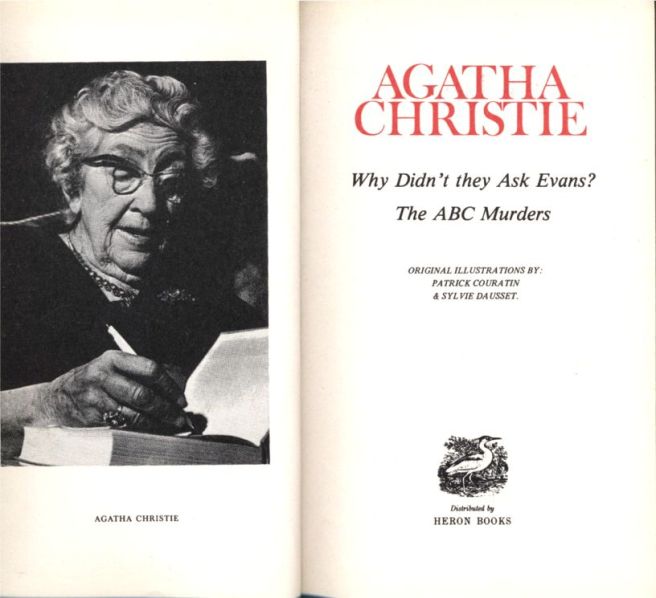
My copy is in a compilation volume along with Why Didn’t They Ask Evans. The ABC Murders was first published in 1936.

It’s narrated by Captain Hastings, for the most part, interspersed by chapters written in the third person, which Hastings assures us are accurate and have been ‘vetted’ by Poirot himself. I thought that was interesting and it alerted me to read those chapters carefully. What follows is a series of murders advertised in advance by letters to Poirot, and signed by an anonymous ‘ABC’. An ABC Railway is left next to each of the bodies. So the first murder is in Andover, the victim a Mrs Alice Ascher; the second in Bexhill, where Betty Barnard was murdered; and then Sir Carmichael Clarke in Churston is found dead. The police are completely puzzled and Poirot gets the victims’ relatives together to see what links if any can be found.

The only thing that seems to link them is that they were killed by the same person and that in each case there is a person who be the obvious suspect as the murderer if it hadn’t been for the ABC murderer. Poirot was convinced that one or possibly all of the relatives ‘knows something that they do not know they know.’ And indeed that was so. In Poirot’s final explanation of the case he admitted that all along he had been worried over the why? Why did ABC commit the murders and why did he select Poirot as his adversary?

Quite early on the book I had my suspicions about the identity of ABC but Agatha Christie was an expert at providing plenty of red herrings and twist and turns, and of course I was actually just as baffled as the police (quite an array of police, including a Chief Constable and an Assistant Commissioner, were involved from different forces around the country as well as Inspector Japp) and Doctor Thompson, a ‘famous alienist’. It was only right at the end that I worked out this ingenious mystery.

4.50 from Paddington by Agatha Christie: Book Review

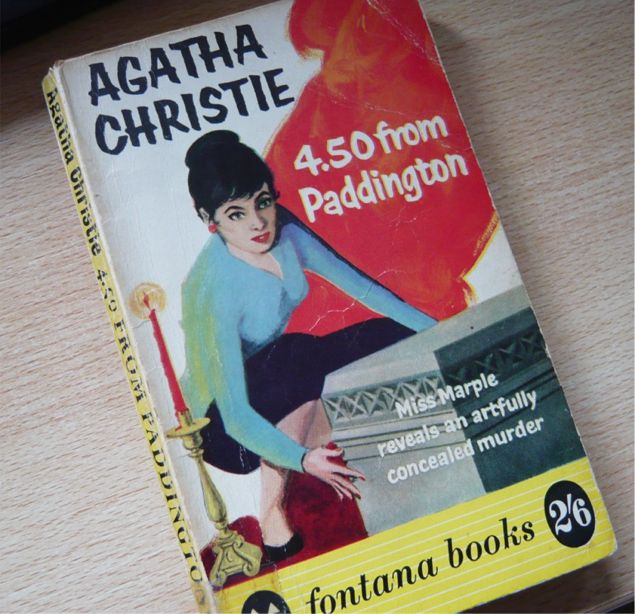
4.50 from Paddington 1

I’d expected the 4.50 from Paddington (first published in 1957) to be set on a train going by its title, but actually it just begins on the train. Train timetables and routes feature quite highly though. Mrs McGillicuddy was going home from Christmas shopping in London when she saw from the window of her train a murder being committed in a train travelling on a parallel line. But nobody believes her because there is no trace of a body and no one is reported missing. Nobody, that is except for her friend Miss Marple.

Miss Marple is getting older and more feeble and she hasn’t got the physical strength to get about and do things as she would like. But she has a theory about the whereabouts of the woman’s body, having worked out the most likely place that a body could have been pushed or thrown out of the train and she enlists the help of Lucy Eyelesbarrow to find it. This takes Lucy to Rutherford Hall, the home of the Crackenthorpe family, a family with many secrets and full of tension.

It’s an intriguing puzzle because you know there has been a murder, that the victim was a woman but her identity is not known, until much later in the book. You also know that the murderer is a man and there are plenty of male suspects to consider. Even though Miss Marple explains it all at the end of the book and says that it was very, very simple – the simplest kind of crime, I didn’t find it simple at all and had no idea who the killer was or even the victim. How Miss Marple worked it out is down to intuition and she tricks the murderer into confessing his crime.