Crime Fiction Alphabet: Letter P

It’s the letter P this week in Kerrie’s Crime Fiction Alphabet and I have another of Agatha Christie’s books to illustrate the letter.

If you haven’t read any of Agatha Christie’s books don’t begin with Postern of Fate. It’s the last novel she wrote, published in 1973, and it’s rambling and repetitive, with very little in the way of mystery. It’s the fourth of the Tommy and Tuppence Beresford mysteries and it begins with the ageing couple, now retired and living in a new home. I read it because I like Tommy and Tuppence and wanted to know what they were doing in this final book.

I liked the opening pages in which Tuppence is bemoaning the fact that they have so many books and there isn’t enough room to shelve them. They’d sorted out their books before they moved house, only bringing with them the ones they couldn’t bear to part with, but they had bought books from the previous owners of the house. Tuppence is sorting through them and in Robert Louis Stevenson’s The Black Arrow she sees that some of the letters are underlined in red ink, spelling out an intriguing message: ‘Mary Jordan did not die naturally. It was one of us. I think I know which one.’

Naturally the Beresfords have to find out more and after talking to some of the local people Tuppence discovers that Mary Jordan had lived in the house during the First World War and there are rumours that she was a German secret agent. It appeared she had died from accidental poisoning. But they aren’t satisfied and want to know more. Whilst Tuppence continues talking to the locals, Tommy goes to London and talks to Captain Pikeaway, ex-head of Special Branch and the enigmatic Mr Robinson (who appeared in Agatha Christie’s thriller Passenger to Frankfurt). They discover some facts, and have lots of meandering discussions, but the denouement is very vague (at least I found it so).

Its interest for me lies in what the book reveals about Agatha Christie. Clearly she is remembering her own childhood when Tuppence is reminiscing about the books she had read as a child, listing them and exclaiming how much she liked them – books such as The New Treasure Seekers, lots of Stanley Weyman books (he wrote historical romances), The Prisoner of Zenda, Treasure Island and Kidnapped.

Throughout her life she was an avid reader and her books include many references to a variety of sources from Shakespeare to T S Eliot. The title of this book derives from a poem Gates of Damascus by John Elroy Flecker, quoted as an epigraph and by Tommy as he worries about keeping Tuppence out of danger:

Four great gates has the city of Damascus …

Postern of Fate, the Desert Gate, Disaster’s Cavern, Fort of Fear …

Pass not beneath, O Caravan, or pass not singing.

Have you heard

That silence where the birds are dead, yet something pipeth like a bird?

I think when Tommy and Tuppence are complaining about the difficulties of getting tradesmen to complete work on their new house Agatha Christie was writing from experience:

Electricians arriving in a kindly tangle of optimism and efficiency had stated work. “Coming along fine now, not much more to do,” they said. “We’ll be back this afternoon.” But they hadn’t been back that afternoon. Tommy was not precisely surprised. He was used, now, to that general pattern of labour in the building trade, electrical trade, gas employees and others. They came, they showed efficiency, they made optimistic remarks, they went away to fetch something. They didn’t come back. One rang up numbers on the telephone but they always seemed to be the wrong numbers. If they were the right numbers, the right man was not working at this particular branch of the trade, whatever it was. (pages 35-36)

Then there are her misgivings about the state of the country:

England was in a funny state, a different state from what it had been. Or was it really always in the same state? Always underneath the smooth surface there was some black mud. There wasn’t clear water down to the pebbles, down to the shells, lying on the bottom of the sea. There was something moving, something sluggish somewhere, something that had to be found, suppressed. (page 138)

But there is rather too much of this sort of digression in Postern of Fate and Agatha Christie comes across as disillusioned with modern life. Here, for example, she has Colonel Pikeaway complaining about the worship of money:

…big fortunes made out of drugs, drug pushers, drugs being sent all over the world, being marketed, a worship of money. Money not just for buying yourself a big house and two Rolls Royces, but money for making more money and doing down, doing away with the old beliefs. Beliefs in honesty, in fair trading. (page 249)

Although there are things I like in this book and I am glad I’ve read it, I think it must be my least favourite of Agatha Christie’s books that I’ve read.

Crime Fiction Alphabet: L is for …

Lord Edgware Dies by Agatha Christie. This was first published in the UK in 1933 and later the same year in the USA as Thirteen for Dinner. It’s the eighth book featuring Hercule Poirot, narrated by Captain Hastings. Agatha Christie had written it in the autumn of 1931 at her house in Ninevah, whilst with her husband, Max Malloran on his expedition in the Middle East sponsored by the British Museum.

Lord Edgware Dies is set far from Ninevah, in London’s West End. Poirot is having supper at the Savoy with Hastings after they had been to the theatre to see the celebrated American impressionist, Carlotta Adams. At the next table is Jane Wilkinson, Lady Edgware, also a celebrated actress, who Carlotta had impersonated during her show. Jane implores Poirot to help her to ‘get rid of her husband’ – to convince him to agree to a divorce. Poirot agrees to go and see Lord Edgware. Much to Poirot’s surprise, Lord Edgware readily agrees to a divorce, but as Poirot and Hastings leave the house, Hastings is surprised to see an astonishing change in Lord Edgware’s face:

That suave smiling face was transformed. The lips were drawn back from the teeth in a snarl, the eyes were alive with fury and an almost insane rage. (page 33 0f my copy)

The next morning Lord Edgware was found dead, stabbed in the back of the neck. Jane was seen at the house the night before, but there are witnesses who can testify that she was at a dinner party with twelve other guests.  Could Jane have been in two places at once and killed him? She had boasted to her friends that if Poirot couldn’t help her that she would

‘have to call a taxi to go round and bump him off myself. (page 17)

Or was it Carlotta Adams impersonating Jane?

It’s not a simple mystery and there is a second murder which complicates matters. Poirot is at his best, relying on his knowledge of psychology, the ‘employment of the little grey cells‘, which gives him such mental pleasure. There are small personal touches such as this where Poirot compares his moustache to that of Hastings in this conversation between the two of them:

‘You have made a hit, Poirot. The fair Lady Edgware can hardly take her eyes off you.’

‘Doubtless she had been informed of my identity’, said Poirot, trying to look modest and failing.

‘I think it is the famous moustaches’, I said. ‘She is carried away by their beauty.’

Poirot caressed them surreptitiously.

‘It is true that they are unique,’ he admitted. ‘Oh, my friend, the ‘tooth-brush’ as you call it, that you wear – it is a horror – an atrocity – a wilful stunting of the bounties of nature. Abandon it, my friend, I pray of you.’ (pages 12-13)

Yet again, another baffling case solved by Hercule Poirot – a very entertaining book.

The Crime Fiction Alphabet 2012 is a meme hosted by Kerrie at Mysteries in Paradise.
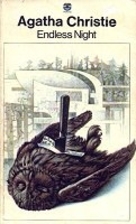
Crime Fiction Alphabet: Letter E

Endless Night (Agatha Christie Collection)…

Endless Night by Agatha Christie was first published in 1967.

She usually spent three to four months writing a book, but she wrote Endless Night in six weeks. It differs from most of her other books in that it is a psychological study. In fact it reminded me very much of Ruth Rendell’s books, writing as Barbara Vine. It has the same suffocating air of menace throughout the book, with more than one twist at the end.

The title comes from William Blake’s Auguries of Innocence:

Every Night and every Morn
Some to Misery are born.
Every Morn and every Night
Some are born to Sweet Delight.
Some are born to Sweet Delight,
Some are born to Endless Night.

It’s hard to write about this book without identifying the murderer.  Don’t read the Wikipedia entry if you don’t want to know,  as that gives it away completely.

The narrator is Michael Rogers, a young man with grand ideas who’d had many jobs and not enough money to buy everything he wanted. He longs for a fine, beautiful house designed by his architect friend, Santonix and after seeing the Sale Notice of ‘The Towers’ and its land, known locally as ‘Gipsy’s Acre’, he dreams that he would live there with the girl that he loved.

His dreams come true when he meets and falls in love with Ellie, an American heiress. They marry when she reaches 21 and she buys the ‘The Towers’ . Santonix designs and builds them a new, modern house and they live there – but not happily ever after because ‘Gipsy’s Acre’  is said to be cursed. Indeed, old Mrs Lee, who tells fortunes and prophesies the future warns Ellie:

‘I’m telling you my pretty. I’m warning you. You can have a happy life – but you must avoid danger. Don’t come to a place where there’s danger or where there’s a curse. Go away where you’re loved and taken care of and looked after.  You’ve got to keep yourself safe. Remember that. Otherwise -otherwise- ‘ she gave a short shiver. I don’t like to see it, I don’t like to see what’s in your hand. (pages 32-3)

It’s Michael  who dominates the book, with his aspirations, his determination to get what he wants, his optimism and also his difficult relationship with his mother, his inability to get along with Ellie’s family and her companion, Greta, who Michael thinks has an undue influence on her.There is little or no detection, and no investigators – no Poirot or Miss Marple – to highlight the clues to the murders, for there are several.

I read Endless Night very quickly and easily, convinced of the characters and the locations. But thinking about it now I can see that it’s deceptively easy to read and I read it too quickly, hardly taking in hints and clues along the way, although I did begin to sense who the murderer was. It’s a study of avarice, of the effect of the pursuit of wealth, of the restless desire to possess. It’s also about evil, love, hate and desire – and ‘endless night’ is a terrible fate.

May’s Reading & Crime Fiction Pick of the Month

I read a lot in May – well I read and listened, because three of the books were audiobooks, which was quite a novelty for me. In total I ‘read’ 11 books and 9 of them were crime fiction. So far I’ve only reviewed 4 of them.

This is what I read –  the links are to my posts on the books and * indicates crime fiction:

  1. Wycliffe and the Cycle of Death by W J Burley* 4/5
  2. The End of the Affair by Graham Greene 3/5
  3. Murder in Mesopotamia by Agatha Christie* 3.5/5
  4. The Redeemed by M R Hall* 4.5/5
  5. Blue Lightning by Ann Cleeves* 4/5
  6. The Hanging in the Hotel by Simon Brett * (library audiobook) 2/5
  7. Fatherland by Robert Harris* 5/5
  8. Bring Up the Bodies by Hilary Mantel 4/5
  9. The Sign of Four by Arthur Conan Doyle* 3/5 (library audiobook)
  10. The Coroner by M R Hall* (library book) 4/5
  11. Dandy Gilver and an Unsuitable Day for a Murder by Catriona McPherson* 3/5 (advanced reading copy)

I’m aiming to review the rest of the books, but for now here are notes on them.

Wycliffe and the Cycle of Death by W J Burley is set in Penzance in Cornwall. Matthew Glynn, a bookseller,is found bludgeoned and strangled, which sets Chief Superintendent Wycliffe a difficult mystery to solve. The answer lies in the past and in the Glynn family’s background. I enjoyed this book, which I read quickly, eager to know the outcome, but the ending was a let down.

Murder in Mesopotamia by Agatha Christie. I always like Agatha Christie’s books and although I don’t think this is one her better books, it was a satisfying read. It’s a closed room type mystery. Who killed Louise, the wife of the celebrated archaeologist leading the Hassanieh dig? Only the people at the dig could have done it, but which one – they’re all under suspicion? Poirot doesn’t appear until quite late on in the book, but, of course, works it all out.

The Hanging in the Hotel by Simon Brett (audiobook). This is the fifth of the Fethering Mysteries, in which Jude and her friend Carole investigate the death of one of the guests at the local country house hotel, following the dinner attended by the all-male members of the Pillars of Sussex the night before. It looks like suicide but Jude thinks it can’t be. I got rather tired listening to this book as Jude and Carole endlessly (or so it seemed) went over and over the events and questioned the suspects.

Bring Up the Bodies by Hilary Mantel is the sequel to Wolf Hall. This book certainly deserves a post of its own. Here I’ll just comment that this chronicles the fall of Anne Boleyn, Henry VIII’s second wife and Cromwell’s part in satisfying Henry’s wishes. I don’t think it’s quite as captivating as Wolf Hall, but it does show just how devious Cromwell could be.

My Crime Fiction Book of the Month is a close call between  Fatherland by Robert Harris  and The Redeemed by MR Hall, both of which had me engrossed.

Fatherland is a fast paced thriller, set in a fictional Germany in 1964, a Germany that had been victorious in the Second World War. It begins with the discovery of the body of one of the former leading members of the Nazi party, who had been instrumental in devising ‘the final solution’. It’s a complex book and leads police detective Xavier March into a very dangerous situation as he discovers the truth.

The Redeemed by MR Hall is by contrast not about a police investigation but is the third book in which Jenny Cooper, a coroner investigates the death of a man discovered in a church yard, the sign of the cross carved into his abdomen. At first it looks like a horrific suicide, but as Jenny delves deeper during her inquest she finds links to yet more deaths. This is the third book in M R Hall’s Jenny Cooper series and I enjoyed it so much that I immediately borrowed the first book, The Coroner, from the library. They do stand well on their own but I think it helps to read them in sequence. In The Coroner Jenny begins her career, having been a solicitor for fifteen years. She obviously has devastating events in her personal life that she has to deal with.

May’s reading has been exclusively fiction, so I’m looking forward to reading some nonfiction in June. I’m feeling like reading a biography or two.

See the round-up post at Mysteries in Paradise for other bloggers’ choices of book of the month for May ‘“ and add your favourite May read to the collection.

Wondrous Words

Reading Agatha Christie’s books I often come across words or phrases that I’m either not sure what they mean but can get the gist of the meaning from the context, or have never come across before.

I found an example of each type whilst reading The Murder on the Links, an early Poirot mystery first published in 1923:

Traps as in this sentence: ‘I had made a somewhat hurried departure from the hotel and was busy assuring myself that I had duly collected all my traps, when the train started.(page 5)

Captain Hastings is the narrator and is returning to London on the Calais train, so I thought he couldn’t be taking animal traps with him on the train and it was more likely to be his luggage. According to the Chambers Dictionary that is the meaning of the word: ‘personal luggage or belongings’. 

I didn’t know what the Bertillon system was. Poirot referred to it when talking about the lack of fingerprints on the murder weapon and remarked that ‘The veriest amateur of an English Mees knows it – thanks to the publicity the Bertillon system has been given in Paris.’ (page 35)

The Bertillon system is described in Wikipedia in the article on Anthropometry. Simple put it is a system for identifying criminals based on a series of their physical measurements introduced by Alphonse Bertillon in 1883. In 1894 England had adopted the system and had added the partial use of fingerprints. By 1900 England relied on finger prints alone.

(Click on the image to enlarge)

Wondrous Words Wednesday is hosted by Kathy at Bermuda Onion.

The Murder on the Links by Agatha Christie: a Book Review

I’m taking part in the Agatha Christie Reading Challenge. I couldn’t wait until I’d got them all in the order she wrote them so I’ve been reading them as I come across them. Some of her earlier books have been hard to find, but on a recent trip to Barter Books in Alnwick I was able to fill in some of my gaps.

I’ve read 34 of her books before finding her third book,The Murder on the Links, originally published in 1923. This is the second book featuring Hercule Poirot.  There have been many editions published since then and my copy is a paperback, published in 1960 by Pan Books.
Agatha Christie had the idea for the book after reading newspaper reports of a murder in France, in which masked men had broken into a house, killed the owner and left his wife bound and gagged. From these facts she then invented her plot, setting the book in the fictional French town of Merlinville ( midway between Boulogne and Calais), at the Villa Genevieve, next to a golf course and overlooking the sea. The owner of the villa, Mr Renauld, a South American millionaire had written to Poirot asking for his help as he feared his life was in danger.

When Poirot and Hastings arrive they are too late to help him as the night before their arrival he was found dead, lying face down in an open grave, stabbed in the back. As they are in France, Inspector Japp does not appear, instead there is a young French detective, M. Giraud, who thinks very little of Poirot’s methods and disagrees with his findings. This is very much a mystery puzzle book, with many clues and several red herrings.

In her Autobiography, Agatha Christie describes how she was writing

… in the Sherlock Holmes tradition – eccentric detective, stooge assistant, with a Lestrange-type Scotland Yard detective, Inspector Japp – and I now added a ‘human foxhound’, Inspector Giraud, of the French police. Giraud despises Poirot as being old and passé. (page 290)

And it was then that she realised that she had made a mistake in starting with Poirot so old. She would have preferred to have abandoned him after her first three or four books and begun again with someone much younger, but she was stuck with him.

It is rather a melodramatic tale, but still enjoyable as Poirot unravels the mystery. An interesting subplot involves a love interest for Hastings, when he mets a young lady calling herself Cinderella. There is a hint at the end of the book that he will marry her and move to South America. Agatha Christie was stuck with Poirot, but she felt she could get rid of Hastings – she was getting rather tired of him. She didn’t write him out completely and he does reappear in later novels, visiting Poirot from his home in Argentina. I like Hastings, who in this book shares rooms with Poirot and is a ‘sort of private secretary to an MP.’

Her Autobiogaphy also reveals that Agatha Christie was not pleased with the jacket cover her publishers had designed as she felt it didn’t reflect the plot. In fact she was ‘really furious and it was agreed that in future she should see the jacket first and approve of it.’

She thought The Murder on the Links was ‘a moderately good example of its kind‘ and I liked it. My rating: 3/5.