Mrs McGinty's Dead by Agatha Christie

Mrs McGinty 001

I think Agatha Christie enjoyed herself writing Mrs McGinty’s Dead, especially the character of the crime novelist, Ariadne Oliver. It was first published in 1952 and written not long after the end of the Second World War, reflecting the difficulties of finding employment and the changes for the post-war impoverished middle classes.

Hercule Poirot is rather bored, missing his friend Hastings and finding that his days are revolving around his meals: ‘One can only eat three times a day. And in between there are gaps.’ Even a newspaper report about the result of the McGinty trial doesn’t interest him: ‘It had not been an interesting murder. Some wretched old woman knocked on the head for a few pounds. All part of the senseless brutality of these days.

It is only when Superintendent Spence comes to him for help, convinced of the innocence of James Bentley, convicted of the murder and under sentence of death that Poirot agrees to reinvestigate the case. And so it is that he goes to the village of Broadhinny, treating it as a ‘challenge to the little grey cells of my brain.’

He investigates in his usual way, with method and logic, first of all by considering the motive and then looking at the characters of Mrs McGinty and James Bradley. He decides that the answer is to be found in the personality of the murderer.There is a sense of urgency, as the death penalty was still in force and there is little time left before James Bentley is due to be hanged. Poirot talks to Mrs McGinty’s neighbours and the people she worked for as a charlady and eventually solves the mystery, but not without a second murder and nearly getting killed himself.

It’s a lively book, the characters and dialogue moving the plot along smoothly. There are plenty of surprises and a lot of misdirection before the killer is revealed. The clues are all there and although I did pick up on the main clue, I picked the wrong person as the murderer.

As always, for me, there is more to the book than the puzzle of the murders, and in Mrs McGinty’s Dead there are several things, including the view Agatha Christie paints of life in an English village not long after the war (usually the setting for a Miss Marple mystery), the mix of characters, working class and middle class, the very amusing picture of the dreadful Bed and Breakfast, run by Major Summerhayes and his wife, Maureen, where Poirot stays in Broadhinny, and then there is Ariadne Oliver.

In portraying Ariadne I think Agatha Christie is revealing her feelings about writing about Poirot, a character she described in her Autobiography as ‘hanging round my neck, firmly attached there like the old man of the sea.’ Ariadne’s detective is a Finn, Sven Hjerson and she has been writing about him for thirty years:

 How do I know why I ever thought of the revolting man? Why a Finn when I know nothing about Finland? Why a vegetarian? Why all the  idiotic mannerisms he’s got? …

And people even write and say how fond of him you must be. Fond of him? If I met that bony, gangling, vegetable-eating Finn in real life, I’d do a better murder than any I’ve invented. (page 201)

She also reveals her feelings about playwrights adapting her plays (and about money for her books!):

So far it’s pure agony. Why I ever let myself in for it I don’t know. My books bring me quite enough money – that is to say the bloodsuckers take most of it, and if I made more, they’d take more. But you have no idea of the agony of having your characters taken and made to say things that they never would have said, and do things that they never would have done. And if you protest, all they say is that it’s “good theatre”. (page 125)

She also wrote in her Autobiography about the ‘terrible suffering you go through with plays, owing to the alterations made in them.'(page 448). I find it reassuring that she didn’t like the way dramatisations changed her books, because I don’t either, although I do like David Suchet as Poirot and Joan Hickson as Miss Marple.

There are references to real life murder cases. On the Sunday before her death, Mrs McGinty had been reading the Sunday Comet, which had an article on women victims of tragedies from the past. Poirot looks at these in detail, concluding that one of the women might have been in Broadhinny when the murder took place.

A short while ago I wrote a guest post for Alyce’s blog At Home With Books about the best and the worst of Agatha Christie’s works. Trying to decide between her numerous novels which one is the best is an impossible task, but I think that Mrs McGinty’s Dead is up there amongst the best of them.

Cat Among the Pigeons by Agatha Christie

I’ve read about half of Agatha Christie’s books ranging from her first books in the 1920s to the later ones in the 1970s and the quality of her writing does change, with some of the later books being rather loosely plotted and meandering. Cat Among the Pigeons is one of her later books, first published in 1959 and it’s one of the best of these later novels.
It’s set mainly in an exclusive and expensive girls’ school, Meadowbank, in England, said to be based on her daughter Rosalind’s school. The summer term has just started and there are some new members of staff as well as some new pupils, including Princess Shaista from Ramat, a small and rich Arab state in the Middle East, which has just suffered a revolution. Her fiancé Prince Ali Yusuf the Hereditary Sheik, has been murdered and his family jewels have disappeared.

The success of the school is down to Miss Bulstrode, the headmistress and founder of Meadowbank, but she is thinking of retiring. Miss Chadwick, who had helped Miss Bulstrode to found Meadowbank would like to be her successor, but Miss Bulstrode has other ideas. Will it be Miss Vansittart, who is her second in command, or one of the other teachers who would be able to develop the school in line with modern educational thinking? Miss Bulstrode is not sure. She is busy greeting one of the parents when her attention is distracted by one of the mothers approaching clearly in a state of advanced intoxication, so she misses something else that could very well be important. And although she feels uneasy:

There was nothing to tell her that within a few weeks Meadowbank would be plunged into a sea of trouble; that disorder, confusion and murder would reign there, that already certain events had been set in motion … (page 27)

The new staff members are not all fitting in very well. There is Miss Springer, the new Games Mistress, who is not popular with the girls and asks too many personal questions, Mlle Angele Blanche, the new French teacher, whose teaching leaves much to be desired, Ann Shapland, Miss Bulstrode’s new and efficient secretary, and last but not least Adam Goodman, the handsome young new gardener, who is good at his job and has other talents too.

As well as Princess Shaista, Jennifer Sutcliffe is new to the school this term. She’s an uncomplicated character who lives mainly for tennis. She makes friends with Julia Upjohn, who is a much more thoughtful, observant character. So when Miss Springer is found shot dead in the new Sports Pavilion, followed not long after by the murder of Miss Vansittart, it’s Julia who decides to contact Hercules Poirot.

There are several possible motives and suspects and Agatha Christie combines the murder stories with a thriller element by introducing Colonel Pikeaway, who it is hinted is in charge of British Intelligence – ‘We know all about things here. That’s what we’re for.‘ (page 46) and the mysterious Mr Robinson, who is most decidedly not an Englishman although his voice was English with no trace of an accent.

Poirot, of course, although arriving very late in the investigations, works it all out and explains what had happened. But Julia also has worked it out and without giving too much away I’m quoting this passage where she is writing an essay on the contrasting attitudes of Macbeth and Lady Macbeth to murder:

Macbeth, Julia had written, liked the idea of murder and had been thinking of it a lot, but he needed a push to get him started. Once he got started he enjoyed murdering people and had no more qualms or fears. Lady Macbeth was just greedy and ambitious. She thought she didn’t mind what she did to get what she wanted. But once she’d done it, she found she didn’t like it after all. (page 239)

There in a nutshell are the motives for the murder – a ruthless disregard of the value of life and greed and ambition.

After the Funeral by Agatha Christie

I thoroughly enjoyed Agatha Christie’s After the Funeral, first published in 1953.

Synopsis (from the official Agatha Christie website):

‘When Cora is savagely murdered, the extraordinary remark she made the previous day at her brother’s funeral takes on a chilling significance. At the reading of Richard’s will, Cora was clearly heard to say, “It’s been hushed up very nicely, hasn’t it…But he was murdered, wasn’t he?”  In desperation, the family solicitor turns to Hercule Poirot to unravel what happened next …

Published in 1953, and appearing in the United States under the title Funerals are Fatal, Christie dedicated the novel to her nephew, James Watt III “in memory of happy days at Abney”, her sister’s family home. The novel  formed the basis for MGM’˜s Murder at the Gallop, although they chose to swap Poirot for Margaret Rutherford’s Miss Marple and took ‘˜artistic licence’ with the book’s plot!  It was broadcast in 2006 with David Suchet as Poirot.’

My view:

I read it quickly and consequently had little idea who had killed Cora. I did spend some time looking at the family tree at the beginning of the book, working out the family relationships and who was present at Richard Abernethie’s funeral and their reaction to Cora’s question. It seemed to me that any of the family could have done it – Agatha Christie goes through the actions and thoughts of each character and there’s cause for suspicion for each one.

None of them had had any close ties and consequently they didn’t feel any deep grief. His brother expected he would inherit as Richard’s only son had died six months before his father. Instead Richard had distributed his property equably between his brother and his nephews and nieces – everyone is disappointed.

Apart from trying to solve the mystery I was interested in the glimpses into life in post-war Britain, where jobs are scarce, servants even more scarce and there are complaints about the economic situation, with high taxation and the prospect of properties such as the Abernethie house being turned into a hotel, or institute, or even worse being pulled down and the whole estate built over.

  • Paperback: 378 pages
  • Publisher: HarperCollins; Masterpiece edition edition (6 May 2008)
  • Language: English
  • ISBN-10: 0007119364
  • ISBN-13: 978-0007119363
  • Source: I bought the book
  • Rating: 5/5

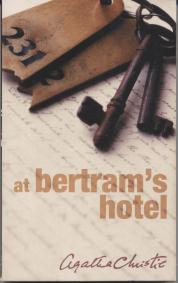
At Bertram’s Hotel by Agatha Christie

At Bertrams Hotel 001

I try to read at least one Agatha Christie book a month. This month’s book is At Bertram’s Hotel, a Miss Marple book, first published in 1965, and written when Agatha Christie was seventy five.

Synopsis (from book cover):

An old-fashioned London Hotel is not quite as reputable as it makes out’¦

When Miss Marple comes up from the country for a holiday in London, she finds what she’s looking for at Bertram’s Hotel: traditional decor, impeccable service and an unmistakable atmosphere of danger behind the highly polished veneer.

Yet, not even Miss Marple can foresee the violent chain of events set in motion when an eccentric guest makes his way to the airport on the wrong day’.

My view:

Miss Marple is now the same age as Agatha Christie was at the time she was writing At Bertram’s Hotel and some of her thoughts and reactions are most likely to be those of the author herself  – reflections on comfort for example – most appreciative of her bed, and a beautifully cooked breakfast, a real breakfast with properly poached eggs and enjoying ‘a delightful morning of shopping’ at the Army& Navy Stores.  But Miss Marple is not one of the main characters in this book, although she does play a vital role.

In some ways, Bertram’s Hotel itself is a leading ‘character’. It’s ‘dignified, unostentatious and quietly expensive‘, patronised by clergymen, ‘dowager ladies of the aristocracy up from the country’ and ‘girls on their way home from expensive finishing schools.’ It’s Miss Marple’s choice when her nephew and his wife decide to do something for ‘poor old Aunt Jane’ and pay for her week’s stay. And yet it doesn’t seem real to her, the fact that it didn’t seem to have changed over the years made her think that it ‘really seemed too good to be true.’ (page 26)

There’s a long build up to any crime being committed and It’s only towards the end of the book that a murder occurs. Scotland Yard are concerned about a crime network that is getting too big and organised:

Robbery on a big scale was increasing. Bank hold-ups, snatches of pay-rolls, thefts of consignments of jewels sent through the mail, train robberies. Hardly a month passed but some daring and stupendous coup was attempted and brought off safely. (page 49)

(I was reminded that Agatha Christie was writing this at the time of, or shortly after the ‘Great Train Robbery’ of 1963 in which a gang of robbers held up a mail train and made off with £2.6 million (equivalent to £41 million now) – later in the book a train robbery takes place in Ireland.)

A number of characters are introduced quite quickly and I had to keep reminding myself who they were and how they fitted into the story. There’s the hotel staff, including Henry the ‘perfect butler’ and the visitors, including Lady Sedgewick and a number of elderly ladies, Colonel Luscombe and other retired military gentlemen, Canon Pennyfather, a vague forgetful white-haired elderly cleric, Elvira Blake, Colonel Luscombe’s ward and the police, including Chief Inspector Davy (nicknamed ‘Father’ by his staff – a nickname that I thought irritating and out of place, probably intended to make him seem paternal and safe). There is also the mysterious Mr Robinson, who I’ve come across in some of Agatha Christie’s other books.

The novel meanders along through a number of subplots before reaching the climax, which I thought was a bit signposted. The ending is both predictable and surprising with a final twist in the last sentence that pleased me.

One of the things I like about At Bertram’s Hotel are the little insights into Miss Marple’s mind – and her past. For example she had first visited Bertram’s Hotel as a  girl of fourteen with her uncle and aunt, her Uncle Thomas had been a Canon of Ely. And I was delighted to discover that she had known romance because when she was a young woman she had had a friendship with ‘a very unsuitable young man‘ whose name she has forgotten. But her mother had firmly nipped that friendship in the bud, which later Jane realised was wise although at the time Jane Marple, ‘that pink and white eager  young girl … such a silly girl in many ways’ had ‘cried herself to sleep for at least a week.’ (page 26)

As in other books featuring Miss Marple it’s her characteristic curiosity, what she preferred to call ‘taking an interest in other people’s affairs’, that is crucial to the plot. She is very good at overhearing conversations and she’s a light sleeper. She’s also very perceptive and just a touch cynical, no longer the silly girl of her youth.

  • Paperback: 224 pages
  • Publisher: HarperCollins; Masterpiece edition edition (1 July 2008)
  • Language: English
  • ISBN-10: 0007121032
  • ISBN-13: 978-0007121038
  • Source: I bought the book
  • My Rating: 4/5

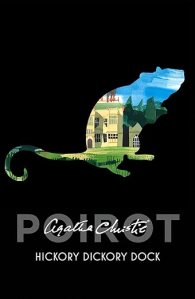
Hickory Dickory Dock by Agatha Christie

Hickory Dickory Dock is a Poirot mystery, first published in 1955. The nursery rhyme title actually bears no relevance to the plot, even though Poirot quotes the rhyme at the end when he hears a clock strike one. The only links I can see are that it’s about the residents of a students’ hostel at 26 Hickory Road and one of the suspects also parodies the rhyme.

Poirot is drawn into the plot through his secretary, Miss Lemon. This is her first appearance as Poirot’s secretary in a full length novel, although she had featured in some of Agatha Christie’s short stories. She had also appeared in Parker Pyne Investigates (1934) when she worked for Mr Parker Pyne. I’m used to Pauline Moran’s portrayal of Miss Lemon, in Agatha Christie’s Poirot TV series – efficient and smart but also attractive. So I was surprised to read this most unflattering description of her as ‘that hideous and efficient woman … she was not a woman at all. She was a machine – the perfect secretary’ , with ‘strong grizzled hair.’ Poirot just cannot believe that she has made three mistakes in one letter and discovers that she is worried about her sister who manages a student hostel where strange things have been happening.

Now this is not the usual setting for an Agatha Christie novel – no quintessential English village, no grand country houses, or quaint cottages, but a crowded London house, owned by Mrs Nicolstis, a Greek and full of a mixed group of young people from a variety of backgrounds and cultures – from America, West Africa and India as well as an assortment from the British Isles. Miss Lemon’s sister, Mrs Hubbard gives Poirot a list of items that have recently gone missing and.invites him to talk to the students about detection and some of his  celebrated criminal cases. At first it all seems to be quite low key, as some of the missing items are rather trivial – lipstick, and a box of chocolates, for example, but others are rather odd – such as one evening shoe, a rucksack, discovered cut up in pieces, and boracic powder. But then one of the students commits suicide – or is it murder? And more deaths follow.

I did enjoy this book, although the plot is somewhat far-fetched, but I liked the characterisation, particularly the way in which Agatha Christie reveals contemporary attitudes (1950s) to race and politics, as the characters’ prejudices come out in their discussions. There are plenty of suspects and red herrings and some interesting reflections on crime and the psychology of behaviour. And I also liked this insight into Miss Lemon’s mind. Poirot has quoted from one of Conan Doyle’s Adventures of Sherlock Holmes and she responds:

‘You mean these Baker Street societies and all that’, said Miss Lemon. ‘Grown men being so silly! But there, that’s men all over. Like the model railways they go on playing with. I can’t say I’ve ever had time to read any of the stories. When I do get time for reading, which isn’t very often, I prefer an improving book.’ (page 9)

It’s just as well we don’t all think like that.