The Labours of Hercules by Agatha Christie: a Book Review

The Labours of Hercules is a collection of 12 short stories featuring Hercule Poirot, first published in 1947. Poirot is thinking of retiring, but before he does he wants to solve 12 more cases and not just any cases. These have to correspond to the Twelve Labours of Hercules, specially selected problems that personally appeal to him.

Most of the stories are quite easy to work out, but that doesn’t detract from the pleasure of reading them. And so that he can complete his twelve cases, Poirot does some uncharacteristic travelling around the world – he can’t rely solely on his ‘little grey cells.’

The labours of Hercules were set for the classical Greek hero by King Eurystheus of Tiryns as a penance. On completing them he was rewarded with immortality. On the face of it, Poirot and Hercules are vastly different, both in character and appearance and after immersing himself in classical lore, Poirot decides he is definitely superior, as he looks at himself in the mirror he thinks:

Here, then, was a modern Hercules – very distinct from that unpleasant sketch of a naked figure with bulging muscles, brandishing a club. Instead a small compact figure attired in correct urban wear with a moustache – such a moustache as Hercules never dreamed of cultivating – a moustache magnificent yet sophisticated.

Yet there was between this Hercule Poirot and the Hercules of Classical lore one point of resemblance. Both of them, undoubtedly, had been instrumental in ridding the world of certain pests … Each of them could be described as a benefactor to the Society he lived in … (page 14)

  •  The first case is my favourite of the twelve. It corresponds to killing the Nemean lion a frightful beast. It’s a mystery concerning the kidnapping of a Pekinese dog. At first Poirot is reluctant to take on the case, disapproving of such dogs – ‘bulging-eyed, overpampered pets of a rich woman.’ But there is one small detail that is unusual and he is curious. And as one of the characters tells him. ‘according to the legend, Pekinese were lions once. And they still have the hearts of lions.’
  • The Lernean Hydra was a monstrous snake with many heads. In the second case Poirot’s modern equivalent is malicious gossip, spreading rumours of murder, which he ‘kills’ by discovering who the real culprit was.
  • The Arcadian Deer – Poirot helps a young mechanic, who is ‘a simple young man with the outward appearance of a Greek god’  reminding him of a ‘shepherd in Arcady’ to find a beautiful young woman who has disappeared – the Arcadian deer.
  • Poirot’s equivalent of the fourth labour of Hercules in the Erymanthian Boar is to capture a violent murderer. Set high in the Swiss Alps, Poirot is in great danger as he contends with an infamous gang leader and in doing so he is uncharacteristically physically active!
  • In the Augean Stables Poirot gets involved in politics, averting a scandal using a force of nature, as Hercules used a torrential river to cleanse the stables belonging to King Augeas. Poirot’s equivalent is a sex scandal to divert attention from political chicanery.
  • The Stymphalean Birds – man-eating birds. In this case Poirot is in Herzoslovakia where Harold Waring is having a restful holiday when he meets a delightful English couple – an elderly woman and her pretty daughter. Also staying at the hotel are two other  women – who are not English and who seem to him to be ‘birds of ill omen’. Harold soon finds himself a victim and it is up to Poirot to chase away the ‘birds’ from their hiding place.
  • The Cretan Bull – in the legend Hercules captures the bull, which was possibly the father of the Minotaur. Diana Maberley appeals to Poirot for help after her fiancé breaks off their engagement as he fears he is going mad. The connection with the legendary story is very slight.
  • The Horses of Diomedes – the eighth labour of Hercules was to capture the wild horses that were fed on human flesh. Poirot’s equivalent are human beasts who supply drugs – ‘the person who deliberately profits from the degradation and misery of other people is a vampire preying on flesh and blood.’
  • The Girdle of Hyppolita was captured by Hercules after he had defeated the Amazons and either killed their Queen or had captured one of her generals. Poirot’s ‘Girdle’ is a Rubens masterpiece, stolen in broad daylight. Initially it doesn’t interest him very much, but it brought the case of the Missing Schoolgirl to his attention – and that interested him much more. She had apparently disappeared off a train, leaving a pair of shoes on the railway track.
  • The Flock of Geryon – in the legend Hercules kills the monster, Geryon, to gain control of the flock. Poirot, of course, doesn’t kill anyone. He meets Miss Carnaby (who is also in the first story, the Nemean Lion) who tells him how worried she is about her friend who she believes is being victimised by Dr Andersen, the leader of a religious sect, The Flock of the Shepherd.
  • The Apples of the Hesperides. There are several versions of this. The apples grew on a tree guarded by a dragon – Hercules either killed the dragon, or sent Atlas for the apples, in the meanwhile holding up the world on his own shoulders. Poirot’s apples are emeralds on a tree around which a dragon is coiled, on a missing Italian renaissance goblet. It seems that Poirot may have to go on a world tour to retrieve the goblet – to investigate locations in five different parts of the globe.
  • The Capture of Cerberus – a three-headed dog guarding the gates of Hades, or Hell. In Poirot’s final case Hell is a nightclub run by the Countess Vera Rossakoff, an old friend of Poirot’s. This nightclub is guarded by the ‘largest and ugliest and blackest dog’  Poirot has ever seen. Entrance to the club is only after throwing a ‘sop’ to Cerberus from a basket of dog biscuits. The police believe it’s the headquarters of a drug racket involving the fencing of stolen jewellery. Poirot can’t believe that Vera, for whom he has a soft spot, can be involved. I liked the ending of this story when Miss Lemon queries a bill for roses sent to the Countess. He responds:

‘There are moments,’ he said, ‘when one does not economise.’

Humming a little tune, he went out of the door. His step was light, almost sprightly. Miss Lemon stared after him. Her filing system was forgotten. All her feminine instincts were aroused.

‘Good gracious,’ she murmured. ‘I wonder … Really – at his age! … Surely not…’

I enjoyed this book both for the linking of Poirot’s cases with the Labours of Hercules and for the personal snippets of information about Poirot, scattered throughout the text.

Sleeping Murder by Agatha Christie: a Book Review

Sleeping Murder is Miss Marple’s last case, published posthumously in 1976, although Agatha Christie had written it during the Second World War. Miss Marple investigates a murder that had happened 18 years ago.

 As I began to read I thought it seemed familiar and then I realised I’d watched the TV version a few years ago, with Geraldine McEwan as Miss Marple and after a couple of chapters I remembered who the murderer was. This didn’t spoil my enjoyment as I was able to see the clues as they cropped up.

Newly married Gwenda has bought a house in Devon. She had only recently returned to England from New Zealand where she had been brought up by an aunt after the death of her parents when she was a small child. She immediately felt at home in the house, but then began to have strange premonitions and whilst she was at the theatre watching The Duchess of Malfi  she had a vision of a murder at the house she had just bought. She heard the words:

‘Cover her face. Mine eyes dazzle, she died young …’

Gwenda screamed.

She sprang up from her seat, pushed blindly past the others out into the aisle, through the exit and up the stairs and so to the street. She did not stop, even then, but half walked, half ran, in a blind panic up the Haymarket (Page 27)

She is convinced that she is going mad, but she is helped by Miss Marple, whose nephew, Raymond West is a distant cousin of Gwenda’s husband, Giles. It’s a most baffling ‘˜cold case’, because first of all they have to discover who, if anyone, had been killed, where, when and why. It does all rather depend on a number of coincidences, beginning with the fact that Gwenda has bought the house that she had lived in as a very young child, but as Miss Marple explains to Gwenda:

‘˜It’s not impossible, my dear. It’s just a very remarkable coincidence – and remarkable coincidences do happen. You wanted a house on the south coast, you were looking for one, and you passed a house that stirred memories and attracted you. It was the right size and a reasonable price, so you bought it. No, it’s not too wildly improbable. Had the house been merely what it is called (perhaps rightly) a haunted house, you would have reacted differently, I think. But you had no feeling of violence or revulsion except, so you have told me, at one very definite moment, and that was when you were just starting to come down the staircase and looking down into the hall. (Pages 33-4)

That moment, as it turned out was very significant, indeed.

Sleeping Murder is a satisfying puzzle and I liked this last view of Miss Marple, compassionate and shrewd and this description of her appearance:

Miss Marple was an attractive old lady, tall and thin, with pink cheeks and blue eyes, and a gentle, rather fussy manner. Her blue eyes often had a little twinkle in them. (page 26)

  • My rating: 4/5
  • Paperback: 304 pages
  • Publisher: HarperCollins; Masterpiece edition (Reissue) edition (2 Jun 2008)
  • Language English
  • ISBN-10: 0007121067
  • ISBN-13: 978-0007121069
  • Source: I bought the book

Crime Fiction Pick of the Month: January

I didn’t read much crime fiction in January, just two books, if you don’t count The Woman in White by Wilkie Collins. They are The Burry Man’s Day by Catriona McPherson and One, Two, Buckle My Shoe by Agatha Christie.

And I’ve chosen One, Two, Buckle My Shoe as my crime fiction pick of the month. This was first published in 1940 (in the USA it was published as The Patriotic Murders).  Hercule Poirot and Inspector Japp investigate the apparent suicide of Mr Morley, Poirot’s Harley Street dentist, who was found dead in his surgery, shot through the head and with a pistol in his hand. Each chapter is entitled after a line of the nursery rhyme and the first line contains an important clue.Earlier in the morning Poirot had visited his dentist and as he was leaving the surgery another patient was arriving by taxi. He watched as a foot  appeared.

Poirot observed the foot with gallant interest.

A neat ankle, quite a good quality stocking. Not a bad foot. But he didn’t like the shoe. A brand new patent leather shoe with a large gleaming buckle. He shook his head.

Not chic – very provincial! (page 26)

The importance of the shoe and its buckle don’t become clear until much later in the book!

Mr Morley had seemed in good spirits when Poirot saw him and had shown no signs of wanting to take his own life. Was it coincidence that his assistant, Gladys, had been called away from his surgery on that day, leaving him on his own in his surgery? As Poirot and Japp interview the other patients it becomes obvious to Poirot that it was murder not suicide. Then one of the patients, a rich Greek, Mr Amberiotis is found dead, and another patient, Miss Sainsbury Seale, the owner of the buckled shoe, goes missing. Poirot begins to wonder if Morley had been killed by mistake whilst another of the patients Alistair Blunt, a banker was the intended victim.

This really is a most complicated plot, and even though the facts are clearly presented and I was on the lookout for clues, Agatha Christie, once again fooled me. Not all the characters are who they purport to be and the involvement of international politics and intrigue doesn’t help in unravelling the puzzle. Poirot, himself, is perplexed until during a church service he is alerted to the trap that has been set for him:

Hercule Poirot essayed in a hesitant baritone.

‘The proud have laid a snare for me,’ he sang, ‘and spread a net with cords: yea and set traps in my way …’

He saw it – saw clearly the trap into which he had so nearly fallen! (page 215)

It all fell into place and he saw the case ‘the right way up’.

Written in 1939, this book reflects the economic and political conditions of the time, with  a definite pre-war atmosphere of a world on the brink of war. But Poirot is concerned with the truth, with the importance of the lives of each individual, no matter how ordinary or insignificant they may seem.

  • My Rating: 4.5/5
  • Paperback: 294 pages
  • Publisher: HarperCollins; Masterpiece edition (Reissue) edition (18 Aug 2008)
  • Language English
  • ISBN-10: 0007120893
  • ISBN-13: 978-0007120895

You can see other people’s crime fiction picks of the month at Mysteries in Paradise.

The Clocks by Agatha Christie: My Thoughts

The Clocks is one of Agatha Christie’s later books, published in 1963. I read it in December and then watched the TV version. They are different and for once that didn’t irritate me, although I do wonder why some of the names were altered. The main difference is that in the book, Poirot doesn’t appear until about halfway into the book, whereas in the TV version he is the main investigator.  So be it, I liked both versions.  This post is now just about the book.

Sheila Webb, a typist, had found a dead man in the sitting room at the home of Miss Pebmarsh at 19 Wilbraham Crescent. He had been drugged and then stabbed. Miss Pebmarsh who is blind didn’t know the dead man and denied ringing the secretarial agency and asking for Sheila. The strange thing was that there were five clocks in the sitting room and all, except for the cuckoo clock which announced the time as 3 o’clock, had stopped at 4.13. Sheila ran out of the house in a panic into the arms of Colin Lamb. Colin has his own reasons for being in Wilbraham Crescent, which only become clear later in the story. He reports the death to Detective Inspector Hardcastle and together they investigate. The first problem is to identify the dead man as no one knows who he is. In fact no one seems to know anything.

This is where Poirot gets involved because Colin knows him. Colin has changed his surname; his father had been a Police Superintendent  – presumably Superintendent Battle. Colin asks for Poirot’s opinion, and challenges him to solve the mystery. At this point Poirot then runs through what amounts to a potted history of crime fiction and the art of detection. He refers to real crimes and then to examples of criminal fiction, including The Leavenworth Case by Anna Katherine Green (which reminds me I have a copy on Kindle still to read). He lambasts fictional writers such as Gary Gregson (one of the characters in The Clocks) and Ariadne Oliver, another of Agatha Christie’s creations, thinking her books are highly improbable.

Colin gives him the facts and wants the answer. He says:

I want you to give me the solution. I’ve always understood from you that it was perfectly possible to lie back in one’s chair, just think about it all, and come up with the answer. That it was quite unnecessary to go and question people  and run about looking for clues. (page 193)

I enjoyed these aspect of the book immensely, where I imagine Agatha Christie was amusing herself at her characters’ expense. Poirot sends Colin away instructing him to talk to people and to let them talk to him. Later on his curiosity gets the better of him and he does leaves his chair and visit the scene of the crime.

I  also liked the descriptions of the neighbours in the Crescent and the confusing way the houses are numbered. I did work out the significance of the numbering quite early on in the book, which rather pleased me. There are many red herrings and I didn’t think the separate plot involving Colin’s work as a British Intelligence agent was terribly interesting,or necessary, although the two plots do connect by the end.

For a more detailed account of the book see Wikipedia.

My rating: 4/5

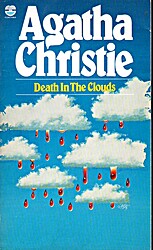
Death in the Clouds by Agatha Christie: a Book Review

Death in the Clouds is a kind of locked room mystery, only this time the ‘locked room’ is a plane on a flight from Paris to Croydon, in which Hercule Poirot is one of the passengers.

In mid-air, Madame Giselle, is found dead in her seat. It appears at first that she has died as a result of a wasp sting (a wasp was flying around in the cabin) but when Poirot discovers a thorn with a discoloured tip it seems that she was killed by a poisoned dart, aimed by a blowpipe.

At the inquest the jury’s verdict is that the murderer is Poirot! However the coroner refuses to accept this and finds that the cause of death was poison with insufficient evidence to show who had administered the poison. All the other passengers and flight attendants are suspects and Poirot together with Inspector Japp, studies the passenger list with details of their belongings. There is a helpful plan of the cabin at the front of the book showing who sat where, including a crime fiction writer, a flute-playing Harley Street doctor, two French archaeologists, a dentist, a hairdresser, a Countess (formerly an actress), a woman who is a compulsive gambler, a crime writer and a businessman . Despite all this I was quite unable to work out who did it.

The question is who could have acquired the rare poison and how could it have been shot at Madame Giselle without anyone noticing that happening. Why would anyone want to kill her, and how were any of the suspects connected with her? Even when Poirot details the clues, including the Clue of the Passenger’s Baggage (and I read through the list a few times), I still didn’t work it out.

Apart from the ingenious mystery, which the coroner describes as the most astonishing and incredible case he had ever dealt with, there were other things I enjoyed in reading this book. First of all the ‘psychological moments’  in which people don’t notice what is happening in front of them because their attention is diverted. Then there is the way Christie makes fun of crime fiction writers and readers, making Japp comment that:

I don’t think it healthy for a man always to be brooding over crime and detective stories, reading up all sorts of cases. It puts ideas into his head. (page 63)

Poirot’s denouement at the end of the book clears up all the confusion, detailing his impressions, precise ideas and methods in dealing with the case. Looking back through the book, all the clues were there, of course, but so cleverly concealed that in most cases I had overlooked them or not realised their significance. A most enjoyable book!

  • Paperback: 336 pages
  • Publisher: HarperCollins; Masterpiece edition (Reissue) edition (3 Mar 2008)
  • Language English
  • ISBN-10: 000711933X
  • ISBN-13: 978-0007119332
  • Source: I bought the book
  • My rating 4/5

Wondrous Words – Flapjack

Reading Agatha Christie’s books I sometimes come across words that I recognise, but know they cannot possibly mean what I understand them to mean. I found an example recently in Death in the Clouds.

A murder has taken place on a plane and Poirot has asked for a detailed list of the passengers’ belongings. In amongst those belongings three of the passengers have flapjacks in their bags. I thought that was quite strange, because to me a flapjack is a type of biscuit made of rolled oats, syrup and maybe pieces of fruit. They’re delicious. I wondered why these people would have flapjacks in their bags, along with cigarette holders, cigarette cases, keys, pencils and loose change, etc.

I was intrigued enough to look up the word. Wikipedia tells me that the word was not used to describe a food made of oats until 1935. Death in the Clouds was published in 1935, so it is just possible that Agatha Christie meant the flapjack that I know, but not very likely when I noticed that these three people were all women and also had lipstick and rouge in their bags and none of the men had flapjacks.

The answer is quite simple when I checked in my Chambers Dictionary:

A flapjack is a flat face-powder compact.

And this website adds that it was a term used in the 1930s and 1940s – voilà, the correct definition!

Nothing to do with the murder, though.

See more Wondrous Words at BermudaOnion’s Weblog.