Old God’s Time by Sebastian Barry

Rating: 4 out of 5.

Faber and Faber Ltd| 2 March 2023 | 228 pages|e-book |Review copy|4*

Synopsis:

Have you ever been the custodian of a story no one else believed?’
‘Oh yes,’ he said.
‘You have?’
‘Yes,’ he said.
‘Then I can tell you.’

Recently retired policeman Tom Kettle is settling into the quiet of his new home, a lean-to annexed to a Victorian castle overlooking the Irish Sea. For months he has barely seen a soul, catching only glimpses of his eccentric landlord and a nervous young mother who has moved in next door. Occasionally, fond memories return, of his family, his beloved wife June and their two children.

But when two former colleagues turn up at his door with questions about a decades-old case, one which Tom never quite came to terms with, he finds himself pulled into the darkest currents of his past.

A beautiful, haunting novel, in which nothing is quite as it seems, Old God’s Time is about what we live through, what we live with, and what may survive of us.

My thoughts:

I’ve enjoyed all Sebastian Barry’s books and Old God’s Time is no exception. It’s set in Dalkey, a small coastal town south of Dublin, where Tom, a recently retired policeman is living in a tiny flat annexed to a Victorian castle. One afternoon he was sitting in a sun-faded wicker chair, enjoying a cigarillo, listening to the sound of the sea below. He was quite content to just gaze out, watching the cormorants on the rocks to the left of Dalkey Island, when two of his former colleagues disturbed his peaceful afternoon, asking for his help on a cold case he had worked on. He doesn’t want to, knowing it will open up painful memories he would rather forget.

So this appears to be a detective story, but the main focus is Tom, himself as the narrative reveals in streams of consciousness. It soon becomes clear that his memories are unreliable and for a while I was confused, not knowing what was going on, whether Tom was remembering, or imagining what had happened in his life. It is beautifully written, showing the beauties of the landscape. It takes us right inside Tom’s mind, highlighting the horrors that Tom had experienced both in his childhood and family life as well as in his professional life. The past had not been kind to him. But now it was as though enough time had gone by and it was as if it had never happened; it had receded away into ‘old God’s time’, and Tom didn’t want to reach back into those memories. They were locked away, preserved in the long-ago.

It is a tragic story, not shying away from describing the horrific details of child abuse, nor the despair and sadness as the details of Tom’s family life are gradually revealed. It is a harrowing book, made even more so as I had to read it slowly making sure I fully understood what I was reading, even going back to re-read some passages. It is bleak, but Tom’s story is also one of love and immeasurable happiness, of strength and goodness, alongside grief and pain.

Top Ten Tuesday: Fantasy Novels

Top Ten Tuesday is a weekly meme created by The Broke and the Bookish and now hosted by Jana at That Artsy Reader Girl. For the rules see her blog.

The topic this week is a Genre Freebie and I’ve chosen the following ten fantasy novels, all of which I’ve read. There are many more I could have included – these are just the ones that came to my mind at the moment, not necessarily the top ten, but ten that I have enjoyed.

  • Rivers of London – urban fantasy set in the real world of London. It’s a mix of reality and the supernatural, a magical reading experience, and a fast-paced police procedural of a very different kind. 
  • A Game of Thrones (A Song of Ice and Fire,1) by George R R Martin, an epic fantasy novel  set in a grim and violent world full of tragedy, betrayals and battles; a tale of good versus evil in which family, duty, and honour are in conflict.
  • The Ladies of Grace and Adieu and Other Stories by Susanna Clarke as fantastical as Jonathan Strange and Mr Norrell, a collection full of fantasy stories of deep dark woods, paths leading to houses that seemingly move locations, ladies who are never what they appear to be, princesses, owls, and above all fairies, including the Raven King.
  • Northern Lights by Philip Pullman, the first book in his trilogy His Dark Materials, set in a universe similar to ours, but different. It’s all so beautifully described that you are convinced of the reality of this universe. 
  • The Library of the Dead by T L Huchu set in a future or alternative Edinburgh, with a wealth of dark secrets in its underground. 
  • Movalwar by Benjamin Cornelius who is my friend’s great-nephew (aged 11 when he wrote his book). It’s about two eleven year-old boys, Alfie and Ben and their exciting and dangerous journey to save the fate of two worlds.
  • The Toymakers by Robert Dinsdale, an extraordinary, magical and wonderful book that captivated me, a book set mainly in 1917 whilst the First World War was taking its toll of humanity, leaving despair and tragedy in its wake. It’s a blend of historical fiction and magic realism.
  • Yesterday by Felicity Yap about a world where memory for everyone over the age of eighteen is limited for 70% of people to just one day (the Monos) whilst the rest (the Duos) have two days of memory. Each day everyone has to write down their actions, thoughts and feelings in their iDiaries and then memorise the ‘facts’. But are these ‘facts’ reliable?
  • The Watchmaker of Filigree Street by Natasha Pulley, that blends historical events with flights of fancy to plunge readers into a strange and magical past, where time, destiny, genius ‘and a clockwork octopus’ collide.
  • The Buried Giant by Kazuo Ishiguro. There are ogres, deadly pixies,  evil monks who keep a dreadful beast underground, Saxons – Wistan, a warrior and a young boy, and Sir Gawain entrusted by King Arthur to slay Querig, a she-dragon roaming the land, who by her breath has spread the mist of forgetfulness.

The City of Tears by Kate Mosse

Rating: 5 out of 5.

Pan Macmillan, Mantle| 19 January 2021 | 562 pages|e-book |Review copy|4*

Kate Mosse sets out in her Historical Note the history of the French Wars of Religion that took place between Huguenots (Protestants) and Catholics from 1562 and 1598 and explains that The City of Tears is the second book in The Burning Chambers series of novels set against the backdrop of 300 years of history from 16th century France and Amsterdam to the Cape of Good Hope in the 18th and 19th centuries. And there is a useful list of the principal characters and the historical characters at the beginning of the book, that helps in remembering who was who and how they were connected.

It’s been four years since I read The Burning Chambers, the first book in The Burning Chambers series, and time has moved on ten years since the events in that first book. You don’t have to read the first book before reading The City of Tears as with four years between the two books I didn’t find it hard to pick up the story, but I do think you need to read the Historical Note to get the background details of the French Wars of Religion first.

There is now a precarious peace in the French Wars of Religion and it looks as though that peace could be maintained as the queen mother, Catherine de Medici, has negotiated a marriage between her Catholic daughter Margot and the Huguenot Henri of Navarre. But that union is opposed by the hardline Catholic faction led by the Duke of Guise. As the novel opens Minou Joubert and Piet Reydon, now married and living in their castle in south west France, are preparing for their visit to Paris for the wedding.

This is a complicated story centred on Minou and Piet Reydon and their family. The wedding took place followed by the St Bartholomew’s Day Massacre on 24 August 1572 when thousands of Protestants were murdered by Catholic troops, in Paris and across France. I’m not going to go into any more detail about the story other than to say it’s a compelling story of chaos and fear as Minou and her family escape, though suffering dreadful losses, including the disappearance of her seven year old daughter, and almost losing their lives. There’s murder, conspiracies, stolen relics and innumerable secrets are brought to light.

It is an enjoyable book, but because of its length it does lose pace in parts. It is not a book you can or would want to read quickly. The strength of the book for me is in the characterisation and the settings. Kate Mosse has thoroughly researched the period and the locations, rooting it firmly in the time it was set. What I particularly like is that she identifies that the characters and their families, apart from the historical ones, are imagined, inspired by ‘the kind of people who might have lived: ordinary women and men , struggling to live, love and survive against a backdrop of religious war and displacement.’ Just as devastating today, as it was then.

It is also a book that is strong on developing the characters, so that you feel for them as they struggle to survive all that is thrown at them, as it is certainly a tragic story. Having said that the ending is a positive one, except for cliff hanger on the last page that hints at what is to come in the third book, The Ghost Ship, a sweeping historical epic about love in a time of war, due out in July this year.

The Dancing Bear by Frances Faviell

Rating: 5 out of 5.

The Dancing Bear by Frances Faviell took me by surprise by how much I enjoyed it. I wasn’t expecting it to be so good.

Frances Faviell (1905-1959) was the pen name of Olivia Faviell Lucas, painter and author. After the war, in 1946, she went with her young son, John, to Berlin where Richard Parker, her second husband, had been posted as a senior civil servant in the post-war British Administration. It was here that she befriended the Altmann family, which prompted her first book The Dancing Bear (1954), a memoir of the Occupation seen through the eyes of both occupier and occupied. She later wrote three novels, A House on the Rhine (1955), Thalia (1957), and The Fledgeling (1958). These are now all available as Furrowed Middlebrow books.

The Dancing Bear covers the years from Autumn 1946 to Autumn 1949, with an Epilogue dated Autumn 1953 and, in this edition, an Afterword by John Parker, Faviell’s son. Her memoir is mainly about her friendship with the Altmann family – Frau Maria Altmann, her husband, Oskar and her children, Ursula, who works for a group of American service men, Lilli, a ballet dancer and son, Fritz, who was a member of the Hitler Youth and is now involved in the Black Market. Their eldest son. Kurt. is missing in Russia. Berlin had been divided into four sectors by the Allies – Britain, the United States, France and the Soviet Union – and Frances is horrified by the conditions she found. There were deaths from hunger and cold as the winter approached and queues for bread, milk, cigarettes, cinemas, buses and trams.

The complete and utter devastation of Berlin had shaken me profoundly. Nothing … had prepared one for the dead horror of this city. (page 15)

The complete absence of shops was something the Allied and German women felt. There was scarcely a single shop left standing in Berlin. The great stores and emporiums lay in dust, as did the great blocks of flats. One could not get the simplest articles except on the Black Market, and then only in exchange for cigarettes and coffee which had taken the place of money. (page 166)

The Altmanns live on the ground floor of a large ruined house – the upper storeys had disappeared and just the twisted iron girders remained, sticking up grotesquely against the sky. The ground floor looked very shaky and the windows were covered in cardboard and the door had been repaired from odd pieces of wood. It was freezing cold, and although they had a stove they had no fuel to light it and because electricity was rationed they had to use candles. There were two bedrooms, a small kitchen, a sitting room and a bathroom. With the help of her driver, Stampie, she does what she can to help them.

The British, unlike the Americans were forbidden to be friendly with the Germans, or to allow them in their homes or any of their buildings, clubs or messes and also to give them lifts, but these rules were frequently broken. At night Berlin ‘became a whirl of revelry’:

But if Berlin was a tragic city by day; at night it became a whirl of revelry. The Allies entertained on a scale which was extraordinary in a starving town, and if one went down to the Kurfurstendamm or the Kaiserdamm at night every cafe and night club was packed with revellers. (page 63)

I have only touched the surface of this book in this short post. It’s a moving memoir and I was fascinated by it all – the people, their situations, and their morale and attitudes as well as the condition of Berlin in the aftermath of World War Two. The realities of living under occupation are clearly shown, as well as the will to survive despite all the devastation and deprivation. I now want to read more of Frances Faviell’s books.

  • ASIN ‏ : ‎ B01M12EH2E
  • Publisher ‏ : ‎ Dean Street Press (3 Oct. 2016)
  • Language ‏ : ‎ English
  • Print length ‏ : ‎ 311 pages
  • My Rating: 5*

WWW Wednesday: 15 February 2023

WWW Wednesday is run by Taking on a World of Words.

The Three Ws are:

What are you currently reading?
What did you recently finish reading?
What do you think you’ll read next?

Currently I’m reading three books:

The Children’s Book by A S Byatt. This is one of my oldest TBRs, a book I’ve owned since 2009. I did start reading it as soon as I got (it was a birthday present) but I didn’t get very far! It’s a big book with 624 pages and at the time I was in the middle of reading Wolf Hall and I couldn’t cope with to such long and complicated books, so I temporarily put down The Children’s Book to read later – then other books got in the way. It begins in 1895 in the South Kensington Museum (now the Victoria and Albert Museum) and ends with the end of the Great War. There are lots of characters and it’s about children, about books, about art, about the writing of children’s books, about the telling of children’s stories, and about the clash between life and art. It’s detailed and richly descriptive full of fascinating facts. I’ve only the first three chapters so far and I’m loving it.

I’m also reading The City of Tears by Kate Mosse, one of my NetGalley books that I ‘should’ have read long before now. It’s another long book, the second in The Burning Chambers trilogy. I’ve read the first book, which began slowly and developed into a fast moving story with a dramatic climax. There’s a huge cast of characters and it continues the story of Minuo Reydon-Joubert and Piet Reydon during the Catholic and Huguenot conflicts in the sixteenth century. It looks to be just as good as The Burning Chambers (my review).

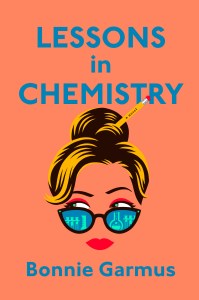
The other book I’m reading is Lessons in Chemistry by Bonnie Garmus. I usually avoid hyped books, but this one interested me. It’s about Elizabeth Zott, who is described as ‘not your average woman’. I had a look at the sample and liked the beginning so I borrowed it from the library. It’s also described as ‘laugh-out-loud funny’, but I’m not finding that at all and I’ve read 13 chapters so far. In fact I’m finding it a bit irritating.

The last book I read is A Death in Tuscany by Michele Giuttari. Chief Superintendent Michele Ferrara, head of Florence’s elite Squadra Mobile, is investigating the death of a young girl, whose body was found in the picturesque Tuscan hill town of Scandicci, lying by the edge of the woods.When he delves deeper he believes the girl was murdered, And then his close friend Massimo Verga is accused of murder and has disappeared, so Ferrara is desperate to find him, and it appears both the Freemasons and the Mafia are involved.

Next I’ll be reading – It’ll be a while before I’ve finished the books I’m currently reading so it’s too soon to decide what I’ll read next.

Although this is a weekly meme I’m only taking part occasionally.

Top Ten Tuesday: Love Stories

Top Ten Tuesday is a weekly meme created by The Broke and the Bookish and now hosted by Jana at That Artsy Reader Girl. For the rules see her blog.

The topic this week is The topic this week is Love/Valentine’s Day Freebie. I thought this would be hard for me as I don’t read many love stories or romantic fiction, but here are 10 love stories I have enjoyed. Some of them are books I read in my teens and others are ones I’ve read more recently. I’ve listed them in no particular order of preference and linked the titles either to Amazon or Goodreads.