

Hosted by Wordless Wednesday
Hosted by Wordless Wednesday
Teaser Tuesday is hosted by MizB at Should Be Reading.
Grab your current read.
Let the book fall open to a random page.
Share with us two (2) ‘teaser’ sentences from that page.
At long last I’ve finished reading After the Victorians: the World Our Parents Knew by A N Wilson.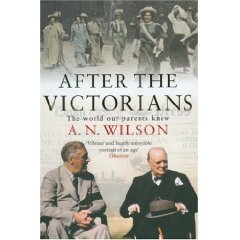
It’s a remarkable book and I’ve learnt so much from it. I began reading it in April when I wrote that it would probably take me until September to read it all – I finished it this morning.
This passage is from page 512 writing about Aneurin Bevan and the setting up of the National Health Service:
Apart from his eloquence, and his wit, which inspired so many who heard his oratory both on the hustings and in the House of Commons, he was that very, very rare thing in the history of politics, a man whose decisions on behalf of those he served brought about human betterment. This book has been a catalogue of mistakes by politicians, moral and practical disasters which led to wars, enslavement and human wretchedness on a scale which no previous age could have dreaded or dreamed of. The National Health Service, which inspired so many other countries in the world to imitate it, did what it set out to do, and with all its many mistakes and short-comings, it still does so: it provides free medicine, free advice, free surgery, free nursing to everyone, regardless of their income.
I shall write in more detail about this book in a later post.

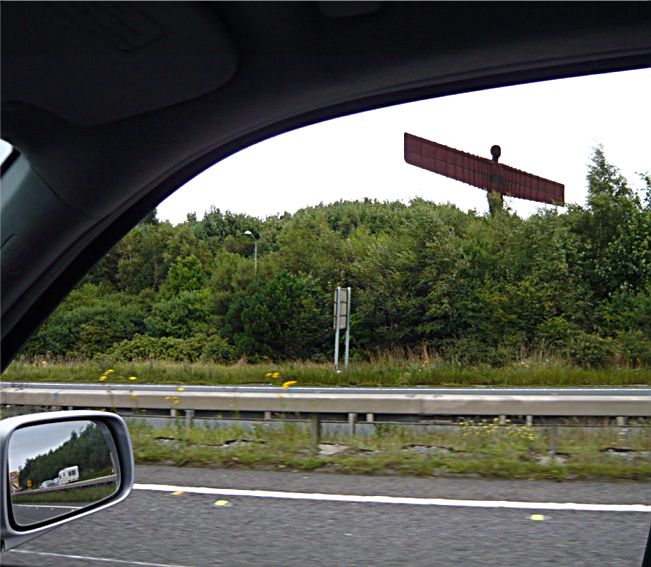
On our way north we drove past the Angel of the North at Gateshead – not too impressive seen from the A1, I thought. It’s 20 metres high with a wingspan of 54 metres!
If you want to make your own Angel here’s a knitting pattern – click on the picture to go to Gateshead Council (where I found this pattern) for more information on the Angel (and a pattern to make an Origamo Angel as well).

I saw this on Dorothy’s blog and thought I’d have a go too.
Using only books you have read this year (2009), answer these questions. Try not to repeat a book title. It’s a lot harder than you think!
Describe yourself: The Madonna of the Almonds (Mariana Fiorata)
How do you feel: A Lost Lady (Willa Catha)
Describe where you currently live: We Have Always Lived in the Castle (Shirley Jackson)
If you could go anywhere, where would you go: Wuthering Heights (Emily Bronte)
Your favorite form of transportation: Doors Open (Ian Rankin) (the best I could do)
Your best friend is: Jane Austen (Claire Tomalin)
You and your friends are: Tangled Roots (Sue Guiney)
What’s the weather like: Turbulence (Gile Foden)
You fear: The Hound of Death (Agatha Christie)
What is the best advice you have to give: Elephants Can Remember (Agatha Christie)
Thought for the day: When Will There Be Good News? (Kate Atkinson)
How I would like to die: Fire in the Blood (Irene Nemirovsky) (no way – this sounds far too painful!)
My soul’s present condition: Star Gazing (Linda Gillard)
Note: this is not a personal look at my life – it’s just book titles!
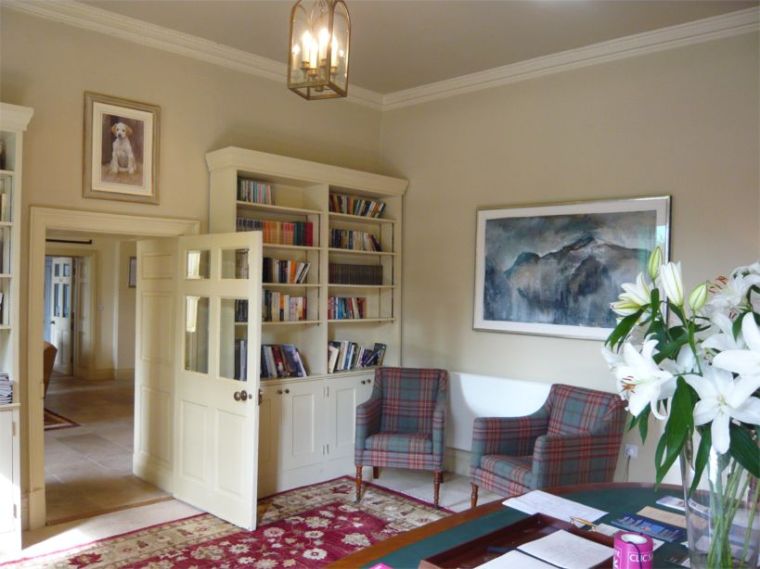
My posts may be a bit hit and miss for a while as we have recently sold our house and are busy searching for somewhere to live in Northumberland/Scottish Borders. Whilst we were away over the last few days I did take some of my current books with me to read but as the hotel had two bookcases of books to choose from I picked up Elephants Can Remember to read instead.
It’s not the best Agatha Christie book I’ve read, but I found it entertaining, if rather repetitive and predictable – I worked out the mystery quite easily. Celia’s parents, apparently a happily married couple, were found shot dead on a cliff top – apparently as a result of a suicide pact. Some twelve to fifteen years later Mrs Burton-Cox, concerned that Celia is about to marry her son, approaches Mrs Ariadne Oliver, the mystery novelist, at a literary luncheon and asks the question – who killed whom? As Ariadne is Celia’s godmother she is curious and starts investigating, enlisting the help of Hercule Poirot.
 The mystery is unravelled by Poirot and Ariadne by talking to the people who knew the couple and comparing their stories. Mrs Oliver interviews several elderly witnesses who she describes as “elephants” because they can remember certain incidents from the past. Much hinges on memory and interpretation of the events, highlighting the unreliable nature of witnesses and their memories, and the brilliance of Poirot in getting to the truth.
In my opinion it would have better if it were shorter and more concise, but then this was Agatha Christie’s last Poirot mystery, published in 1972 when she was in her eighties!
I did like the comments Ariadne makes about the relationship between authors and their readers, but as I put the book back on the hotel’s bookshelf I can’t give any quotes! This is only the second book I’ve read featuring Mrs Oliver, but occurs to me that Agatha Christie was using her to express her own views on writing and her reaction to her readers. Ariadne doesn’t like “literary lunches” and is shy about talking to people about her books, especially disliking those who simply gush and tell her how wonderful her books are. I can see I’ll have to read Agatha Christie’s Secret Notebooks and her autobiography.

 I love starting to read new books and planning which books to read next, so the Currently Reading section on the sidebar over on the right is often not up to date. These are on the sidebar:
The folowing books are not listed on the sidebar but are books I’ve started and would love to continue reading, but there is a limit to how many I can keep in my mind at one time:
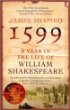

I really, really want to find time to read these books as well (all borrowed from the library):
Oh, for more reading time!
 BooksPlease