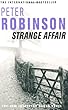
Strange Affair by Peter Robinson: a Book Review

Peter Robinson has written a series of Inspector Banks books. Strange Affair is the first one I’ve read but not the first in the series. I borrowed this one from the library as it was the earliest in the series available on the shelves. Although it’s one of the later ones in the series it does work on its own, as enough information is given about earlier events for me to get the gist of Banks’s history, but I would like to read the novels in the order they were written.

As soon as I started reading it I was hooked. It’s a great read – I didn’t want to stop reading. Detective Chief Inspector Alan Banks receives an urgent phone call from his brother asking for his help. He has never been close to his brother Roy, but alarmed by the message on his answerphone he sets off from the Yorkshire Dales for London to see exactly what the problem is. But on his arrival he finds his brother’s house empty and no-one knows where he is.

Meanwhile back in Yorkshire DI Annie Cabbott is investigating the death of a young woman found in her car. She had Banks’s name and address scribbled on a piece of paper in her pocket. Unaware that Banks has gone to London, Annie tries to find him to discover the link between them. Although officially on leave from work Banks, who is still recovering from his depression after the fire that destroyed his house and possessions, immediately gets involved in delving into Roy’s life whilst trying to find out what has happened to him. Just how has Roy made his money, what shady deals has he done, who are his connections? The more Banks discovers the worse it gets, until he fears for his parents’ safety, not just his brother’s.

A tense and gripping novel – I loved it and can’t wait to read more by Peter Robinson.

The Hound of Death by Agatha Christie: a Book Review

Hound of deathI borrowed The Hound of Death by Agatha Christie from the library. It’s a collection of twelve short stories, stories of unexplained phenomena, in most cases tales of the supernatural rather than detective stories.

Of the twelve stories I think The Witness for the Prosecution is the best. Agatha Christie later wrote a play based on this story which has subsequently been adapted for film and television. It’s the story of Leonard Vole, a young man who has been arrested for the murder of an elderly lady, Miss Emily French. He befriended this rich lonely old woman who left him everything in her will. He protests his innocence and is astounded when Romaine (who lives with him as his wife) refuses to back up his story at the trial. It is up to his lawyer Mr Mayherne to get to the truth.

I also liked the more supernatural stories – those with no explanation and those where the supernatural either have natural, scientific explanations or are plain con tricks. The narrator in The Hound of Death is unsure of how to view the events during the First World War where a Belgian nun, Sister Marie Angelique is said to have caused her convent to explode when it was invaded by German soldiers. He reflects:

But of course it is all nonsense! Everything can be accounted for quite naturally. That doctor believed in Sister Marie Angelique’s hallucinations merely proves that his mind too, was slightly unbalanced.

Yet sometimes I dream of a continent under the seas where men once lived and attained to a degree of civilization far ahead of ours …

… Nonsense – of course the whole thing was merely hallucination! (p36)

There are stories of premonitions, intuition or a sixth sense, stories of seances, haunted houses, nightmares, amnesia and a very strange tale The Call of Wings in which a millionaire hears a tune, played by man with no legs.

It was a strange tune – strictly speaking, it was not a tune at all, but a single phrase, not unlike the slow turn given out by the violins of Rienzi, repeated again and again, passing from key to key, from harmony to harmony, but always rising and attaining each time to a greater and more boundless freedom. (p269)

The music makes him feel he is being released from all his burdens as he is carried higher and higher. This story, with its mystical overtones reveals the power of music to transport the soul.

Years ago I read as many of Agatha Christie’s books as I could find, but they were all the detective stories – Poirot or Miss Marple. I was unaware that she wrote anything else, so these collections of short stories are a bonus for me. She really was a superb storyteller.

This year’s Agatha Christie Week is being celebrated at The Southbank Centre in September and on the English Riveria too, along with new radio productions and publications of previously unpublished stories – see the Agatha Christie website.

Tuesday Teaser – The Hound of Death by Agatha Christie

teaser-tuesday

Teaser Tuesday is hosted by MizB at Should Be Reading.

Grab your current read.
Let the book fall open to a random page.
Share with us two (2) ‘teaser’ sentences from that page.

Hound of death The Hound of Death is a book of short stories. Today’s teaser is from the second story, The Red Signal on page 46:

And I will tell you this, if the man suffering from a delusion happened to hold his tongue about it, in all probability we should never be able to distinguish him from a normal individual. The extraordinary sanity of the insane is a most interesting subject.

The Sunday Salon – newbooks magazine

tssbadge1My copy of ‘newbooks’ magazine arrived the other day. This is perhaps the one magazine that I always read from cover to cover. The editorial highlights the changes in publishing in the last decades with

… the conglomeration first of publishing houses and then bookselling, and the negative contribution made by literary agents pedalling a ‘stifling excess of lucrative junk’, hand-in-hand with Google and Amazon’s rapid growth in influence. … ‘No one can predict how books and readers will survive.

The trend seems to be away from books in print, with not only independent bookshops dwindling but also the high street bookshops in decline, towards the on-line digital era. Whilst this is something that has been debated extensively online before, it did strike me that this could mean that in future magazines like ‘newbooks’ would not be issued physically but only available on line and how would I like that?

Well, I wouldn’t – I like it dropping through the letterbox onto the doormat and then flicking through its pages before settling down to read it. Maybe there won’t be any letterboxes in future – everything will be done online? I have no problem with reading somethings online – after all I write this blog and read lots of other blogs quite happily. But I’m not up to reading whole books on screen, nor do I want to print them off and read them that way and the same goes for magazines – I want the physical object – books in print please. Although I do buy some books from online boksellers I prefer to go to a bookshop and browse the books. So I hope the complete change doesn’t come soon.

newbooks-augustIn the meantime I’m happy reading and choosing which book to pick as my free book from ‘newbooks’. Will it be An Equal Stillness by Francesca Kay, The Girl on the Landing by Paul Torday, Antigona and Me by Kate Clanchy, The Book of Unholy Mischief by Elle Newmark, or The Elegance of the Hedgehog by Muriel Barbery?

Mog commented on my previous post that she has chosen The Book of Unholy Mischief and I’m very tempted  by that one too. It’s set in Venice in 1498, where an ancient book, rumoured to contain heresies and secrets of immeasurable power, is hidden. Luciano, a chef’s apprentice in the doge’s palace is drawn into the search leading him into a perilous maze to the centre of an intrigue concerning some of the most powerful and dangerous men in Venice.

I’m also drawn to The Girl on the Landing, which is about Michael and his wife Elizabeth. Michael spots a painting whilst staying at a friend’s country house in Ireland. In the background of the painting he see a woman clad in a dark green dress, except his hosts say there is no woman in the picture and indeed when he looks again she is not there.

There is also an interview with Paul Torday in the magazine in which Zoe Fairbairns reveals that its the nature of Britishness and Englishness that is debated furiously in this book as Michael, on medication which he then refuses to take, plummets towards breakdown. She writes:

If identity and personality are so fragile, how can anyone said to be ‘truly’ British, ‘truly’ anything? It’s disturbing stuff, but compulsively readable, which is what Torday wants: ‘My perfect reader is someone who picks the book up and goes on reading it until it’s late at night.’

That could be me!