Surprise Endings – Booking Through Thursday

The question this week is from Jackie:

I love books with complicated plots and unexpected endings. What is your favourite book with a fantastic twist at the end?

So, today’s question is in two parts.

  1.  Do YOU like books with complicated plots and unexpected endings
  2. What book with a surprise ending is your favorite? Or your least favorite?

This is easy – I do like complicated plots and unexpected endings. And the book with a surprise ending that immediately came into my mind when I read this question is The Last Time They Met by Anita Shreve. It’s a love story, which had me enthralled. The ending took me completely by surprise. I just hadn’t seen it coming. Sometimes I’m tempted to look at the last few pages when I’m part way into a book and I’m so glad I didn’t with this one.

 As for my least favourite, that’s not so easy. There have been quite a few that I think are disappointing and a let down, but I tend to forget about them.

Lucy and the Snow

Lucy has now ventured outside. We kept her in the house after we moved in, as you’re supposed to (the vet said so)  and we didn’t have an address tag for her anyway. Then the snow came and she didn’t want to go out. If she had I think she would have been buried in the snow, as she’s so small.

She has a tag now, so we thought she could go out into the garden. She didn’t really want to the first day, just looked very warily out of the door. Yesterday she had a walk along the decking, which extends round the back and side of the house. She didn’t stay out long – well it was cold – and she hasn’t gone down on to the grass yet. She’s getting to be an indoor cat!

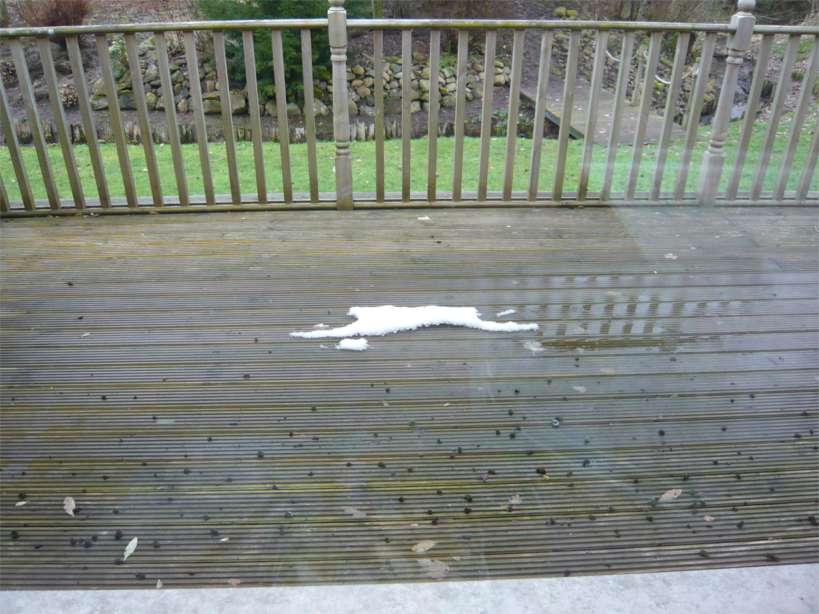
Today the snow has nearly all gone and there’s just this patch left on the decking.

Is it just my imagination, or does it look like a cat running?

Library Loot

I had two trips to two libraries last week. As I live in England, but close to the Scottish border I can borrow books from both Scottish and English libraries. I’d joined the Scottish Borders Library Services earlier this year as it’s the nearest one and had already borrowed a few books. They were due back this week and I renewed The Music Room by William Fiennes and borrowed two more – Peter Robinson’s Not Safe After Dark, a collection of short crime stories. I wrote a bit about it here. I also borrowed Winnie and Wolf by A N Wilson. This is a novel about the relationship between Winifred Wagner, the daughter-in-law of Richard Wagner, and Adolf Hitler.


On Friday we joined the Northumberland County Library, where amazingly you can borrow 20 items at a time, that includes books, CDs, DVDs or Spoken Word material for three weeks. Even I couldn’t possibly get through that lot in three weeks! Time was limited for our visit as we only had an hour in the parking space and some of that time had gone walking to the library, so we did a quick tour round and came away with five books:

  1. Northumberland: and the Land of the Prince Bishops by Ed Geldard, a beautiful book with photos of places along the Rivers Tees, Wear, Tyne, Coquet and Tweed. There are plenty of places for us to visit once the weather improves.
  2. Walk Lothian The Borders & Fife by Richard Hallewell. Another book to look at preparing for our walks over the Border.
  3. Crime on the Move: the official anthology of the Crime Writers’ Association 2005 edited by Martin Edwards. More short crime stories to enjoy. I’ve read one so far, which was excellent – On a Bicycle Made For Two – an amusing look at the tension in the build up to a bike race in the little village of Bossingham.
  4. Raven Black by Ann Cleeves – more crime fiction, this time from an author who is best known for her Inspector Ramsay novels set in Northumberland. I haven’t read any of her books yet and perversely the one I’ve borrowed isn’t set in Northumberland, nor is it an Inspector Ramsay book. Raven Black is set in Shetland.
  5.  Northumberland Climbing Guide (this was D’s choice). I’ve read the introduction to this book which is about the history of the crags and found that there are examples of rock art on the crags near here. I shan’t be doing any climbing, but I will be looking out for the carved goats and prehistoric spirals.

Musing Mondays – Borrowed Books

Today’s question from Just One More Page is
Where do you keep any books borrowed from friends or the library? Do they live with your own collection, or do you keep them separate? Do you monitor them in anyway.
I don’t borrow many books from friends, those I have borrowed I keep together and try to read them as soon as I can so that I can return them before I forget I have them. I really dislike lending books to people and not getting them back, so I try to return books that people have lent to me as soon as possible.

But I do have a few  borrowed from friends that I’ve yet to read and return.  Some are from one friend who, since I’ve moved house, lives about 300 miles away. She lent them to me ages ago and when I knew I was moving I gave them back. Or rather I tried to, but as I hadn’t read them she said I could keep them, which was lovely – thank you M.

I also have one from my nephew, one from a colleague where I used to work and some from my son. I feel bad that I haven’t read them and returned them yet. I will, though.

I’m always borrowing library books and I keep these separate  from my own books. They’re easy to spot anyway but I usually keep them in a pile either by the bed or in the living room. I don’t monitor them except to check when they’re due back. Maybe I should do the same with books borrowed from other people and set myself a due back date.

Crime Fiction Alphabet: O is for …

letter OThis week my choice for the Crime Fiction Alphabet meme is Oscar Wilde and the Candlelight Murders by Gyles Brandreth (published in the USA as Oscar Wilde and a Death of No Importance), John Murray Publishers Ltd, 2008, 355 pages). I read this in April 2008 and these were my thoughts about it at the time.

This is an ‘historical whodunit’ set in 1889 €“ 1890, fin-de-siècle London and Paris. The mystery begins with Oscar Wilde finding the naked body of Billy Wood, a 16 year old boy in the candle-lit room in a small terraced house in Westminster, close to the Houses of Parliament. Billy’s throat has been cut and he is laid out as though on a funeral bier, surrounded by candles, with the smell of incense still in the air. It’s a combination of fiction and fact, with both real and imaginary characters. Wilde with the help of his friends Arthur Conan Doyle and Robert Sherard sets out to solve the crime. Sherard (the great grandson of William Wordsworth) who wrote poems, novels, biographies (including five of Oscar Wilde) and social studies is the narrator.

The story reads quickly and is full of colourful characters such as Gerard Bellotti, who runs an ‘informal luncheon club for gentlemen’. Bellotti is

‘grossly corpulent’ giving the impression of ‘a toad that sits and blinks, yet never moves’ wearing ‘an orange checked suit that would have done credit to the first comedian at Collins’ Music Hall and on the top of his onion-shaped head of oily hair, which was tightly curled and dyed the colour of henna, he sported a battered straw boater.’

Wilde is a fan of Conan Doyle’s Sherlock Holmes stories so much so that as the mystery is unravelled he picks up clues in the manner of Holmes, observing and deducing, exclaiming when questioned by Conan Doyle ‘Come, Arthur, this is elementary stuff €¦ Holmes is where my heart is.’ I think it is this combination of fact and fiction that I enjoyed most in reading the book. I knew little about Wilde or Doyle and nothing about Sherard before reading it, but I think I learned a lot about all three people, about their characters, their views on life and love, and their works, as well as about the society in which they lived.

According to The Oscar Wilde Murder Mysteries website the book is peppered through with quotes from Wilde, or Brandreth’s versions of Wilde’s words, together with Brandreth’s own inventions. I couldn’t tell which was which, as I’ve only read Wilde’s The Picture of Dorian Gray and seen a TV production of The Importance of Being Ernest, but it all seemed perfectly in character to me. I found the details of Wilde’s love for his wife Constance particularly interesting in contrast to his trial for gross indecency in 1895. In fact I came away from the book really liking Wilde and wanting to read more about him and by him. Fortunately the biographical notes at the end of the book give more details of works by and about Wilde, Conan Doyle and Sherard.

I didn’t find the mystery too difficult to work out, with lots of clues throughout the book, but that didn’t detract from my enjoyment. On the contrary it made it all the more pleasurable. There are two more books in the series Oscar Wilde and the Ring of Death and Oscar Wilde and the Dead Man’s Smile.