Invisible by Paul Auster

I read Invisible by Paul Auster in January and wasn’t quite sure what to make of it. I feel  may understand it more if I reread it, but I have little inclination to do so.

The story opens in New York City in 1967 when student Adam Walker meets a Swiss professor, Rudolf Born and his girlfriend Margot. Born is a visiting lecturer at Columbia University, where Adam is studying literature. He is drawn into their offbeat world, then caught in a triangle that soon descends into violence that shocks and disturbs Adam.

There are three different narrators and the story moves both in time and place, between 1967 and 2007, in New York, Paris and the Caribbean. It also moves between writing in the first person to the second and third person. Like other Auster books, it is multilayered containing stories within stories, which I always enjoy.

From the book jacket:

It is a book of youthful rage, unbridled sexual hunger and a relentless quest for justice. With uncompromising insight, Auster takes us into the shadowy borderland between truth and memory, between authorship and identity, to produce a work of unforgettable power that confirms his reputation as ‘one of America’s most spectacularly inventive writers’.

It’s about writers and writing, how they deal with expressing themselves, and overcoming their writer’s block. One of the narrators comments on a problem he had when writing a memoir:

By writing about myself in the first person, I had smothered myself and made myself invisible, had made it impossible for me to find the thing I was looking for. I needed to separate myself from myself, to step back and carve out some space between myself and my subject (which was myself) and therefore I returned to the beginning of Part Two and began writing it in the third person. I became He, and the distance created by that shift allowed me to finish the book. (page 89)

It started well, but as I read on it became dreary and cringe-making. But strangely I found it  compelling reading and had to read on to the end.  After the first part, it became harder to distiguish who was narrating.   None of the characters are very likeable, some are downright unlikeable (Born for example) and the book slips between truth and  fantasy so you don’t know whether to believe anything the narrators say. It’s a puzzle and a tiresome one.  Overall I didn’t like it. If I hadn’t read any of Auster’s books before I wouldn’t bother reading one again after this one.

Not everyone agrees with me  – both Gaskella and Reading Matters loved this book and recommend it highly.

Winter Reading – Booking Through Thursday

This week’s question:

The northern hemisphere, at least, is socked in by winter right now€¦ So, on a cold, wintry day, when you want nothing more than to curl up with a good book on the couch €¦ what kind of reading do you want to do?

It is cold here, but looking at what I’m currently reading it’s the same as if we were in a heatwave. In both scenarios I’d be reading indoors – today it’s too cold to sit outside reading and when it’s hot I can’t read outside either. So, the weather does not affect my choice of reading at all. If it’s cold I like to get warm and if it’s hot I look for somewhere cool to sit and read, but my choice of reading is the same.

Wondrous Words

Each Wednesday Kathy (Bermuda Onion) runs the Wondrous Words Wednesday meme to share new (to us) words that we’ve encountered in our reading.

I’ve been reading and learning new (to me) words for a while but haven’t yet joined in. Here are my first “Wondrous Words”, taken from Ian Rankin’s Black and Blue, an Inspector Rebus book. I always come across words I’m not sure I understand but usually I’m so engrossed in reading that I don’t stop to look up their definitions. I’m reading this book for the second time, having raced through it recently and this time I’ve jotted down a few words to look up. Some of them I could guess the meaning from the context, others I couldn’t. As you can see they’re all Scots words.

  • Radge – ‘On dope, he was a small problem, an irritation; off dope, he was pure radge.’

‘Radge’ means a rage,  an unpleasant person.

  • Bridie – ‘He’d laughed again, bought her tea and a bridie at a late-opening cafe.’

‘Bridie’ is a minced meat and onion pie.

  •  Smirr – ‘Only it wasn’t real rain, it was smirr, a fine spray-mist which drenched you before you knew it.’

‘Smirr’, is defined in the text.

  •  Dreich – ‘It was all Rebus needed first thing on a dreich Monday morning.’

‘Dreich’ is tedious, dreary, long drawn out.

  • Stoor – ‘We had this lot stashed in a storeroom’, Ancram said. ‘You should have seen the stoor that came off when we brought them out.’

‘Stoor’ – is fine dust.

  • Broo – ‘The cabbies are all on the broo, claiming benefit.’

‘Broo’ – is unemployment benefit.

  • Stooshie – ‘Does that mean the stooshie’ll die down?’

‘Stooshie’ – is fuss, disturbance, ado.

The Music Room by William Fiennes

The Music Room must have been a difficult book to write and in parts it’s a difficult book to read.  It’s lyrical and strong in setting the scene – the castle with its battlements, secret rooms and spiral staircases where William grew up and the landscape, the moat, the fields and birds all came vividly to life as I read it. And yet as I read more and more of it I almost began to tire of it. There was little variation and it felt detached and over-stylised and impassive. But on reflection, I think that maybe that’s the only way Fiennes could write this book.

I never felt I really got to know William himself or most of his family, certainly not his mother, father, or his twin brother and sister. Most of the book is about his brother Richard, who was epileptic, and about the brain – the discovery of how it worked and the causes and treatment of epilepsy. William’s reactions to Richard are there – how as a small child, eleven years younger than Richard, he just accepted that that was how Richard was and how as he got older he became fascinated with the anger and aggression that could dominate Richard, how William almost tested him to see how far he would go. His love for Richard is also evident and Richard himself is a strong presence, with his violent outbursts and his passion for football, his mood swings and  his tenderness and remorse for what he has done.

William and the rest of the family almost faded into the background and I wanted to know more about them. There were glimpses of them such as the passages where  his father finds strength from the castle itself:

One afternoon I saw Dad standing next to the house, his right arm stretched out, palm pressed flat against a buttress, his head dropped. He didn’t move.

‘What are you doing?’ I asked.

He said he was asking the house for some of its strength. (page 131)

William describes hearing his mother playing the viola in the music room. The music room is a place of refuge – his mother

… didn’t want to leave the music; she wanted longer in that private room, away from everything, playing each piece as if she were trying to say how much she loved it. (page 48)

Music played its part in Richard’s life too. He had a ‘clear, soft baritone voice’ and liked to sing songs from Gilbert and Sullivan and Welsh hymns such as ‘Guide Me, O Thou Great Redeemer’.

He sang in the music room. Often he started too low or too high, and when the melody got away from his range he’d change key like someone shifting gear in a car so he could keep a grip on the tune. Sometimes in the evening, inspired, he’d dress up in suit, waistcoat and bow tie, and stand in the music room with the score held out in front of his chest just as a professional would, the Anglepoise at full extension over his shoulder. (page 210)

A disturbing book that has stayed with me over the last week or so, the idyllic setting, an extraordinary childhood and an outstanding portrait of his brother.

Crime Fiction Alphabet: P is for …

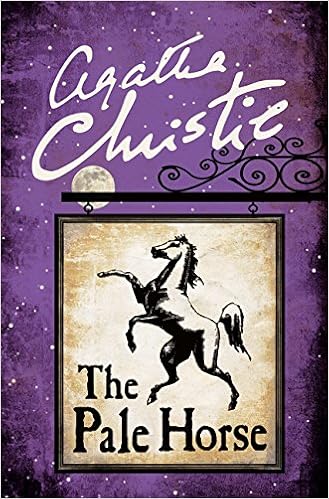
The Pale Horse by Agatha Christie. My copy is a hardback published in 1961 for The Crime Club.

Neither Hercule Poirot, nor Miss Marple feature in this novel and Mrs Ariadne Oliver has only a small part. Detective Inspector Lejeune is in charge of the investigation into the murder of Father Gorman who was killed one night on his way home. A list of names is found on Father Gorman’s body, seemingly unconnected in any way. The title,  a reference from the Book of Revelation  to a pale horse ridden by Death suggested to me from the beginning that what they had in common was death.

Mark Easterbrook, an historian and friend of Mrs Oliver, is drawn into the mystery when he meets an old friend Dr Corrigan, a police doctor, who shows him the list. Mark recognises two of the named people, both of whom are now dead. His cousin Rhoda lives in Much Deeping where he meets Ginger, a young red-haired woman and a friend of Rhoda. They visit The Pale Horse, an old house  which was formerly an inn in the village and is now the home of three weird women, thought by the locals to be witches. The Pale Horse is also the name of a sinister organisation that arranges murders based on black magic. Together, Mark and Ginger set out to unravel the mystery of the Pale Horse, but it is down to Inspector Lejeune to find the killer.

The book is a study of evil. Some of the characters are together discussing witchcraft and the nature of evil. Venables, a man crippled with polio says:

‘I can’t really go along with this modern playing down of evil as something that doesn’t really exist. There is evil. And evil is powerful. Sometimes more powerful than good. It’s there. It has to be recognised – and fought. Otherwise -‘ he spread out his hands.’We go down to darkness.’ (page 70)

It’s a fascinating book conveying a feeling of real menace. As usual with Agatha Christie’s books there are several suspects and various red herrings. However, I began to suspect who the culprit was quite early on in the book and this time I was right. This did not detract at all from my enjoyment and I hadn’t worked out the method until right at the end. I liked the various references to previous crimes that Agatha Christie dropped into the narrative, and also the portrait of Mrs Oliver as an author who liked her own privacy and disliked the embarrassing questions, always the same, that people asked her every time:

What made you first think of taking up writing? How many books have you written? How much money do you make? (page 17)

Reading about The Pale Horse in John Curran’s book Agatha Christie’s Secret Notebooks I discovered that this novel was mentioned during the trial in 1972 when Graham Young was convicted of murder, using the same method as detailed in the book, although he denied having read The Pale Horse. Still, it’s a disturbing thought, one that often occured to me when I used to watch TV programmes such as Wire in the Blood (I can’t watch it any more, it’s far too gory for me).

Favourite Places – Stratford-upon-Avon

On Sundays Margot at Joyfully Retired writes about one of her favourite places. Here’s one of mine – it’s Stratford-upon-Avon.  

We went there last August to see Julius Caesar at the Courtyard Theatre. I wrote about that here. We stayed at this hotel  

Alveston Manor

 in the room on the first floor next to the entrance (in shadow in the photo). This is the view through the window  

Bedroom window

The hotel is not far from the River Avon

River Avon

Whilst there we visited various houses connected with Shakespeare. We’ve been to Stratford many times but had never been in Shakespeare’s birthplace, so that is where we started.  

Shakespeare’s Birthplace

There is a display at the entrance which I found to be claustrophobic because the doors were locked behind us as we went in, but I enjoyed the tour of the house.  

Shakespeare’s Birthplace

We then went to Nash’s House and New Place. New Place was Shakespeare’s home for the last 18 years of his life. It was pulled down in the 18th century. Nash’s House, next to New Place belonged to Thomas Nash who married Elizabeth, Shakespeare’s granddaughter. 

Shakespeare Nash’s House & New Place
The Site of New Place

New Place Trellis-work Tunnel
New Place Knot Garden seen through the Tunnel

On after that to visit Hall’s Croft. John Hall, a physician, married Susanna, Shakespeare’s oldest daughter. The house has a small room furnished as John Hall’s consulting-room would have been and the garden contains many of the herbs mentioned in Hall’s medical notebook.   

Hall’s Croft

There is so much to see in Stratford – these are just a few of my photos! There are more on Flickr