Tryfan, Snowdonia

Tryfan is the 14th highest peak in Wales at 3010 feet.

I took this photo from the car as we were travelling along the A5 in the Ogwen Valley, part of the Nant Ffrancon Pass. The A5 Holyhead to London trunk road was re-engineered by Thomas Telford between 1810 and 1826.

Here it was shrouded in clouds.

And here is a photo taken later that same day when the clouds had cleared a bit. The speck in the sky is a helicopter, possibly a mountain rescue helicopter from RAF Valley stationed on Anglesey.

An ABC Wednesday post T is for …

Macbeth at the Royal Shakespeare Company

We’ve been away most of last week visiting family and going to Stratford-upon-Avon to see Macbeth at the transformed Royal Shakespeare Theatre.

Watching a live performance of any of Shakespeare’s plays is a special treat, one that we manage less frequently now that we’ve moved so far away from Stratford, but combining our visit with a family occasion made it possible this year. The new auditorium is impressive with a huge stage thrusting into the audience, seating around 1,000 people on three sides of the stage. Our seats were in the stalls, very close to the stage, with a group of school children seated in front of us, whose reactions were highly amusing.

The set design was dramatic and atmospherically dark, shattered stained glass windows in a ruined church with defaced images of saints and piles of rubble on the floor. At one point in the play Macbeth and Banquo erupted onto the stage through holes in the back wall. There are no weird sisters in this version of Macbeth; the prophecy is announced in suitably ghost-like tones by three children (the children of Macduff) suspended in the air above the stage as though they have been hung on meat hooks.

It was the children and Seyton the porter who stole the show for me, although the other actors all gave excellent performances. The murder of the children had me gasping and almost in tears as Macduff’s little daughter was taken away to her death. Jamie Beamish as Seyton was fantastic and his pyrotechnics really shocked me. Jonathan Slinger portrayed Macbeth as an frenetic lunatic who made me decidedly edgy and I never knew how close to me in the audience he was going to get – I was glad I wasn’t on the front row.

A hugely enjoyable performance.

Crime Fiction Alphabet: T is for Once a Biker by Peter Turnbull

I’ve chosen Peter Turnbull’s Once a Biker, a Hennessey and Yellich mystery to illustrate the letter T in Kerrie’s Crime Fiction Alphabet. For a full list of his books see Fantastic Fiction.

Synopsis from the book jacket

When a death bed confession leads to the reopening of a murder case, it doesn’t bode well when both victims were members of the same bikers’ gang twenty years ago. As Detective Chief Inspector Hennessey and his team try to investigate, it seems the vow of silence is still as strong as it was all those years ago, and many ex-gang members refuse to discuss those days of dangerous initiation rites and violent dares. But, when an ex-member is suddenly found murdered, it seems that someone is determined to keep old secrets dead and buried…

My view

This is the 16th Hennessey and Yellich mystery, a police procedural set in the city of York. Once again I have jumped into a series that is well advanced in the sequence, but Once a Biker works well as a standalone. Chief Inspector George Hennessey is nearing retirement – ‘His pension was calling his name more and more loudly with each day that passed.’(page 15)  But he is still very much in charge and leads his team, Detective Sergeant Somerled Yellich, Detective Constables Thompson Ventnor and Reginald Webster (new to CID) in uncovering the murderer.

Tony Wells, dying of cancer in a hospice tells Gillian Stoneham, a counsellor, the whereabouts of Terry North’s body, buried in Foxfoot Wood outside York. Both Tony and Terry had been members of a bikers’ gang known as the Dungeon Kings. The post-mortem reveals that Terry had been killed by a blow to the head. There were fractures all over his body but no facial injuries. The pathologist Dr Louise D’Acre describes it as ‘a very dispassionate execution, but somebody wanted to hurt him before they killed him.’ (page 20)

One of the biker chicks had been murdered three weeks before Terry had been reported missing and Harry the ‘Horse’ Turner, a gang member had been convicted of her murder. Released from prison he now maintains that he was innocent and Hennessey believes him, but first he has to penetrate the bikers’ code:

“Don’t grass on your mates”. They are still bikers in their hearts, early middle-aged as they may be. Once a biker, always a biker. (page 62)

I know nothing about bikers and their gangs, but learnt a lot from this book, enough to make me glad that I didn’t – if the initiation ceremony is dangerous, the biker’s chicks’ leaving ‘ceremony’ is very brutal and shocking.

There is a very strong sense of place in this book, as George Hennessey walks to and from his office in Micklegate along the medieval city walls. I liked the chapter headings giving a short preview of the contents, in a similar vein to a Dickens’ novel, such as this for chapter 4 Wednesday, 19 June, 10.10 hours – 13.40 hours in which life in the biker gang is recalled.’ (page 71) In places the dialogue also has an old fashioned feel and the use of words, such as ‘forenoon’ adds to the formality not found in most of today’s crime fiction books. I liked it.

There is an intriguing ending to this book involving George Hennessey which made me realise that I have missed something in not reading the earlier books in the series, something I hope to remedy.

  • Paperback: 201 pages
  • Publisher: Severn House Paperbacks Ltd (Jun 2008)
  • Language English
  • ISBN-10: 9781847510266
  • ISBN-13: 978-1847510266
  • Source: Borrowed from the library

Saturday Snapshot – Family

I don’t have many photos of my grandparents. Here are two.

The first is a photo of George Ellis Owens, my Taid (grandfather on my mother’s side) at his home in Penyffordd, North Wales. My mother has written on the back ‘My father 1930‘. He was born in 1880 and was a steel worker at John Summers at Hawarden Bridge Steelworks Shotton.

He is the grandparent I knew the most, because he and my grandmother came to live with us when I was 5. My granny died five years later and he lived to the ripe old age of 87, when I was 20. My other grandparents died when I was 6.

Below is a photo of  my granny, my father’s mother, taken in her garden at Bowdon Vale, Cheshire with my cousin Sylvia. I do remember her fairly well. She was always smiling in contrast to my granddad who was always grumpy, I thought. He had a big mustache and a loud gruff voice which made me nervous, plus he had his dog tied up to his armchair which scared me. She had her hair in a bun – just like grannies in picture books. She was born in 1878 and died when she was 74. I was named after her.

and this is me when I was 5½. I’ve cheated a bit here as this was a school photo.

To participate in Alyce’s Saturday Snapshot meme post a photo that you (or a friend or family member) have taken. Photos can be old or new, and be of any subject as long as they are clean and appropriate for all eyes to see. How much detail you give in the caption is entirely up to you. All Alyce asks is that you don’t post random photos that you find online.

I bought a book …

… not so unusual! But I had decided I wouldn’t buy any more until I’d read at least 6 of my to-be-read books and so far I’ve only read 3.

I gave  in and bought first one book and then another because we went to Much Wenlock in Shropshire on our way to Stratford-upon-Avon and found two good bookshops on the High Street. The  first one I saw on the High Street was Wenlock Books, selling new and secondhand books in a lovely old timber-framed building:

The secondhand books are upstairs:

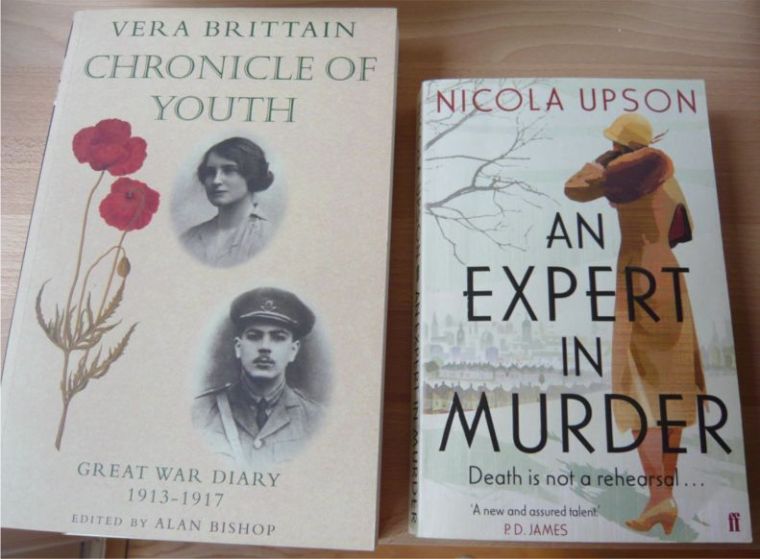
where I bought Vera Brittain’s Chronicle of Youth Great War Diary 1913 – 1917. It looks unread and as good as new. I’ve borrowed her diary Testament of Youth from a friend, so I’ll read that first.

We walked across the road to the Copper Kettle for a cup of tea and then saw another bookshop further down the High Street – Much More Books, selling secondhand books:

where I bought An Expert in Murder by Nicola Upson.

I’m following Fleur’s method of not buying books except for exceptional bargains, which I think these two books were:


ABC Wednesday – S is for …

… Alfred Sisley (1839 – 1899)

Sisley was an English Impressionist landscape artist, born in France where he lived for most of his life.

This is one of his paintings that particularly appeals to me – Small Meadows in Spring (c.1881)

This shows ‘le Chemin des Petits Prés‘, an oil painting of a riverside path which ran along the left bank of the Seine, connecting the villages of Veneux and By. The path has now been replaced by a paved walkway. The village visible on the opposite bank is Champagne.