U is for Umbrellas

‘The Umbrellas’, a painting by Pierre-Auguste Renoir c. 1881 – 85 an oil painting on canvas, held in the  National Gallery in London, shows an urban landscape – a crowd of fashionable Parisians in the rain under their umbrellas with a little girl in the foreground carrying a hoop. I like the contrast between the feathery brushwork of the people in the background and the harder outlines of the umbrellas and the precise drawing of the woman and little girl in the foreground. I also like the composition with the figures at the sides cut off as in a photograph and the way the painting conveys such a sense of the movement  of the bustling crowd.

An ABC Wednesday post illustrating the letter U.

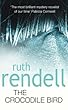
The Crocodile Bird by Ruth Rendell: a Book Review

I posted the opening sentences of The Crocodile Birdlast Friday. It really grabbed my attention and got me wondering what had caused Liza’s world fall apart. The cause is revealed when Eve, Liza’s mother tells her she has to leave home because Eve is liable to be booked for murder in the morning. Liza is nearly seventeen but has been brought up with practically no knowledge of the world outside the little gatehouse to Shrove House, where she has lived in seclusion, never having been on a bus or train or having any contact with other children. As Liza explained, Eve had wanted to protect her:

The world had treated her so badly, it was so awful out there, that I wasn’t to be allowed to go through any of that. I was to be sheltered from the world, hence no school and no visits to town, no meeting other people, other people kept down to a minimum, a totally protected childhood and youth. (page 116)

Liza, however, has a secret lover, Sean and when she leaves home she to goes to live with him in his caravan. She tells him the story of her life in a series of tales each night, just like Scheherazade in One Thousand and One Nights, culminating in how her mother is now on trial for murder. It seems, moreover, that she has killed more than once. Eve’s passion and obsession is for Shrove House, owned by Jonathan Tobias. Eve and Jonathan had grown up together and she had once thought they would marry and Shrove House would be hers. She would do anything to stay there.

This really a psychological study, rather than a straightforward crime fiction novel. It’s written in a simple style matching Liza’s childlike naivety.  To some extent, I thought that reduced the tension, although as Liza’s eyes were opened and she realised the meaning of events she had witnessed as a child, the tension mounted. It seemed that she might be following in her mother’s murderous footsteps!

The Crocodile Bird is an easy book to read and one that I enjoyed. The title intrigued me for most of the book, as I wondered where the bird comes into the story. The explanation is as Liza explains to Sean that just as the crocodile bird is able to feed safely from the mouth of a crocodile, so whatever Eve did to others (and she did some terrible things) Liza, like the bird, was always safe with her.

  • Paperback: 368 pages
  • Publisher: Arrow; New edition edition (29 Sep 1994)
  • Language English
  • ISBN-10: 0099303787
  • ISBN-13: 978-0099303787
  • Source: I bought the book
  • My Rating: 3.5/5

Saturday Snapshot – Newcastle’s Castle

A few Saturdays ago I posted photos of Newcastle uponTyne’s bridges. Today here are some more photos I took on that grey, gloomy day. This time they are of Newcastle’s Castle Keep and Black Gate.

Our first sight of the castle was as it appeared behind the railway line:

The Castle was was built in stone during the reign of Henry II, between 1168 and 1178, at a cost of £1,144. There was an earlier castle on the site, a wooden motte and bailey castle built by William the Conqueror’s son, Robert Curthose. This was replaced by the stone castle – hence the name of Newcastle! It stands high above the River Tyne – Newcastle upon Tyne.

This is the Castle Keep, which is the only remaining part of the 12th century Castle:

It is a Scheduled Ancient Monument and is open to the public, but we didn’t have time that day to go inside. On our next visit to Newcastle, we will make time to have a proper look at the Castle Keep!

The Gatehouse to the Castle is still standing – the Black Gate. It was added to the Castle site in 1247 by Henry III.  The wooden footbridge was originally a drawbridge.

Saturday Snapshot is hosted by Alyce at At Home With Books.

What’s in a Name 5

In September I completed this year’s What’s in a Name Challenge and I’ve been wondering whether or not to join in again for next year’s challenge. On the one hand, I’ve done it most years and it’s one of the few challenges that I’ve joined that I’ve finished. On the other hand I’m not over keen on reading a book based on the fact that it has a particular word in the title. But, then again I do like making lists and seeing if I can find enough of my unread books to match the categories.

So, I am going to take part, because I’ve gone through my books and found that I have more than enough books to finish the challenge and after all it only involves reading 6 books over the year. It’s hosted by Beth at Beth Fish Reads:

The categories and my choices are as follows:

A book with a topographical feature in the title.  I have lots of choice for this category – 

  • On the Black Hill by Bruce Chatwin
  • The Way Through the Woods by Colin Dexter
  • The Secret River by Kate Grenville
  • Hanging Valley by Peter Robinson
  • The Ghost Road by Pat Barker
  • The River Midnight by Lilian Nattel
  • Shadows in the Street by Susan Hill
  • The Island by Victoria Hislop
  • The Road by Cormac McCarthy

A book with something you’d see in the sky in the title

  •  Cloud Atlas by David Mitchell
  • The Book of Air and Shadows by Michael Gruber
  • Death in the Clouds by Agatha Christie

A book with a creepy crawly in the title – just one book!

  • The Wasp Factory by Iain Banks

A book with a type of house in the title:

  • The Girl Who Kicked the Hornet’s Nest by Steig Larsson
  • The House of Spirits by Isabel Allende
  • Wycliffe and the House of Fear by W J Burley
  • I’m the King of the Castle by Susan Hill

A book with something you’d carry in your pocket, purse, or backpack in the title:

  • The Scarlet Letter by Nathaniel Hawthorne
  • Notes from an Exhibition by Patrick Gale
  • Schindler’s List by Thomas Keneally
  • Village Diary by Miss Read
  • They Do It With Mirrors by Agatha Christie
  • Book of Love by Sarah Bower

A book with something you’d find on a calendar in the title:

  • The Friday Night Knitting Club by Kate Jacobs
  • The Year of the Flood by Margaret Atwood
  • The Day Gone By by Richard Adams (autobiography of the author of Watership Down)

Book Beginnings on Friday

I began reading The Crocodile Bird by Ruth Rendell last night for no reason other than it has been on the top of a pile by my bedside for a while.

It begins well:

 The world began to fall apart at nine in the evening. Not at five when it happened, nor at half-past six when the policemen came and Eve said to go into the little castle and not show herself, but at nine when all was quiet again and it was dark outside.

I had to read on, even though I was falling asleep. It grabbed my attention – what had happened? It must have been something bad, because the policemen came. Who is Eve? Who did she tell to go into the little castle and why? The little castle … what is that? If the thing that happened was so bad, why hadn’t the world begun to fall apart at five? Whatever happened at nine must have been much worse – or was it?

This is a Ruth Rendell book, so I expect it to be mysterious and creepy. I’ve read further on and it’s full of secrets that are slowly being revealed and so far I’m enjoying the experience.

Book Beginnings is run by Kathy at A Few More Pages.

How to participate: Share the first line (or two) of the book you are currently reading on your blog or in the comments. Include the title and the author so we know what you’re reading. Then, if you would like, let us know what your first impressions were based on that first line, and let us know if you liked or did not like the sentence. The link-up will be at  every Friday and will be open for the entire week.

Much in Evidence by Henry Cecil

I’ve been reading quite a few long books recently and fancied something shorter, and more amusing. I also noticed that I’ve not been reading much crime fiction lately, so I looked at my bookshelves and took down Much in Evidence by Henry Cecil (published in the US as The Long Arm). My copy is a secondhand book, with this great cover.

I haven’t read any of Cecil’s other books, but after reading this one I certainly will look out for more. there is a list of his books on Fantastic Fiction. It’s no surprise to me to find out that Henry Cecil, real name Henry Cecil Leon (1902 -1976), was a judge and I loved the way he pokes fun at the law and the legal system in this book. The dialogue is masterful, and the characters are hilarious, from the drunken solicitor, Mr Tewkesbury, to the barrow boy, Mr Brown. The plot is farcical, which I found fascinating and highly entertaining.

To summarise the plot very briefly – Mr Richmond, bald and lame was attacked in his home and robbed of £100,000. The insurance company reluctantly paid up, but then they discover that a series of bald, lame men had been making dubious claims on insurance companies and he is charged with fraud.

Coincidences abound in this book, until you just don’t know what to believe. Is there just once coincidence too many … ? It was with relief that I read the last chapter, where my suspicions were confirmed.

My rating: 4/5

Details of a new copy of Much in Evidence (from Amazon UK):

  • Paperback: 212 pages
  • Publisher: House of Stratus; New edition edition (16 Oct 2000)
  • Language English
  • ISBN-10: 1842320572
  • ISBN-13: 978-1842320570