Teaser Tuesdays

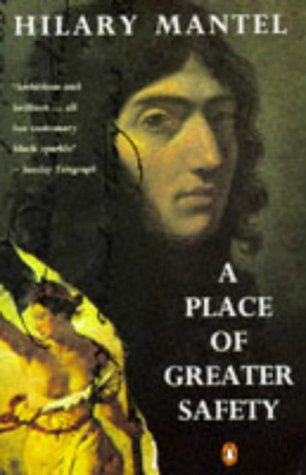
The book I’m currently reading is A Place of Greater Safety by Hilary Mantel, a huge book of 872 pages. I’m only on page 136, so it’s early days. In fact so far it’s been setting the scene of pre-Revolutionary France as seen through the key characters of Georges-Jacques Danton, Maximilien Robespierre and Camille Desmoulins. I’m liking it and it brings back to my mind history lessons at school when we listed the causes of the French Revolution.

This extract summarises, I think, the mood of the times in 1788:

Nothing changes. Nothing new. The same old dreary crisis atmosphere. The feeling that it can’t get much worse without something giving way. but nothing does. Ruin, collapse, the sinking ship of state: the point of no return, the shifting balance, the crumbling edifice and the sands of time. Only the cliche flourishes. (page 130)

Not long afterwards everything changed!

Books I read in March 2012

I read some good books in March, four of them are crime fiction, indicated below by *, and one is a memoir (Testament of Youth). The others are all fiction. (The links are to my posts on the books).

My Book of the Month has to be Pride and Prejudice and my Crime Fiction Book of the Month is a close call between the books rated 4/5, but on balance I think Peter Robinson’s Before the Poison comes out on top.


So far this month I’ve read 24 books, 22 of them fiction (12 of which are crime fiction), and  2 non-fiction. I’ve been making inroads into my TBR books, with 10 of the 24 books being books I’ve owned since before January 2012.

  1. The Labours of Hercules* by Agatha Christie 4/5
  2. Testament of Youth by Vera Brittain 4/5 (from TBR books)
  3. The Victorian Chaise-Longue by Marghanita Laski 3/5 (library book)
  4. The Messenger of Athens* by Anne Zouroudi 4/5 (Kindle from TBR bks)
  5. Before the Poison* by Peter Robinson 4/5 (library book)
  6. Pride and Prejudice by Jane Austen 5/5 (re-read)
  7. The Inspector’s Daughter* by Alanna Knight 3.5/5 (library book)
  8. The Parasites by Daphne du Maurier 3.5/5 (from TBR bks)
  9. Daphne by Justine Picardie 4/5 (from TBR bks)

Saturday Snapshot: A View of Glasgow

A couple of years ago we went to the Glasgow Science Centre on the banks of the River Clyde .

Entrance to Glasgow Science Centre

There is so much to see and do in the Centre, not least the Planetarium which dominates the scene as you approach the entrance.

You can go up to the roof, where the view is excellent:

View of Glasgow from the Science Centre

The armadillo shaped building on the north bank of the Clyde is the Scottish Exhibition and Conference Centre, where, amongst other events, they hold hold auditions for X-Factor.

The Planetarium is fascinating – I wished it was possible to take photos inside, but of course I couldn’t. It was enough, though, to sit back and gaze upon the night sky and have constellations and planets pointed out to me.

For more Saturday Snapshots see Alyce’s blog At Home With Books.

Book Beginnings on Friday

This is the opening sentence of the book I’m going to read next:

The night the war ended, both Mrs Trevor and Mrs Wilson went on duty at the Red Cross post as usual.

from The Village by Marghanita Laski. As this sentence indicates the setting is at the end of World War Two – in fact, the very day it ended. It seems to me as though Mrs Trevor and Mrs Wilson don’t want to give up the routine they had during the war and I’m keen to see what effect the end of the war will have on them.

This opening reminds me a bit of One Fine Day by Mollie Panter-Downes, also set in 1946 and chronicles the changes the Marshall family encountered, a book which I loved.

Book Beginnings on Friday is now hosted by Gilion at Rose City Reader.

The Parasites by Daphne du Maurier: a Book Review

Daphne Du Maurier has been one of my favourite authors ever since I read Rebecca as a young teenager. I’ve read quite a lot of her books, some more than once, but this is the first time I’ve read The Parasites.

This is different from the other books by Du Maurier that I’ve read. There’s no real mystery, no dramatic suspense, no need to hold your breath and wonder what comes next. In some ways it’s a family drama and in others it’s a psychological study. The characters, for the most part, are not likeable – they’re selfish and self-centred, the ‘dreadful Delaneys‘. They’re from the theatrical, artistic world and they mix with the rich and the upper classes. They are siblings, with famous parents – Pappy, a singer who is a  larger-than life character and Mama who is a dancer. Between them they have three children – Maria, who is Pappy’s daughter; Niall, who is Mama’s son; and Celia who is their daughter.

At the beginning of this book Charles, Maria’s husband accuses her and her stepbrother, Niall and half-sister Celia of being parasites:

… that’s what you are, the three of you. Parasites. The whole bunch. You always have been and you always will be. Nothing can change you. You are doubly, triply parasitic; first, because you’ve traded ever since childhood on that seed of talent you had the luck to inherit from your fantastic forbears; secondly, because you’ve none of you done a stroke of ordinary honest work in your lives, but batten upon us, the fool public who allow you to exist; and thirdly, because you prey upon each other, the three of you, living in a world of fantasy which you have created for yourselves and which bears no relation to anything in heaven or on earth. (page 5)

The narration alternates between the past and the present and between the first person narrator and third person description, which I found rather odd at first. The narrator could be any one of the three – Maria, Niall or Celia – or is it Daphne Du Maurier herself? I read Margaret Forster’s biography of Daphne a while ago and checked what she had to say about The Parasites. I wasn’t surprised to find out that this book is semi-autobiographical. Daphne had written to a friend in 1957 explaining that these characters were her ‘three inner selves’ and Margaret Forster considers that Pappy was modelled on Gerald, Daphne’s father.

It’s the relationships between the three siblings that forms the core of The Parasites. After Charles’s outburst the three of them discuss what he meant and go back through their lives. There are poignant moments as they remember the joys and difficulties of growing up and that strange realisation that you’re no longer a child:

Grown-up people … How suddenly would it happen, the final plunge into their world? Did it really come overnight, as Pappy said, between sleeping and waking? A day would come, a day like any other day, and looking over your shoulder you would see the shadow of the child that was, receding; and there would be no going back, no possibility of recapturing the shadow. You had to go on; you had to step forward into the future, however much you dreaded the thought, however much you were afraid. (page 61)

Like all of Du Maurier’s books I could visualise the scenes, almost as though I was really there. I may not have liked the characters but they are convincing –  I wouldn’t want to have to spend much time with any of them. But it’s not all intense. There is also humour to balance the drama, such as the hilarious scene where the Delaneys visit the Wyndham family soon after Maria has married Charles.

Even though this does not rank with my favourites of Daphne’s books I did enjoy it and it spurred me on to read My Cousin Rachel, which I’ve been meaning to read for years, and Justine Picardie’s novel, Daphne – more about both books another time.

  • Paperback: 352 pages
  • Publisher: Virago Press Ltd; New edition edition (5 May 2005)
  • Language English
  • ISBN-10: 1844080722
  • ISBN-13: 978-1844080724
  • Source: I bought it
  • My Rating: 3.5/5

Testament of Youth by Vera Brittain

Testament of Youth by Vera Brittain is based on her diaries, telling of her life up to 1925, concentrating on the World War One years.

It is an absolutely fascinating account of the war and all its horror and sufferings, and very moving. Vera was a VAD (Voluntary Aid Detachment) during the war, nursing casualties both in Britain and France. The conditions were appalling.

During the war her fiance, Roland Leighton, her brother, Edward, and two friends, Geoffrey Thurlow and Victor Richardson, were all killed. Roland was killed the day before he was due home on leave at Christmas 1915 and Edward was killed just a few months before the Armistice – all heart-breaking. Vera’s life was irrevocably changed – as were those of so many others.

For me, her account of the war years is the most outstanding in this book, the most personal and vivid. The preceding years are about her childhood and youth and bring to life the social conditions and her struggles for education. By the outbreak of war she was an undergraduate at Somerville College, Oxford. But I found the final section after the war to be more detached. It’s about her work as a speaker on the League of Nations and International Relations, about the development of the peace ideal. The language in this section is more formal and so does not come across as fresh and immediate as in those on her childhood and war years.

 I read this book as a result of reading Climbing the Bookshelves by Shirley Williams, Vera’s daughter. It slots nicely into the War through the Generations Challenge – World War One.

  • Paperback: 640 pages
  • Publisher: Virago; New Edition with new cover edition (2004)
  • Language English
  • ISBN-10: 0860680355
  • ISBN-13: 978-0860680352
  • Source: borrowed from a friend – I’ve now bought the e-book version
  • My rating 4/5 (it would have been 5/5 apart from the change in writing in the last section)