Saturday Snapshot

On a grey, dismal day in May we visited Smailholm Tower in the Scottish Borders. It’s a four-storey tower house on a base of volcanic rock, a stark feature on the skyline between Kelso and Selkirk in the Tweed Valley.

(click on the photos to enlarge)

It was built in the 15th century by the Pringle family on Smailholm Craig, providing protection from the elements and from raiding parties of English reivers (raiders).

Standing 650ft (200m) above sea level, it’s walls are 9ft (2.5m) thick and 65ft (20m) high and it has one small entrance in the south wall and tiny windows.

Inside it’s quite dark and most of my photos inside aren’t very good. There’s a spiral staircase giving access to all five floors and the battlements.

In 1645 the Pringle family sold the tower and Smailholm Craig to the Scott family. Sir Walter Scott lived at Smailholm for a while with his grandmother and Aunt Janet after he’d had polio because they thought the fresh country air would be good for him. It was his aunt who told him tales of the Border countryside which gave him his passion for folklore and history.

The three upper floors house an exhibition of costume figures and tapestries to illustrate Sir Walter Scott’s Minstrelsy of the Borders, his collection of ballads. The photo below is of the Queen of the Fairies:

and below is one of little Walter Scott and his Aunt Janet:

I was fascinated by the roof of the tower, because it’s covered in turf, making a living roof:

There are spectacular views of the surrounding countryside on the way up. Below is the view of the Eildon Hills through a window:and even more panoramic views from the battlements:

For more Saturday Snapshots see Alyce’s blog At Home With Books.

Library Loot

It’s been ages since I did a Library Loot post. These reflect the variety of books that I enjoy. For more details about the books click on the links which take you to Amazon UK:

  • D H Lawrence – Daughters of the Vicar. This is a novella written in 1911. I’d never come across this before and thought it looked interesting. It has a foreword by Anita Desai – she writes that ‘here in the little story, Daughters of the Vicar (could any title be more redolent of the England of its time?) we have the essential D H Lawrence – the little contained world in a mossy valley of coal-veined hills from which that D H Lawrence grew’.
  • Kate Atkinson – Started Early, Took My Dog. This is the fourth Jackson Brodie book, described by The Times as ‘A comic novel of great wit and virtuosity.’ I’ve been meaning to get this since it came out a couple of years ago.
  • Edna O’Brien – The Country Girls. This was first published in 1960 and it’s set in a country village in Ireland in the early 1960s – a period piece now. Her books then were both successful and scandalous. In her native Ireland she was considered irreligious.
  • Guilty Consciences: a Crime Writers’ Association Anthology, edited by Martin Edwards (himself a successful crime fiction writer and blogger). I had to borrow this collection of short stories from some of my favourite crime fiction authors.
  • Peter James – Looking Good Dead. Even though I’ve had a couple of Peter James’s books for a few years I’d never read them, until I started Dead Simple (the first Detective Superintendent Grace book) this week. I’m hooked – it’s really good. So when I saw this in the library today I was delighted – it’s the second of his Roy Grace books!
  • M R Hall – The Flight. Another series of crime fiction that I like – this is the fourth in Hall’s Coroner Jenny Cooper series. I’ve read the first and the third – Jenny Cooper is a coroner who acts as a detective. Again, another series that has me captivated.

And finally, two books on a subject that is equally as absorbing as reading and blogging – painting:

Both books include demonstrations and advice on techniques, types of paint and pastels, and composition. I just need to get painting – and reading!

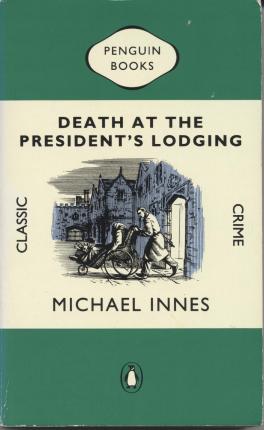
Death at the President’s Lodging by Michael Innes: a Book Review

A Golden Age Mystery

Death at the President's Lodging 001

This is the first Inspector Appleby mystery by Michael Innes. What struck me most about Death at the President’s Lodging is that it is essentially a ‘locked room’ mystery. Dr Umpleby, the unpopular president of St Anthony’s College (a fictional college similar to an Oxford college)  is found in his study, shot through the head.


The crime was at once intriguing and bizarre, efficient and theatrical. It was efficient because nobody knew who had committed it. And it was theatrical because of a macabre and necessary act of fantasy with which the criminal, it was quickly rumoured, had accompanied his deed. (page 1)

Inspector Appleby from Scotland Yard is in charge of the investigation, helped by Inspector Dodd from the local police force. They provide an interesting contrast, both in appearance, age and methods. Appleby is an intellectual, contemplative, preferring to study human nature rather than rely on the use of finger prints and material evidence. Dodd is reliant on routine and although untrained and unspecialised is shrewd and thorough. They know each other and make a good pair. This passage sums up their working relationship:

And now Dodd for all his fifteen stone and an uncommon tiredness (he had been working on the case since early morning), sprang up with decent cordiality to welcome his colleague. ‘The detective arrives,’ he said with a deep chuckle when greetings had been exchanged, ‘and the village policeman hands over the body with all the misunderstood clues to date.’ (page 5)

What follows is an extremely convoluted and complex investigation of the strange crime. Without the plan at the beginning of the book I would have been lost. The college is divided into different areas and each area is locked each evening, shutting it off from the outside world and shutting one part of the college off from the rest. Dodd describes it as a ‘submarine within a submarine’. The questions are how did the murderer get in and out, who had keys, and why was Umpleby murdered?

Appleby and Dodd interview the Fellows of the College, each of whom it seems at first could have had reason to murder Umpleby. Who is telling the truth? I couldn’t tell and there are innumerable clues to mystify both the police and the reader. Appleby watches and listens, recognising that he is not going to get a quick result in such a complicated case. Of course, in the end he works it all out. He gathers together the Fellows and calls on a number of them to give their statements of the facts as they know them. They each suspect a different person as the culprit, but Appleby gradually eliminates the suspects to reveal the murderer.

It was masterly. It’s also a book that you can’t read quickly. It requires concentration. There is little action, much description and a lot of analysis. I enjoyed it very much, but after reading it I felt my brain needed a little rest.

I also wrote about Michael Innes in my Crime Fiction Alphabet series of posts – I is for Innes.

ABC Wednesday: A is for The Artist’s House at Argenteuil

Another round of ABC Wednesday began today. Amazingly it’s been going for around 5 years and this is Round 11.

A is for The Artist’s House at Argenteuil by Claude Monet, one of my favourite Impressionist paintings. It’s oil on canvas painted in 1873, now held in the Art Institute of Chicago.

Monet moved to Argenteuil in 1871 and lived there until 1877. This was a prolific period for him – he was happy and well-off during that time. It was whilst he was living there that he developed a passion for gardening, influenced by fellow artist Gustave Caillebotte. This painting shows the first house he lived in at Argenteuil, with beds of red, white and blue flowers in front of the house, a creeper covering much of the wall and potted plants in large blue and white tubs on the gravel drive.

I especially like this painting because of the colours and also the figures adding personality – the little child with a hoop is Monet’s five-year old son, Jean, whilst his wife, Camille is seen in the doorway.

First Chapter First Paragraph Tuesday Intros

Every Tuesday, Diane at Bibilophile by the Sea posts the opening paragraph (sometimes maybe a few) of a book she’s decided to read based on the opening paragraph (s). Feel free to grab the banner and play along.

I must be one of the minority who didn’t love The Time Traveler’s Wife (it irritated me), but still when I saw Her Fearful Symmetry by Audrey Niffennegger and read the opening paragraphs, I thought maybe I’d read it.

The first chapter is called The End and begins:

Elspeth died while Robert was standing in front of a vending machine watching tea shoot into a small plastic cup. Later he would remember walking down the hospital corridor with the cup of horrible tea in his hand, alone under the fluorescent lights, retracing his steps to the room where Elspeth lay surrounded by machines. She had turned her head towards the door and her eyes were open; at first Robert thought she was conscious.

In the seconds before she died, Elspeth remembered a day last spring when she and Robert had walked along a muddy path by the Thames in Kew Gardens. There was a smell of rotted leaves; it had been raining. Robert said, ‘We should have had kids,’ and Elspeth replied, ‘Don’t be silly, sweet.’ She said it out loud, in the hospital room, but Robert wasn’t there to hear.

If you’ve read this book what do you think? I’ve looked on Amazon and the verdict is split almost 50/50 between 5/4 stars and 1/2 stars!

Crime Fiction Alphabet: I is for Innes

Michael Innes is the pseudonym of John Innes Mackintosh Stewart (1906 – 1994), a British scholar and novelist, and is my choice to illustrate the letter I in Kerrie’s Crime Fiction Alphabet.

He was born near Edinburgh, the son of a Scottish professor, and attended Edinburgh Academy, then Oriel College, Oxford where he won the Matthew Arnold Memorial Prize in 1939 and honours in English. He was a Lecturer, then a Professor in English at different universities, finishing his academic career in 1973 as a Student (Fellow) at Christ Church Oxford.

He published many novels, and short stories as well as books of criticism and essays under his own name, including biographical works on Rudyard Kipling and Thomas Hardy. Writing as Michael Innes he wrote many crime novels, the first being Death at the President’s Lodging, written in 1934 during his sea voyage to Australia. It was the first of his 29 books about his Scotland Yard detective, John Appleby, published in the UK in 1936, and in the USA in 1937 as Seven Suspects, to avoid readers thinking it dealt with the US President.

In an essay written in 1964 Innes described his writing methods – during the academic year he wrote for two hours before breakfast. He thought that reading detective stories was addictive (I have to agree with that!) and that he managed to escape the compulsion to read them by writing his own mysteries (maybe I should try that). He thought in depth characterisation wasn’t right in detective stories and he avoided having real problems or feelings intrude on his characters. He regarded crime fiction solely as escapist literature.

Death at the President's Lodging 001I’m currently reading Death at the President’s Lodging – a used Penguin Books edition published in 1958, one of the green and white crime fiction books.

It’s set in a fictional English college, St Anthony’s (much like an Oxford college) where the President of the college has been murdered, his head swathed in a black academic gown, a human skull beside his body and surrounding it, little piles of human bones.

As I would expect from a professor of English, Innes’s writing is intellectual, detailed, formal and scattered with frequent literary allusions and quotations.  The plot is complex and in the nature of a puzzle. There are plenty of characters, the suspects being the dons of the college. As well as Appleby there are the local police, headed up by Inspector Dodd, who acts as a foil to Appleby’s intellectual approach to the murder. I’ll write more about the book when I’ve finished it.

For a list of Michael Innes’s work see Wikipedia.