Top Ten Tuesday: Bookish Wishes

Top Ten Tuesday is a weekly meme created by The Broke and the Bookish and now hosted by Jana at That Artsy Reader Girl. For the rules see her blog.

The topic this week is Bookish Wishes. List the top 10 books you’d love to own. In no particular order these are the books on my Amazon Wish List:

The Black Tulip by Alexandre Dumas

4*

The Black Tulip is historical fiction, a love story, mixing historical characters with fictional ones. It was first published in 1850. I loved The Count of Monte Cristo by Alexandre Dumas, so I was hoping to enjoy The Black Tulip too. I did, but not quite as much. I think it’s because I don’t know much about Dutch history and so I found the early chapters, about the brothers Cornelius and Johan de Witt, a bit difficult to follow. They were Dutch statesmen, accused of treason, who were brutally killed by a mob in the Hague in 1672, during a period of political upheaval, when they escaped from prison.

The story centres on Cornelius von Baerle, the fictional godson of Cornelius de Witt and his desire to grow a black tulip. He became involved in the de Witts’ affairs when Cornelius de Witt left a sealed parcel of his correspondence with the French war minister, with him for safekeeping. He didn’t open the parcel and didn’t know what it contained.

When the Tulip Society of Haarlem offered a prize of a hundred thousand guilders for the development of a tulip ‘without a spot of colour‘, this set the tulip growers into a frenzy of activity, including Van Baerle and his neighbour, Isaac Boxtel. Boxtel spied on Van Baerle’s experiments to grow a black tulip, which were having more success than his own efforts. Indeed Boxtel was obsessed with what Van Baerle was doing, neglecting his own tulips to wither and rot as he observed, through a telescope, what his neighbour was doing both in his garden and in his laboratory.

Whilst observing Van Baerle’s laboratory, Boxtel had seen the meeting between Cornelius de Witt and Van Baerle when he entrusted his papers to his godson. On hearing that the de Witt brothers had been arrested Boxtel realised he could inform against Van Baerle and get him arrested, thus giving himself the opportunity to steal the bulb Van Baerle had produced. And the hundred thousand guilder prize would be his.

And so Van Baerle was thrown into prison, wrongly convicted of treason and under sentence of death. However William of Orange, Stadtholder of Holland granted him his life but condemned him to imprisonment for life. He was sent to the fortress of Loewestein and there kept in solitary confinement. What follows is a dark and somewhat farcical tale, as aided by the jailer’s daughter Rosa he continues to cultivate his tulip bulbs. He and Rosa fall in love, despite all the difficulties that assault them.

It’s a great story, full of drama and emotion. It’s a love story, a story about passion, hatred, jealousy, obsession and injustice. After the difficulties I had with the first four or five chapters (I had to re-read them to work out how the rest of the story was connected) I found it difficult to put down, keen to find out what would happen next. I didn’t love it like I loved The Count of Monte Cristo, but I really liked it.

WWW Wednesday: 5 June 2024

WWW Wednesday is run by Taking on a World of Words.

The Three Ws are:

What are you currently reading?
What did you recently finish reading?
What do you think you’ll read next?

It’s been several weeks since I wrote a WWW Wednesday post. The books in this post are all from my 20 Books of Summer list.

Currently I’m reading Black Roses by Jane Thynne, a book I bought 10 years ago. It’s set in Germany in 1933 as Hitler came to power. Clara Vine, an attractive young Anglo-German actress, arrives in Berlin to find work at the famous Ufa studios. Through a chance meeting, she is unwillingly drawn into a circle of Nazi wives, among them Magda Goebbels, Anneliese von Ribbentrop and Goering’s girlfriend Emmy Sonnemann. (Goodreads). I’m enjoying this book so far, although it’s moving very slowly and I am getting a bit confused by the minor characters.

The last book I read was Great Meadow by Dirk Bogarde, subtitled on the cover, An Evocation. I couldn’t resist the cover of this book when I spotted it at a bookstall at the local village fair in July 2010. When I read the opening words in the Author’s Note at the beginning of the book I knew I wanted to read it:

An evocation, this, of the happiest days of my childhood: 1930 – 34. The world was gradually falling apart all around me, but I was serenely unaware. I was not, alas, the only ostrich. (page vii)

It has been sitting on my bookshelves since then. and I’m kicking myself that I took so long to get round to reading it because I loved it. I’ll be writing more about this book soon.

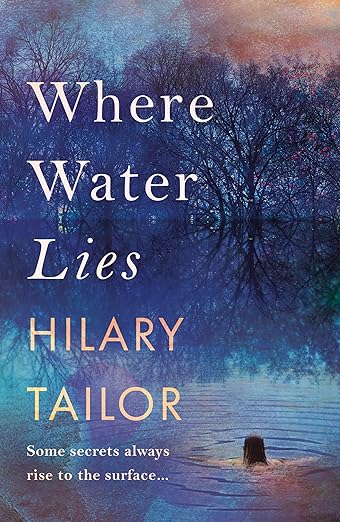
Next I’m planning to read Where Water Lies by Hilary Tailor. I put this on my 20 Books of Summer list because I loved her first book The Vanishing Tide.

Synopsis from Amazon UK

Eliza has lived two lives – one before she fell into an obsessive teenage friendship with Eric and Maggie, and the one after it was destroyed in a single afternoon. To Eliza, Eric and Maggie were irreplaceable, so she hasn’t. Instead, drifting through life alone, she spends every morning diving into her memories as she swims in Hampstead Ponds, her guilt never far below the surface.

Twenty years might have passed, yet Eliza still can’t help searching for Maggie everywhere. Then one day she spots a woman who looks just like her. Eliza has spent half her life wondering what really happened that afternoon and if Maggie’s back, will it help her finally get answers?

But memories are like ripples on water, and can be deceptive. As the past and present collide, Eliza begins to wonder: will learning the truth set her free – or will it only drag her down deeper?

Although this is a weekly meme I’m only taking part occasionally.

Spell the Month in Books June 2024

Spell the Month in Books is a linkup hosted by Jana on Reviews From the Stacks on the first Saturday of each month. The goal is to spell the current month with the first letter of book titles, excluding articles such as ‘the’ and ‘a’ as needed. That’s all there is to it! Some months there are optional theme challenges, such as “books with an orange cover” or books of a particular genre, but for the most part, any book you want to use is fair game!

This month’s theme is History. I don’t think that the books you choose have to be books that you’ve read, but where possible I like to do that, or at least choose books that I want to read and and this month I’ve managed to find enough nonfiction books about different aspects of history that I have read with titles beginning with each of the letters to spell JUNE.

J is for Jane Austen at Home by Lucy Worsley

I think it was a foregone conclusion that I would really enjoy historian Lucy Worsley’s Jane Austen at Home. I have loved Jane Austen’s books for many years, going back to when I was about 12 and read Pride and Prejudice for the first time. I’d previously read Carol Shields’s biography Jane Austen and Claire Tomalin’s Jane Austen: a Life so there was really very little I learned reading Jane Austen at Home that surprised me or that I hadn’t known before.

I suppose what was new to me was the emphasis on what home life was like during the period of Jane’s life and seeing photos of the houses and places that she had lived or stayed in as a visitor. And I think I gained a better understanding of the social history of Georgian England and of Jane’s wider family connections and what her family and friends thought of her both as a person and as an author.

Jane Austen at Home is both very readable and very detailed, which is not an easy thing to achieve. There is an extensive section at the end of the book, listing sources, a bibliography, notes on the text and an index. There are two sections of colour plates.

U is for Under the Tuscan Sun by Frances Mayes

In this book the author describes how she bought and renovated an abandoned villa. It’s full of the pleasures of living in Tuscany – the sun, the food, the wine and the local people. It makes me want to do the same! It’s nothing like the film they made of it – the book is much better. Bella Tuscany is the follow up book with more details about the restoration of the villa and its garden, plus recipes.

I read this book before I began blogging, so no review. And I no longer have my copy, which just shows the dangers of recycling books as I’d love to re-read it!

N is for Nagasaki: Life After Nuclear War by Susan Southard

The facts are horrendous – on August 9th 1945, two days after the atomic bombing of Hiroshima, a five-ton plutonium bomb was dropped on the small coastal town of Nagasaki. The effects were cataclysmic.

This must be one of the most devastatingly sad and depressing books I’ve read and yet also one of the most uplifting, detailing the dropping of the bomb, which killed 74,000 people and injured another 75,000. As the subtitle indicates this book is not just about the events of 9 August 1945 but it follows the lives of five of the survivors from then to the present day. And it is their accounts which make this such an emotive and uplifting book, as it shows their bravery, how they survived, and how they were eventually able to tell others about their experiences. Along with all the facts about the after effects of the bombing, the destruction, and radiation, it exposes the true horror of atomic warfare, making it an impressive and most compelling account of pain, fear, bravery and compassion.

E is for Elizabeth Macarthur: A Life at the Edge of the World by Michelle Scott Tucker

This is an excellent biography because it is thorough, well researched and it provides an insight into the early years of Australia’s colonial history. It is an extremely readable biography of a fascinating woman. Elizabeth was born on 14 August 1766 in Devon, England and she married John Macarthur in October 1788. In June 1789 they sailed with their first child, Edward, initially on the Neptune, and then on the convict ship Scarborough to New South Wales where John joined his regiment, the New South Wales Corps, in the recently established colony of New South Wales.

For sixty years, Elizabeth ran the family farm in Parramatta, west of Sydney town – on her own during her husband’s long absences abroad, four years during her husband’s first absence, and nine years during the second, when she was responsible for the care of their valuable merino flocks, as well as the Camden Park estate and the direction of its convict labourers.

The book is packed with detail about the landscape, the indigenous population, the disputes between various sections of the colony, about farming and the establishment of the wool industry, not forgetting the details of the Macarthur family members, illnesses, and the position of the women within the community.

The next link up will be on July 6, 2024 when the optional theme will be Stars/Sky

Six Degrees of Separation from Butter to the Betrayal of Trust: June 2024

It’s time again for Six Degrees of Separation, a monthly link-up hosted by Kate at Books Are My Favourite and Best. Each month a book is chosen as a starting point and linked to six other books to form a chain. A book doesn’t need to be connected to all the other books on the list, only to the one next to it in the chain.

This month starts with Butter by Asako Yuzuki, a novel of food and murder. Inspired by a true story this is described on Amazon as a cult Japanese bestseller about a female gourmet cook and serial killer and the journalist intent on cracking her case, a vivid, unsettling exploration of misogyny, obsession, romance and the transgressive pleasures of food in Japan.

My first link is based simply on the title Toast by Nigel Slater, because I love hot buttered toast. It’s the story of his childhood and adolescence told through food; food he liked and food he hated. There are no recipes, but descriptions of toast, cakes, puddings, jam tarts, pancakes, sweets and toffee, tinned ham, lamb chops – you name it and it’s in this book. It’s also a very frank book about a young boy’s feelings and a teenager’s sexual experiences, and his relationship with his mother whom he loved, and his father who sometimes scared him.

My second link is another book by Nigel Slater, Kitchen Diaries. This is an account of more or less everything Nigel cooked in the course of a year, presented as an illustrated diary. The photographs are sublime, and they are done in ‘real time’; they are photos of the food he cooked and ate on that day.The book follows the seasons so you can find suggestions about what is worth eating and when – a book to dip into throughout the year and for years to come. There are recipes for Onion Soup Without Tears, Thyme and Feta Lamb, Roast Tomatoes with Anchovy and Basil, Mushroom Pappardella, Stilton, Onion and Potato Pie and many many more.

My third link is another diary – Ink in the Blood: a Hospital Diary by Hilary Mantel. I was really pleased to find this because I loved Wolf Hall and had tickets for Hilary Mantel’s talk at the Borders Book Festival at Melrose in the summer of 2010.  She had to cancel that because she wasn’t well – I didn’t know just how ill she was. Ink in the Blood reveals all – how she had surgery to remove an intestinal obstruction that ended up in a marathon operation, followed by intense pain, nightmares and hallucinations. Writing was Hilary Mantel’s lifeline – it was the ink, as she wrote in her diary, that reassured her she was alive.

Hallucinations gives me My fourth link in Don’t Look Now, a short story (52 pages, one of five short stories in a collection of Daphne du Murier). It’s a supernatural tale about a couple, John and Laura who have come to Venice to recover after their young daughter’s death. They encounter two old women who claim to have second sight and find themselves caught up in a train of increasingly strange and violent events, involving hallucinations, mistaken identity and a murderer.

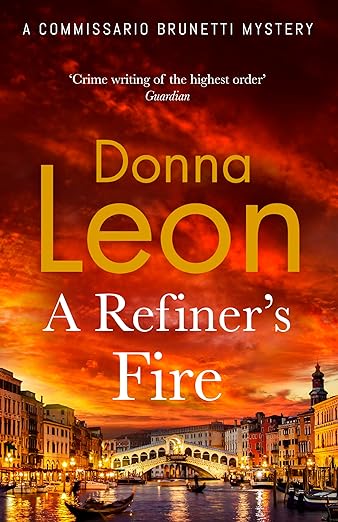
My fifth link is also set in Venice, Drawing Conclusions by Donna Leon. It’s the 20th book in her Commissario Guido Brunetti series. Brunetti is somewhat of a rarity in crime fiction novels – a detective who is happily married with two children. He doesn’t smoke or drink to excess and often goes home for lunch to his beautiful wife Paolo. I was immediately drawn into this book, with its wonderful sense of locality, believable characters and intricate plot. It’s more than crime fiction as Brunetti ponders on life, the problems of ageing, and the nature of truth and honesty. 

My final link is via ageing in the crime fiction novel The Betrayal of Trust by Susan Hill. It’s  character-driven, concentrating on the people involved in the crime, a cold case, that of a teenager missing for 16 years, and on Simon’s family. It focuses on the problems of ageing, hospice care, Motor Neurone Disease, assisted suicide, Parkinson’s Disease and Alzheimer’s Disease. A lot to cope with all at once and at times I found The Betrayal of Trust a deeply depressing book.

My chain consists mainly of mystery/crime fiction books, as usual, plus books on food and cooking and a frank account of a stay in hospital after a nightmare operation.

Next month (July , 2024), we’ll start with the 2024 winner of the International Booker PrizeKairos by Jenny Erpenbeck (translated by Michael Hofmann).

Black Roses: Book Beginnings & The Friday 56

Every Friday Book Beginnings on Friday is hosted by Gillion at Rose City Reader where you can share the first sentence (or so) of the book you are reading. You can also share from a book you want to highlight just because it caught your fancy.

I’m featuring Black Roses by Jane Thynne. It’s on my 20 Books of Summer list, a book I’ve had for several years.

Chapter One:

For a wedding it would have made a good funeral.

Also every Friday there is The Friday 56, hosted by Freda at Freda’s Voice, but she is taking a break and Anne at My Head is Full of Books has taken on hosting duties in her absence. You grab a book and turn to page 56 (or 56% of an eBook), find one or more interesting sentences (no spoilers), and post them.

Frau Doktor Goebbels is the wife of the Minister of Public Enlightenment and Propaganda.’

Clara nodded politely, thinking what a dreadful mouthful that title was to be saddled with.

‘But we prefer to call her the First Lady of the Reich,

Synopsis from Amazon:

Berlin, 1933. Warning bells ring across Europe as Hitler comes to power. Clara Vine, an attractive young Anglo-German actress, arrives in Berlin to find work at the famous Ufa studios. Through a chance meeting, she is unwillingly drawn into a circle of Nazi wives, among them Magda Goebbels, Anneliese von Ribbentrop and Goering’s girlfriend Emmy Sonnemann. As part of his plan to create a new pure German race, Hitler wants to make sweeping changes to the lives of women, starting with the formation of a Reich Fashion Bureau, instructing women on what to wear and how to behave. Clara is invited to model the dowdy, unflattering clothes.

Then she meets Leo Quinn who is working for British intelligence and who sees in Clara the perfect recruit to spy on her new elite friends, using her acting skills to win their confidence. But when Magda Goebbels reveals to Clara a dramatic secret and entrusts her with an extraordinary mission, Clara feels threatened, compromised, desperately caught between her duty towards – and growing affection for – Leo, and the impossibly dangerous task Magda has forced upon her.

~~~

What do you think, does it appeal to you? What are you currently reading?