Saturday Snapshots: Cats again

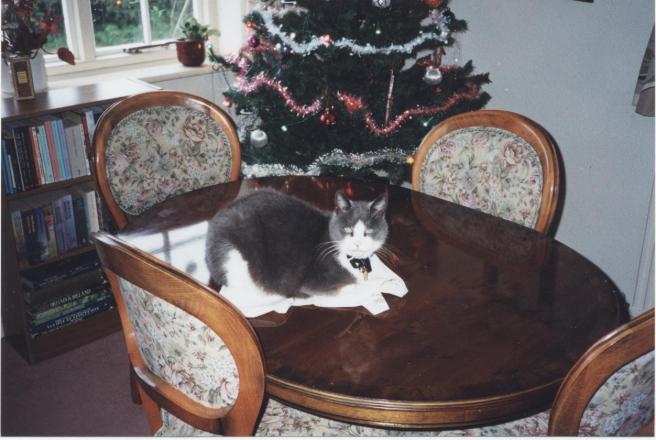
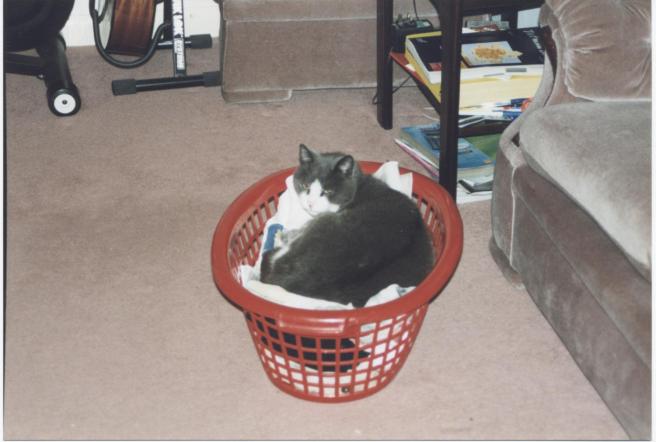
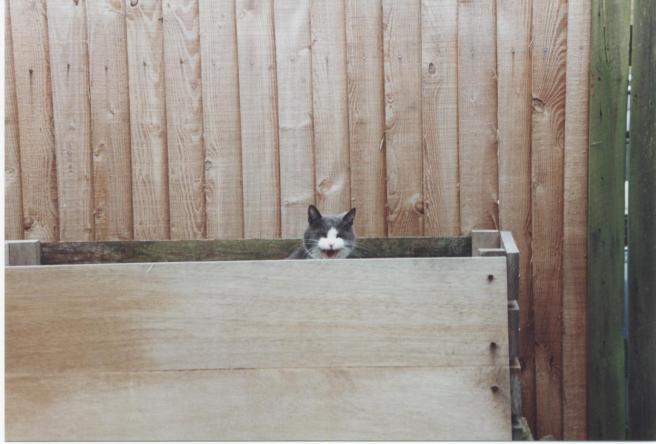
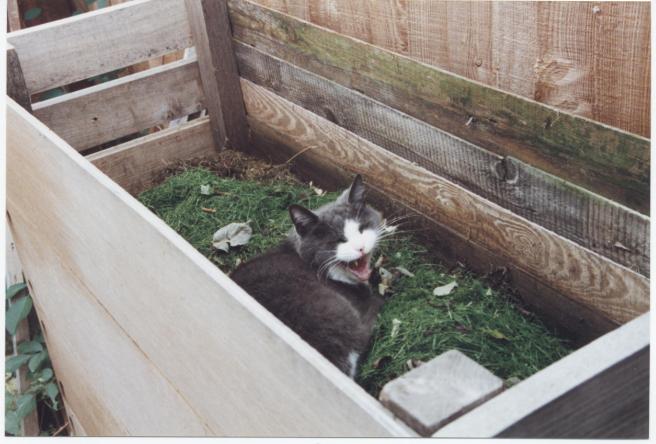
Sometimes I think I should call my blog CatsPlease as well as BooksPlease because of the number of cat photos I post. Today’s photos are of a cat called George. He came to live with us when D’s mother moved into an apartment on the third floor. He was quite a character and liked to sit on/in things. He was also quite vocal!

One day out in the garden I heard him miaowing:

He was sitting on top of the compost:

George in the compost heap

It was just the same inside. He liked sitting on tables:

And he especially liked sitting in the laundry basket on top of the clean clothes waiting to be ironed:

For more Saturday Snapshots see Alyce’s blog At Home With Books.

Mount TBR Reading Challenge 2013

Here’s another Reading Challenge that I can’t ignore, because it’s one that I’ve been doing quietly and slowly on my own, ever since I can remember. It’s Bev’s Mount TBR Reading Challenge 2013.

Bev plans to primarily from her own shelves next year. It might not seem to be a very challenging challenge – to read books you already have on your shelves – but faced with the almost constant temptation to borrow books from the library, buy new books, and download free ones to Kindle, it is! And whilst I can’t promise that I won’t give in to that temptation, I too would like to think that I’ll make great inroads to my ever-growing pile of TBRs.

Challenge Levels

Pike’s Peak: Read 12 books from your TBR pile/s
Mount Blanc: Read 24 books from your TBR pile/s
Mt. Vancouver: Read 36 books from your TBR pile/s
Mt. Ararat: Read 48 books from your TBR piles/s
Mt. Kilimanjaro: Read 60 books from your TBR pile/s
El Toro: Read 75 books from your TBR pile/s
Mt. Everest: Read 100 books from your TBR pile/s
Mount Olympus (Mars): Read 150+ books from your TBR pile/s

And the rules:
*Once you choose your challenge level, you are locked in for at least that many books. If you find that you’re on a mountain-climbing roll and want to tackle a taller mountain, then you are certainly welcome to upgrade.

*Challenge runs from January 1 to December 31, 2013.

This year I’ve read 25 of my TBRs, so next year I’m aiming to increase that by attempting Mount Ararat, that is, to read 48 books from my own bookshelves. I really ‘should’ go for Mount Olympus (Mars) but that is a few steps too far!

Here is my Progress Page

Scottish History

Ever since we moved to live just south of the border with Scotland I’ve been interested in learning more about its history. My knowledge was limited to the basics and mainly related to the monarchy – Robert the Bruce, Mary Queen of Scots, James VI of Scotland and I of England, the Jacobite Rebellions, and Bonnie Prince Charlie and so on.

Many books have been written on Scottish history and when I saw this little book some years ago I thought it could be a good place to start to find out more:

A Short History of Scotland by Richard Killeen is by its very nature a summary account and a basic introduction. There are 31 short chapters covering the period from Prehistoric Scotland up to the Twentieth Century – all in 69 pages, including coloured illustrations of people and places.

I found the early chapters the most interesting (maybe because it was mainly new information for me) covering the early periods – Iron Age Celts, Roman Scotland and later invaders – Anglo-Saxons, raiders from Dalriada in Ireland (Irish Celts), Picts and Vikings.

Much of the book is the history of the monarchy. Kenneth MacAlpin was the first King of Scotland (9th century) but not of all modern Scotland – he never established himself in the Borders, which was held by the Anglo-Saxon Northumbrians. Northumbria had formerly extended from the Humber right up to the Forth, and it was not until Malcolm II (1005-34) won the battle of Carham in 1018 that the land north of the Tweed became part of his kingdom.

The book traces the history of Scotland through the various battles for power and control – the Norman settlement of the lowlands founding abbeys and cathedrals, the contest for the crown between John Balliol and Robert Bruce (both members of the Norman aristocracy) and the intervention of Edward I of England in choosing John Balliol as king in 1292 and claiming formal overlordship for himself and his successors.

Scottish kings had paid feudal homage to English kings before the 1290s. As far back as 1174, William the Lion had acknowledged himself the formal vassal of Henry II. Such acts did not imply that Scotland was a dependency of England. In the first place, England and Scotland hardly existed in the modern sense. The age of centralised states with uniform laws, secure boundaries with centralised administration – all things we take completely for granted – lay well in the future. (page 28)

Edward’s actions triggered Scottish resistance, with William Wallace winning victory over the English at Stirling Bridge in 1297. Wallace was then defeated within a year at the Battle of Falkirk. Robert the Bruce gained the crown, and in 1314 defeated Edward II at the Battle of Bannockburn: ‘the battle which confirmed Scotland as an independent kingdom.’ (page 31)

Moving forward in time, Killeen describes the history of Scotland until the Reformation as ‘a guignol of intrigue, faction and murder mixed with solid achievement.’ The rest of the book includes chapters on the Stewarts, Mary Queen of Scots, the Union of Crowns (1603), the Civil War, Glencoe, the Act of Union (1707), Scottish Enlightenment, the Clearances and the Industrial Revolution.

Reading this little book has spurred me on to read more detailed histories and I’ve started with Neil Oliver’s A History of Scotland. More about that another time.
Cats: Drawing and Painting

I drew this last week, copied from a card, using pencils and pens. It’s made me keen to try painting/sketching our cat Heidi. She’s white so I’ll have to use coloured paper, or a coloured background.

I looked for help in this beautiful book:

 Cats: Drawing and Painting in Watercolour by Lesley Fotherby. This is what she has to say about drawing white cats on white paper:

You can’t paint the cat in white, so you have to paint the background and leave the cat to show up against it, ie look at the negative shape, paint that in and the positive image will appear. (page 96)

I’ve tried negative painting before and didn’t find it easy. She also suggests using pencil and paint and to illustrate the technique shows this painting:

There is so much in this book, from using different materials, paper and techniques  to showing how to depict movement and markings and composition. I’m going to study it and have a go.

Previously when I’ve posted photos of my sketches some people have commented that they wish they could draw. I can only endorse what Lesley Fotherby writes in this book:

Many people feel that being able to draw is a gift and that either you can draw or you can’t. It is true that some will find it easier than others, but in fact drawing is a skill which can be learnt like any other. As with other skills, it can only improve with practice, so do not be discouraged if your first efforts are unsatisfactory. …

Learning to draw is a bit like learning to swim: you can stand on the side of the pool and listen to a lecture, or you can jump in, wearing your lifejacket of course, and feel the element around you. Then you understand what they are all talking about. (page 8)

Book Beginnings: Wild Swans by Jung Chang

I’m currently reading Wild Swans by Jung Chang.

It begins:

At the age of fifteen my grandmother became the concubine of a warlord general, the police chief of a tenuous national government of China. The year was 1924 and China was in chaos. Much of it, including Manchuria, where my grandmother lived, was ruled by warlords. the liaison was arranged by her father, a police official in the provincial town of Xixian in southwest Manchuria, about a hundred miles north of the Great Wall and 250 miles northeast of Peking.

Wild Swans is a family memoir – the story of three generations of woman in Jung Chang’s family – her grandmother, mother and herself. This is the 2003 edition with an introduction by Jung Chang explaining how she came to write the book. She had always dreamed of being a writer, but growing up in Mao’s China it seemed out of the question, with most writers suffering in endless police persecutions. It was only after she had been allowed to come to Britain in 1978 to study that she had the freedom to write and to write what she wanted.

So far, I’m finding it fascinating, reading about her grandmother, who was one of the last generation of Chinese woman to suffer the practice of binding feet. I knew of this practice, but hadn’t realised just how much the little girls suffered and continued to suffer throughout their lives.

As this book is so long (over 600 pages in a small font) it’s going to take me quite a while to read it. I’l probably write a few posts on my progress.

First Chapter, First Paragraph is hosted by Diane at Bibliophile by the Sea.

What’s in a Name 6

At this time of year I often think that I won’t take part in any book challenges in the future and I was just thinking that the other day when I saw that Beth Fish Reads had posted about next year’s What’s in a Name challenge, which will run between January 1 and December 31, 2013. As I do like working through my unread books and making lists of what to read next I had to see if it would be easy to fit books to fit the challenge – of course I did! The idea is to read one book in each of the following categories:

1. A book with up or down (or equivalent) in the title: eg Deep Down True, The Girl Below, The Diva Digs up the Dirt

2. A book with something you’d find in your kitchen in the title: Loose Lips Sink Ships, The Knife of Never Letting Go, Breadcrumbs

3. A book with a party or celebration in the title: A Feast for Crows, A Wedding in Haiti, Cocktail Hour under the Tree of Forgetfulness

4. A book with fire (or equivalent) in the title: Burning for Revenge, Fireworks over Toccoa, Catching Fire

5. A book with an emotion in the title: Baltimore Blues, Say You’re Sorry, Dreams of Joy

6. A book with lost or found (or equivalent) in the title: The Book of Lost Fragrances, The World We Found, A Discovery of Witches

  • Books may be any form (audio, print, e-book).
  • Books may overlap other challenges.
  • Books may not overlap categories; you need a different book for each category.
  • Creativity for matching the categories is not only allowed but encouraged.
  • You do not have to make a list of books before hand.
  • You do not have to read through the categories in any particular order.
Here are my choices:
1. A book with up or down (or equivalent) in the title:
  • Ripley Under Water by Patricia Highsmith
  • Rise and Shine by Anna Quindlen

2. A book with something you’d find in your kitchen in the title:

  • Gem Squash Tokoloshe by Rachel Zadok
  • The Various Flavours of Coffee by Anthony Capella
  • The Olive Readers by Christine Aziz
  • Saving Fish from Drowning by Amy Tan
  • The Water Horse by Julia Gregson

3. A book with a party or celebration in the title:

  • Ralph’s Party by Lisa Jewel
  • A Time to Dance, No Time to Weep by Rumer Godden
  • The Birthday Boys by Beryl Bainbridge

4. A book with fire (or equivalent) in the title:

  • Daughters of Fire by Barbara Erskine
  • The Girl who Played with Fire by Stieg Larsson

5. A book with an emotion in the title:

  • Book of Love by Sarah Bower
  • Love in the Time of Cholera by Gabriel Garcia Marquez
  • Sword of Shame by The Medieval Murderers
  • The Pursuit of Happiness by Douglas Kennedy
  • The Soul of Kindness by Elizabeth Taylor
  • The Tenderness of Wolves by Stef Penney

6. A book with lost or found (or equivalent) in the title:

  • The Book of Lost Things by John Connolly
  • The Lost Art of Keeping Secrets by Eva rice
  • The Lost Prophecies by The  Medieval Murderers
  • The Lost Army of Cambyses by Paul Sussman
  • The Inheritance of Loss by Kiran Desai

More than enough!