The Book of Lost Things by John Connolly

I like fantasy, so when I came across The Book of Lost Things, a modern version of traditional fairy tales that has glowing reviews from various sources, I was keen to read it. Fairy tales are full of bad things happening to people, wicked stepmothers, evil witches, wolves and trolls, fantasy characters, damsels in distress and magic and enchantments, but in the end good overcomes evil and they live happily ever after.

The Book of Lost Things begins at the start of World War Two, with David, a boy of twelve, who is mourning the death of his mother, resenting his father’s new wife, Rose and his new baby brother, George. Alone in his bedroom he hears the books on the shelves murmuring and whispering in the darkness, and his fantasy world becomes peopled with the characters from his books and he dreams of the Crooked Man, waiting for him out in the woods beyond the house.

One night his dreams and nightmares become reality as he sees through a fissure in his room into another realm beyond. He falls unconscious and coming to he hears his mother calling out him to save her, saying she is not dead but trapped in a strange place. He climbs out of his window and then as a bomber crashes in the garden David escapes through the sunken garden into a different world, a world peopled by the characters from the stories he has been reading. Told that the king has a ‘Book of Lost Things’ that will help him find the way back to his own world, he is met with the most terrible and gruesome opposition.

As well as stomach churning and excruciatingly toe-curling grisly detail there are some very dark episodes in this book with an element of moralising within the story from a number of ‘father figures’ David meets, for example the Woodsman and the knight Roland who tells him that life is filled with threats and dangers.

It is indeed filled with danger but the book becomes a sequence of ‘this happened and then that happened’, of showing rather than telling. The writing is flat; there is no sense of suspense, David is attacked and goes on to fight battle after battle as the characters helping him are killed off. There are his battles against the Loups, wolves who dress like men. He has to answer a riddle to choose the right bridge to cross a chasm thronged with harpies. He meets seven dwarves  dominated by an obese Snow White, her face caked with white make-up (this story is quite funny actually with its references to communism). He comes across a peasant village terrorised by a monstrous loathsome worm which gives birth in mid-battle. He eventually finds the castle of thorns where his mother may be imprisoned, and then finally the great castle of the ancient and now dying king, the guardian of the ‘book of lost things’. And behind it all is the sinister and evil Crooked Man.

I quite liked the concept of this book, it promised much, but I didn’t like its gruesomeness, the torture chambers, the animal and human experimentations, the sexual innuendos, nor did I like the ending, which I thought was weak. These details didn’t leave me with a chill down my spine, but just feeling rather sick.

Still, it seems an appropriate book to include in the Once Upon a Time Challenge, which ended yesterday and certainly for the Mount To Be Read Challenge as it has sat unread on my shelves for 7 years. Maybe fairy stories are no longer magical for me, this one wasn’t.

I can almost hear the rest of my books muttering, well thank goodness that one’s on its way out of the house.

Library Loot

I like to support the mobile library that comes round once a fortnight. I am always amazed that in such a small selection of books I always find such a wide variety – apart from the Art books that is, the choice in that section is very limited, but I suppose most people want to read fiction.

These books are ones that I’ve borrowed recently:

Library Loot Brodrick

From top to bottom:

  • The Marseille Caper by Peter Mayle – I fancied a cheerful book and as the quote on the front cover says this is ‘a feel-good book for the summer over a glass of vintage rosé’ I thought it may be just the book to read right now.

First sentence:

Shock has a chilling effect, particularly when it takes the form of an unexpected meeting with a man from whom you have recently stolen three million dollars worth of wine.

  • The Testament of Mary by Colm Toibin – I’ve never read any books by Toibin, so I thought this short book, about Mary the mother of Jesus, might be the place to start. It was longlisted for the Man Booker Prize last year.

First sentence:

They appear more often now, both of them, and on every visit they seem more impatient with me and with the world.

  • Off the Record: a Jack Haldean Mystery by Dolores Gordon-Smith, crime fiction, described on the front cover as ‘eccentric, unusual, suspenseful and gripping’. Gordon-Smith is a new-to-me author and I came across her on Cath’s blog Read-Warbler.

First sentence:

It was the summer of 1899 when Charles Otterbourne first came to Stoke Horam.

  • The Last Runaway by Tracy Chevalier – I’ve liked the two books by Chevalier that I’ve read, so on the strength of that I thought I’d have a look at this historical fiction, set in Ohio in the 1850s.

First sentence:

She could not go back.

  • Four Sisters: the Lost Lives of the Romanov Grand Duchesses by Helen Rappaport. A big book of biography about the tragic fate of the sisters in the dying days of the Romanov dynasty. It appeals to me, especially after seeing a programme a short while ago on the BBC The Royal Cousins at War, George (England), Willie (Germany) and Nicky (Russia).

First sentence:

The day they sent the Romanovs away the Alexander Palace became forlorn and forgotten – a palace of ghosts.

  • The Discourtesy of Death by William Brodrick, the fifth Father Anselm book. I didn’t have to think at all about whether to borrow this book as Brodrick is most definitely one of my favourite authors. His books always give me lots to think about and this one promises to do just that.

The book begins with a Prologue, but I’m quoting the first few sentences of chapter 1:

‘There is no God’, murmured Anselm.

‘You’re going a bit far there’, replied Bede, Larkwood Priory’s tubby archivist.

‘No, I’m not. This is one of those moments of insight that sent Nietzsche over the edge.’

Anselm stared in horror at the open pages of the Sunday Times, laid out for all to see, on the table in the monastery’s library. The title ran: ‘The Monk who Left it All for a Life of Crime.’

I can’t wait to read this last book, but I have to finish another library book first – Sisters of Sinai by Janet Soskice, a fascinating biography of twin sisters, Agnes and Margaret and their amazing travels in the 19th century to Cairo, taking a trip down the Nile and later to Mount Sinai, where they discovered one of the earliest copies of the Gospels written in ancient Syriac. This is another book recommended by Cath on her blog, Read-Warbler.

Sisters of Sinai

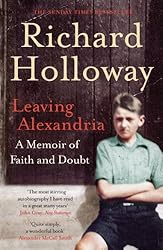
Leaving Alexandria by Richard Holloway

I was browsing the biography section in the local library when I came across Leaving Alexandria: a Memoir of Faith and Doubt by Richard Holloway. I vaguely remembered that he had been an outspoken bishop who had resigned some years ago and I thought it would be interesting to read what had led up to his resignation. The blurbs on the back encouraged me to borrow the book:
This poignant memoir, written with integrity, intelligence and wit, lays bare the ludicrous and entirely unnecessary mess we have made of religion. (Karen Armstrong)

and:

So compelling and so intense. Nobody, whether interested in religion or not, could fail to be intensely moved … What a deeply lovable man; and what a wonderful book. (Mary Warnock, Observer)

In the past I have read many books on religion, mainly on Christianity, but I am not currently a church goer and I know little about the Anglican Church and next to nothing about the Scottish Episcopal Church – Richard Holloway was the Primus of the latter. Reading Richard Holloway’s own account of his beliefs and doubts was without doubt an eye-opener.

Leaving Alexandria is fascinating. Richard Holloway grew up in Alexandria, a town in the Vale of Leven, north of Glasgow. At the age of fourteen he left home to train for the priesthood at Kelham Hall in Nottinghamshire, the mother house of  the Anglo-Catholic Society of the Sacred Mission, an order that trained uneducated boys for the priesthood in a monastic setting. Subsequently, he worked in Africa, the Gorbals in Glasgow, Boston, and Old Saint Paul’s in Edinburgh before becoming the Bishop of Edinburgh. His resignation in 2000 as the Bishop of Edinburgh came when he was 66.

He had a controversial career, dubbed the ‘Barmy Bishop’. He was an outspoken champion of progressive causes, but he had many crises of faith and at times was plagued with doubt, experiencing God as an absence. To me that sounds as though he wasn’t sure about the existence of God. He ponders whether religion is a lie and states that it is a ‘mistake’:

I was less sure whether God was also just a human invention, but I was quite sure religion was. It was a work of human imagination, a work of art – an opera – and could be appreciated as such.  The real issue was whether it should be given more authority over us than any other work of art, especially if it is the kind of authority that over rides our own better judgements. (page 343)

In the Epilogue he explained that he came to believe that

Religion is human, and like humanity it is both a glory and a scandal. It is full of pity and full of cruelty. Just like us. So is the Bible.

He went on that he had discovered his real dilemma:

I wanted to keep religion around, purged of cruelty, because it gives us a space to wonder and listen within. Purged of the explanations that don’t explain, the science that does not prove, the morality that does not improve; purged in fact, of its prose, religion’s poetry could still touch us, make us weep, make us tender, and take us out of ourselves into the possibility of a courageous pity. (page 345)

He resigned at odds with many strongly held Episcopal Church doctrines and beliefs, and precipitated by the publication of his book Godless Morality. It was because of the Church’s insistence on rules, its attitudes towards women and homosexuals, and its inability to understand the nature of myth. But he had struggled all the way through, feeling himself a disappointment, often knowing that he was a ‘double-minded man’ and ‘unstable, if not in all my ways, then certainly in many of my attitudes and opinions. Janus-like, I seemed able to look two ways at once, be in two minds about things.’  My question is not why he resigned, but why it took him so long, and how had he become a bishop at all?

There are many things about Richard Holloway that I like, but overarching them all is his compassion and his honesty. There are so many passages I could quote, including this one describing the opponents of women’s ordination:

‘Oh the miserable buggers, the mean-minded wee sods.’ (page 309)

I am sure that I have not really done justice to this book and refer to this review of Leaving Alexandria by Mary Warnock in The Guardian/The Observer 19 February 2012 and to an interview with Richard Holloway at the Gladstone’s Library 26 February 2012.

He Wants by Alison Moore

I received a proof copy of He Wants by Alison Moore from Lovereading for review. It will be published in August this year. I began reading with high expectations because I thought I’d like it from the publishers’ synopsis:

Lewis Sullivan, an RE teacher at a secondary school, is approaching retirement when he wonders for the first time whether he ought to have chosen a more dramatic career. He lives in a village in the Midlands, less than a mile from the house in which he grew up. He always imagined living by the sea. His grown-up daughter visits every day, bringing soup. He does not want soup. He frequents his second-favourite pub, where he can get half a shandy, a speciality sausage and a bit of company. When an old friend appears on the scene, Lewis finds his routine and comfortable life shaken up.

However, this synopsis is a bit misleading. Lewis is not approaching retirement – he has already retired. He is looking back over his life and thinking about all the things he had wanted/wants/ does not want.  It’s a book about ageing and unfulfilled expectations. It jumps around mirroring Lewis thought processes as he remembers his childhood, his parents, his wife, his daughter and his friend Sydney.

He Wants is a short book (180 pages in the proof copy). Written in the present tense, it’s a bleak tale of a man whose life did not turn out as he expected or wanted. I don’t have to like the characters to enjoy reading a book, but despite the quality of writing, which is taut and effective in creating an atmosphere of unease and emptiness, I couldn’t take to this book. Lewis’s dissatisfaction with his life compared to how had imagined it would be was just too drab and unrelenting.

Lewis had wanted all sorts of fantastic things. The chapter headings indicate the things he wanted but never got, or the things he did not want and did get: he did not want soup or the sausages, he did not want the boy to be spoiled, he wanted to go to the moon, to live in Australia, to be seen, a time machine and a cup of tea and so on.

Sadly, it was not my cup of tea.

Alison Moore was shortlisted for the Man Book Prize in 2012 with her debut novel The Lighthouse, a book I haven’t read and may check just to see if it’s in the same vein as He Wants.

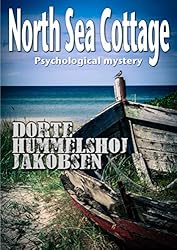
North Sea Cottage by Dorte Hummelshoj Jakobsen

Dorte Hummelshoj Jakobsen’s latest book, North Sea Cottage, is an e-book, a novella set in Denmark. It’s another dual time period book – it seems that each book I’ve read recently is one of these. This one is split between the present day and 1943/4 and it works very well.
I thoroughly enjoyed this book; the cottage in the title is owned by Tora’s aunt, Bergatora. As soon as I began reading I was immediately transported in place away to the other side of the North Sea to Denmark with Tora, and in time back to the Second World War, with her aunt, Bergatora. In just a few words Dorte Hummelshoj Jakobsen draws a vivid picture of the old fisherman’s cottage surrounded by dense sea fog.

Tora is struggling to overcome her own problems when she is faced with a new problem. The old stable next to the cottage catches fire during a thunder storm and in the aftermath of the fire Tora finds a skeleton in the potato cellar under the ruined stable. Who is it who had died in the cellar? Bergatora is reluctant to talk about the war years and her brother, Tora’s father, was too young at the time to help. It was a time when Denmark was under German occupation and a resistance movement was under way. Inspector Thomas Bilgren suspects the victim may have been related to the German occupation.

Tora, helped by Bilgren attempts to discover the truth, but is hampered by the strong character of her aunt and the silence surrounding what happened during the war. I loved this aspect of the book – the delving back into history, the way the narrative switches backwards and forwards, gradually revealing what had happened. North Sea Cottage is only about 90 pages but it has depth both in mystery and in characterisation and the setting is so atmospheric. I was fearful for Tora’s safety as she dug deeper into the mysteries from the past.

Thanks to Dorte Hummelshoj Jakobsen, who kindly sent me a copy of her book. She has a blog – Djskrimiblog and used to be a teacher. She writes both serious mysteries as well as humorous and cosy stories about the Gershwin family in Knavesborough, a fictional village in Yorkshire, publishing in Danish and English. I like her humorous stories but prefer the serious ones like North Sea Cottage and her previous novel, Anna Märklin’s Family Chronicles. She is currently at work on her next novel – Crystal Nights, to be published in 2014/5.

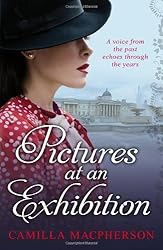
Pictures at an Exhibition by Camilla Macpherson

I enjoyed Pictures at an Exhibition by Camilla Macpherson very much. It’s a dual time period novel moving between the present day and the Second World War, a format I think that can be hard to do successfully. In this book, Camilla Macpherson’s first published novel, I think it is successful as I was equally keen to find out what happened next in both periods.

Pictures at an Exhibition is structured around Daisy’s letters to her cousin Elizabeth telling her about the paintings on display at London’s National Gallery during the war years – one a month. In the present day Claire reads the letters, left to her husband Rob, by his grandmother, Elizabeth. They are not just about the paintings but also about Daisy’s life and the man she meets and loves. Claire meanwhile, is struggling to recover from a tragedy that threatens to overwhelm her and wreck her marriage. She decides to read the letters, one a month, and visit the National Gallery to see the paintings and compare them with Daisy’s descriptions.

I found the characters thoroughly convincing, the settings and the time periods contrasting vividly and loved all the details about the paintings. I also liked the way the characters developed throughout the book. For example, at the beginning of the book, which I found so devastatingly sad, Claire is full of anger and grief, affecting her relationship with Rob:

It was the grief speaking. It could do strange things grief. She had not known that until now. She had never had to know. It had brought with it this desperate, physical need to blame someone, someone who would be right there when she had to lash out – Rob. The only person who was always there. (page 106)

She becomes obsessed with the letters, the paintings and with Daisy’s life. It’s a remarkable portrayal of a woman in crisis and how she managed to find herself again. Daisy’s story is just as convincing describing life in London during the Blitz and along with Claire I really wanted to know more about her and what happened to her.

I think it was the art that drew me to this book in the first place and I found those parts of the book absolutely fascinating. The National Gallery did display one painting a month after most of them had been transported away from London and the bombs for safe keeping. You can see the paintings described by scanning the QR codes at the beginning of each chapter and also see them on Camilla Macpherson’s website, and of course on the National Gallery’s site too. I knew of most of them before, but not all of them and as I was reading I printed copies to see what Daisy and Claire saw.

But by the end of the book it was the characters and the story that had captivated me too.  It’s about life and death, love and loss, grief and relationships and I found it compelling reading – when I wasn’t reading it I was thinking about it and keen to get back to it. It’s a book I want to re-read at some time – and there aren’t many of those.

My thanks go to Camilla Macpherson, who kindly sent me a copy of her book. I look forward to reading more of her work in the future.