The Sunne in Splendour by Sharon Penman

Richard III (1452 – 1485), that controversial king – what was the truth about him? Did he murder his nephews, the ‘Princes in the Tower’, was he deformed, with a withered arm, a hunch back and a limp as Shakespeare portrayed him, was he a cold-blooded, evil villain? Or has he been maligned and been turned into a  monster who killed his brother’s sons in order to take the Crown?

I remembered merely the brief details about the Wars of the Roses, the conflict between the houses of York and Lancaster for the throne of England,  from my school history lessons and only became interested in Richard III years later when I read Alison Weir’s non-fictional The Princes in the Tower, which examined the available evidence and came to the conclusion that Richard III was responsible for their deaths. Some years later I read Josephine Tey’s novel The Daughter of Time, which also investigates his role in the death of his nephews and his own death at the Battle of Bosworth and concluded that Richard hadn’t murdered his nephews.

The discovery of his skeleton buried beneath a car park in Leicester in 2012 revealed that although ‘the curved spine on the skeleton does show he had Scoliosis, he did not have a withered arm or other details attributed to him in some characterisations’ (see the Incredible Discovery at the King Richard III Visitor Centre ).

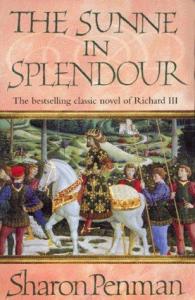
But it wasn’t the discovery of his skeleton that nudged me into reading  The Sunne in Splendour, Sharon Penman’s detailed historical novel, first published in 1982. It was watching A Game of Thrones, which is based in part on the Wars of the Roses – Stark and Lannister/York and Lancaster etc.
1192920

The Sunne in Splendour is a fascinating novel about his life from his childhood to his death at Bosworth Field in 1485. Much has been written about Richard, from the time of his death onwards, that Sharon Penman points out has to be considered in the light of the writers’ bias, stating in her Author’s Note at the end of the book:

I once came upon the definition of history as ‘the process by which complex truths are transformed into simplified falsehoods’. That is particularly true in the case of Richard III, where the normal medieval proclivity for moralizing and partisanship was further complicated by deliberate distortion to suit Tudor political needs.’ (page 884)

She states that she had tried to be as accurate as possible, drawing upon facts that are not in dispute, relying on contemporary chroniclers, and when dealing with conflicting accounts ‘to choose the one most in accord with what we know of the people involved.’ 

I think this is one of the best historical novels that I’ve read. It is full of detail, but her research sits very lightly in this book, none of it feels like a history lesson, and it all brings Richard’s world to life. Penman portrays a very likeable Richard, from his childhood onwards he comes across as a kind, generous and brave man, a skilled leader on the battlefield, a loving husband to his wife, Anne, and devoted and loyal to his brother, Edward IV, who was by no means a saint. I particularly liked the way Penman showed his relationship with his family, especially with his brothers Edward and George, the Duke of Clarence.

I could easily visualise the battle scenes, that eventually brought the Wars of the Roses to an end and was fascinated by the view of Henry Tudor (Henry VII) – I’d like to know more about him. It’s his view of Richard that prevailed after his accession to the throne. During his life Richard he had a good reputation and was loved, particularly in the North of England. But he fell victim to treachery and intrigue.

One of the drawbacks of reading historical fiction is that if you have any knowledge of the period you know the eventual outcome. Penman’s skill is such that even though I knew Richard was killed at the battle of Bosworth Field I kept hoping he would survive and defeat Henry Tudor.

As for her solution to who killed the princes, that is one spoiler I’m not going to reveal – I was convinced though by her version of events. I think The Sunne in Splendour is a brilliant book, I was absolutely gripped by it and was sad when I came to the end. It’s a long book, nearly 900 pages and it took me a while to read it, but never once did I think it was too long, or needed editing. I loved it.

Reading Challenges: Mount TBR Reading Challenge – a book I’ve left too long unread as it’s been on my shelves for 5 years!
Six Degrees Of Separation: Year of Wonders to Blood Harvest

I found this meme on Debbie’s ExUrbanis blog. It is hosted by Books Are My Favourite and Best, and was inspired by Hungarian writer and poet Frigyes Karinthy. In his 1929 short story, ‘Chains’, Karinthy coined the phrase ‘˜six degrees of separation‘. The phrase was popularized by a 1990 play written by John Guare, which was later made into a film starring Stockard Channing.

On the first Saturday of every month, a book is chosen as a starting point and linked to six other books to form a chain. Readers and bloggers are invited to join in by creating their own ‘chain’ leading from the selected book, for example, books by the same authors, from the same era or genre, or books with similar themes or settings. Or, you may choose to link them in more personal or esoteric ways: books you read on the same holiday, books given to you by a particular friend, books that remind you of a particular time in your life, or books you read for an online challenge.

You make your own rules. A book doesn’t need to be connected to all the other books on the list, only to the ones next to them in the chain.

This is my first chain:

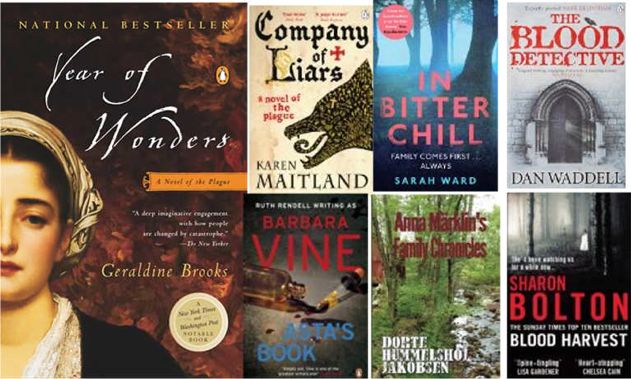
Year of Wonders chain

The chain this month begins with Year of Wonders by Geraldine Brooks, one of my favourite authors, although I haven’t read this book – yet. It’s set in a small village in Derbyshire, during the year of 1666 ravaged by the plague. The story was inspired by the true story of the villagers of Eyam, Derbyshire and their own historical account of the plague.

This leads on to the following books:

Company of Liars by Karen Maitland, also a novel of the plague, but set in 1348 as a group of people flee across England as the plague moves inland from the ports. The members of the group, a conjurer, a one-armed storyteller, a musician and his apprentice, a young couple on the run, a mid-wife and a strange child who can read the runes, are all liars with secrets that are gradually exposed as they journey on.

Secrets are also a major part of In Bitter Chill by Sarah Ward, in which two girls go missing: Rachel Jones returns, Sophie Jenkins is never found. Thirty years later, Yvonne, Sophie’s mother commits suicide, which prompts Rachel, to try to remember what had happened. She is a genealogist and her research into her own family history proves to be invaluable, as devastating family secrets are revealed. This also links back to Year of Wonders as it is set in Derbyshire.

In The Blood Detective genealogist Nigel Barnes helps DCI Grant Foster to track down a killer who has left cryptic clues carved into his victims’ bodies. Although this has some really gruesome scenes, which I normally avoid, this a fascinating fast-paced book linking the crimes of the past ‘the events of 1879 ‘ to a series of murders in the present.  It is set in London and the topography of London through the years also helps Barnes to solve the crimes.

Asta’s Book by Barbara Vine is also set in London. It begins in 1905 when Asta Westerby and her husband Rasmus come to East London from Denmark with their two little boys.  Asta keeps loneliness and isolation at bay by writing a diary. These diaries, published over seventy years later, reveal themselves to be more than a mere journal. For they seem to hold the key to an unsolved murder and to the mystery of a missing child. It falls to Asta’s granddaughter Ann to unearth the buried secrets of nearly a century before.

Denmark and family secrets are the links to this next book, Anna Marklin’s Family Chronicles, a psychological mystery by Dorte Hummelshoj Jakobsen, a Danish author.  Set in Denmark in the present day with flashbacks to Sweden during the early part of at the beginning of the twentieth century, Anna finds herself with beset with problems. Her father is seriously ill and strangely secretive about his family background.  Anna longs to know more and when she finds her grandmother’s journal she is enthralled. But digging into the past can reveal secrets that you might not want to know.

The final link in this chain is another psychological mystery, Blood Harvest by Sharon Bolton. I could have chosen any one of her books but this one stands out for me.  Evi, a psychiatrist has a new patient, Gillian, unemployed, divorced and alcoholic, who can’t accept that her daughter died in the fire that burnt down her home. Meanwhile, the new vicar in town is feeling unwelcome and hears voices in the church, but can’t find anyone there And a young boy keeps seeing a strange, solitary girl playing in the churchyard. Who is she and what is she trying to tell him? It’s a dark, scary book and one that I found disturbing, but thoroughly absorbing.

My chain goes from a seventeenth century English village devastated by plague to a twentieth century English village in six links, via books revealing murder, mayhem and mystery in their pages. Apart from Year of Wonders these are all books I’ve read and enjoyed, even The Blood Detective, a grisly tale.

Favourite Books: July 2007 – 2010

This month I’m  looking back at some of my favourite books I read in July in each of the years 2007 ‘“ 2010. Click on the titles to see my original reviews, some of my earlier posts are rather brief as I was finding my way on the blog.

I read some really excellent books during these months – here are some of my all-time favourite books. Looking back at these books makes me want to re-read each one. I was enthralled by them all:

2007

1340900Angle of Repose by Wallace Stegner, historical fiction, the winner of the Pullitzer Prize for fiction in 1972, telling the story of Lyman Ward, a wheelchair bound retired historian who is writing his grandparents’ life history and who also gradually reveals his own story.

It’s set in the early days of the opening up of America’s western frontier telling of Oliver Ward’s struggles with various mining and engineering construction jobs, contrasted with his wife, Susan’s efforts to support him against great difficulties. This is made more difficult when she compares her life with that of her New York society friend, Augusta.  It’s a long book, but completely enthralling. I could imagine what life was really like at that time and place.

2008

15107Chocolat by Joanne Harris – a fabulous book, this is a story about Vianne Rocher who arrives in Lansquenet-sous-Tannes on Shrove Tuesday. She takes over the old bakery and transforms it into La Celeste Praline Chocolaterie Artisanale ‘“ in other words the most enticing, the most delicious and sensuous Chocolaterie, selling not only all sorts and types of chocolate treats but delicious chocolate drinks.

There is so much more to this book than a simple story about a chocolaterie.  It covers an enormous range of topics ‘“ fear of the outsider, prejudice against ‘these people”“ immigrants, vagrants, and gypsies; bigotry; fear of death, old age and illness; and fear that the Church will lose its purity and that the community will be corrupted by liberal and heretic beliefs. It’s also about how so many lives intersect and interact and above all about the importance of love and understanding in everyone’s life.

2009

Company of Liars by [Maitland, Karen]Company of Liars: a novel of the plague by Karen Maitland – historical fiction set
in England in 1348 this tells the tale of a group of people fleeing across the country as the plague moves inland from the ports. The narrator is Camelot, a pedlar. The members of the group, a conjurer, a one-armed storyteller, a musician and his apprentice, a young couple on the run, a mid-wife and a strange child who can read the runes are all liars, with secrets that are gradually exposed as they journey on.

This is a memorable story, with a colourful cast of characters. It’s a long book (over 550 pages) and there are many other characters than the group of nine. Yet I had no difficulty keeping track of who was who and it was actually a quick read as I was keen to know what would happen next. It is full of suspense, menace and drama.

2010

5621474A Dark-Adapted Eye by Barbara Vine (Ruth Rendell). This is psychological crime fiction; you
know right from the beginning who the murderer is, but not why or how the murder was committed. It’s not even clear immediately who the victim is.  The narrator, Faith has spent her life avoiding thinking, talking or reading about at the events that led up to her aunt’s hanging for murder. Slowly, very slowly, with lots of hints and questions about how things could have turned out differently the family relationships and events that led up to the tragedy are revealed.

This is a book where you can see events and people so clearly through their thoughts and emotions as much as through their actions, but their secrets are so well concealed. And by the end just when you think you understand it all, Vine  throws everything into question yet again and the reader is left to decide just what did happen, just what was the truth. Fantastic.

First Chapter, First Paragraph: The Girl in the Cellar

First chapterEvery Tuesday Diane at Bibliophile by the Sea hosts First Chapter First Paragraph Tuesday Intros to share the first paragraph sometimes two, of a book that she’s reading or planning to read soon.

I didn’t read any of my books for the 20 Books of Summer Challenge in July, so I’ve got some catching up to do. One of the shorter books on my list is The Girl in the Cellar by Patricia Wentworth, in which Miss Silver helps Anne, who has lost her memory, but who thinks she has witnessed a murder.

It begins:

She looked into the dead unbroken dark and had neither memory nor thought. She was not conscious of where she was, or of how she had come there. She was not conscious of anything except the darkness. She did not know if time had passed. There seemed to be no sense that it went by, but it must have done, because the moment when she knew nothing but darkness had changed into a moment in which she knew that her feet were on stone, and that she must not move from where she stood.

Blurb:

A young woman regains consciousness and finds herself on some cellar steps. At the bottom of the steps there is the corpse of a dead girl. She cannot remember who she is, what has happened or why she is there. Terrified and confused she manages to find a way out and as she flees she runs into Miss Silver, who offers to help her.

A letter in her bag is the only clue to her identity. But by investigating what has happened to her will she find herself in danger? Can she trust the letter writer? And who is the girl in the cellar?

This is a Miss Silver Mystery (there are 32 in the series), first published in 1961, the year that Patricia Wentworth died. She was born in India in 1878 and wrote dozens of best-selling mysteries being recognised as one of the ‘mistresses of classic crime.’She died in 1961 and was as popular in the 1940s as Agatha Christie and Dorothy L Sayers. Miss Silver, a contemporary of Miss Marple ‘was her finest creation‘.

What do you think? Would you keep reading? I think this opening paragraph sets the scene well, with the sense of danger and mystery to make me want to know more.

The Man Who Would Be King by Rudyard Kipling

For me the book chosen for the current Classics Club Spin is The Man Who Would Be King by Rudyard Kipling. It’s a novella, just 60 pages, which first appeared in The Phantom Rickshaw and other Eerie Tales, published in 1888.

Set in India and narrated by a journalist this is a story of two ruffianly-looking adventurers, wanderers and vagabonds, Daniel Dravot and Peachey Carnehan, who announce that they are off to Kafiristan in the mountains of Afghanistan to make themselves Kings. They tell the journalist that when they have got their kingdom ‘in going order’ they will let him know and that he can then come and help them govern it.

But some two years later, on a hot summer’s night, what was left of Carnehan crept into the journalist’s office,

He was bent into a circle, his head was sunk between his shoulders, and he moved his feet one over the other like a bear. I could hardly see whether he walked or crawled- this rag-wrapped, whining cripple who addressed me by name, crying that he was come back. (page 24)

And he had a sorry tale to tell.

I was a bit disappointed with it, mainly because for a novella it took such a long time to set the scene and the opening section was confusing, with references I didn’t understand. After the slow beginning the story picks up when it gets to relating what happened to Dravot and Carnehan. The Kipling Society website (where you can read the story, which is also free on Amazon) has some notes that helped me understand more – Masonic, Biblical and other references and details about the places and people mentioned.

The Kipling Society also gives details of the background to the story and some critical responses to it. Overall the responses are good – that it is a memorable, fantastic tale, some believing it to be a masterpiece, but Kingley Amis stated it was a ‘grossly overrated long tale‘. I was also interested that Edmund Wilson is quoted as stating that the story is “…surely a parable of what might happen to the English if they should forfeit their moral authority.”[Edmund Wilson ‘The Kipling that Nobody Read’, in Kipling’s Mind and Art ed. Andrew Rutherford, Oliver & Boyd, 1964.]

There was a film adaptation in 1975, starring Sean Connery as Dravot and Michael Caine as Carnehan with Christopher Plummer as Kipling, which according to some is much better than the story itself.

Rudyard Kipling was born in Bombay in 1865 and lived there until he was five when he was taken to live in England, returning to India in 1882, where he worked as a journalist. As well as short stories he also wrote poems, including If, and novels, and was awarded the Nobel Prize in Literature in 1907.

My copy is an e-book, which I’ve had for several years, so it counts towards my Mount TBR Reading Challenge.

Books Read in July 2016

At the beginning of July I was in the middle of reading two long non-fiction books, A History of Modern Britain by Andrew Marr  and John Le Carre: the Biography by Adam Sisman and inevitably this slowed down my reading as I took my time with those.

The fiction I read is a mixed bunch, one crime fiction No Man’s Nightingale by Ruth Rendell, a spy thriller, The Spy Who Came in from the Cold by John Le Carre, a book of short stories, Sandlands by Rosy Thornton and a novella, The Man Who Would Be King by Rudyard Kipling.

And I’m now in the middle of reading The Sunne in Splendour by Sharon Penman, a huge historical novel about Richard III. She paints a very different picture of him from the villain in Shakespeare’s play and in the Tudor historians’ depictions.

Three books are from my TBR books, the Andrew Marr, Rudyard Kipling and Sharon Penman books, and none are for the 20 Books of Summer challenge. Sometimes I just have to forget about reading plans and lists and enjoy reading books as I come across them – there is pleasure in that too.

My favourite for July

I’m amazed at this, because short stories are not usually high on my list of favourite books, but the book that gave me the most pleasure this month is Rosy Thornton’s collection of short stories, Sandlands, strong, atmospheric stories, bringing to life the world of the past, and tying them to the present; stories of family life, of the natural world, of folklore and the mystery and wonder of it all. I loved it!

(The links are to my  posts on the books – I’ll post a review of The Man Who Would be King in the next few days)